Author: Huang Publish Time: 19-02-2026 Origin: Site


 If your apartment ceilings top out at 2.7 meters, great lighting is less about raw wattage and more about smart layering, glare control, and scene-based dimming. This practical guide gives you a room by room lighting plan at a balanced 3000–3500K, with low-profile fixtures that won’t crowd the ceiling and controls that make every zone feel intentional.
A good apartment lighting plan solves for four things: comfortable ambient light, targeted task light where work really happens, gentle accents to add depth, and modern control that ties it all together. Think of your lighting like a playlist: different tracks for different moods, all harmonized at a consistent color temperature so the home feels cohesive.
At 2.7 m, the ceiling is close to your eyes. That means glare and harsh hotspots become noticeable fast. Favor low-profile fixtures (slim recessed, surface-mounted linear, and shallow track) with diffusers or anti-glare optics. Keep color temperature consistent across rooms—3000–3500K blends warm comfort with natural clarity, so art and food look appealing and skin tones stay honest. For technical context on residential design principles, see the Illuminating Engineering Society overview in the IES Lighting Library and RP-11-20’s residential practice guidance via the official page: the IES Lighting Library overview and RP-11-20 residential environments overview.
These are practical, IES-informed ranges for typical homes (lux ≈ lumens per square meter). Use them as targets, then tune with dimming.
Space | Ambient target (lux) | Task target (lux) | Recommended CCT |
Living room | 150–300 | 300–500 (reading) | 3000–3500K |
Dining | 150–300 | 300–500 (tabletop accent) | 3000–3500K |
Kitchen | 200–300 | 500–750 (counters) | 3000–3500K |
Bedroom | 50–150 | 300–500 (bedside reading) | 3000–3500K |
Bathroom | 200–400 | 500–1000 (mirror, vertical) | 3000–3500K |
Hall/Entry | 100–150 | — | 3000–3500K |
Home office | 300–500 | 500–750 (task) | 3000–3500K |
Reference ranges triangulated from the IES Lighting Library context and reputable summaries such as the Super Bright LEDs residential lighting levels (2024).
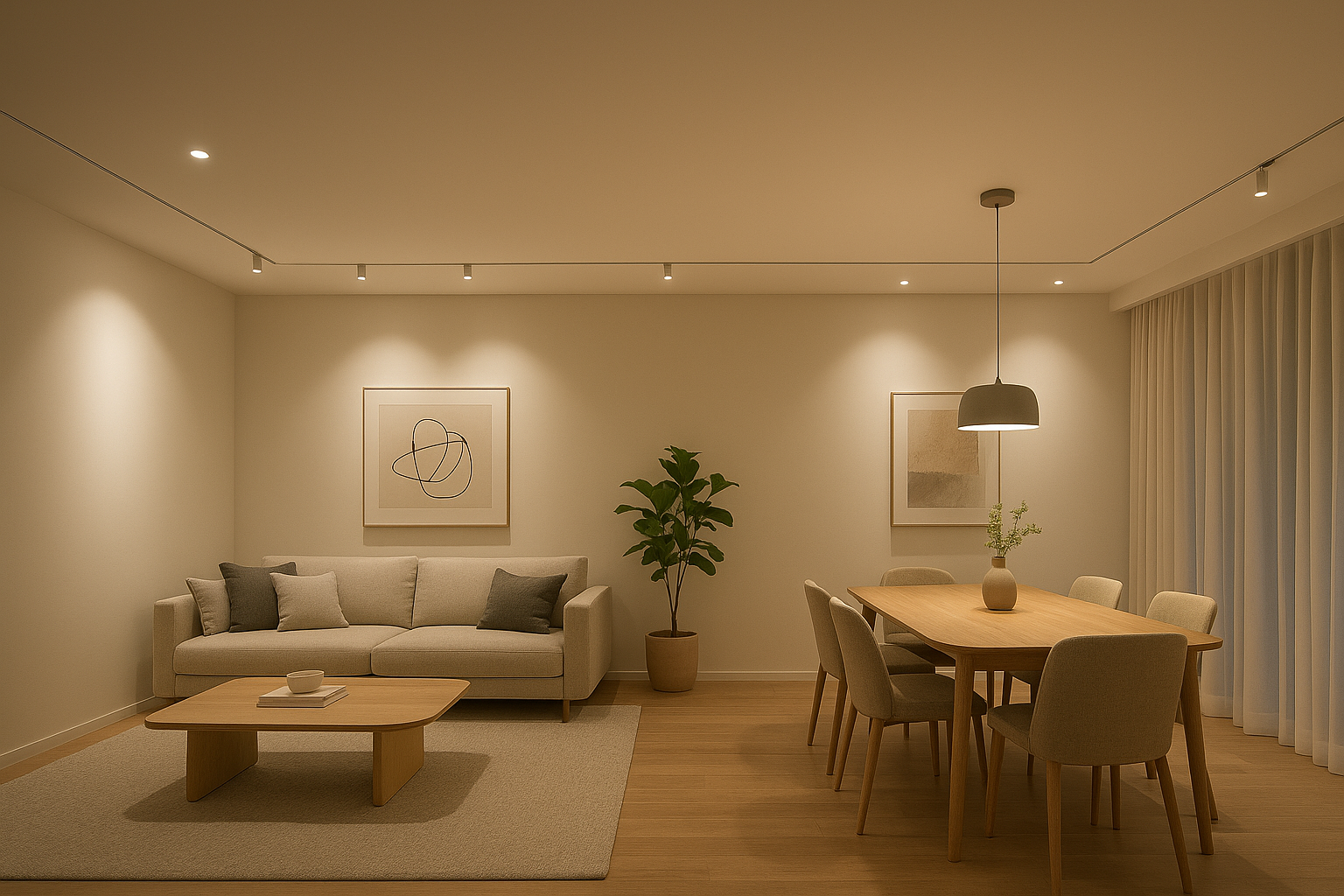
Open living-dining spaces feel best when light lands on the walls and table surfaces, not just the floor. Perimeter linear or track modules lift vertical surfaces so the room reads larger and the ceiling feels higher.
Your baseline is soft ambient light plus layered accents that can dial up for reading or dial down for movie night. Aim wall-washing or wide floods toward bookcases and art to avoid the “cave” effect. A few adjustable spot modules let you highlight a gallery wall or plants.
Choose wide-flood recessed downlights or shallow surface-mounted panels as the ambient backbone. For low ceilings, medium-to-wide beams (around 40–60°) minimize scallops and bright disks. Spacing up to about 1.5× mounting height is a useful rule of thumb; manufacturer application notes such as ERCO’s guidance describe spacing up to 1.5× h for uniform results. Add a perimeter magnetic track (recessed where possible, or slim surface-mount) with a mix of wall-washer and adjustable spots. Over the dining table, use a short-drop pendant to center the social zone—keep the drop conservative for head clearance and to avoid glare in open plans.
Set up scenes that map to real life: “Entertain” with ambient at ~150–200 lux and accents up; “TV” with ambient at ~50–100 lux and a bias light behind the screen; “Read” with a floor lamp or track spot delivering ~300–500 lux at the seat. Continuous dimming to ≤10% is now common in modern systems, echoing best-practice trends identified in ASHRAE/IES 90.1-2022 lighting changes.
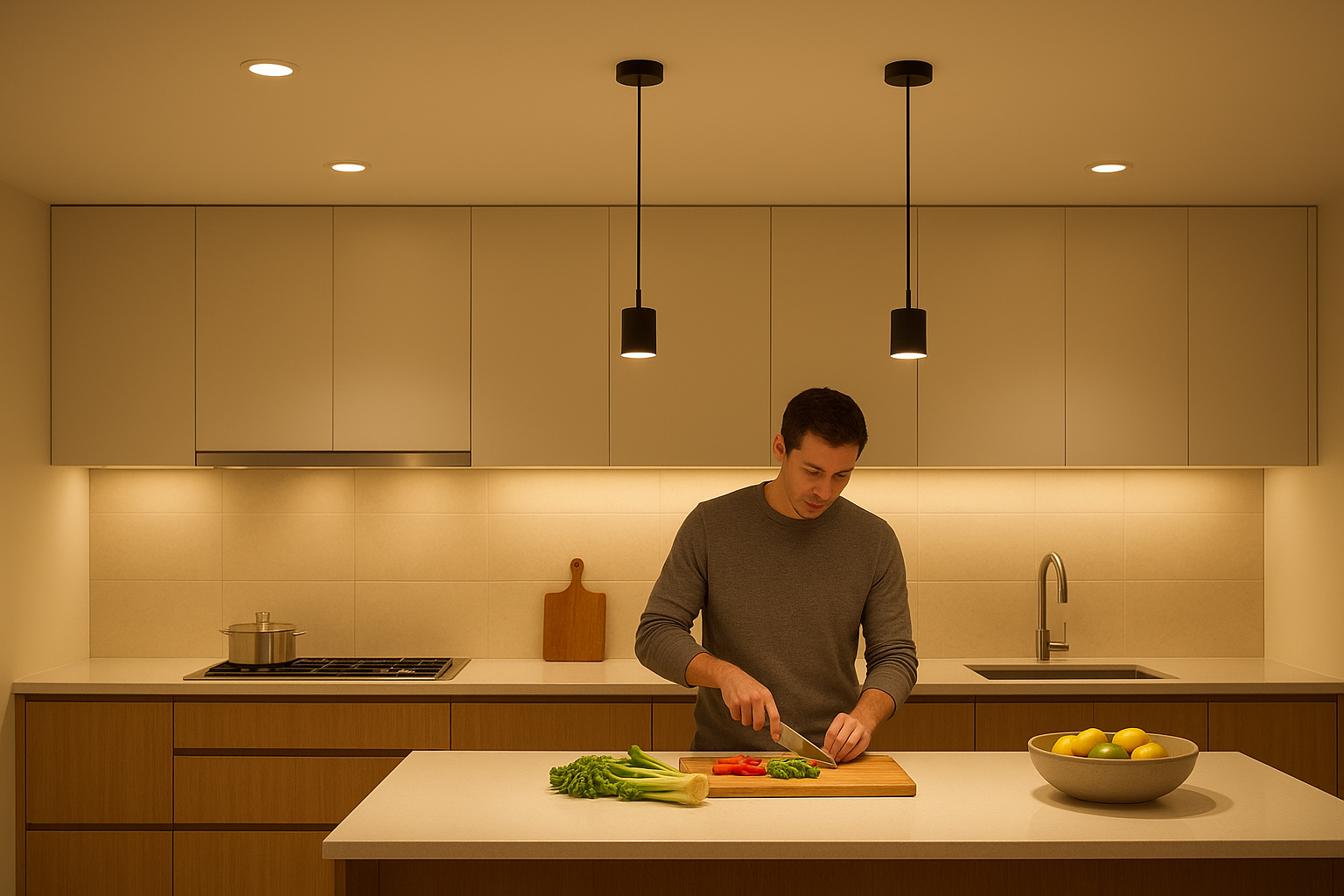
The kitchen deserves crisp task lighting on counters and a gentle ambient layer that doesn’t cast hard shadows where you chop.
Aim for 200–300 lux ambient from low-profile recessed or a slim panel. Then target 500–750 lux on counters via continuous under-cabinet linear with good diffusion. Reserve pendants for the island, keeping drops short to protect sightlines.
Shallow recessed downlights or a low-UGR panel provide smooth ambient light. Linear under-cabinet strips should be continuous, high CRI (≥90), and positioned near the front of the cabinet underside to push light onto the worktop and not the backsplash. If you’re evaluating panels for multiple rooms, see a practical explainer on applications and selection in LED Panel Lights: Where To Use Them And How To Choose (Knowledge Base Source).
Create “Prep,” “Cook,” and “Night” scenes. Under-cabinet lighting at a low dim level doubles as a night path. Match dimmer types to drivers; reverse-phase (ELV) or 0–10 V often yield smoother LED dimming than legacy TRIAC. If you’re planning low-voltage linear or track, coordinate power supplies and control wiring early.
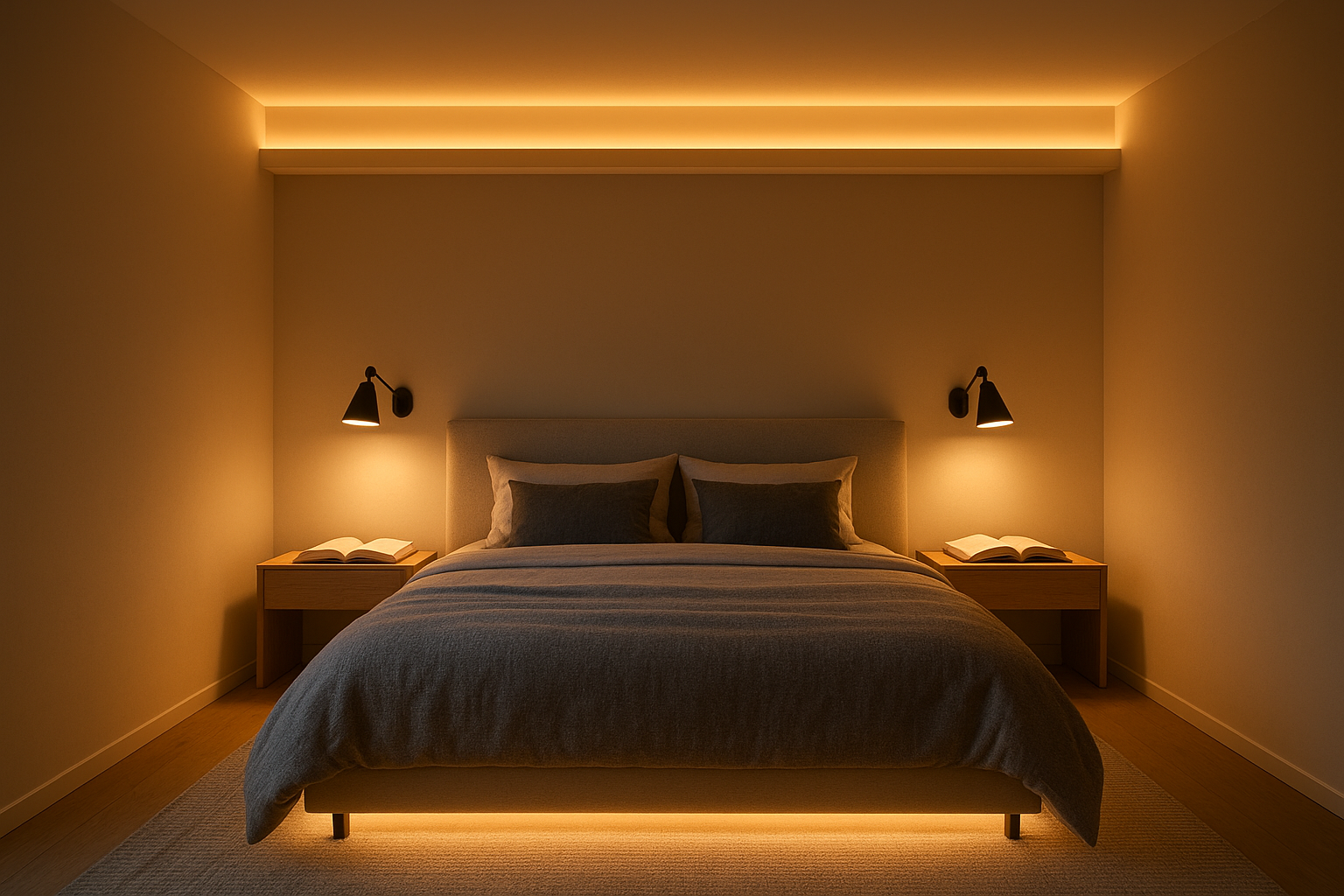
Bedrooms should transition effortlessly from relaxing ambient light to focused reading without glare.
Keep ambient levels gentle—50–150 lux—with indirect linear in coves or shallow downlights aimed away from the bed. For reading, deliver 300–500 lux at the page via adjustable wall sconces or small track heads directed to pillows, not eyes.
Wall-mounted swing-arm fixtures free the nightstand and reduce clutter. If recessed, choose low-glare optics or honeycomb louvres. A small under-bed or toe-kick linear on a motion sensor makes midnight movement safer without waking you fully.
Program “Unwind” for warm, low ambient; “Read” for higher localized task; and a very low “Night” scene. Keep the same 3000–3500K family to avoid jarring shifts when moving around the home.
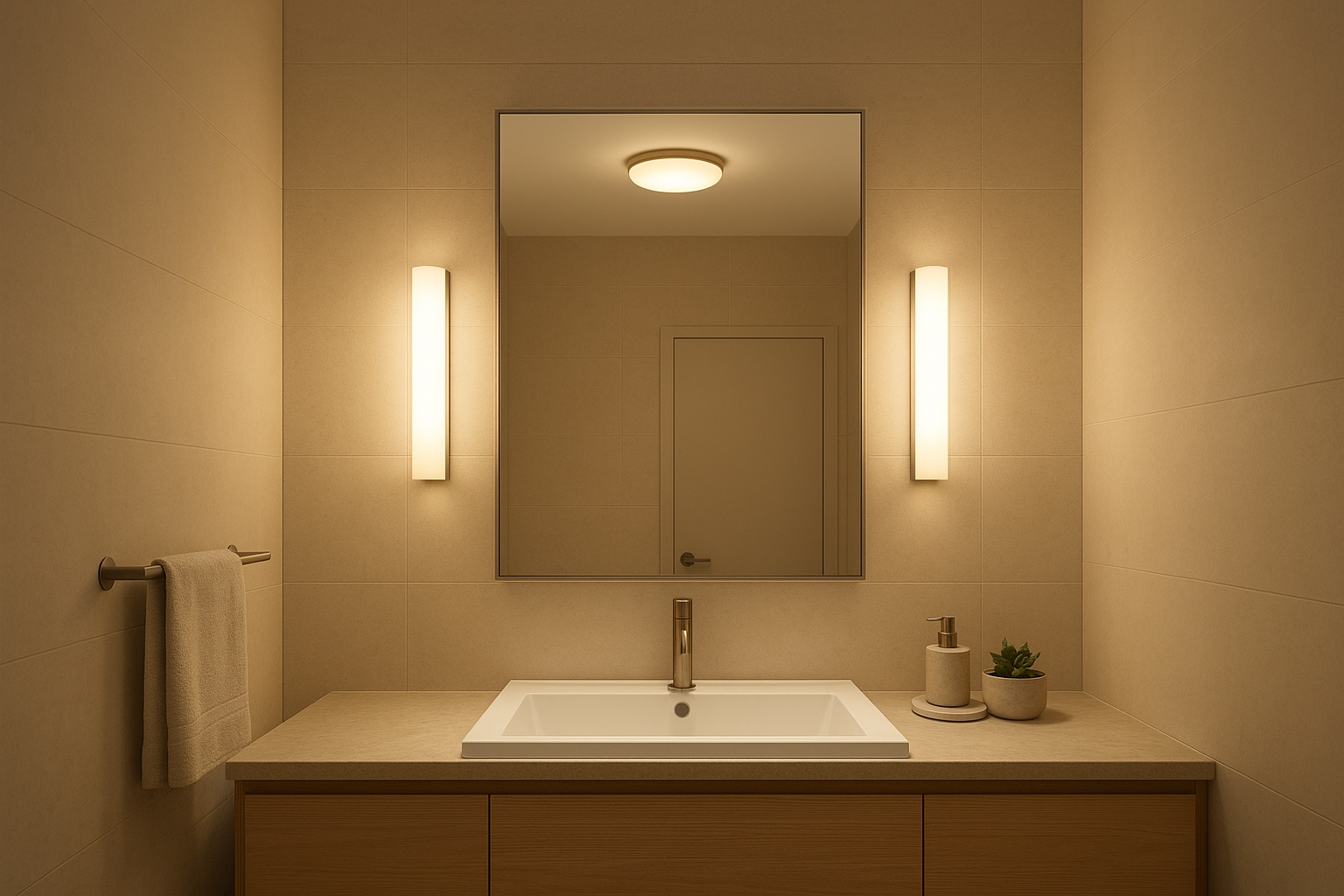
Flattering mirror light is all about even vertical illumination at face level—not a single bright downlight overhead.
Place vertical sconces on both sides of the mirror at roughly eye height, or use a high-quality backlit mirror. This cross-lighting reduces shadows under the eyes and chin. Aim for about 500–1000 lux at the face for grooming, then dim for ambient bathing. Pair these practices with residential best-practice summaries from CLTC’s Residential Lighting Guide.
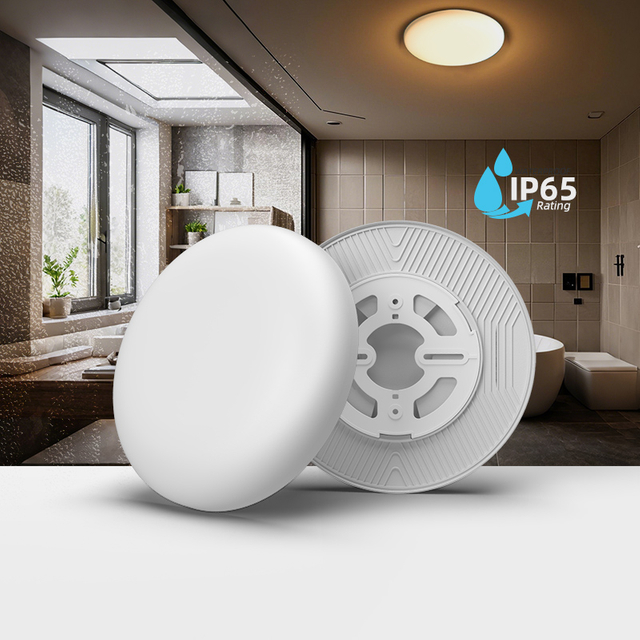
Use moisture-appropriate IP ratings around tubs and showers and keep the CCT consistent with the rest of the home. A shallow ceiling fixture with a lens will resist condensation and reduce glare.
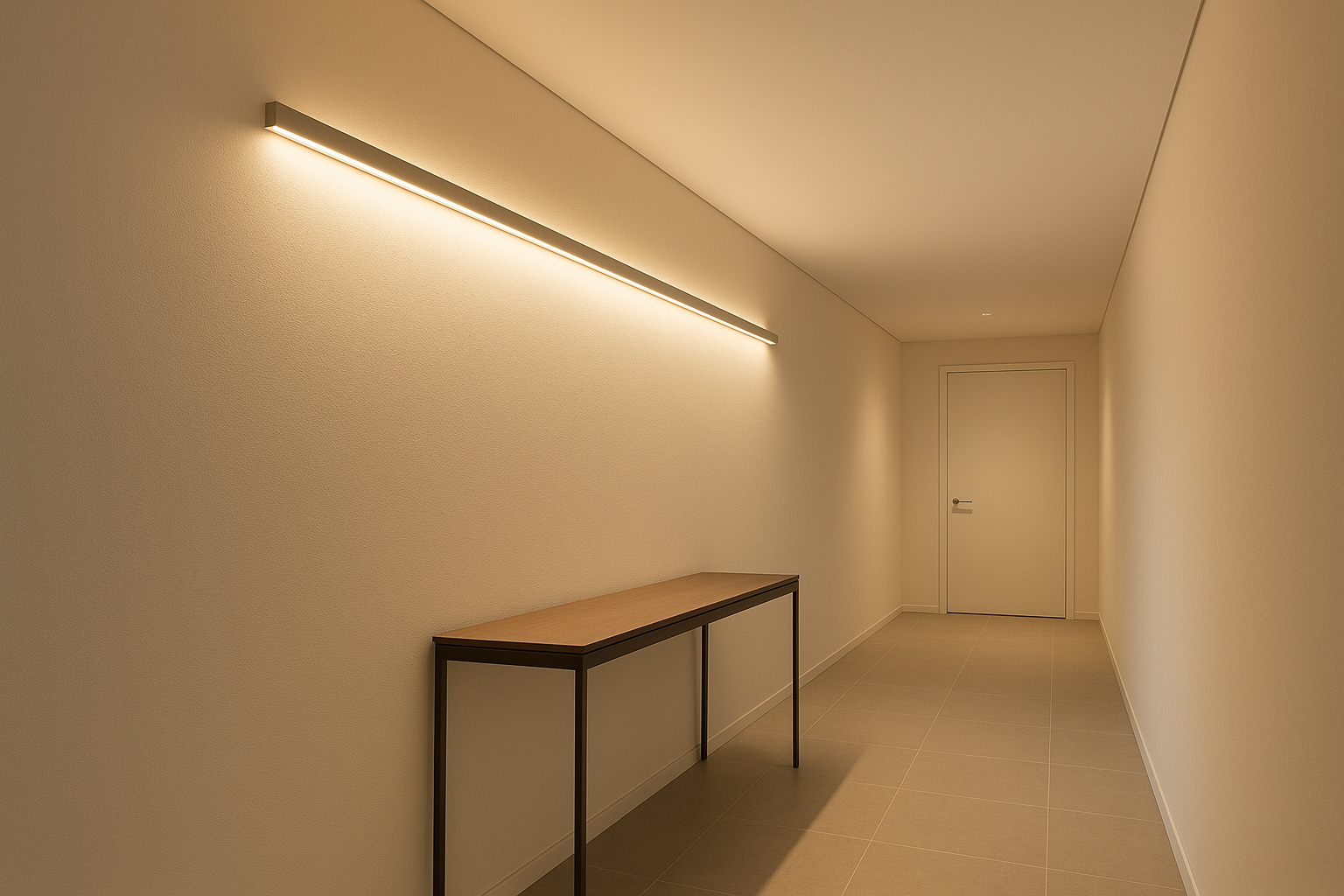
These circulation zones benefit from wall-washing and gentle grazing to “stretch” perceived height. A surface-mounted linear along the wall side or a perimeter recessed track sends light onto vertical surfaces, improving guidance and safety at night. Keep about 100–150 lux as a baseline and tie into vacancy/occupancy sensors where practical.
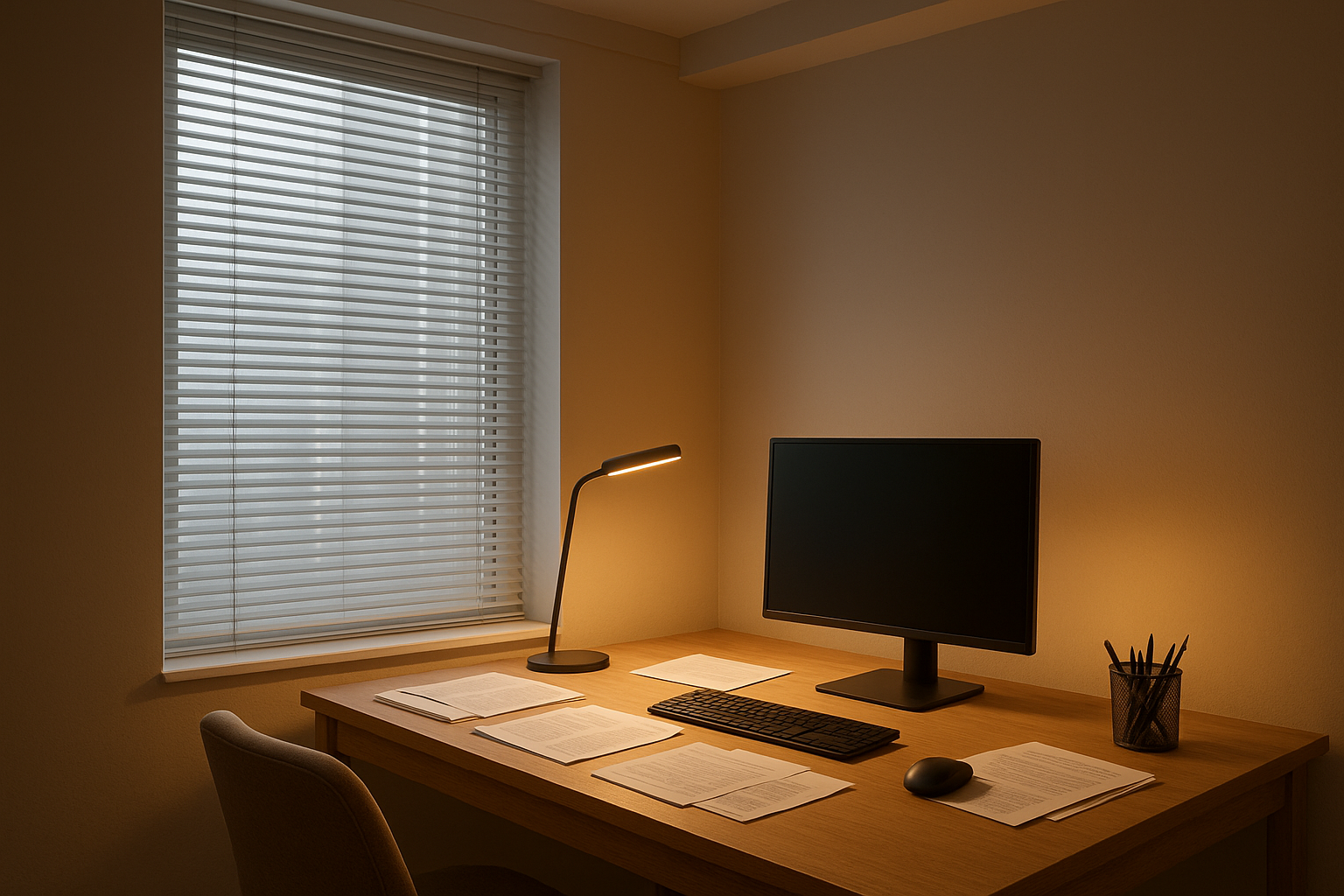
Target 300–500 lux ambient with 500–750 lux task lighting on documents, not the screen. Position monitors perpendicular to windows and use shading to tame daylight glare. Combine diffuse overheads with a dimmable task lamp; keep reflections off glossy desktops.
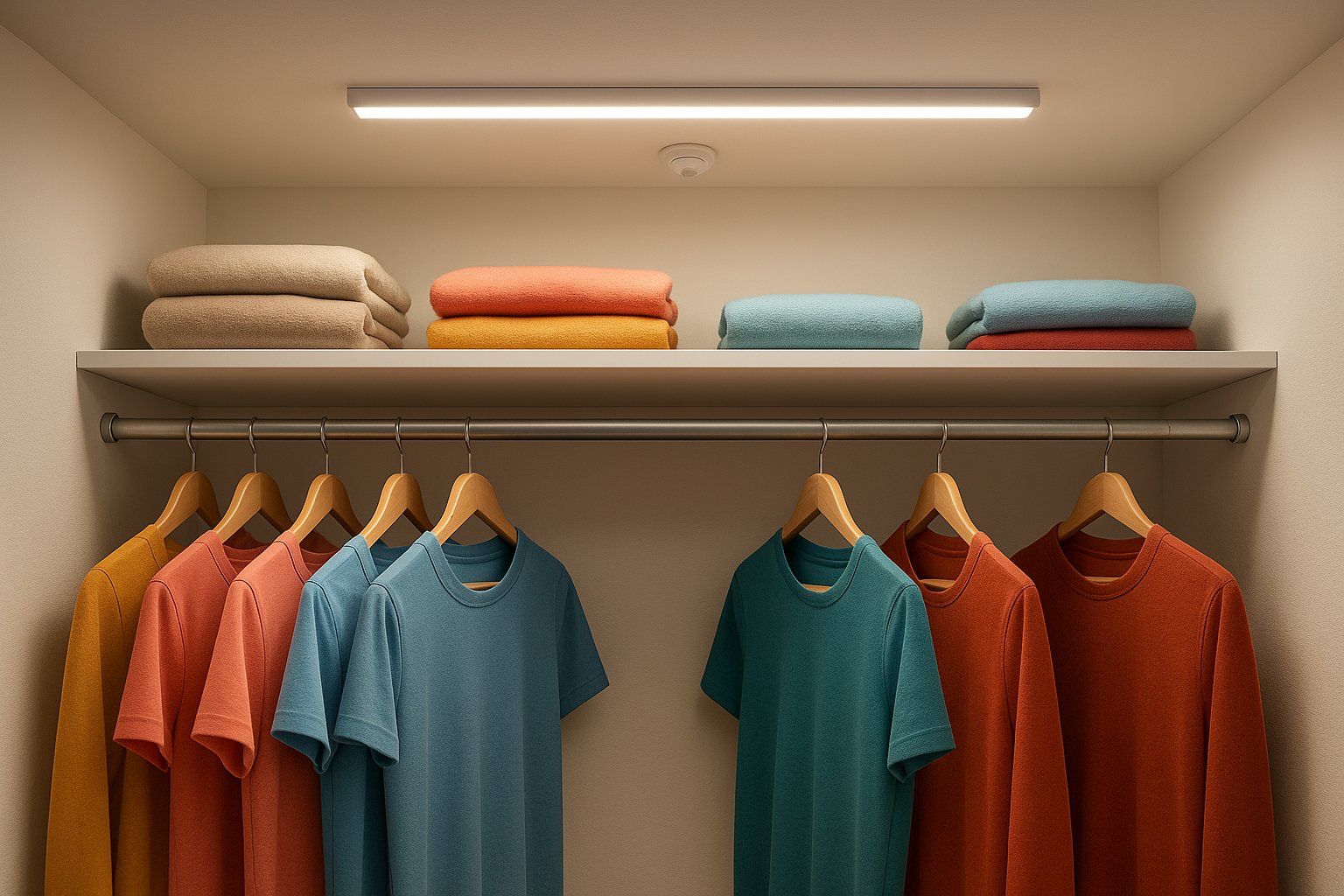
In small rooms, a thin panel or short linear does the job cleanly. Favor CRI ≥90 in closets so clothing colors are accurate. Motion sensors make these spaces hands-free, and a slightly higher CCT near 3500K can feel bright without being stark.
Not ready to rewire? Use plug-in floor lamps with drum shades for diffuse ambient, adhesive under-cabinet strips in kitchens, and battery-powered sconces for bedside or entry. Smart bulbs and plug-in dimmers provide basic scene control without opening walls.
Pick a home-wide CCT at 3000–3500K and stick with it.
For low ceilings, favor low-profile recessed, slim panels, and perimeter linear or magnetic track; beams around 40–60° for ambient.
Prioritize CRI ≥90 in kitchens, baths, and closets; consider TM‑30 data when available for natural rendering.
Plan scenes before you buy: which circuits should dim together, and where do you need night paths?
Match driver and dimmer type early; test one room before you commit across the home.
Case 1 — 60 m² open living-kitchen: Perimeter recessed magnetic track with wall-washers and a few adjustable spots; slim panel in the kitchen for 200–300 lux ambient; continuous under-cabinet linear for 500–750 lux task; island pendants with short drops. Scenes: “Entertain,” “Cook,” and “TV.”
Case 2 — 35 m² studio: One surface linear along the window wall to lift vertical brightness; two shallow downlights over the seating zone; plug-in floor lamp with smart bulb for evening dimming; under-cabinet adhesive strips in kitchenette.
Case 3 — 90 m² family apartment: Bedrooms with indirect cove linear and bedside adjustable sconces; bathroom with side sconces at the mirror; hall with wall-grazing linear for wayfinding; home office corner gets a dimmable task arm and a glare-controlled overhead.
A smooth install hinges on compatibility and wiring clarity. Pair dimmers to drivers (ELV with ELV, 0–10 V with 0–10 V), observe minimum loads, and avoid mixing control types on one circuit. Always consult a qualified electrician and verify local electrical code before wiring or modifying circuits. Where panels make sense, skim a practical installation primer such as What is Needed to Install LED Panel Lights (Knowledge Base Source). For a clear picture of control best practices shaping today’s market, see the ASHRAE/IES 90.1-2022 summary.
Residential practice context and standards overview: IES Lighting Library; residential scope via RP-11-20.
Practical illuminance ranges checked against Super Bright LEDs residential levels.
Beam and spacing heuristics reference: ERCO note on spacing up to 1.5× mounting height.
Disclosure and example: KEOU Lighting is our product. As a practical option for low ceilings, a low‑UGR slim panel or a recessed magnetic track module from a reputable supplier can support comfortable ambient layers in living rooms and kitchens. For panel selection criteria and room-by-room fit, see How to Use and Choose LED Panel Lights (Knowledge Base Source).