
Author: Site Editor Publish Time: 17-02-2026 Origin: Site


Choosing industrial high bay light types should be straightforward. This guide maps common factory environments to the right fixture families, using plain language and clear height ranges in meters and feet.
If your plant includes warehouse bays, machining lines, and clean or wet areas, you’ll see exactly which type fits each zone—without deep specs or jargon. We also include a comparison table, simple mounting height guidance, pricing notes, and five quick FAQs.
Soft CTA: For a fast overview of solutions by zone, explore the KEOU Industrial Lighting Solution page: industrial lighting solutions for mixed factory environments.
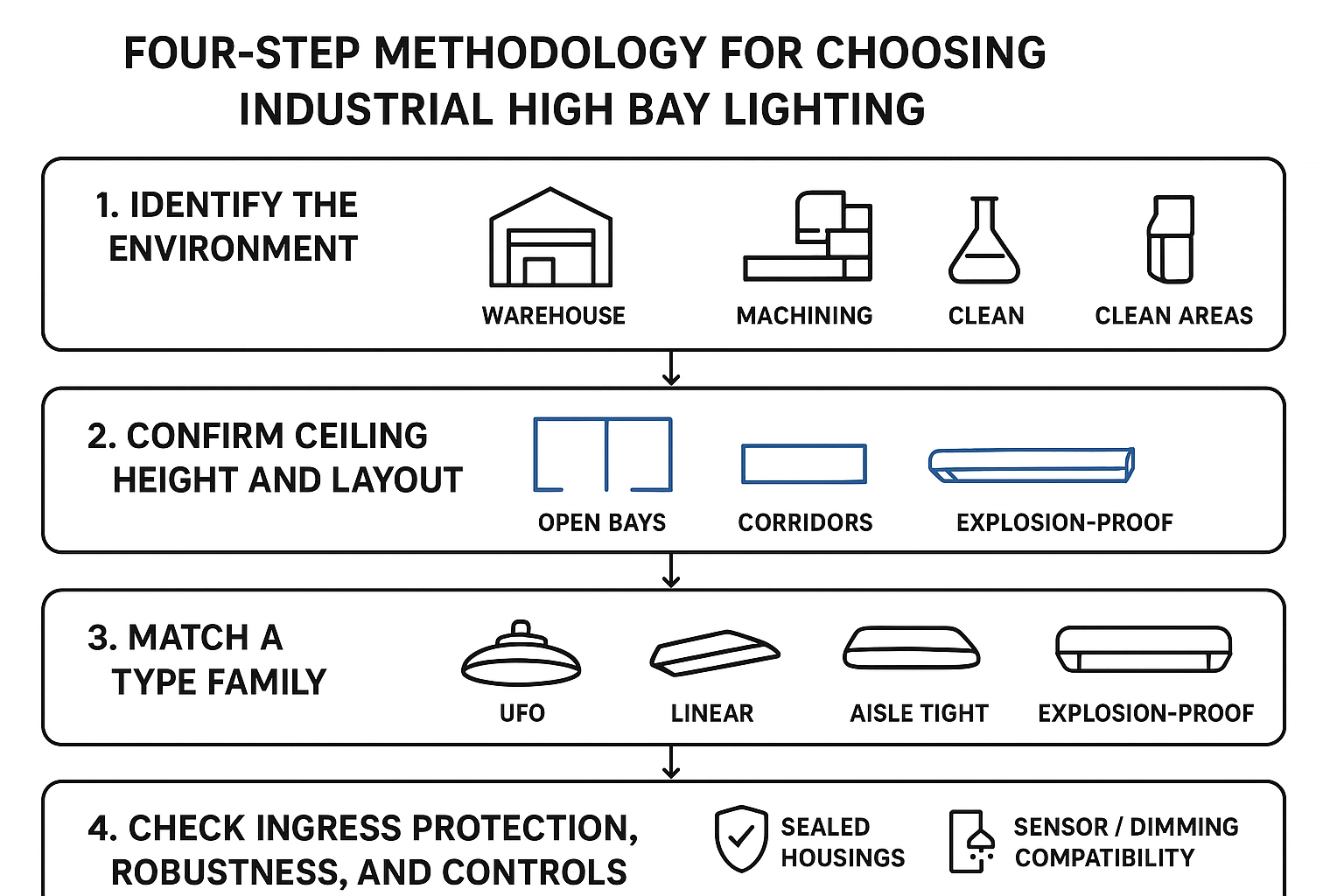
We followed a simple four-step method:
Identify the environment: warehouse/logistics; machining/heavy industry; clean/wet areas.
Confirm ceiling height and layout: open bays vs corridors; typical heights 4–12 m.
Match a type family: UFO/round for open bays; linear for rectangular lines; narrow-beam aisle fixtures for racks; vapor-tight for wet/clean; explosion-proof where compliance requires; controls-ready for energy savings.
Check ingress protection, robustness, and controls: look for sealed housings where needed, sturdy materials, and sensor/dimming compatibility.
Disclosure: KEOU Lighting is our product. We evaluated it using the same criteria as other solutions in this list. For brand context, see our manufacturer overview for 2026.
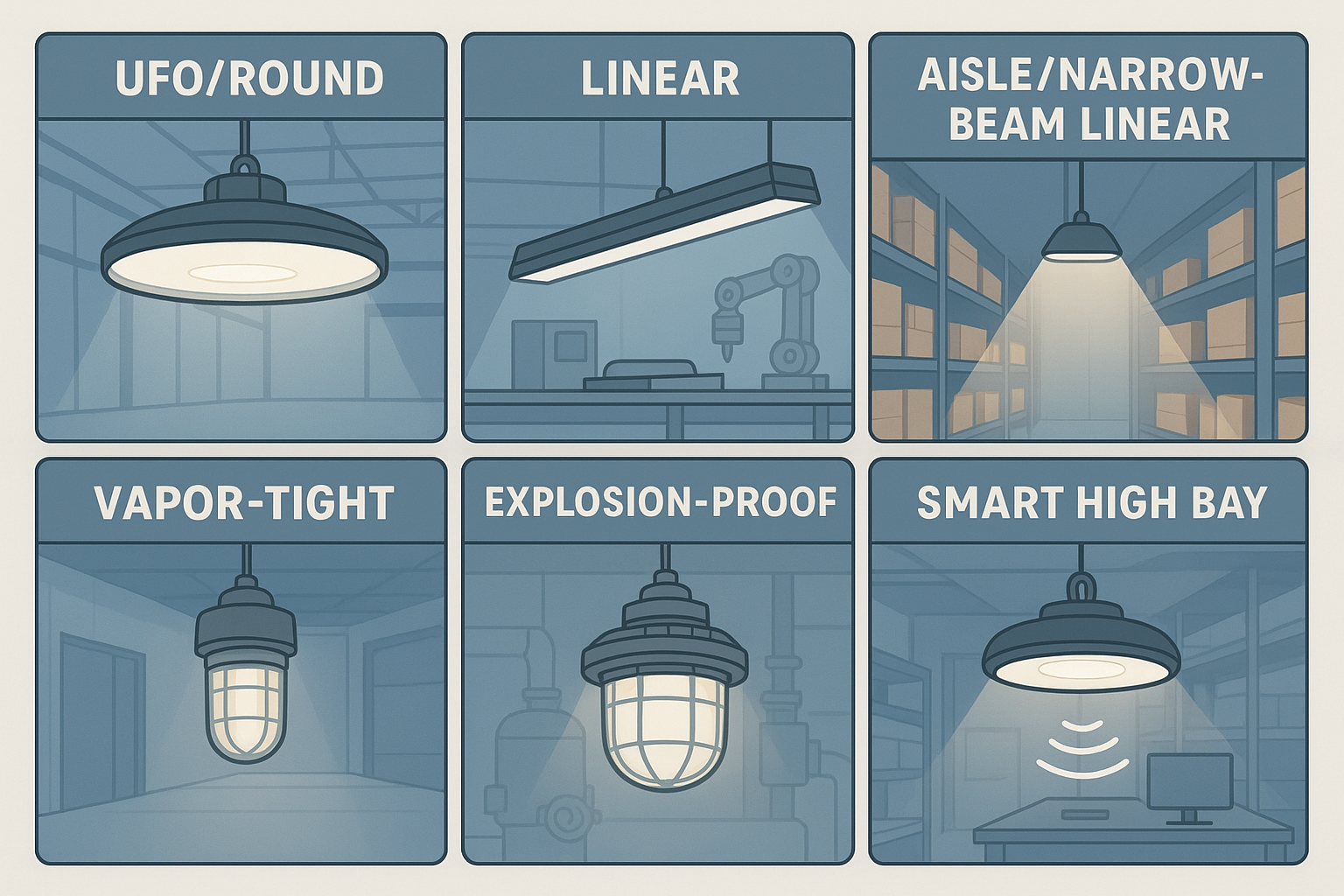
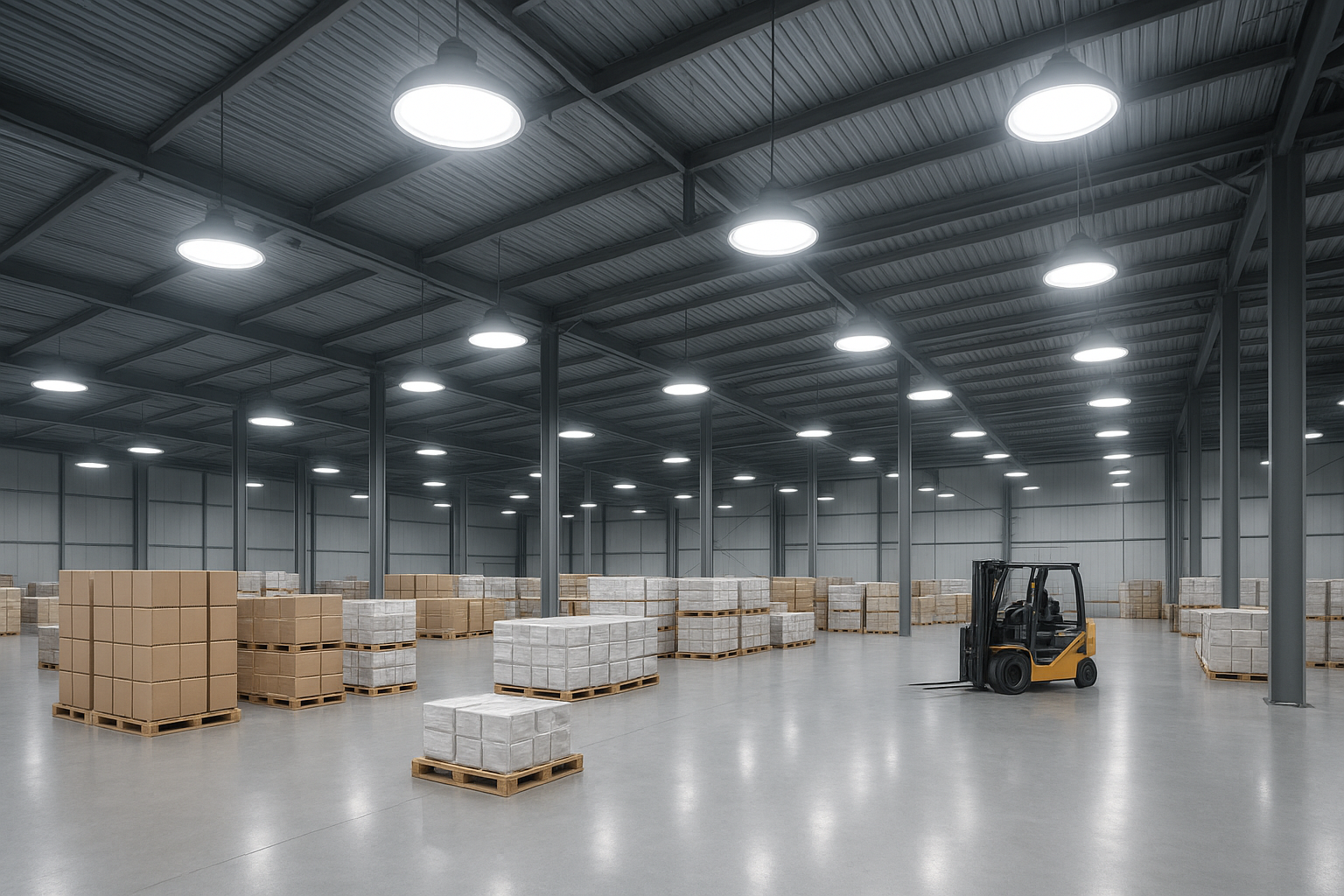
Positioning: Compact round fixtures that deliver broad, uniform coverage in open warehouse or production areas.
Key traits: Wide beam distributions for large areas; simple hook or pendant mounting; common power/CCT selectable options.
Pros: Fast to install; good uniformity in open zones. Cons: Potential glare in precision tasks unless optics control is added; choose appropriate IP rating for dust/moisture.
Best for: General warehouse bays and open factory floors. Not for: Narrow aisles or environments that demand sealed housings.
Typical mounting height: About 6–12 m (20–40 ft). Maintenance/durability: Choose solid aluminum housings and sealed lenses in dusty or damp areas.
Evidence: Practical height rules are summarized by PACLights in the mounting height guidance (2025), and price snapshots appear on OEO’s public 2026 listings.
Positioning: Rectangular fixtures that align with aisles and production lines, providing consistent row lighting under mid-height ceilings.
Key traits: Directional distribution matches long bays; flexible surface/chain mounting; easy to lay out in rows.
Pros: Clean row alignment with less spill. Cons: Bulkier housings; spacing and glare control require attention for detail work.
Best for: Assembly lines, rectangular bays, and mid-height ceilings. Not for: Very high open spaces where round fixtures spread better.
Typical mounting height: About 4–8 m (15–25 ft). Maintenance/durability: Select robust housings with good thermal design.
Evidence: PACLights explains spacing and layout in how to space high bay fixtures for uniform lighting (2025), while OEO’s linear high bay catalog (2026) shows typical options and prices.
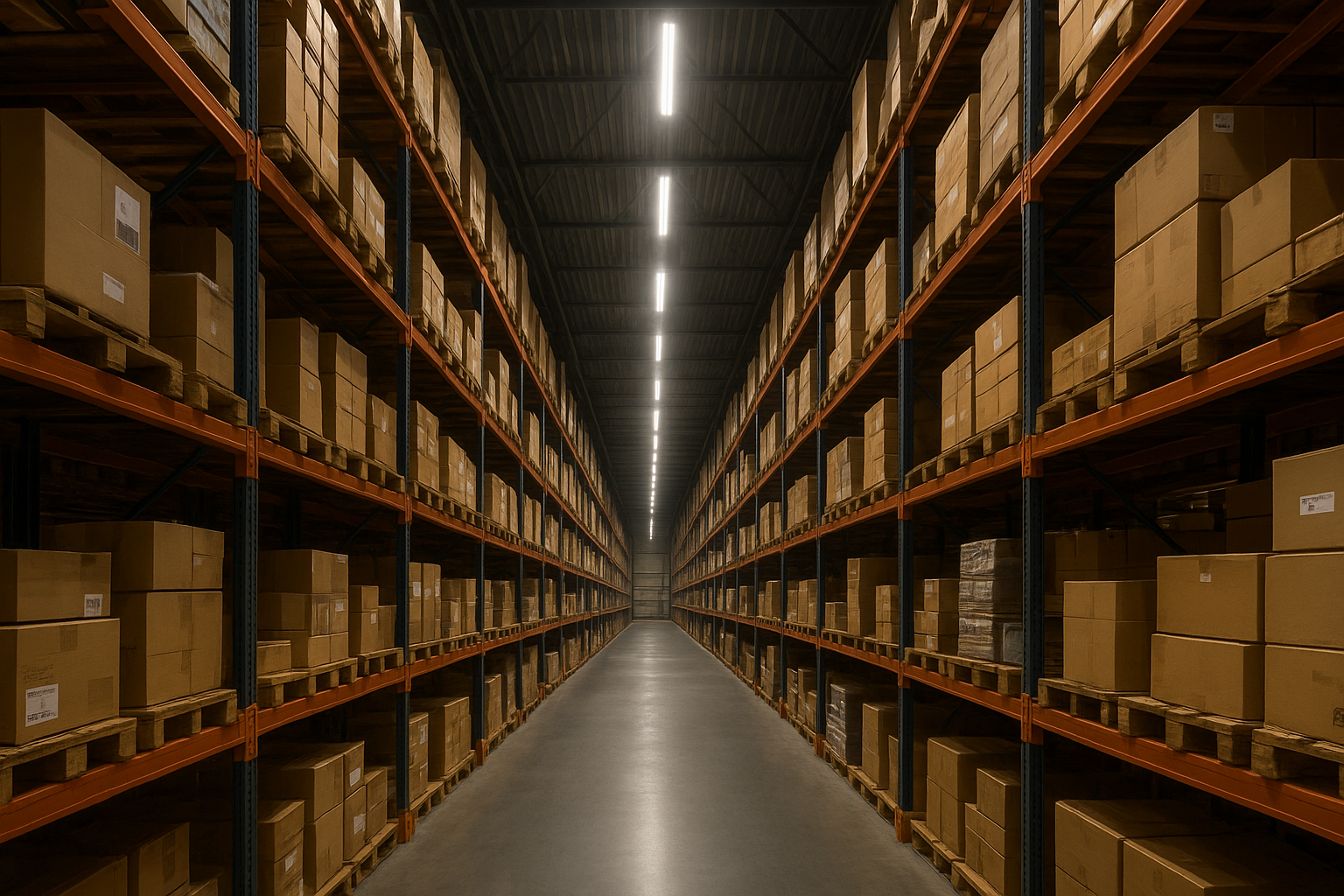
Positioning: Narrow-optic fixtures that concentrate light along aisles to reach vertical surfaces and lower shelves while minimizing shadows.
Key traits: Targeted beam angles to illuminate racks; efficient spacing with a spacing-to-mounting-height ratio near 1.0–1.2.
Pros: Better vertical illuminance on racking; reduced shadowing when laid out correctly. Cons: Poor fit for open areas; requires precise layout.
Best for: Warehousing corridors and tall racking. Not for: Open bays and broad assembly spaces.
Typical mounting height: Commonly 6–12 m; higher mounts are possible with narrow optics when spacing is planned.
Maintenance/durability: Keep lenses clean to preserve narrow-beam performance.
Evidence: SIROLight’s professional guide details optimal mounting height and spacing for high bay lighting (2024), with aisle layout concepts echoed in PACLights’ layout notes.
Soft CTA: Want a quick aisle layout sanity check? Send your ceiling height and aisle widths, and we’ll suggest a narrow-beam starting layout you can compare against your current plan.

Positioning: Sealed, gasketed fixtures that resist moisture, dust, and corrosive washdown, suitable for food processing, wet manufacturing, and exposed docks.
Key traits: IP65 or IP66 protection against dust and water jets; sealed housings and lenses; materials designed for cleaning.
Pros: Withstands washdown and airborne contaminants; supports hygiene requirements. Cons: Heavier and costlier than standard high bays; accessories can be limited.
Best for: Clean/wet zones and corrosive environments. Not for: Dry open bays where sealed enclosures aren’t needed.
Typical mounting height: Often 6–12 m in factory settings.
Maintenance/durability: Gaskets and seals need periodic checks; choose materials that resist chemicals used on site.
Evidence: Access Fixtures explains vapor-proof applications in IP65 and IP66 vapor-proof lighting guidance (2025).
Helpful context: See KEOU’s explainer on how IP ratings translate to damp and wet areas (2025) for plain-language IP notes.

Positioning: Certified fixtures for Class I/II/III hazardous locations where flammable gases, vapors, dust, or fibers may be present.
Key traits: Enclosures designed to contain internal ignition sources; compliance to relevant NEC articles; rugged materials and high ingress protection.
Pros: Meets safety compliance in hazardous zones; robust construction. Cons: Higher cost and weight; professional classification and certification checks required.
Best for: Areas classified as hazardous under local codes. Not for: Standard dry warehouses where compliant sealed fixtures aren’t necessary.
Typical mounting height: Determined by the environment and certification; follow code and vendor guidance.
Maintenance/durability: Follow certified maintenance procedures; ensure seals remain intact.
Evidence: Access Fixtures outlines classifications in hazardous-location lighting basics (2025), with additional context from PACLights’ explosion-proof industrial lighting overview (2025).
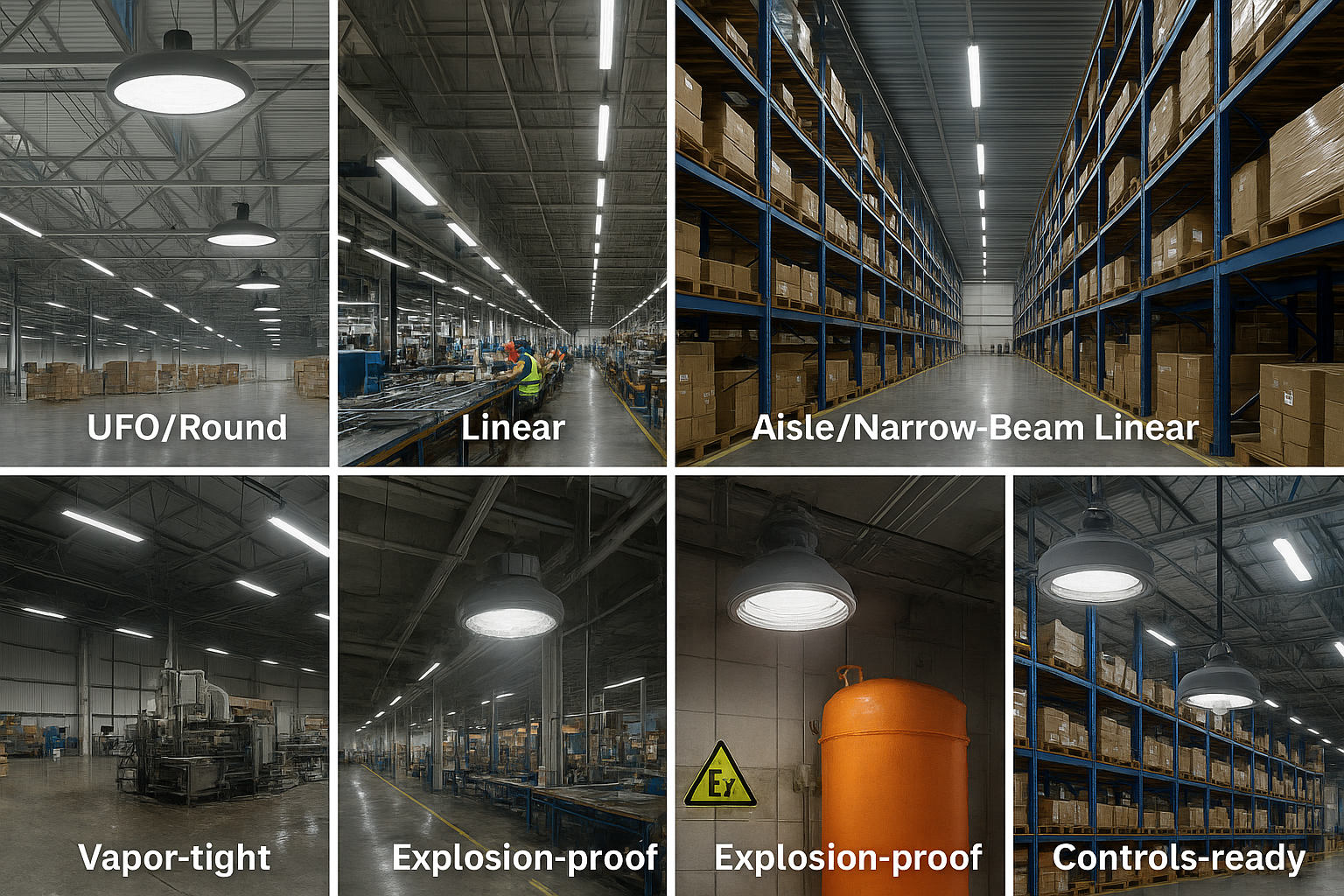
Positioning: High bays with occupancy/daylight sensors and dimming interfaces to reduce energy use in intermittently occupied areas.
Key traits: 0–10V dimming and optional DALI/networked controls; occupancy/daylight sensors; wireless options to ease retrofit.
Pros: Commonly delivers 30–60%+ energy savings depending on usage; improves comfort with adaptive light levels. Cons: Setup adds complexity; sensor placement and driver compatibility matter.
Best for: Warehouses with variable occupancy, staging zones, and facilities targeting energy reduction. Not for: Areas where controls integration is not feasible.
Typical mounting height: Type-dependent; works with UFO or linear families.
Maintenance/durability: Keep sensors clean and aligned; verify firmware and network settings.
Evidence: PACLights notes savings and controls in high-efficiency warehouse lighting and controls (2025).
Type | Best-for environment | Mounting height | Pros | Cons |
UFO/Round | Open warehouse bays and open factory floors | 6–12 m typical | Broad coverage; simple mounting | Glare risk in precision tasks; needs spacing planning |
Linear | Rectangular bays and production lines | 4–8 m typical | Aligns neatly to rows; less spill | Bulkier housings; spacing precision needed |
Aisle/Narrow | Rack corridors and tall racking | 6–12 m typical; higher with narrow optics | Focused vertical illuminance | Not for open areas; layout must be precise |
Vapor-tight IP65/66 | Clean, wet, corrosive zones | 6–12 m typical | Sealed; washdown compatible | Heavier; higher cost |
Explosion-proof | Hazardous locations (code-defined) | As specified by compliance | Safety compliance; rugged | Expensive; certification checks required |
Controls-ready | Intermittent occupancy zones | Type-dependent | Energy savings; adaptive dimming | Setup/commissioning complexity |
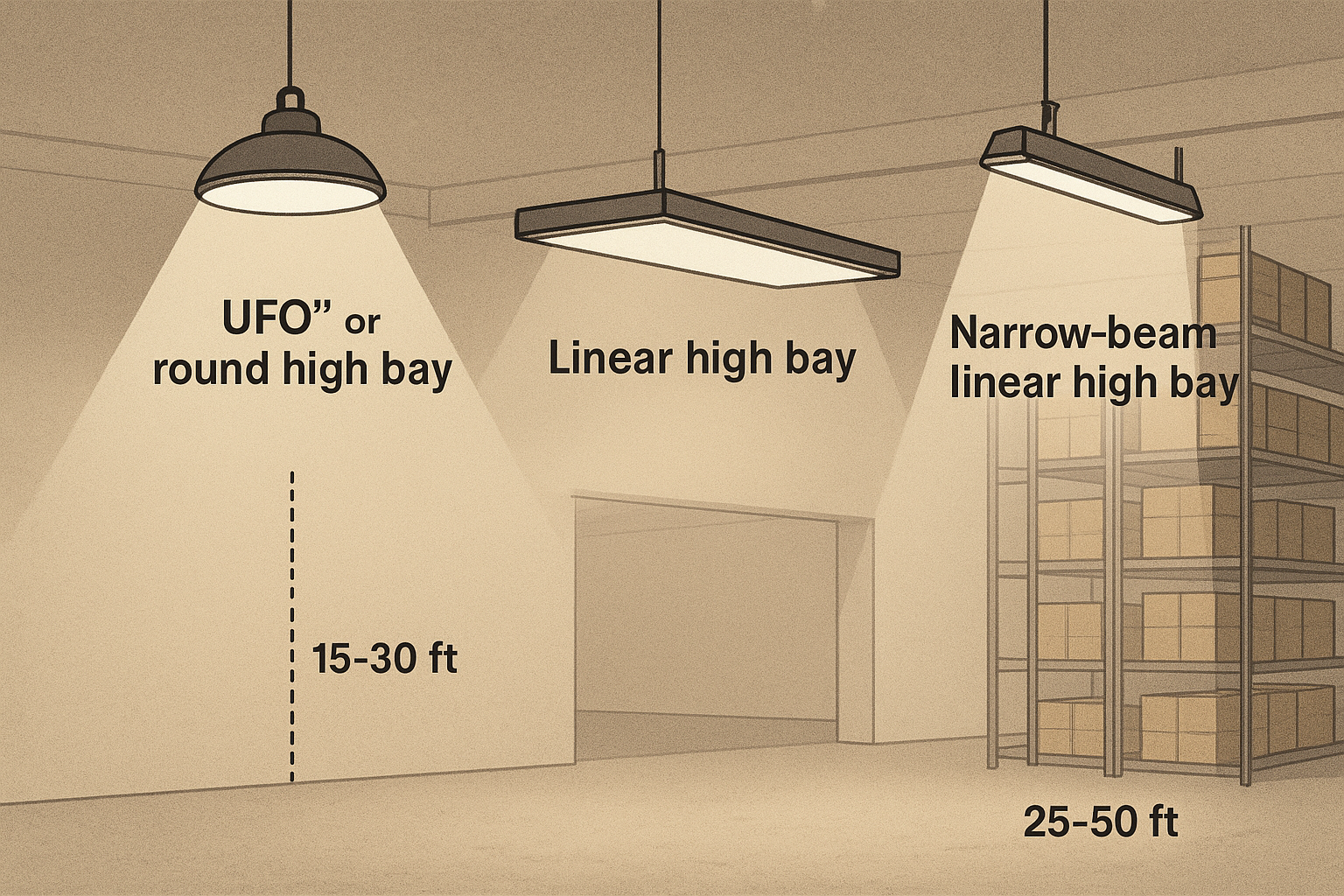
Here’s the simple way to think about mounting height high bay lights:
UFO or round high bays: About 6–12 m (20–40 ft) in open areas, starting near 60% of ceiling height as a rule of thumb for spacing and uniformity.
Linear high bays: About 4–8 m (15–25 ft) for rectangular bays and assembly lines, ideal for neat row alignment and targeted distribution.
Aisle or narrow-beam fixtures: Use tighter spacing with narrow optics for racking corridors; a spacing-to-mounting-height ratio near 1.0–1.2 is common.
For practical ranges and spacing ratios, PACLights’ mounting height quick reference (2025) and SIROLight’s optimal mounting and spacing guide (2024) offer helpful visuals and examples
UFO or round high bays fit open areas at about 6–12 m (20–40 ft). Linear high bays fit rectangular bays or lines at about 4–8 m (15–25 ft). For aisles, use narrow optics and closer spacing. Guidance is summarized by PACLights and SIROLight in the mounting and spacing resources cited above.
Use sealed, vapor-tight fixtures (IP65 or IP66) where water jets, cleaning, or airborne contaminants are present—such as food processing or wet manufacturing. Access Fixtures’ vapor-proof overview (2025) explains common use cases, and our IP explainer provides practical context for damp vs wet areas.
Many modern high bays offer simple hook or surface mounts and 0–10V dimming. Sensor add-ons are available, but verify driver and control compatibility. PACLights’ layout and controls notes provide helpful retrofit tips.
Pick optics or lenses that control glare, use lower UGR designs when available, and consider narrow-beam aisle fixtures over precision lines. Proper spacing helps, too. Some vendors document glare-control options, and it’s a focus area in customization-heavy projects.
Occupancy and daylight sensors typically deliver 30–60%+ savings depending on usage patterns. Networked controls can add scheduling and grouping benefits. PACLights summarizes savings and controls in a practical buyer context.


