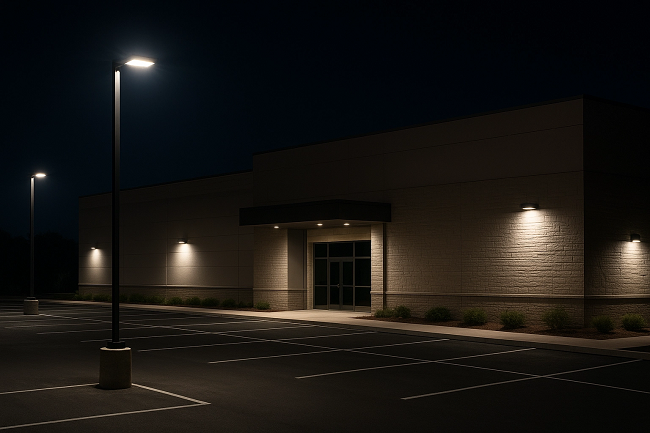
“Commercial-grade” outdoor led lighting isn’t about the biggest wattage. It’s about putting the right distribution, glare control, durability, and controls in the right place—so the site is safer, easier to maintain, and less likely to fail an inspection or annoy neighbors.
This guide is written for contractors, specifiers, and distributors who need a practical answer to one question:
For this outdoor scenario, what fixture type should I spec—and what should I verify on the cut sheet?
1. Quick pick matrix: scenario → fixture type → what to check
|
Scenario |
Typical fixture types |
Optics / distribution shortcut |
Specs to verify first |
|---|---|---|---|
|
Parking lots & open site areas |
Pole-mounted area/site lights |
Type III (perimeter) and/or Type V (interior) |
IES file, BUG rating, IP rating, surge protection option, controls (photocell / scheduling) |
|
Building perimeter & security |
Wall packs (full cutoff or forward throw) |
Type IV-style forward throw for reach; full cutoff where trespass is sensitive |
BUG/backlight control, mounting height, lens durability (IK), IP rating |
|
Loading docks & service yards |
Floods + wall packs (layered) |
Asymmetric/aimed floods + controlled wall packs |
Glare control, aiming, IP rating, driver/controls compatibility |
|
Walkways & entries |
Bollards + low-glare wall |
Narrow/controlled optics; avoid high-angle glare |
BUG/glare control, CCT selection, spacing, vandal resistance |
|
Canopies (covered entries, fueling areas) |
Canopy fixtures (downlight) |
Wide, uniform, fully shielded downward light |
Cutoff/shielding, IP rating, corrosion resistance; code requirements by site |
|
Facades, signage, vertical surfaces |
Flood lights / wall grazers |
Narrow-to-medium beams aimed at target |
Glare to drivers/pedestrians, shielding, aiming, maintenance access |
Pro Tip: If you don’t have the photometric file (IES) and a mounting-height plan, you’re guessing. Ask for the IES file early—before you order fixtures.
2. How to choose outdoor LED lights for commercial sites

2.1. Step 1: A quick needs assessment (ask this before you pick fixtures)
You can often get to the right fixture family in 5 minutes if you collect these inputs. This is the fastest, most repeatable way to choose outdoor LED lights without over-spec’ing.
-
Mounting height and spacing (poles, wall height, canopy height)
-
What needs to be lit (vehicles, pedestrians, cameras, loading tasks)
-
Exposure (rain/snow, wind, dust, coastal corrosion, washdown)
-
Neighbors and light sensitivity (residential boundary, dark-sky zone, wildlife)
-
Controls expectations (dusk-to-dawn photocell, scheduled dimming, motion, networked controls)
-
Maintenance reality (lift access, cleaning schedule, swap-from-ground options)
Get these wrong and you’ll pay for it later—usually in glare complaints, dark spots, or premature failures.
3. Commercial outdoor LED lighting specs that actually matter
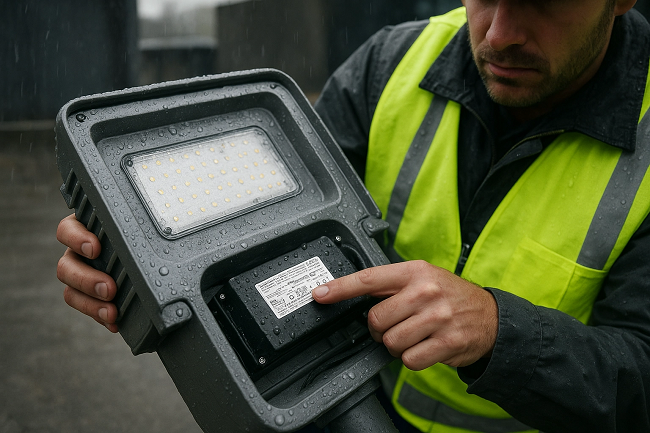
3.1 IP rating: don’t treat it as a marketing badge
The IP code is an ingress protection classification under IEC 60529 “Degrees of protection provided by enclosures (IP Code)”. In plain English:
-
The first digit “6” (as in IP65/IP66) is about dust protection.
-
The second digit is about water exposure.
For outdoor luminaires, you’ll commonly see IP65, IP66, or IP67 called out depending on exposure (weather, wind-driven rain, washdown, or temporary submersion risk).
One practical caution: NEMA enclosure “Types” and IP ratings are not interchangeable. NEMA notes that enclosure Types evaluate additional hazards beyond basic ingress, so a one-to-one equivalence doesn’t exist—see NEMA’s “FAQs: Enclosures”.
3.2 BUG ratings: the fast way to talk about spill and glare
If you’ve ever seen a parking lot that “works” but feels harsh—or lights up the neighbor’s windows—you’ve seen a BUG problem.
The IES Luminaire Classification System (LCS) uses BUG ratings to quantify:
-
Backlight (B): light spilling backward toward adjacent properties
-
Uplight (U): light above 90° contributing to sky glow
-
Glare (G): high-angle light that causes discomfort or veiling glare
For the formal definition, the IES provides a BUG rating explanation in the IES TM-15-11 BUG Ratings Addendum (2017, PDF).
Many jurisdictions and projects align with the IDA/IES lighting-zone framework; the IDA/IES Model Lighting Ordinance (2011, PDF) shows how zones and BUG limits can be used to control light trespass and sky glow.
3.3 Distribution and optics: pick the pattern before you pick the wattage
For site and roadway work, distribution shortcuts help you avoid common mistakes:
-
Type III is often used on the perimeter of parking lots (forward throw).
-
Type V is common for interior/central parking lot poles where you want more uniform 360° distribution.
-
Type II is useful for narrower roadway-like runs or tighter areas.
Treat this as a starting point—not a substitute for the photometric layout.
3.4 CCT: don’t default to cooler is better
Most commercial sites live in the 3000K–5000K range. Your best choice depends on the project:
-
Use neutral (around 4000K) when you want a balance of visibility and comfort.
-
Use warmer (3000K) when spill, neighborhood impact, or dark-sky expectations are stricter.
-
Use cooler (5000K) when visibility and camera performance are prioritized—and the site context allows it.
3.5 Controls readiness: plan for how the site will actually operate
Even a basic outdoor project usually needs:
-
Photocell or schedule for dusk-to-dawn behavior
-
Dimming for after-hours reduction (where allowed)
-
Motion control for low-traffic zones (walkways, back-of-house)
Controls aren’t just an “extra.” They’re how projects cut operating cost without under-lighting.
4. Scenario playbook: which commercial outdoor LED light fixtures fit where
4.1 Parking lots and open site areas
Go-to fixture types
-
Pole-mounted area/site lights
What usually works
-
Perimeter poles: forward-throw optics (often Type III)
-
Interior poles: more symmetric optics (often Type V)
What to verify
-
Photometric file (IES) matches your pole height and spacing
-
BUG rating (especially backlight and glare) fits the site sensitivity
-
IP rating fits the exposure (wind-driven rain, dust, coastal air)
-
Surge protection option and driver quality documentation
-
Controls path (photocell/schedule now; networked later)
Common failure mode
-
Over-lighting to “solve” uniformity issues, creating glare and complaints. Fix the optics/layout first.
4.2 Building perimeter and security
Go-to fixture types
-
Wall packs (either full cutoff or forward-throw)
What usually works
-
Full cutoff where you’re close to property lines or residential boundaries
-
Forward throw where you need reach into a drive lane or parking edge
What to verify
-
BUG/backlight control so you don’t light the sky or the neighbor’s windows
-
Mounting height and spacing (wall packs too high often create harsh shadows)
-
Lens durability for vandal-prone areas (ask for IK rating if applicable)
Common failure mode
-
A “security” wall pack that’s bright but uncontrolled—creating glare that actually makes cameras and eyes work harder.
4.3 Loading docks and service yards
Go-to fixture types
-
Layered approach: flood lights for task zones + controlled wall lighting for circulation
What usually works
-
Aim floods to cover the dock face and apron without spilling into driver sightlines
-
Use controlled wall packs to avoid deep shadows near doors and corners
What to verify
-
Aiming and shielding options (visors, louvers)
-
Maintenance access (lifts, reach, and how often the lens will need cleaning)
⚠️ Warning: The fastest way to get “good-looking” but unsafe dock lighting is to aim floods too high. You’ll create glare and lose vertical illumination where workers actually need it.
4.4 Walkways, entries, and pedestrian routes
Go-to fixture types
-
Bollards (for wayfinding)
-
Low-glare wall-mounted or pole-mounted fixtures with controlled optics
What usually works
-
Lower mounting heights with controlled optics so pedestrians aren’t staring into a bright source
What to verify
-
Glare control (G rating / shielding) and consistency of spacing
-
CCT choice that matches the property character and local expectations
Common failure mode
-
Widely spaced fixtures with very high output: bright pools of light + dark gaps between them.
4.5 Canopies: covered entries, drive-throughs, and fueling areas
Go-to fixture types
-
Canopy fixtures with fully shielded downward distribution
What usually works
-
Wide, uniform downlight that avoids hot spots (good for cameras and wayfinding)
What to verify
-
Shielding/cutoff (no upward spill into the canopy structure)
-
IP rating and corrosion resistance in harsh environments
-
Any site-specific code requirements (for example, fueling canopies may have additional electrical and safety constraints)
4.6 Facades, signage, and vertical accents
Go-to fixture types
-
Aimed flood lights or wall grazers
What usually works
-
Narrow-to-medium beams, aimed precisely at the target surface
What to verify
-
Glare to drivers and pedestrians (add shielding if needed)
-
Maintenance access (these are often installed where access is annoying)
5. Red flags that cause outdoor jobs to fail (or get expensive)
-
You chose wattage before optics/distribution.
-
No BUG/glare plan near property lines.
-
IP rating doesn’t match the environment (dust, washdown, coastal corrosion).
-
Controls were “left for later,” so lights run at full output all night.
-
No maintenance plan (dirty lenses and loose connections quietly kill performance).
6. Spec-sheet checklist for commercial outdoor LED light fixtures
Use this when you’re comparing quotes or submittals:
-
Photometric file (IES) provided and matches layout assumptions
-
Distribution/optics called out (Type II/III/IV/V or equivalent)
-
BUG rating available for spill/glare control (where required)
-
IP rating stated (and appropriate for exposure)
-
Operating temperature range and housing material listed
-
Surge protection option listed (especially for pole-mounted site lighting)
-
Control options: photocell, dimming method, sensor compatibility
-
Warranty terms and support process clearly stated
7. Where KEOU Lighting fits
If you’re sourcing fixtures for mixed outdoor scenarios, it can help to work with a supplier that covers multiple outdoor families so you can standardize parts and support. For an overview of categories, see KEOU’s outdoor lighting solutions.
For facade, yard, and general site applications, commercial LED flood lights are a common workhorse category—and KEOU also has a practical note on glare and BUG-rated floodlight optics.
8. Next steps
If you want a fast, spec-ready recommendation, send:
-
a simple site sketch (or aerial screenshot)
-
mounting heights
-
any local dark-sky / spill constraints
-
your preferred control approach
Then compare options with a quick photometric check—and use the checklist above to keep the submittal clean.
You can also browse KEOU’s product catalog to shortlist fixture families before you request a quote.