
Author: Huang Publish Time: 13-05-2026 Origin: Site


When people compare “LED vs incandescent,” the conversation often collapses into one number: hours. For street lighting, that’s not enough.
A street light’s real-life uptime is shaped by two different mechanisms:
Gradual dimming (lumen maintenance) — the light still works, but output drops over time.
Sudden failures — the light goes out due to driver electronics, surge damage, water ingress, or other system-level issues.
This article compares LED street lights and incandescent street lights using the kinds of evidence and failure thinking that matter in municipal and commercial projects: LM-80/TM-21 concepts, surge immunity concepts, and real-world failure modes.
Evaluation criterion | LED street lights | Incandescent street lights |
|---|---|---|
“Lifetime” meaning | Combination of lumen depreciation and system survival (driver, surge, sealing) | Mostly filament survival (hard failure) |
Evidence you can audit | Lumen maintenance via LM-80 + TM-21 projections (component-level) plus luminaire/system tests | Rated life under defined conditions; fewer system variables |
Typical failure signature | Often electronics or protection (driver/SPD), sometimes sealing/thermal | Filament opens; sensitive to switching and vibration |
Duty-cycle sensitivity | Strongly affected by thermal design, driver quality, surge environment, and operating conditions | Strongly affected by switching/inrush, vibration, and voltage variation |
Maintenance planning | Can be planned around lumen maintenance + known weak points | Frequent replacements are inherent; higher truck rolls |
Key Takeaway: For street lighting, “long-life LEDs” is only true when the system is designed for surge + heat + ingress—not just when the LED package has a good lumen-maintenance curve.
Street lighting buyers often need two different answers:
How long until the light output is no longer acceptable? (useful life)
How long until the light stops working? (failure life)
LED standards and test practices mostly support (1) — lumen maintenance. But municipalities spend real money on (2): outage calls, repairs, and warranty returns.
The difference matters because an LED street light can keep running while slowly dimming, whereas an incandescent lamp tends to produce steady light until it suddenly fails.
This is the part of the comparison where the standards-based evidence is the strongest—if you keep the scope straight.
LM-80 is a standardized approach to measure luminous flux maintenance (how LED light output changes over time) and color maintenance for LED packages, arrays, and modules. It’s component-focused, not a full luminaire test, and it’s not a pass/fail label.
A clear, practical overview is NVC Lighting’s guide to “What is LM-80?”.
TM-21 is the method used to project long-term lumen maintenance from LM-80 test data. That’s how many spec sheets talk about targets like “L70” (the point where light output reaches 70% of the initial level).
The most important procurement takeaway: TM-21 is about lumen depreciation, not a guarantee that the full street light assembly won’t fail from other causes.
Incandescent rated life is usually closer to a direct “time-to-failure” idea because the filament is the central life-limiting element. The dominant failure is mechanical/electrical failure of the filament.
For a practical breakdown of early failure mechanisms (including vibration and over-voltage signatures), see Lamptech’s engineering notes on premature incandescent failures.
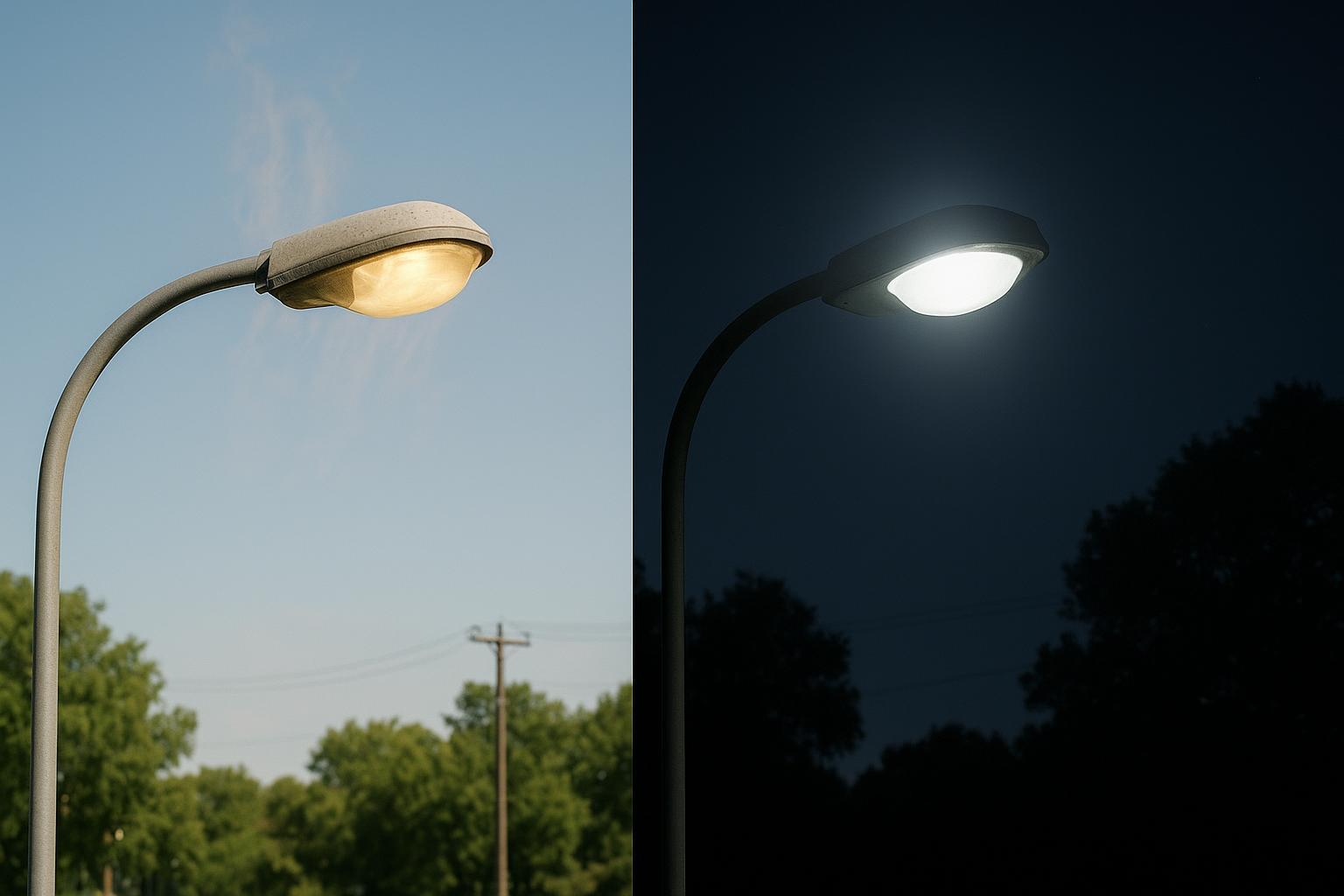
“Duty cycle” in street lighting is more than “hours per night.” It includes:
Switching frequency (including brownouts and grid events)
Thermal cycling (heat-up / cool-down every day)
Operating temperature (ambient + enclosure temperature)
Driver electrical stress, especially capacitor aging
For incandescent, switching is harsh because startup inrush and thermal shock are severe on a thin, hot filament.
For LED street lights, the LED package’s lumen maintenance can be excellent, but the system’s duty-cycle life is often limited by:
driver components aging faster at higher temperatures
repeated transient stress (surges)
moisture/corrosion risk over years
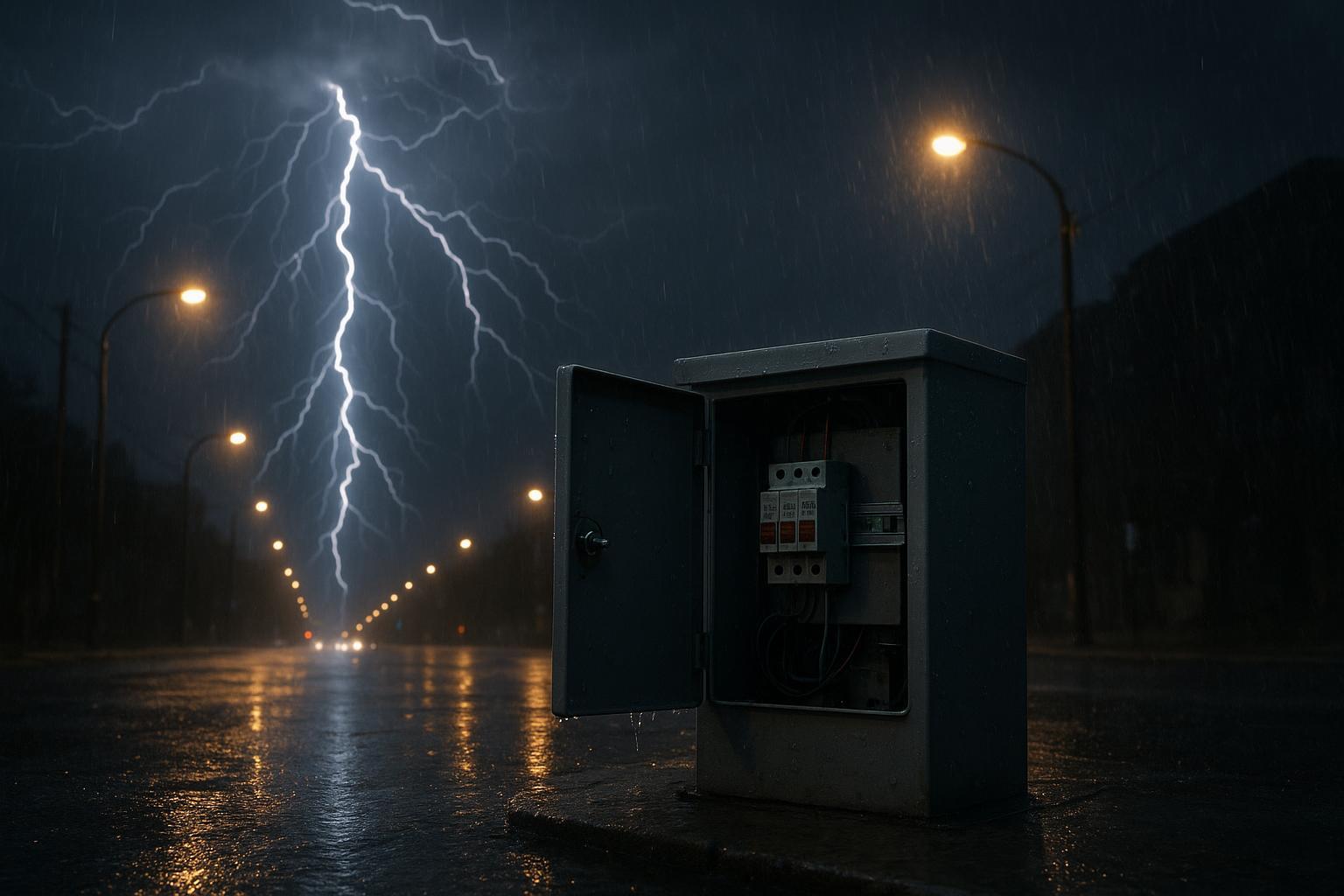
Outdoor lighting sits on long runs of wiring, exposed to induced lightning transients and switching events. That’s why surge immunity becomes a real separator between “lab life” and “field life.”
IEC 61000-4-5 is the common surge immunity test reference. A readable overview is the IEC 61000-4-5 page describing the combination wave (commonly “1.2/50 µs” voltage and “8/20 µs” current) and the typical 2 Ω relationship between open-circuit voltage and short-circuit current: IEC 61000-4-5 overview.
Instead of treating “surge protection” as a checkbox, ask for:
the test reference (IEC 61000-4-5) and the stated test level(s)
the test mode (line-to-line, line-to-ground) and pass criteria
whether surge protection is integrated (driver/SPD) and whether it’s field-replaceable
Pro Tip: Ask where surge protection is located (at the luminaire, at the pole base, or upstream). Redundancy often matters more than a single headline “kV” number.
When municipalities report early LED street light issues, the LED chips are often not the first point of failure. More common patterns include:
Drivers contain electrolytic capacitors and power electronics that are sensitive to temperature and transients. In procurement terms, driver selection and thermal design are “real lifetime” levers. If you’re collecting field feedback, “driver failure” is often the label maintenance teams use for these outages—even when the root cause is thermal stress or repeated surges.
SPDs (often MOV-based) can degrade over repeated surge events. A luminaire can survive “today’s surge” and still be closer to end-of-life protection tomorrow.
IP ratings and mechanical sealing quality matter because outdoor installations face rain, condensation cycles, and corrosive environments. Ingress-driven failures can look random, but they often correlate with gasket design, cable entry practices, and pressure equalization.
Field issues aren’t always exotic. Loose connectors, poor strain relief, and insufficient conformal coating can turn normal duty cycles into repeat failures.
For a broader perspective on why LED lifetime and reliability are more complex than “50,000 hours,” the U.S. DOE fact sheet on Lifetime and Reliability is a useful baseline.
A practical way to compare the two technologies is to ask: How predictable is your maintenance?
Incandescent street lighting tends to imply frequent lamp replacements as a standard operating condition.
LED street lighting can reduce replacement frequency, but only if your qualification process covers the non-LED failure modes (surge, driver, sealing, thermal management).
For distributors, predictable maintenance is not just a city-operations benefit; it reduces warranty exposure and return-handling cost across multi-year projects.
Choose LED street lights when you can secure documentation on:
lumen maintenance evidence (LM-80/TM-21 context)
surge immunity approach (IEC 61000-4-5 or equivalent testing practice)
sealing/IP approach and serviceability
driver details and replacement strategy
If you want a starting point for product exploration, KEOU publishes a street lighting category page you can use as a reference for typical fixture families and configurations: KEOU street light.
Incandescent’s simplicity is real, but its short rated life and maintenance cadence generally makes it a poor match for modern street lighting operations—especially where labor cost and outage response time matter.
Q1:Is LM-80/TM-21 “the lifetime of the street light”?
No. LM-80 and TM-21 are used for lumen maintenance of LED components. Street light uptime also depends on driver electronics, surge environment, sealing, and thermal design.
Q2:If a supplier claims “anti-surge,” what should I ask for?
Ask which test method they reference (often IEC 61000-4-5), what level was tested, and whether protection is integrated and serviceable. A single headline number without context doesn’t help you manage risk.
Q3:Do LED street lights fail gradually or suddenly?
Both are possible. Lumen depreciation is gradual; electrical or ingress failures can be sudden. Procurement should qualify for both behaviors.
Q4:What’s the most common “real” failure point in outdoor LED lighting?
It varies by environment and design, but drivers, surge protection, and ingress-related corrosion often dominate field issues—more than LED emitters themselves.

If you’re evaluating LED street lights for a bid, a fast way to reduce risk is to standardize a documentation checklist: LM-80/TM-21 context, surge immunity approach, sealing/IP strategy, and driver serviceability.
For reference, you can also review typical street light variants such as KEOU COB street light and die-casting aluminum cobra LED street lights to align your inquiry list with common fixture architectures.


