Author: Huang Publish Time: 21-02-2026 Origin: Site


 1. TL;DR scenario verdict for COB vs SMD floodlight
Need maximum throw in a compact head for façades or high masts at 200 W and above? Choose COB because higher flux density enables tighter beams and higher CBCP with smaller optics.
Need uniform wide or asymmetric coverage with flexible SKUs and easier field service? Choose SMD because arrays pair well with multi-lens banks, modular boards, and accessory stacks.
▍Scope note and caveat: This comparison focuses on outdoor commercial floodlighting and centers on form factor and scenario fit. Pricing and availability vary by region and supplier, and figures change over time.
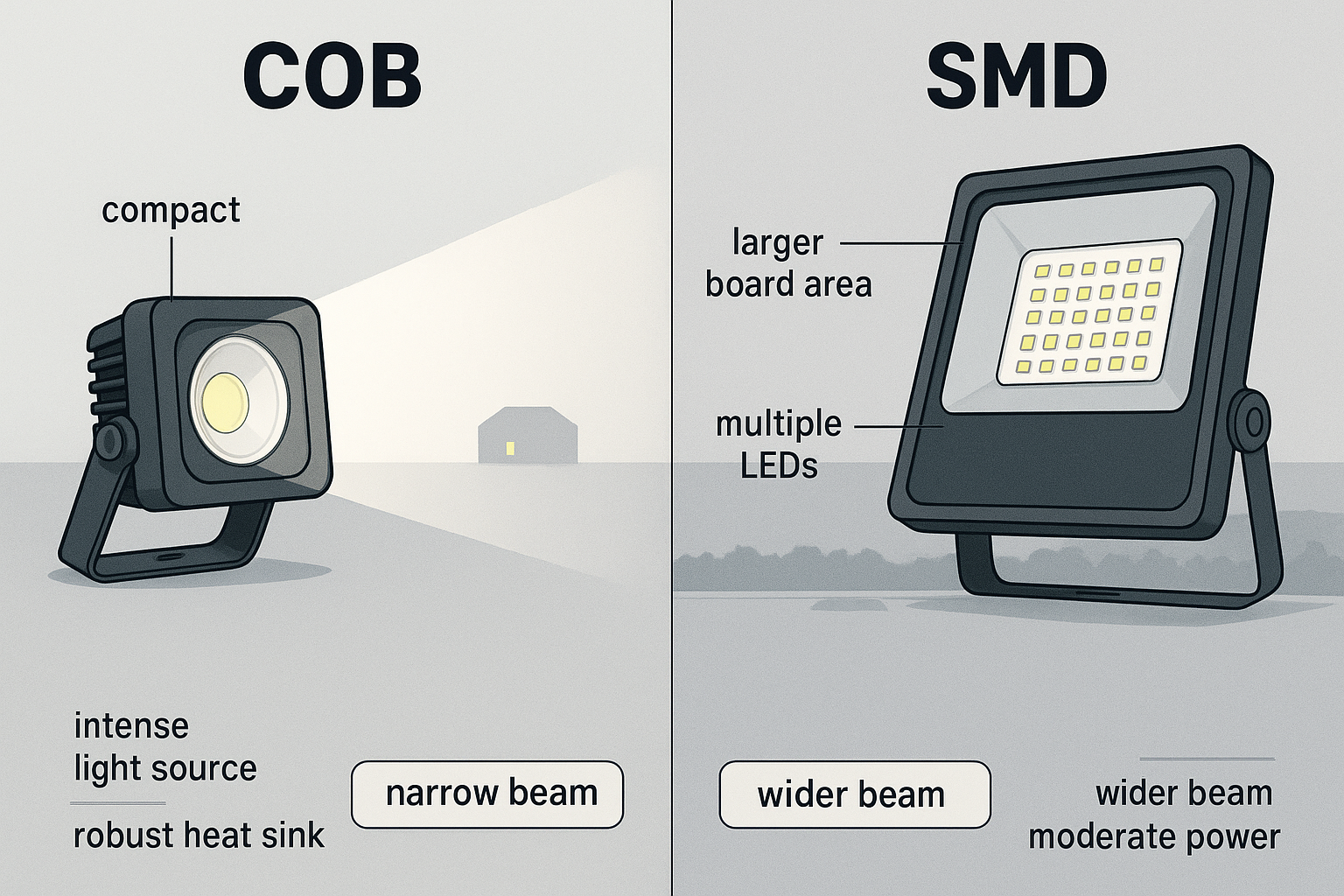
▍COB (chip-on-board) concentrates many dies on a single emitter surface, giving a small, intense source; SMD (surface‑mount device) distributes many discrete emitters across one or more PCBs. That single packaging decision cascades into optics, thermal design, housing volume, and service strategy.
Beam shaping: A small, bright COB couples cleanly to narrow TIR lenses and deep reflectors for 10–20° spots. SMD arrays more often use multi‑cell lens banks to produce medium, wide, and asymmetric distributions ideal for car parks and yards.
Glare and accessories: Regardless of package, glare control improves with shields, snoots, and honeycomb louvers that lower high‑angle luminance. Professional vendors document this: see Selux — melli application guide (2025) for louvers and Designplan — OLIVER floodlights overview (2025) for snoots and honeycomb examples.
Education resource: For a compact primer on UGR and anti‑glare concepts (panel context with principles that carry over to floods), see KEOU Lighting — LED Panel Lights: Where To Use Them And How To Choose (2026).
COB concentrates heat into a short path to the heatsink, enabling high power density in a smaller head—but it can demand a robust heat sink to keep junction temperatures in range at high wattages.
SMD spreads heat across a larger board area, which suits moderate power levels and large housings with good airflow. Either way, proper TIMs, flatness, and torque control matter; for best practices on thermal interfaces, see the Cutter — Guide to thermal interface materials (2024).
Resulting form factor: At 150–300 W with narrow beams, COB designs often achieve smaller, lighter heads per delivered CBCP than SMD arrays attempting the same throw. At wide beams and moderate power, SMD heads can be compact while achieving better uniformity with simpler lens banks.
Modularity: Many SMD floodlights use replaceable LED boards and lens tiles, which simplifies spares and mid‑life upgrades. COB modules can be replaceable, but sealed optics and thermal bonding often make field service less straightforward.
Customization: SMD platforms typically offer more CCT/CRI choices, RGBW/tunable white options, and asymmetric lens families. COB platforms excel when you need a tight beam with a classic snoot or baffle—and can still support CCT/CRI variety through module selection.
| Dimension | COB floodlight | SMD floodlight |
Source & optics | Small, high‑flux source — tight TIR/reflector beams | Distributed emitters — multi‑cell lenses for medium/wide/asymmetric beams |
Throw ability | Best for high CBCP and long throw with compact heads | Better for broad coverage; long throw possible with larger optics |
Glare control | Deep snoots / honeycomb work well for small source | Louvers, visors, and lens banks reduce high‑angle luminance |
Thermal path | Short, concentrated path — needs robust heatsink | Heat spread across PCB — suits moderate per‑board power |
Volume & weight per lumen | Compact at high lumen density | Larger for long‑throw; compact for wide/asymmetric layouts |
Modularity & service | Modules can be sealed — field service harder | Board‑level swaps and lens tiles simplify spares |
Customization & SKUs | Good for narrow‑beam modules; CCT/CRI variants available | Strongest for CCT/CRI, RGBW/TW and asymmetric optics |
Outdoor reliability | Achieves IP66 / IK08–IK10 with proper materials | Same IP/IK targets; watch UV stability of lens tiles |
Controls & drivers | Compatible with 0–10V, DALI‑2, networked nodes | Same; array form factor doesn’t limit control options |
TCO tendency | Efficient for long‑throw, low‑access sites (lower fixture count) | Favours lower downtime where spare‑board strategy used |
Best‑for scenarios | Façades, high‑masts, architectural accents | Parking, logistics yards, glare‑sensitive and brand lighting |
Data varies by supplier and optics. Use manufacturer datasheets and IES files for project‑specific decisions.
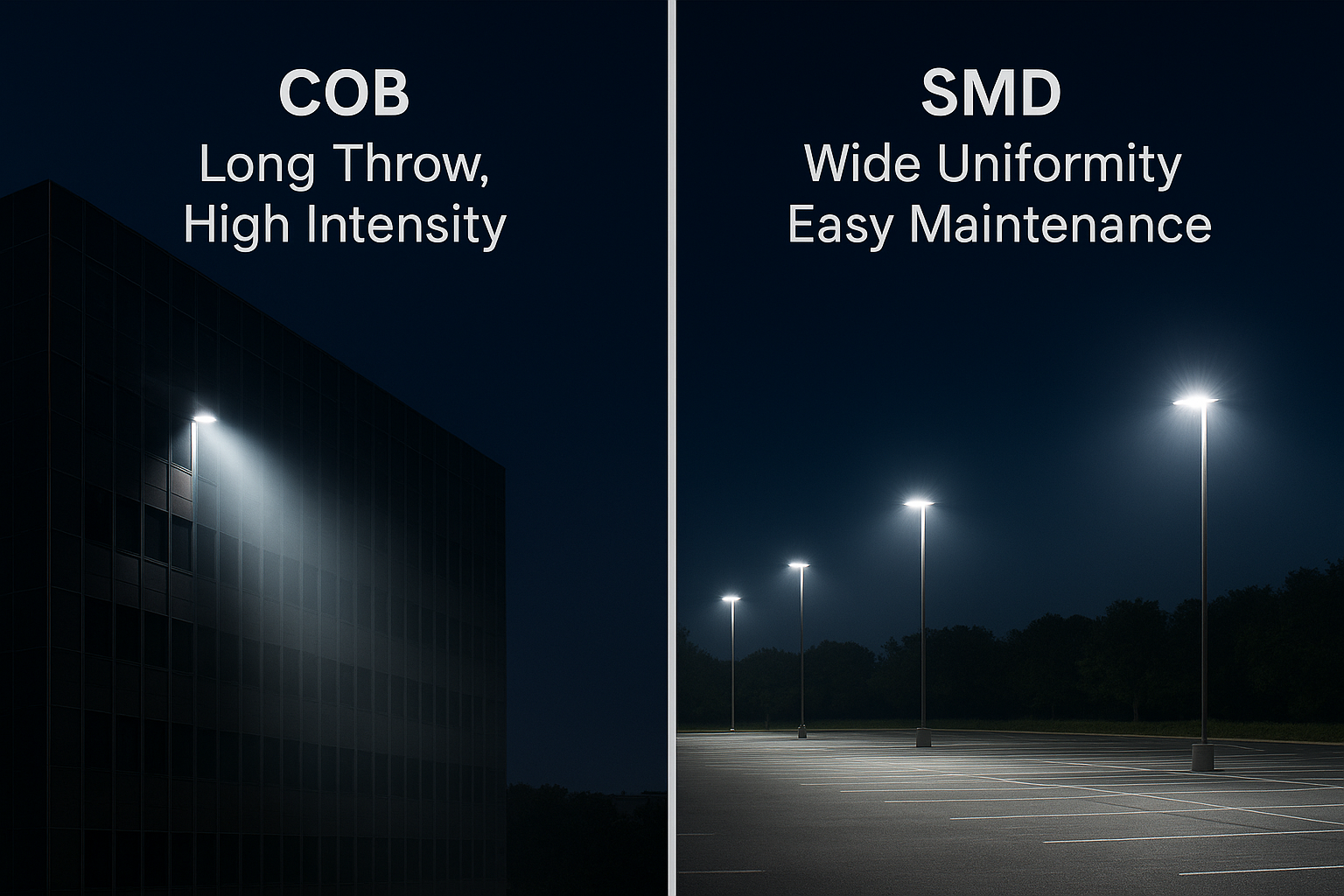
Pick COB when you need high CBCP and tight cut‑offs with compact heads and deep snoots. The small source maximizes lens efficiency for narrow beams, helping you reach façades or targets from long offsets.
Pick SMD when uniformity across wide or asymmetric footprints is critical. Multi‑lens arrays help fill bays between poles and reduce hot spots, and board‑level spares simplify maintenance planning.
Start with SMD arrays plus louvers or visors to lower perceived luminance near guests. COB can still work well with a deep snoot, but distributed sources typically make it easier to manage high‑angle brightness with accessory stacks.
Decision tree
Do you need a narrow, long‑throw beam for façades or high masts? If yes, lean COB.
Do you need wide or asymmetric uniformity with flexible spares? If yes, lean SMD.
Is field servicing costly or access constrained? If yes, weigh COB at high power or SMD with a spare‑board plan depending on optics.
Do you need RGBW or tunable white for branding or landscape effects? If yes, lean SMD.
Q1:Which is better for outdoor commercial floodlights—COB or SMD?
Neither wins universally. For long‑throw with compact heads, COB tends to lead. For wide/asymmetric uniformity and modular service, SMD is usually the better fit.
Q2:Does COB always have higher efficiency than SMD?
Not always. Package and driver choices, optics, and operating temperatures all affect system lm/W. Compare full system specs, not just emitter claims.
Q3:How do I reduce glare in parking lots and hospitality forecourts?
Use lens banks or distributed arrays with louvers or honeycomb, and consider visors or snoots. Shielding angles and BUG ratings matter; accessories can significantly lower perceived glare, as documented by pro manufacturers in 2025 resources.
Q4:What IP and IK ratings should I look for outdoors?
IP65–IP66 and IK08–IK10 are common targets. Select higher protection for exposed or vandal‑prone areas and verify ratings on the exact datasheet.
Q5:What should I include in a TCO comparison between COB and SMD floods?
Include fixture cost, energy over hours/year, control strategy, maintenance labor and access, spare parts logistics, and downtime risk. Run sensitivity to ambient temperature and aiming height.