
Author: Site Editor Publish Time: 20-02-2026 Origin: Site


Choosing the wrong moisture or water protection level can shorten the life of your LED panel lights—and in some cases, violate code. This beginner guide explains the IP code in plain English, shows how it relates to UL/NRTL Dry–Damp–Wet locations used in the U.S., and gives simple decision rules for offices, kitchens, and bathrooms. We’ll keep it practical and neutral so you can make confident, compliant choices.
Moisture sneaks in through seams, cable entries, and ceiling cutouts. When it does, drivers corrode, diffusers fog, and light output degrades. In splash zones, a panel with no water protection can fail early or become unsafe. Picking the right protection level isn’t about overbuilding—it’s about matching the luminaire to the room.
Failure modes to avoid: condensation inside the panel, gasket compression set, corroded terminals, and shortened driver life.
Compliance angle: in the U.S., the UL/NRTL location listing (Dry, Damp, Wet) governs where a luminaire may be installed; the IEC IP code describes enclosure resistance to dust and water. You should check both before purchase.
According to industry explainers aligned with IEC 60529, the IP code’s two digits describe protection from solids and water. For installation suitability in the U.S., UL 1598-based listings mark the luminaire as Dry, Damp, or Wet, following NEC Article 100 definitions referenced by Article 410. See these primers for context: the IP code overview by Magnaflux referencing ANSI/IEC 60529 and UL’s overview of indoor and decorative lighting listing under UL 1598.
IP basics reference: see the IP ratings overview aligned to IEC 60529 in the Magnaflux explainer: IP ratings overview (IEC 60529).
UL/NEC context: see UL’s summary of luminaire listings under UL 1598: UL indoor and decorative lighting overview. For definition placement in the NEC, see the NFPA style manual for Article 100 references: NEC Style Manual (2023).
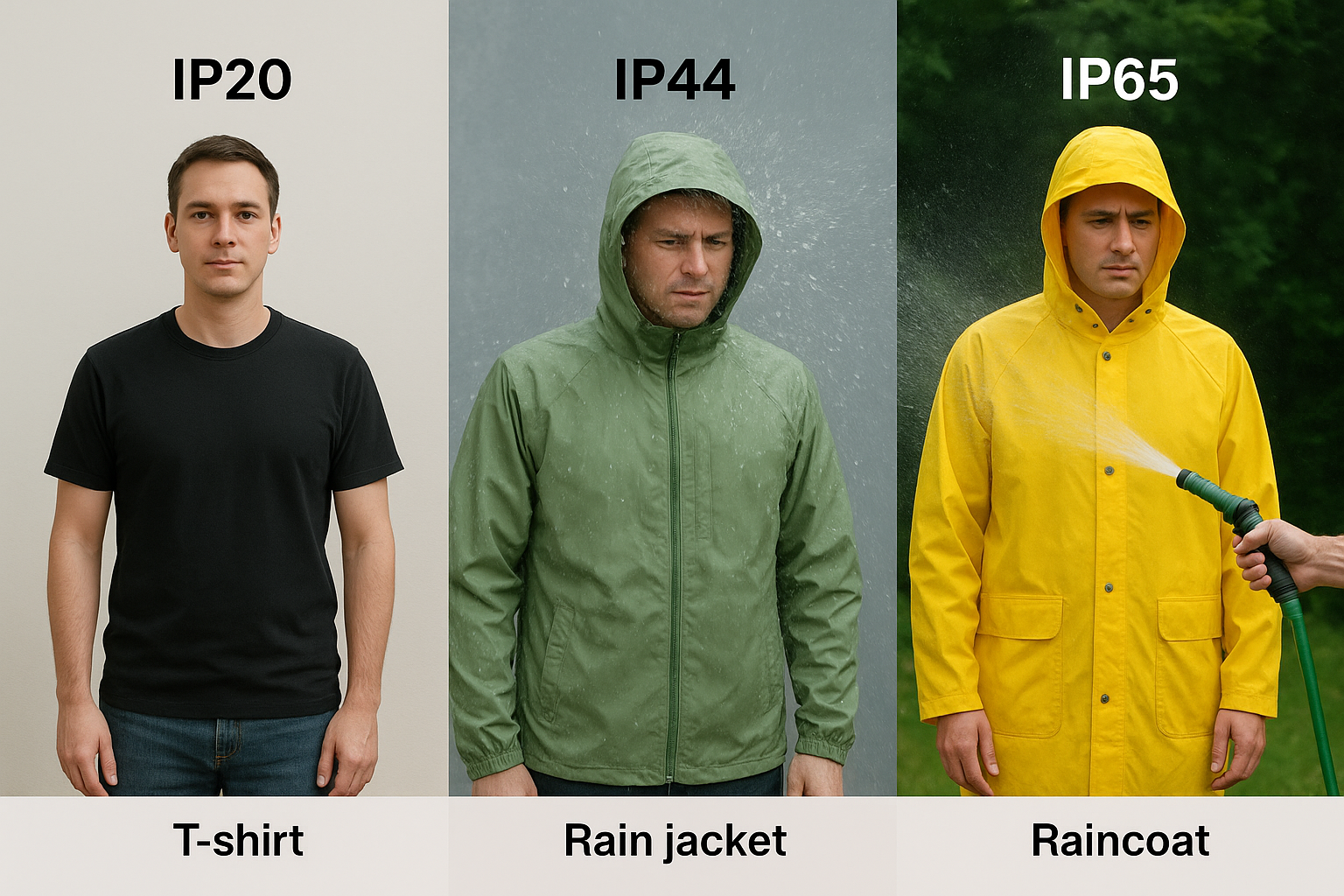
Think of IP like outerwear:
IP20: like a T‑shirt—fine in clean, dry rooms. “2” means protection against fingers and similar objects (≥12.5 mm). “0” means no water protection.
IP44: like a light rain jacket—resists splashing water from any direction. “4” for solids protects against objects ≥1 mm; “4” for water means splashes.
IP65: like a raincoat tested against hose spray—“6” is dust‑tight; “5” for water resists low‑pressure water jets.
Authoritative summaries consistent with IEC 60529 explain these levels in detail; see GWP’s and Polycase’s guides: GWP’s IP ratings explained and Polycase’s IP water-resistance guide.
“Higher IP always better.” Not necessarily. Extra seals can add cost and maintenance without improving visual comfort.
“IP equals code suitability.” In the U.S., installation suitability is set by the UL/NRTL location listing (Dry/Damp/Wet). IP describes enclosure tests, not legal placement.
“IP44 works in showers.” Only if the product is Wet‑listed by UL/NRTL and permitted by your authority having jurisdiction (AHJ). Many shower zones require Wet‑listed luminaires; IP65 is commonly paired with that exposure.
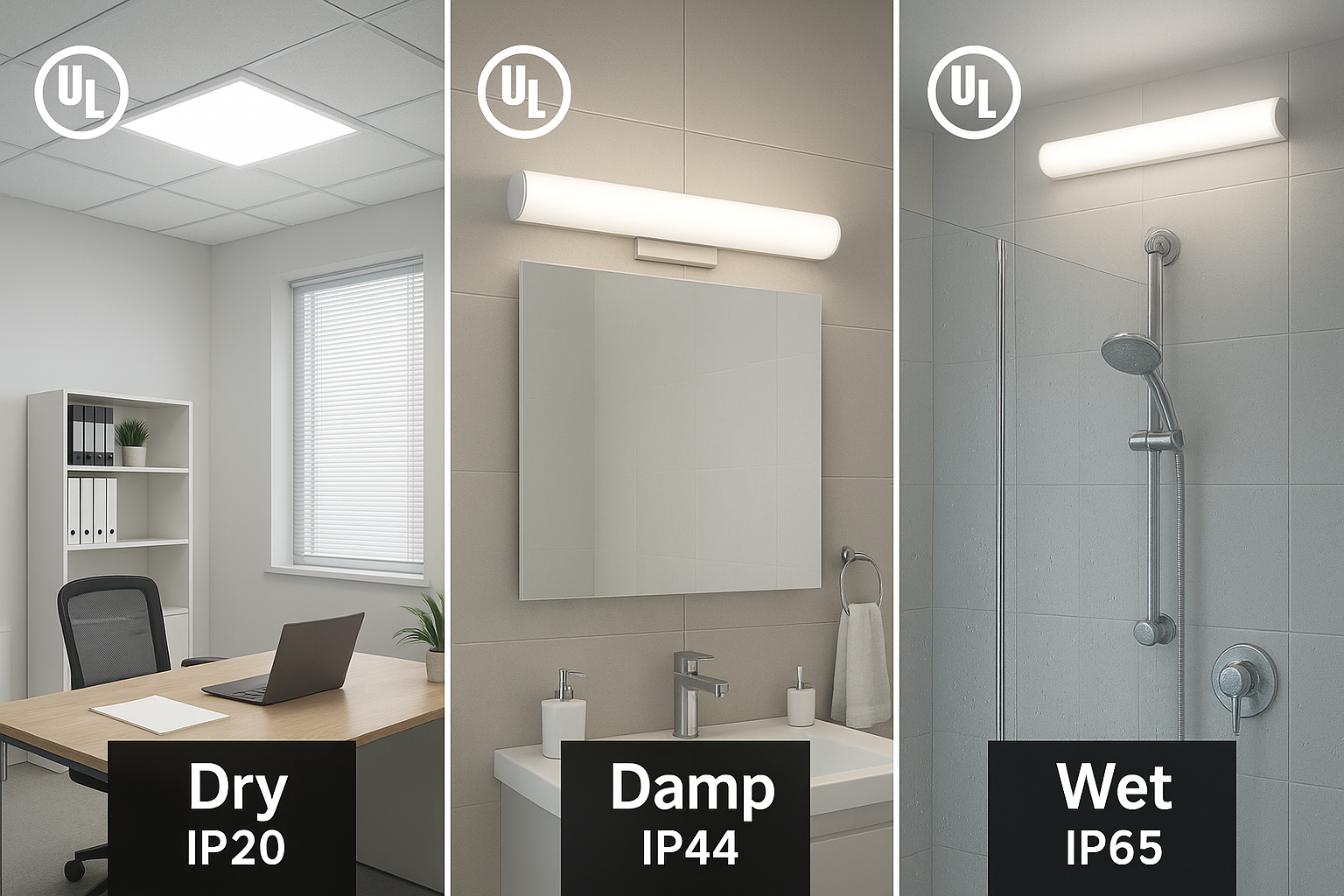
Treat IP as environmental toughness, and the UL/NRTL listing as permission to install in a given location category:
Dry location: spaces not normally subject to dampness—typical offices and bedrooms.
Damp location: areas with moisture or condensation but without direct water exposure—over-sink vanities, laundry rooms, and some kitchens away from spray.
Wet location: areas subject to saturation or direct spray—showers and wash‑down zones.
Public NFPA inputs note that products suitable for Wet locations are considered suitable for Damp as well, reflecting a hierarchy of suitability. See: NFPA public input response on wet vs damp suitability and the IAEI’s context article on luminaires under the NEC: IAEI on lighting and the NEC.
This table is a practical guide (not a legal equivalence). Always confirm the product’s UL/NRTL marking.
| Room/Zone (Typical) | UL/NEC Location Category | Minimum IEC IP (Practical) | Common Recommendation |
Office open area, conference room | Dry | IP20 | IP20–IP40; prioritize glare control and CRI |
Kitchen ceiling away from sink/stove | Damp | IP44 | IP44–IP54; confirm Damp listing |
Bathroom vanity over sink | Damp | IP44 | IP44–IP54; confirm Damp listing |
Shower enclosure or direct spray | Wet | IP65 | IP65+; must be Wet‑listed; GFCI as applicable |
For a concise overview contrasting IP and UL location ratings, see Natural LED’s explainer: IP vs UL wet rating.
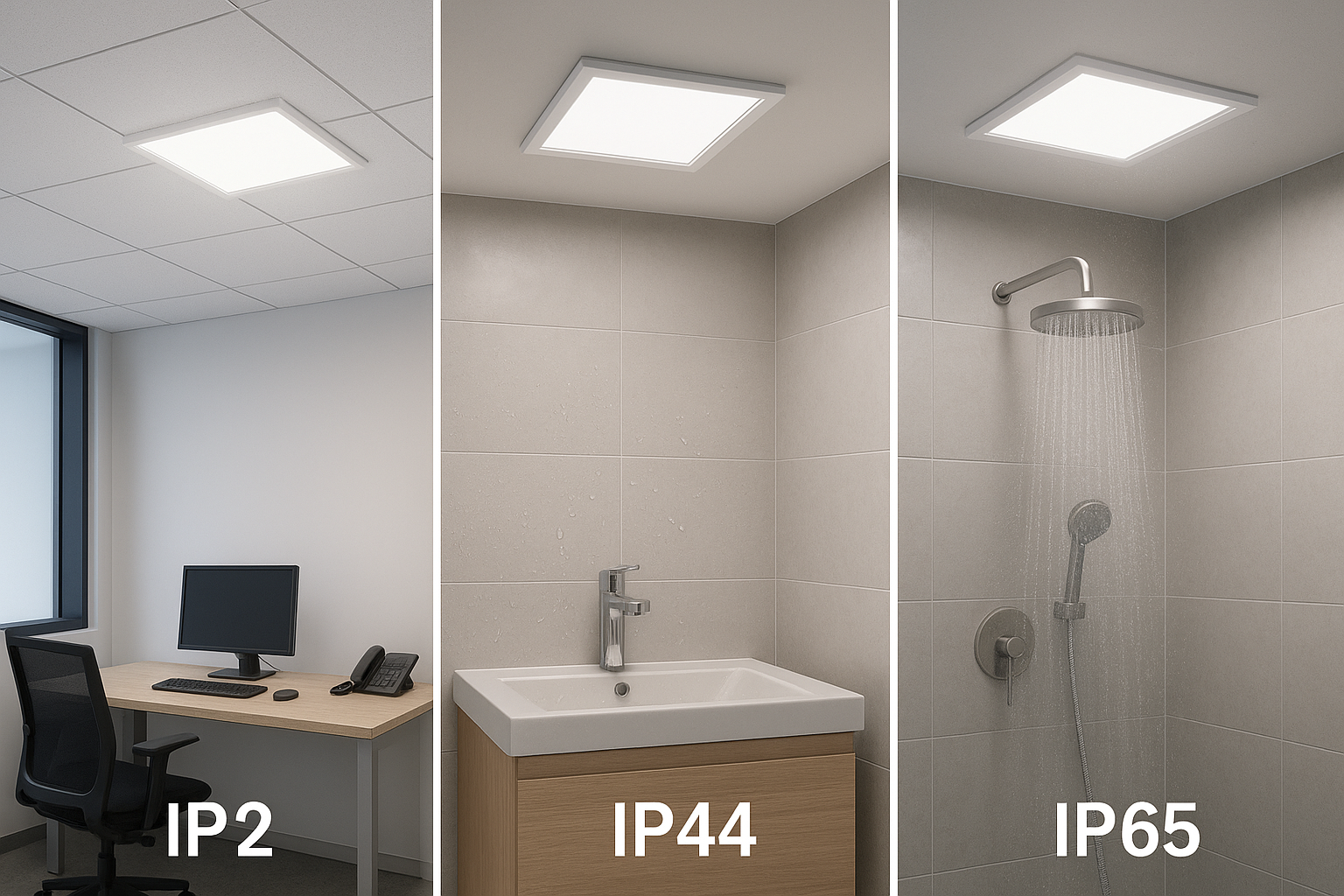
In offices with suspended grid ceilings, IP20 panels are standard and appropriate. Focus on a low‑glare optic and comfortable color quality rather than chasing higher IP. Look for UGR‑friendly diffusers or microprism lenses, CRI 80–90, and a CCT around 3500–4000 K for balanced clarity. Verify the luminaire is listed for Dry locations.
Splash risk, steam, and occasional condensation call for a Damp‑listed luminaire with IP44–IP54 enclosure protection. Inspect gaskets at the bezel and cable entries, and make sure driver compartments are protected or remote‑mounted when needed.
Disclosure: KEOU Lighting is our product. As a neutral example, an IP54 panel from KEOU’s catalog can suit over‑sink or vanity zones where splashes occur, provided the model is UL/NRTL Damp‑listed. Always verify the product label and follow local code. You can browse panel options here: KEOU panel lights (filter by IP). For deeper reading on choosing IP levels for damp areas, see this guide on our site: LED panel lights—where to use them and how to choose.
Direct water calls for a Wet‑listed luminaire; panels with IP65‑level protection are commonly aligned with this exposure. Seal ceiling cutouts and junction boxes to avoid steam paths. Where required, protect the branch circuit with GFCI and follow AHJ guidance.
| Rating | Solids Protection | Water Protection | Typical Indoor Uses | Cost/Weight Trend | Maintenance Notes |
IP20 | Fingers and large objects (≥12.5 mm) | None | Offices, corridors, classrooms (Dry) | Low | Minimal—focus on optic cleanliness |
IP44 | Objects ≥1 mm | Splashing water from any direction | Vanities, over‑sink areas, kitchens away from spray (Damp) | Medium | Inspect seals annually; clean diffusers |
IP65 | Dust‑tight | Low‑pressure water jets | Shower enclosures, wash‑down areas (Wet) | Higher | Check gaskets/vents every 6–12 months |
Moisture protection won’t solve glare. For bathrooms and kitchens with glossy tile and stainless steel, consider diffusers or microprism optics to reduce UGR and reflections. A CRI of 80–90 maintains natural color rendering for grooming and food prep. Choose a CCT around 3000–4000 K to balance warmth and clarity. These visual comfort choices are independent of IP level but essential for a pleasant space.
Condensation inside the panel: prevents with proper IP level, sealed cutouts, and allowing ventilation where designed.
Gasket compression set: check annually and replace if hardened or cracked.
Driver corrosion: keep drivers in rated compartments or remote and away from steam paths.
Over‑specifying IP: adds cost and weight without improving visual comfort—choose the minimum that meets the environment, with a small margin if uncertain.
What’s the difference between IP and UL/NRTL Dry–Damp–Wet labels?
IP (IEC 60529) describes enclosure resistance to dust and water. UL/NRTL location labels mark where a product can be installed in the U.S. The UL/NRTL listing governs installation suitability; IP helps judge environmental robustness. See: IP vs UL wet rating explainer.
Is IP20 acceptable for offices?
Yes, in typical Dry locations such as offices and classrooms, IP20 is standard. Prioritize glare control and color quality.
Do I need IP65 for bathrooms?
For vanity or over‑sink zones (Damp), IP44–IP54 is usually appropriate with a Damp listing. For shower enclosures or direct spray (Wet), look for a Wet‑listed luminaire; IP65 is commonly paired with that exposure. Always follow your AHJ.
How do I confirm a product is Damp or Wet listed?
Check the luminaire’s label or datasheet for “Suitable for Damp Locations” or “Suitable for Wet Locations,” typically under UL 1598. When in doubt, ask the supplier for certification documentation.
What maintenance do IP44/IP65 panels need in humid rooms?
Plan periodic cleaning of diffusers and inspection of gaskets every 6–12 months. Replace seals that show cracking or loss of elasticity; verify screws and glands remain tight after temperature cycles.
▍Next steps: Match your room to Dry/Damp/Wet, pick the minimum IP that fits (IP20 vs IP44 vs IP65 for indoor LED panel lights), and verify the UL/NRTL label before buying. If you’d like to browse by IP level, you can explore our catalog: KEOU panel lights. For broader selection tips beyond moisture protection, see: Where to use LED panel lights and how to choose.


