
Author: Huang Publish Time: 29-08-2026 Origin: Site


Every street light project reaches the same decision point: which control system do you actually need? The LED fixture itself is often straightforward — but the control layer determines long-term operating costs, maintenance burden, and project scalability more than the luminaire does.
Three control architectures dominate the outdoor lighting market today: remote-controlled street lights, sensor-based street lights, and smart system (IoT-networked) street lights. Each addresses a different set of operational priorities. Choosing the wrong one doesn't just waste the upfront budget — it locks procurement teams into a mismatched operating model for the next 15–20 years.
This guide structures the decision around seven procurement criteria: energy savings potential, installation and retrofit effort, operational complexity, maintenance model, upfront and total cost of ownership, scalability, and compliance / certification requirements. A summary decision matrix is at the top; the criteria analysis follows for teams that need the reasoning behind it.
Criterion |
Remote-Controlled |
Sensor-Based |
Smart System (IoT) |
|---|---|---|---|
Energy savings vs. conventional |
30–50% |
40–80% (traffic-dependent) |
60–80% |
Installation complexity |
Low–Medium |
Medium |
High |
Ongoing operational complexity |
Low |
Low–Medium |
High |
Maintenance model |
Schedule-driven |
Reactive |
Predictive (fault alerts) |
Upfront cost |
Moderate |
Moderate |
Highest |
Total cost of ownership (10-yr) |
Moderate |
Moderate–Low |
Lowest (large networks) |
Scalability |
Limited |
Moderate |
High |
Best fit |
Centralized control rooms, phased upgrades |
Variable-traffic roads, low-maintenance sites |
City-scale networks, smart city integration |
This is the criterion that drives most procurement justifications — but the headline percentages require context.
Remote-controlled street lights achieve energy savings primarily through scheduled dimming. By reducing output during off-peak hours (typically 11 PM to 5 AM), cities typically add 10–30% savings on top of the LED baseline conversion, with some dimming programs reaching up to 50% reduction in energy consumption according to reports from remote street light deployments analyzed by Fonda Lighting. The savings are real, but they depend heavily on the quality of the dimming schedule — a poorly managed schedule narrows the gap considerably.
Sensor-based street lights link output directly to occupancy. When no pedestrian or vehicle activity is detected, the fixture dims to a baseline (often 20–30% output). When activity is detected, it returns to full power within milliseconds. A study published in the journal Energies found that motion-detection-controlled street lighting can save up to 40% of energy per month in variable-traffic conditions. On arterial roads with steady nighttime traffic, the savings narrow. On residential streets or industrial areas with low late-night activity, sensor systems consistently outperform scheduled dimming.
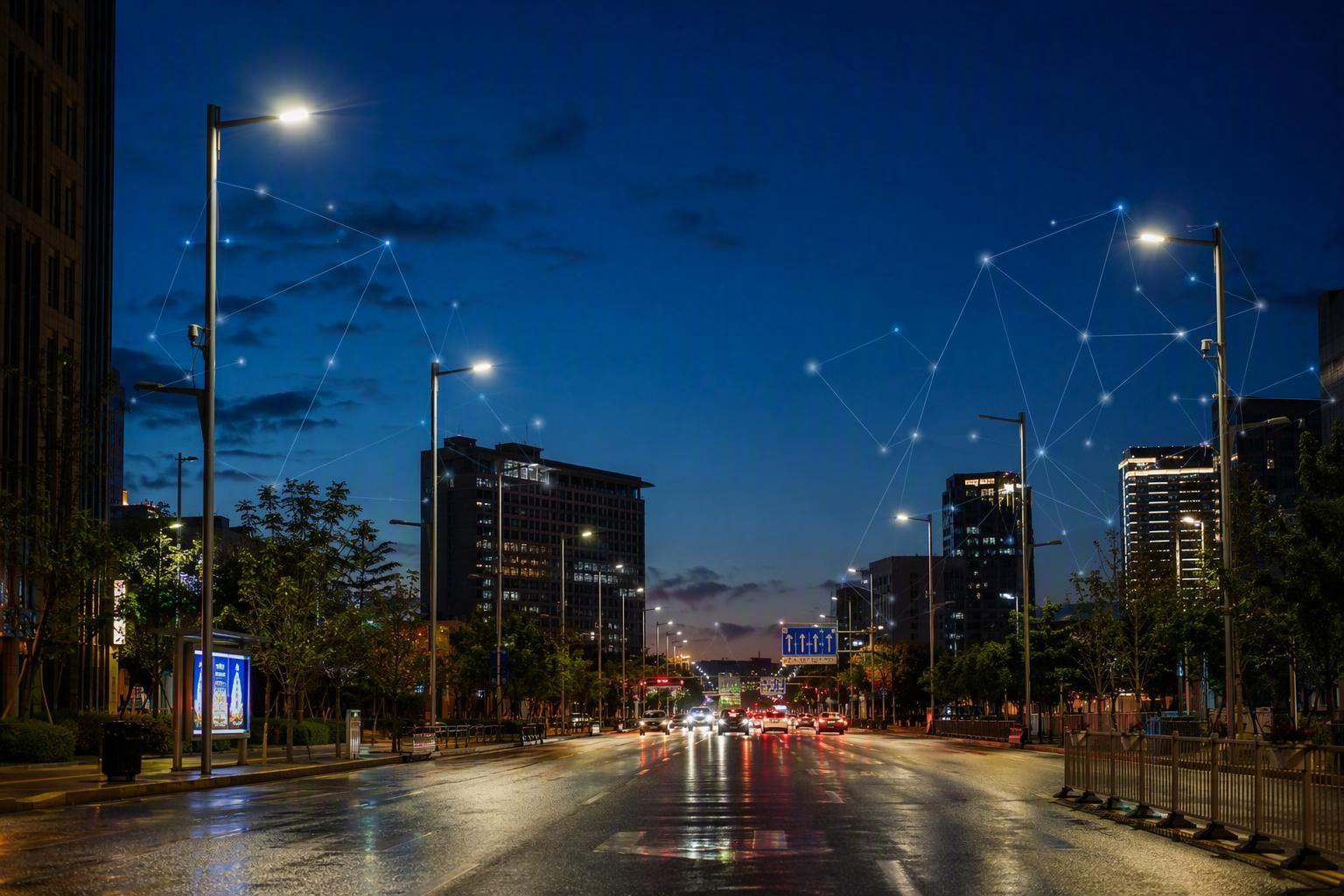
Smart IoT street lighting combines both approaches — scheduled dimming, real-time sensor response, and data-driven adaptive control — and typically produces the highest energy reductions. Research reviewed by Verizon Business's smart lighting analysis cites average savings of 70% compared to conventional street lighting, while a 30-city deployment reported by RealTerm Energy and Ubicquia achieved a 67% average energy reduction. A City of San Diego smart streetlight case documented an additional 60% reduction on top of the LED conversion baseline through centralized dimming control.
Key Takeaway: Sensor systems outperform scheduled remote control on roads with variable occupancy. Smart IoT systems outperform both where adaptive dimming, real-time monitoring, and city-scale optimization are feasible.
Upfront installation decisions have a direct impact on project timelines and labour costs — often underweighted in procurement specifications.
Remote-controlled systems are the easiest to install in existing infrastructure. The controller interfaces with the LED driver through standard 0–10V, DALI, or PWM protocols. Integration into a central software platform or SCADA system requires network connectivity at the control room level, not at each pole. For retrofit projects replacing high-pressure sodium or metal halide fixtures, remote-controlled LED street lights can often be installed with minimal wiring changes.
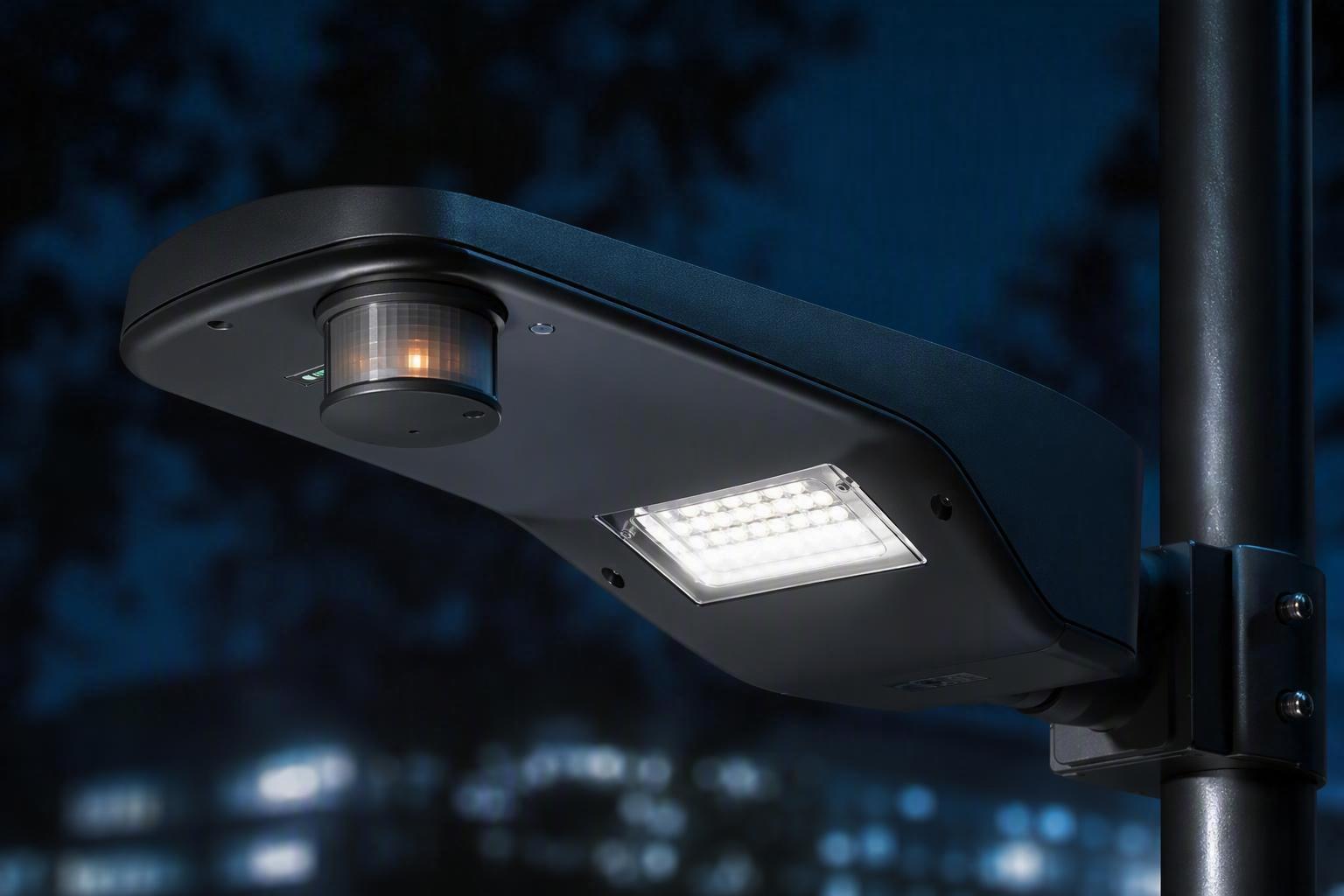
Sensor-based systems add a sensor module — typically a photocell, PIR motion sensor, or microwave radar unit — at each fixture. These modules are either factory-integrated or field-mounted. Installation time per pole increases, but only modestly. The primary complication arises in dense road networks where sensor overlap zones require calibration to prevent uneven light stepping across consecutive fixtures.
Smart IoT systems require network node installation at each fixture point (or cluster), plus back-end platform setup, connectivity provisioning (4G/LTE-M, Zigbee mesh, or LoRaWAN depending on the protocol), and system commissioning. The ANSI C136.48 wireless networked lighting controller standard introduced smart socket interfaces (ANSI C136.41/Zhaga-D4i) that reduce integration friction — but the setup effort remains significantly higher than the other two options.
For distributors managing retrofit bids on a compressed timeline, smart IoT installation complexity is the most common reason projects specify sensor-based or remote-controlled systems instead, even when the long-term TCO would favour IoT.
Running the system after installation is where procurement teams frequently underestimate the total workload.
Remote-controlled systems are operationally simple: schedule the dim levels, monitor from a central console, and adjust the schedule seasonally. The learning curve is low. Most maintenance teams familiar with SCADA or building automation systems can manage remote street lighting with minimal additional training.
Sensor-based systems are largely self-managing. Once photocell and motion thresholds are configured, the system operates autonomously without operator intervention. The operational burden is lower than remote control in practice — there are no schedules to maintain, and no dimming profiles to adjust for seasonal daylight changes.
Smart IoT systems carry the highest operational complexity. Managing a city-scale networked lighting platform requires dedicated personnel (or a managed service agreement), familiarity with the platform software, firmware update processes, and data analytics interpretation. The operational benefit is correspondingly higher — real-time fault detection, adaptive dimming, asset monitoring — but the staffing requirement must be budgeted explicitly.
Pro Tip: If the end customer lacks a staffed operations team, a sensor-based system often delivers better real-world energy savings than a smart IoT system that is under-managed.
The maintenance implications of each control type are often more consequential than the installation cost.
Remote-controlled systems rely on schedule-driven maintenance — periodic field inspections and reactive repairs when failures are reported. Faults are discovered after the fact, which can mean extended periods of failed fixtures on high-traffic routes.
Sensor-based systems follow a similar reactive model. Sensor modules can fail independently of the LED driver, adding a new failure mode — but at low system complexity, fault isolation is straightforward.
Smart IoT systems enable predictive maintenance. Real-time telemetry from each fixture monitors operating parameters including driver performance, lumen depreciation estimates, and power draw anomalies. Fault detection is immediate: the platform flags a fixture failure before a manual inspection would catch it. The IET Smart Cities review on smart streetlight systems identifies autonomous fault detection as one of the primary maintenance cost drivers favouring IoT adoption at network scale. For large municipal networks, this can reduce maintenance patrol labour significantly — failures are dispatched directly rather than discovered during routine sweeps.
For projects where maintenance staffing is a budget constraint, smart IoT's predictive model often produces measurable cost reductions that partially offset the higher capital investment.
The purchase price comparison is straightforward: remote control < sensor-based < smart IoT. The TCO comparison inverts at scale.
Remote-controlled street lights carry the lowest hardware premium per unit. Software platforms and network integration costs are typically centralised rather than per-fixture. For small deployments (under 200 fixtures), this often makes remote control the most cost-efficient option over a 10-year period.
Sensor-based street lights add a per-fixture cost for the sensor module (typically a PIR, microwave, or photocell unit), which ranges from modest to significant depending on sensor quality and integration complexity. Total cost of ownership is generally competitive because low operational complexity and the absence of software licensing fees keep ongoing costs low.
Smart IoT street lights carry the highest CAPEX per fixture — hardware, connectivity, software licensing, and commissioning. However, the City of Los Angeles Philips smart streetlight case documented by ICLEI demonstrated that large-scale IoT deployment produced energy savings and maintenance efficiencies sufficient to offset the premium over a multi-year period. A practical rule from procurement analysis: the TCO crossover point — where smart IoT becomes cheaper than sensor-based or remote-controlled — generally occurs at networks of 500+ fixtures with active operational management.
For medium-to-large urban lighting contracts, distributors should build a 10-year TCO model rather than presenting only first-cost comparisons to procurement decision-makers. The gap is not visible in a unit price sheet.
For reference on the 9 best outdoor smart lighting control systems evaluated across seven practical dimensions including TCO and interoperability, a structured comparison of control families is available that maps procurement criteria to real-world performance.
Procurement teams specifying infrastructure for 10–20 year asset lifespans should consider scalability separately from current project scope.
Remote-controlled systems scale horizontally — adding fixtures to an existing control zone is straightforward. However, they do not natively support adaptive, per-fixture intelligence. Upgrading to sensor-based or smart IoT capability later typically requires either hardware replacement or overlay systems, both of which add cost.
Sensor-based systems are moderately scalable but can develop coordination challenges in dense networks. Without a central platform, fixture behaviour is locally determined — adjacent sensors may produce visible light stepping effects on busy roads as vehicles or pedestrians move between detection zones.
Smart IoT systems are purpose-built for scale. ANSI C136.41 smart socket compatibility allows per-fixture addressing and telemetry at any network size. Interoperability with broader smart city platforms — traffic systems, environmental monitoring, emergency services — is an inherent design feature, not a retrofit capability. For projects in development plans that include smart city integration, specifying IoT-ready infrastructure from the start is substantially cheaper than upgrading later.
The ultimate guide to smart outdoor lighting controls on keouled.com covers protocol-level decisions (DALI-2/D4i, Zhaga nodes, 0–10V zoning) in detail for procurement teams evaluating interoperability across fixture and control brands.
Regulatory requirements are non-negotiable in most municipal and commercial tenders.
All three control system types must meet the same baseline fixture certifications: IP65 or higher for luminaire ingress protection on outdoor road applications, IK08 or IK10 for mechanical impact resistance in public areas, and applicable regional certifications (CE for European markets, UL/DLC for North American projects). These requirements apply regardless of control type.
Control-layer-specific compliance differs:
Remote-controlled systems: Compliance is primarily at the driver and control protocol level. DALI-2 certified components carry stronger interoperability guarantees than proprietary dimming systems.
Sensor-based systems: Photocell and motion sensor components must meet the same IP rating requirements as the luminaire. ANSI C136.10 defines photocell socket standards for plug-in sensor integration on compatible street lights.
Smart IoT systems: Wireless communication components must meet radio frequency regulations in each deployment market (ETSI for Europe, FCC for North America, CITC for Saudi Arabia, TRA for UAE). IoT nodes and communication modules carry their own certification requirements beyond the luminaire itself.
For tender submissions in the UAE and GCC markets specifically, certification documentation — IP test reports, IK test evidence, CE/SASO declarations, and driver compliance statements — is increasingly required at bid stage rather than post-award. A comprehensive compliance checklist for outdoor lighting procurement in 2026 is covered in the 2026 outdoor lighting demand and specifications guide.
Use these four filters to narrow the decision:
1. What is the operational staffing level at the end customer?
No dedicated lighting operations team → Sensor-based (autonomous, minimal management)
Control room with operators and scheduling capability → Remote-controlled or Smart IoT
Dedicated smart city / infrastructure team → Smart IoT
2. What is the network size and project budget position?
Under 200 fixtures or CAPEX-constrained → Remote-controlled or Sensor-based
200–500 fixtures with a 10-year TCO orientation → Sensor-based or Smart IoT
500+ fixtures or part of a broader urban infrastructure programme → Smart IoT
3. What is the traffic pattern on the target roads?
High, consistent traffic all night → Remote-controlled scheduled dimming (sensor dimming adds little benefit)
Variable occupancy, residential or low-traffic corridors → Sensor-based or Smart IoT
Mixed network with diverse road classes → Smart IoT (per-fixture adaptive control across zones)
4. Is future smart city integration on the project roadmap?
No → Remote-controlled or Sensor-based are sufficient
Yes → Smart IoT (avoid a costly overlay or replacement in year 5–7)
Pro Tip: Selecting the right control system matters — but so does the LED fixture underneath it. Fixture quality, driver transparency, and photometric documentation (IES files) determine whether the control system's savings projections are achievable. A poorly specified LED chassis undercuts any control investment.
Control systems do not operate independently of the luminaires. Procurement teams should confirm before bid:
Driver compatibility: The LED driver must support the target dimming protocol (DALI-2, 0–10V, PWM, or wireless). Not all LED drivers support all protocols.
Smart socket availability: For IoT integration, the fixture should carry an ANSI C136.41 (NEMA) or Zhaga-D4i socket. Retrofit-only solutions that add an external controller to a non-socket fixture are more failure-prone.
Surge protection: Outdoor street lighting encounters transient voltages from lightning and grid fluctuations. Verify the driver's built-in surge protection rating (10kV is a common minimum for exposed road applications).
Manufacturers offering OEM or ODM LED street light production — including control-ready driver selection, socket integration, and custom photometric profiles — can significantly reduce the field integration complexity that drives cost overruns in large tenders. KEOU Lighting's LED street light range supports factory-specified driver integration for DALI-2, 0–10V, and smart socket configurations, with IES file documentation available for tender submissions.
Can remote-controlled street lights be upgraded to smart IoT later? Yes, with caveats. If the LED fixtures include an ANSI C136.41 smart socket, an IoT node can be plugged in at a later date without replacing the luminaire. If no socket is present, the upgrade requires either adding an external controller housing or replacing the driver — both add labour and material cost.
What energy savings can a sensor street light realistically achieve in a UAE road context? UAE urban roads typically see moderate-to-high traffic through midnight, with sharper drops between 1–4 AM. In that pattern, sensor-based systems generally achieve 30–50% energy reduction versus a non-controlled LED baseline. Smart IoT systems with scheduled dimming plus motion response can reach 60–70% in low-traffic hours on the same roads.
Is smart IoT required for GCC smart city projects? Not universally — it depends on the project scope and the specific smart city integration requirements. Some GCC smart city initiatives specify IoT-readiness (smart socket, wireless protocol compatibility) without requiring active platform deployment at launch. Specifying IoT-compatible fixtures now preserves optionality without mandating the full platform investment immediately.
How does sensor street light dimming affect road safety standards? The critical parameter is minimum maintained illuminance during the dimmed state. Most road safety standards (EN 13201 in Europe, equivalent standards in GCC) allow adaptive dimming provided the baseline lighting level in dim mode meets the applicable road class minimum. Sensor systems must be configured to maintain compliance at baseline, not only at full power.
What certifications should procurement teams require from LED street light suppliers for UAE projects? At minimum: IP65 rated enclosure (IEC 60598 tested), IK08 or IK10 impact rating, CE or equivalent market-of-use certification, LM80 LED module data for lumen depreciation claims, and a driver specification sheet confirming the dimming protocol and surge protection rating.
Ready to evaluate LED street light options with the right control system for your next project? Contact KEOU Lighting for specification-ready datasheets, IES photometric files, and OEM/ODM consultation for municipal and commercial street lighting tenders.


