Author: Huang Publish Time: 17-03-2026 Origin: Site


Outdoor smart lighting control systems help cities and facilities keep people safe, cut energy waste, and simplify maintenance—without burying teams in complexity. For municipal streets, parks, tunnels, and streetscapes, the right control keeps light available when needed and toned down when it isn’t. On commercial and industrial sites—parking lots, plant roads, and warehouse perimeters—controls reduce burn hours, curb light pollution, and flag faults before they become outages.
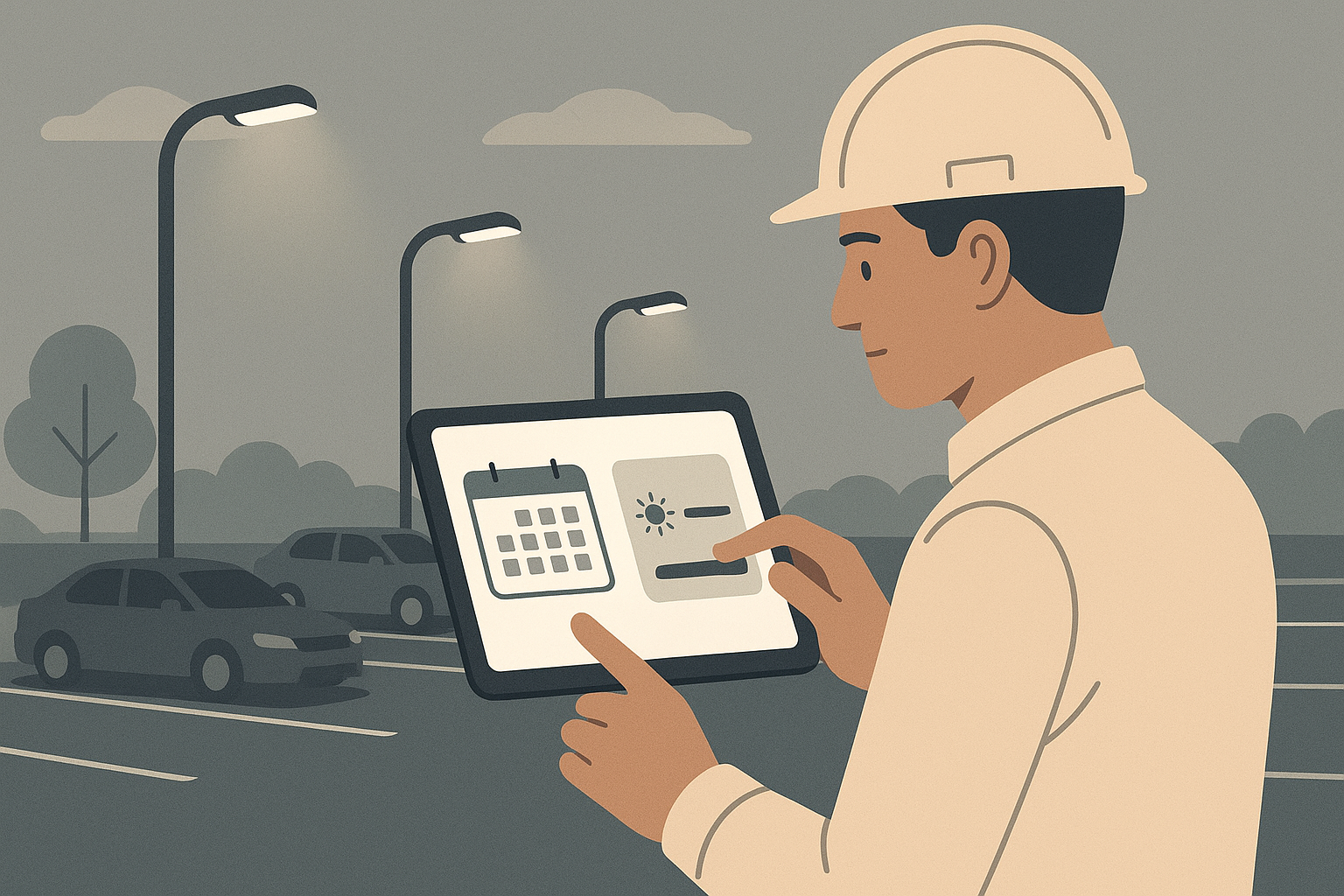
Beyond energy savings, the biggest wins are operational: standardized schedules, fast fault alerts, and remote tweaks after a resident complaint or a safety audit. When controls match the site—simple where simple is enough; networked where scale demands it—you get predictable results and fewer truck rolls.
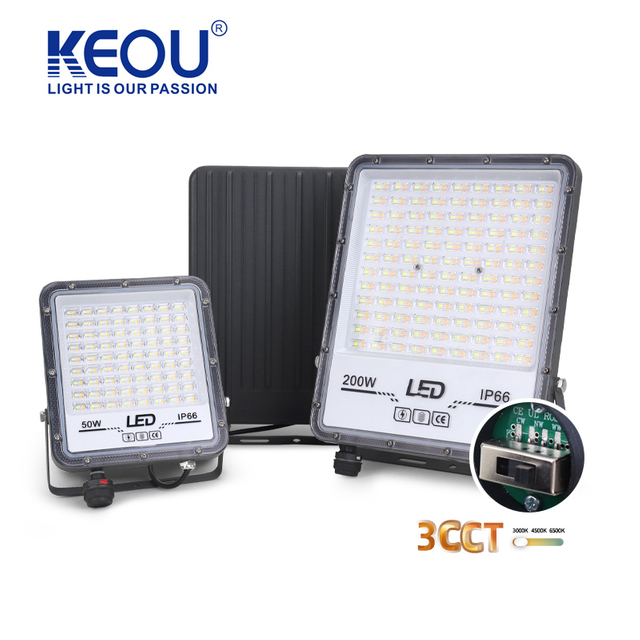
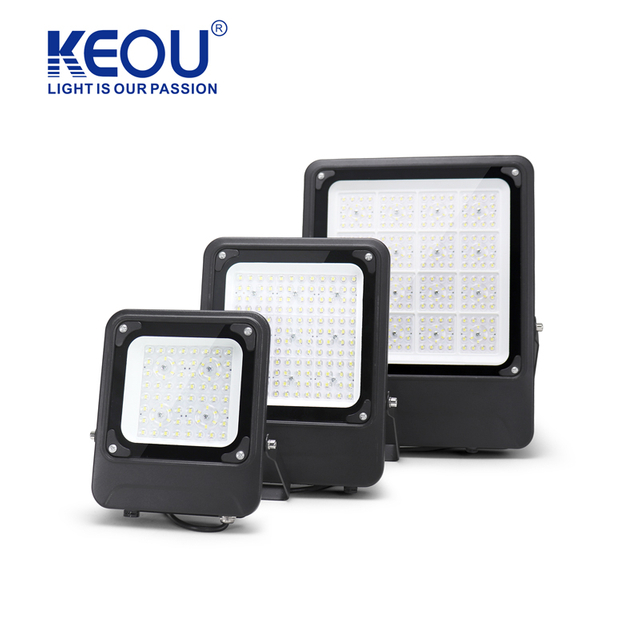
▌Soft CTA: Want a sense of fixture readiness for controls? Browse KEOU’s robust outdoor flood/area luminaires for material and durability context on projects that pair well with controls: KEOU Lighting flood lights.
We evaluated control modes against seven practical dimensions: installation/retrofit flexibility, outdoor durability and optics, energy‑saving capability, centralized management and monitoring, interoperability/wireless options, total cost of ownership and support, and customization/OEM services. We also referenced open standards and alliances to anchor definitions and procurement criteria, including the TALQ Smart City Protocol for CMS features, DALI/D4i and Zhaga/ANSI socket guidance from the DALI Alliance for driver/interfaces, and protocol bodies such as the CSA for Zigbee, the LoRa Alliance, and 3GPP for NB‑IoT.
What you’ll find below: a quick comparison table, then concise “item cards” for the most common control modes with where they fit, typical fixtures, wireless options, pros/cons, scale, and price notes. We keep theory light and focus on decisions.
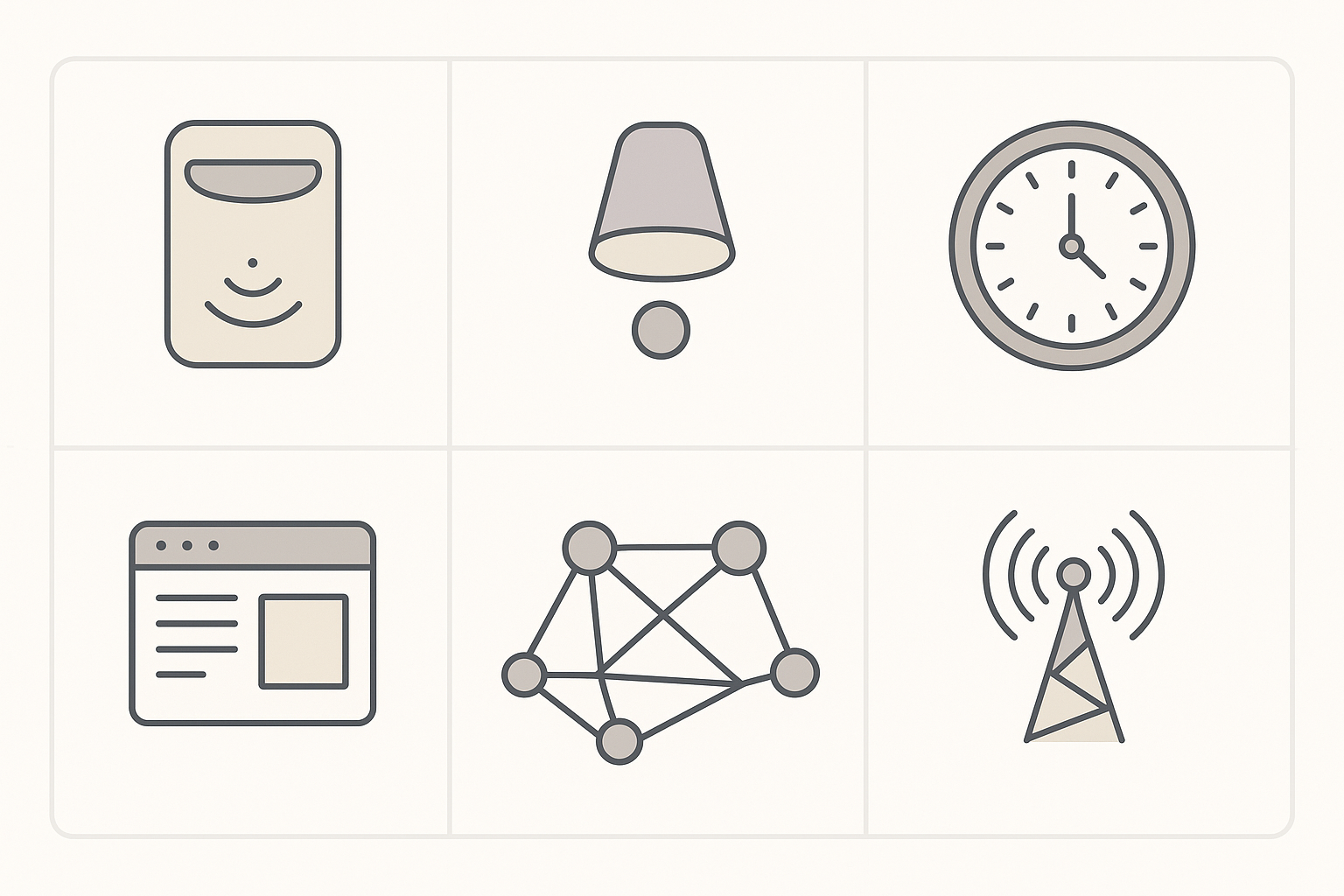
| Control type | Trigger/logic | Best-for locations | Wireless options | Typical energy savings | Notes/limitations |
Motion sensing (PIR/microwave) | Presence boosts to full, dim/idle when vacant | Parking lots, campus roads, park paths, warehouse perimeters | Can feed Zigbee/LoRaWAN/NB‑IoT | Often 10–20% beyond dusk‑to‑dawn when well‑commissioned | Placement and tuning matter; PIR is line‑of‑sight, microwave can false‑trigger |
Photocell (dusk‑to‑dawn) | Ambient light threshold | Streets, parks, perimeters | Local sensor (no network needed) | Avoids daytime burn; varies by mis‑switch avoidance | Shielding/orientation to avoid glare or skyglow reflections |
Astronomical timer | Sunrise/sunset by location/date | Streetscapes, campuses | Often built into CMS or node | Reliable seasonal tracking | No weather/cloud response; pair with photocell/occupancy |
CMS with group control | Remote schedules, dimming, alerts, energy KPIs | City streets, tunnels, large campuses | TALQ‑aligned networks/gateways | System‑level savings + fewer truck rolls | Requires gateways, security review, integration |
Adaptive dimming profiles | Time‑of‑night/traffic‑aware curves | Roads/arterials, predictable lull hours | Via networked nodes | Extends savings beyond on/off | Requires stakeholder alignment and commissioning |
Wireless mesh (Zigbee/BLE Mesh) | Short‑range hop‑by‑hop | Dense campuses, parking structures | Zigbee/BLE Mesh | Savings via fine‑grain profiles | More gateways than LPWAN; RF planning |
LPWAN (LoRaWAN/NB‑IoT) | Long‑range star topology | City‑scale streets/parks, distributed lots | LoRaWAN/NB‑IoT | Scalable monitoring + profiles | Low throughput; subscriptions/coverage |
Hybrid (photocell+timer+motion) | Layered logic with presence override | Lots, paths, campuses | Any network | Combines benefits; supports dark‑sky | Commissioning complexity |
Solar‑integrated | PV + battery + control | Off‑grid paths/remote roads | Often LPWAN optional | Enables lighting off grid | Battery life and climate constraints |
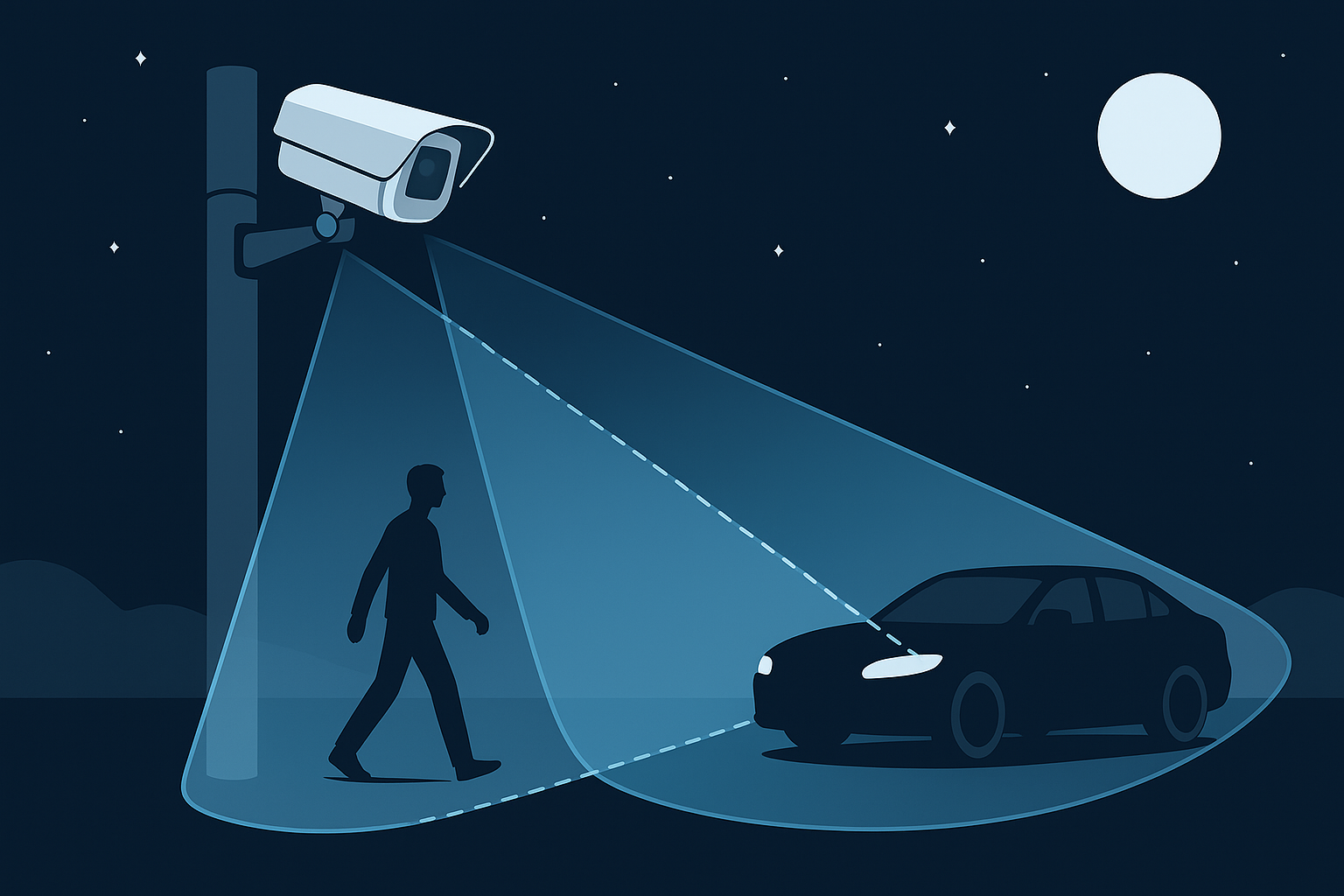
Control mode/type: Presence‑based boost with dim/idle baseline.
How it works: A PIR or microwave sensor detects people/vehicles and temporarily raises output to a safe level, then returns to a lower setpoint when the area is empty.
Best for: Parking lots, campus roads, warehouse yards, park pathways where traffic is intermittent.
Typical fixtures: Area lights, street luminaires, bollards/pathway lights, floodlights for perimeters.
Wireless options: Works standalone; or the sensor input feeds a Zigbee mesh, LoRaWAN, or NB‑IoT node for group coordination and reporting.
Pros: Cuts burn hours during lull periods; improves perceived security when activity occurs; easy retrofit at the fixture.
Cons/limitations: Placement and aiming are critical; microwave can pick up distant motion or traffic; PIR needs line‑of‑sight and correct mounting height; extreme weather can affect sensitivity.
Scale/coverage: Fixture‑level; networked variants scale to lots/campuses.
Price note: Outdoor PIR/microwave sensors commonly list around $35–$120 per fixture (subject to change).
Evidence links: Presence controls and roadway research context from the U.S. DOE: DOE occupancy sensor test method review (2020).
Control mode/type: Local daylight switch.
How it works: A sensor turns lights on when ambient light drops below a threshold and off at first light.
Best for: Streets and park lighting, lot perimeters—anywhere dusk‑to‑dawn is sufficient.
Typical fixtures: Street and area lights, floodlights, some tunnel/daylight sensors (supplemental).
Wireless options: None required; coexists with networked nodes via ANSI C136.41 or Zhaga sockets.
Pros: Simple, low cost, autonomous; tracks seasonal changes.
Cons/limitations: Susceptible to glare/reflections; incorrect orientation can cause nuisance switching.
Scale/coverage: Per fixture.
Price note: Typical turn‑lock photocontrols retail roughly $10–$50 (subject to change).
Evidence links: Interface standards overview from NEMA/ANSI and DALI/Zhaga context: ANSI C136 series (C136.41) overview.
Control mode/type: Time‑based scheduling using calculated sunrise/sunset.
How it works: The controller uses latitude/longitude and date to auto‑adjust on/off times through the year; often layered with dimming profiles.
Best for: Streetscapes and campuses with predictable schedules and limited seasonal variability.
Typical fixtures: Street and area lights on shared circuits, architectural/streetscape lighting.
Wireless options: Frequently embedded in CMS/node logic; can be standalone.
Pros: No photocell required; accurate seasonal tracking without manual reprogramming.
Cons/limitations: No real‑time response to weather or localized darkness; pair with photocell or presence sensors for resilience.
Scale/coverage: Panel level, circuit level, or node level.
Price note: Usually bundled within node/CMS; standalone timer pricing varies (subject to change).
Evidence links: Definition and program references: IES definition of astronomical time switch.
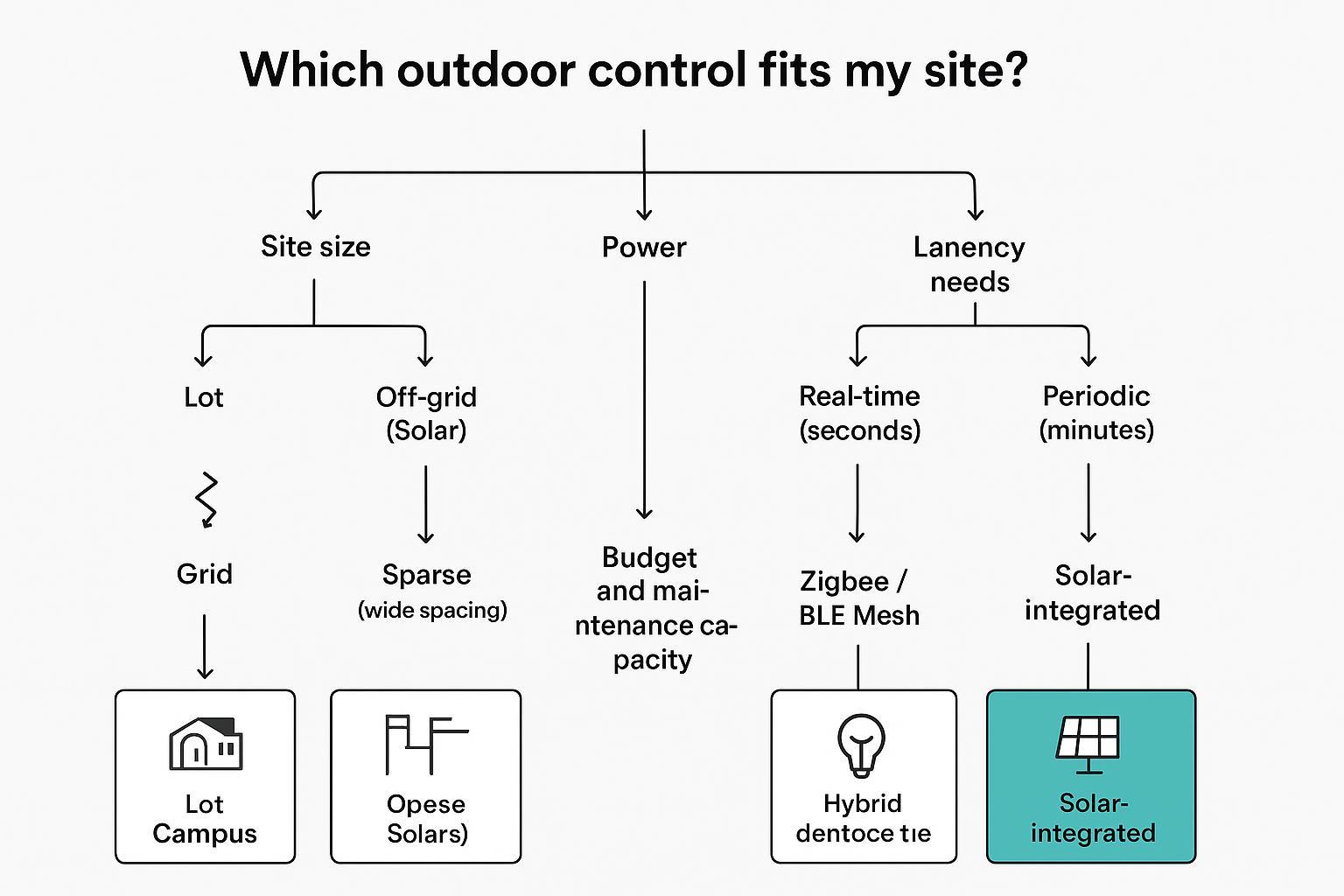
▌Soft CTA: Not sure which path fits your site? Use the decision tree above as a starter and compare it with your bid documents or RFP criteria.
Control mode/type: Remote grouping, schedules, dimming, alarms, and energy KPIs—procured to a standard profile.
How it works: Gateways relay messages between a central platform and edge nodes; operators manage groups, calendars, and alerts from a dashboard.
Best for: City streets, tunnels, large campuses, and parks that need coordinated behavior and rapid fault response.
Typical fixtures: Street/area/tunnel lights; sports/large‑area floodlighting.
Wireless options: Works with TALQ‑aligned networks; mesh or LPWAN under the hood.
Pros: System‑level optimization, fault reductions, energy reporting, asset management, firmware updates.
Cons/limitations: Adds gateways and integration work; review security and API access; watch for vendor lock‑in.
Scale/coverage: From campuses to city‑scale.
Price note: Typically per‑node license/subscription plus gateways/integration (subject to change).
Evidence links: Procurement and capability framing from the TALQ Consortium: TALQ Tender Template (2024).
Control mode/type: Scheduled dimming curves and/or sensor‑informed profiles that align output with lull hours and activity peaks.
How it works: Predefined curves lower output after peak hours and raise it pre‑dawn; presence signals can override instantly.
Best for: Roadways, arterials, and lots with predictable low‑traffic windows; communities pursuing dark‑sky goals.
Typical fixtures: Street and area lights.
Wireless options: Typically delivered through networked nodes/CMS.
Pros: Extends savings beyond on/off; can reduce light pollution and complaints when done transparently.
Cons/limitations: Requires stakeholder alignment and commissioning; under‑lighting risk if curves are too aggressive.
Scale/coverage: Lot, campus, or city.
Price note: Feature of node/CMS; incremental cost is commissioning time (subject to change).
Evidence links: Program perspective on efficiency and light‑pollution mitigation: DesignLights Consortium discussion.
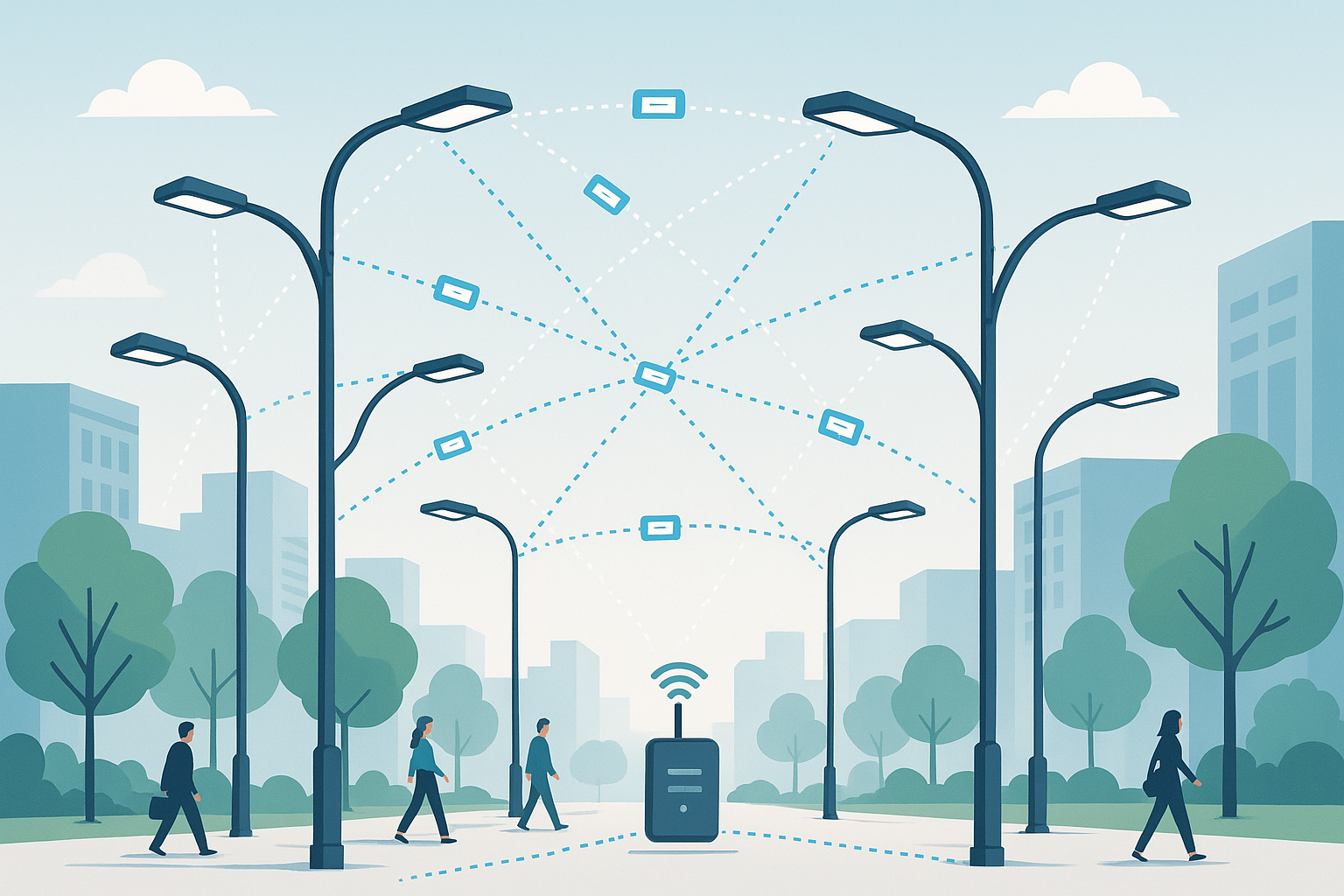
Control mode/type: Short‑range, self‑healing mesh relays messages node‑to‑node to reach gateways.
How it works: Each luminaire node can forward traffic, creating multiple paths for resiliency across dense sites.
Best for: Campuses, parking structures, and dense streetscapes where poles are within hop distance.
Typical fixtures: Area/street lights on campuses and in garages; façade/streetscape luminaires.
Wireless options: Zigbee (CSA ecosystem) or Bluetooth Mesh.
Pros: Fine‑grain control, local redundancy, rich multi‑vendor ecosystem for Zigbee.
Cons/limitations: More gateways than LPWAN for wide areas; hop latency and RF planning.
Scale/coverage: Lot/campus scales; block‑to‑district coverage in dense cores.
Price note: Mesh nodes often ~$45–$150 each; gateways vary by capacity (subject to change).
Evidence links: Interoperability ecosystem context from the Connectivity Standards Alliance: CSA certified product ecosystem.
Control mode/type: Long‑range, low‑power star networks—private LoRaWAN or carrier‑based NB‑IoT.
How it works: Nodes communicate directly to gateways (LoRaWAN) or cellular base stations (NB‑IoT), trading throughput for reach and battery life.
Best for: City‑scale streets and parks, distributed lots, rural corridors where poles are far apart.
Typical fixtures: Street/area/tunnel lights, solar‑integrated poles.
Wireless options: LoRaWAN (public/private), NB‑IoT (carrier).
Pros: Fewer gateways for large footprints; excellent telemetry reach; can ride existing cellular networks.
Cons/limitations: Low data rates and higher downlink latency; subscription costs for cellular; private LoRaWAN requires RF expertise.
Scale/coverage: District to city‑wide.
Price note: LPWAN nodes ~$60–$180; gateway and subscription costs vary (subject to change).
Evidence links: Coverage/capacity guidance from Semtech: Semtech LoRaWAN gateway FAQs.
Control mode/type: Layered baseline (astro or dusk‑to‑dawn) with occupancy overrides.
How it works: Lights follow a time/dusk schedule, dim deeper during lull hours, and immediately brighten on presence detection.
Best for: Parking lots, campus paths, and residential streets aiming for safety plus dark‑sky alignment.
Typical fixtures: Area/street/pathway luminaires with sensor ports.
Wireless options: Any network; logic can be local or managed via CMS.
Pros: Combines the strengths of simple and adaptive controls; flexible and resilient.
Cons/limitations: More points of failure; requires careful zoning and commissioning.
Scale/coverage: Fixture to city.
Price note: Incremental cost is mainly sensors and commissioning (subject to change).
Evidence links: Standards/program context for controllability and dark‑sky aims: DLC SSL/LUNA technical references.
Control mode/type: Off‑grid PV + battery + control logic; can still report via LPWAN.
How it works: Panels charge batteries by day; controllers manage output profiles and optional telemetry.
Best for: Remote paths, parks, rural roads, and temporary sites where trenching is impractical.
Typical fixtures: Integrated solar street/area lights.
Wireless options: Often LoRaWAN or NB‑IoT add‑on for monitoring.
Pros: Eliminates grid connection and utility metering; rapid deployment.
Cons/limitations: Battery life varies by climate and cycling; vandalism/theft mitigation may be needed; careful photometric planning to match storage.
Scale/coverage: Point to distributed networks.
Price note: Highly variable by PV/battery sizing; controller costs align with LPWAN node ranges (subject to change).
Evidence links: Pair the interface standards above (Zhaga/ANSI/DALI) with DOE/DLC controllability guidance for profiles.
Q1:What are the common types of outdoor smart lighting control systems?
The most used are motion sensing, photocells (dusk‑to‑dawn), astronomical timers, centralized management systems (CMS), adaptive dimming profiles, wireless mesh (Zigbee/BLE), LPWAN (LoRaWAN/NB‑IoT), hybrid combinations, and solar‑integrated controllers. This guide maps where each fits across municipal and commercial sites.
Q2:Which wireless protocol is best for city street lights: LoRaWAN, Zigbee, or NB‑IoT?
For distributed, city‑scale coverage with sparse poles, LoRaWAN or NB‑IoT is typically favored due to long range and low power. Dense campuses and garages often benefit from Zigbee/BLE Mesh. Always validate coverage, latency needs, and gateway/subscription models with the LoRa Alliance and 3GPP NB‑IoT references in hand.
Q3:How much can motion sensors save on outdoor lighting?
Savings vary by site, but properly commissioned presence controls commonly add around 10–20% beyond basic dusk‑to‑dawn operation, with deeper reductions possible in adaptive roadway schemes. See the U.S. DOE’s occupancy sensor review for context.
Q4:What’s the difference between a photocell and an astronomical timer?
A photocell reacts to actual daylight at the pole, while an astronomical timer calculates sunrise/sunset by location and date. Many teams use both: the timer sets the baseline schedule, and the photocell provides local weather resilience. The IES definition of astronomical time switches is a good primer.
Q5:Do I need a centralized management system (CMS)?
If you manage many poles across roads, parks, or a large campus and want remote schedules, fault alerts, and energy reports, a CMS pays off operationally. When procuring, ask for TALQ‑aligned capabilities to reduce lock‑in; see the TALQ Tender Template for functions to specify.