
Author: Huang Publish Time: 07-03-2026 Origin: Site


 1. Quick verdict and how to choose
If your indoor project pushes temperature or airflow limits, aluminum housings and heatsinks are the safer bet for downlights, spotlights, and track heads. Steel or iron backplates can work in low‑power, budget‑sensitive builds with good coatings and verified thermal paths, but they carry higher risk of elevated junction temperatures in recessed or hot environments. For buyers searching specifically for aluminum vs steel LED downlight housing options, the short answer is scenario‑based—aluminum wins most heat‑critical and coastal cases, while coated steel can fit low‑power, temperate interiors.
Recessed ceilings with poor airflow and hot plenums lean toward aluminum because higher thermal conductivity helps keep LED junction temperature down and preserves lumen maintenance. Coastal or humid interiors favor coated aluminum with thoughtful fasteners and isolation to manage salt spray and galvanic effects. Temperate inland sites with low‑power luminaires may accept steel backplates when a proper aluminum MCPCB or spreader is in place and temperatures are verified in situ. Weight‑limited track systems benefit from aluminum to reduce mass on adapters and improve handling.
This comparison focuses on indoor downlights, spotlights, and track lights. It emphasizes thermal fundamentals that directly impact lifetime and color stability, and maps climate suitability for typical interior applications. Pricing is discussed as relative bands only and may vary by alloy, finish, and region in 2026.
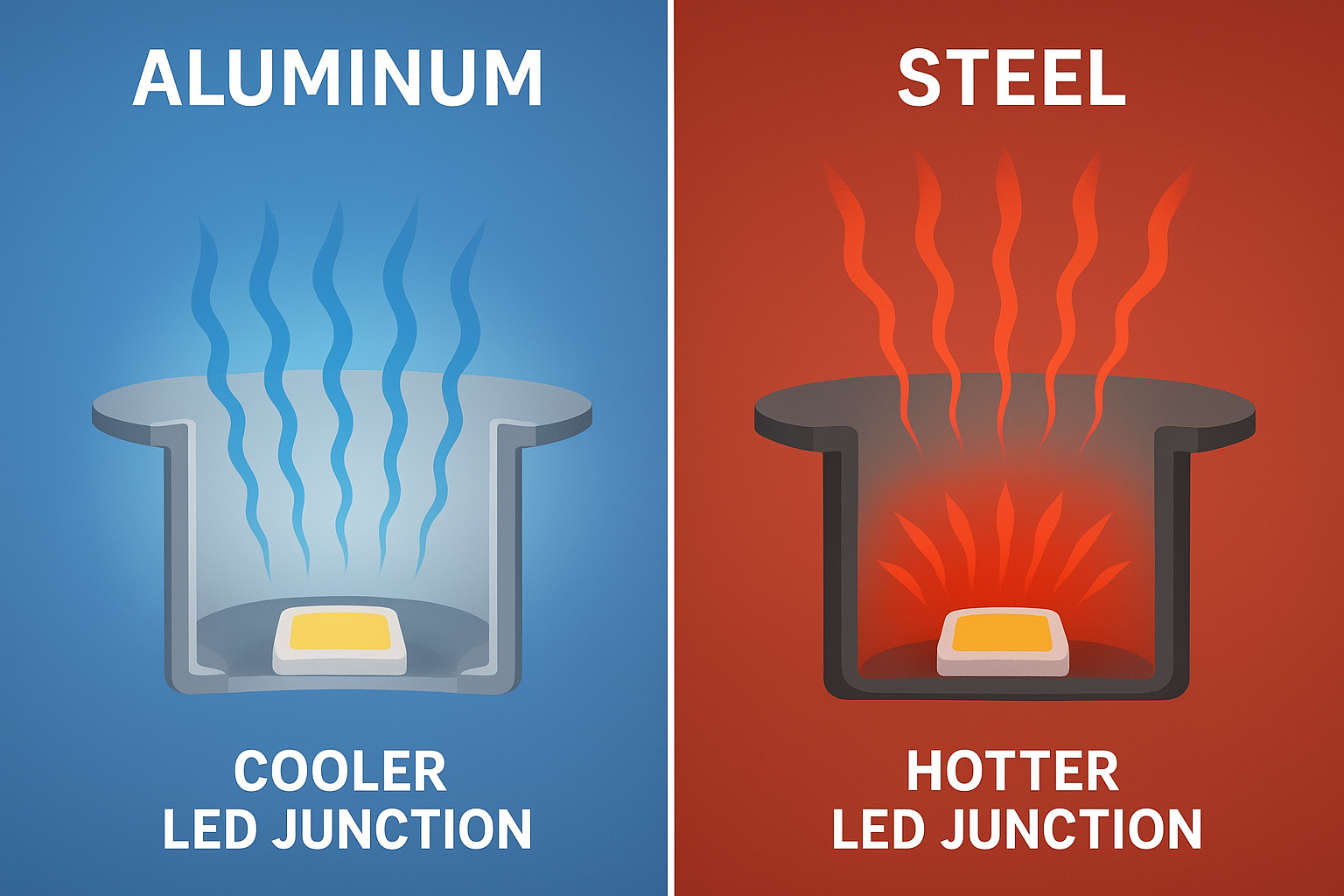
Aluminum’s standout advantage is bulk thermal conductivity. Common luminaire alloys such as 6063 are typically around the 200 W/m·K class, with many authoritative summaries placing aluminum alloys in the 150–210 W/m·K range, whereas steels are far lower. For example, an engineering overview of aluminum reports high conductivity values suitable for heatsinks, while carbon steels often sit around the 44–52 W/m·K band and 304 stainless is roughly 14–17 W/m·K. These order‑of‑magnitude differences matter because they shape the heat path from LED to ambient air and determine whether a like‑for‑like housing geometry can keep the LED junction temperature within target.
Aluminum conductivity reference: see the engineering summary of the thermal conductivity of aluminum and common alloys in the 200 W/m·K class in the industry explainer by YAJI Aluminum, Thermal conductivity of aluminum (room temperature) and common alloy ranges YAJI Aluminum.
Steel conductivity references: for carbon steel ranges around the 44–52 W/m·K class, consult the material property overview of medium carbon steels on MatWeb MatWeb medium carbon steel overview. Stainless 304 properties show 14–17 W/m·K in AZoM’s datasheet summary AZoM 304 stainless properties.
Think of the housing as a highway for heat. Aluminum’s wider, smoother highway moves heat from the LED board into fins and out to air more readily. With identical geometry, a steel or iron backplate’s lower conductivity creates hotter spots and higher thermal resistance. Designers compensate with thicker sections, added spreaders, or separate heatsinks, but those changes often increase weight and cost or consume valuable space in a recessed can.
LED lifetime claims depend on keeping junction temperature within the envelope used in standardized testing. LM‑80 defines how LED packages are tested for lumen maintenance, while TM‑21 explains how to extrapolate those results to project life claims. The practical point is simple: higher junction temperature shortens useful life and can shift color. A technical review highlighting temperature effects on luminous output shows significant drop as Tj rises from 25°C toward 60–100°C, underscoring why thermal headroom matters for downlights and spotlights. For foundational context, see the U.S. Department of Energy explainer on LM‑80 and TM‑21 DOE white paper on LM‑80 and TM‑21 and an InTechOpen technical chapter illustrating luminous output reduction at elevated junction temperatures InTechOpen chapter on LED thermal effects.
Below is a compact view of the key factors buyers and specifiers weigh for indoor downlights, spotlights, and track heads. Values and suitability are generalized; always verify with product‑level data and in‑situ tests.
| Dimension | Aluminum housings and heatsinks (6063, 6061, ADC12) | Steel or iron backplates and housings (carbon steel, stainless, cast iron) |
Thermal conductivity | 6063 often ~200 W/m·K; 6061‑T6 commonly ~150–165 W/m·K; die‑cast ADC12 lower but serviceable for complex shapes. Evidence: engineering summaries and alloy sheets. | Carbon steel typically ~44–52 W/m·K; 304 stainless ~14–17 W/m·K; cast iron ~40–55 W/m·K class. Conductivity is 3–12× lower than aluminum, so geometry must compensate. |
Weight and handling | Density ~2.7 g/cm³ keeps recessed cans lighter and improves track head articulation. | Density ~7.8 g/cm³ increases load on ceilings and tracks; handling is heavier for installers. |
Manufacturability for passive cooling | Extrusion enables high fin area; die‑casting enables compact, integrated shapes and rich surface area. | Stamping and pressing suit thin shells; to dissipate heat effectively often requires added spreaders, bonded heatsinks, or thicker sections. |
Corrosion behavior indoors | With anodize or marine‑grade powder and good design, performs well in humid or coastal interiors. | Carbon steel needs robust coatings; stainless resists corrosion but sacrifices conductivity and adds weight. |
Coatings and finishes | Anodize or matte powder increases emissivity and protects surfaces; salt‑spray performance depends on system choice and prep. | Powder and e‑coat systems protect carbon steel; emissivity can be high, but poor conduction still limits system performance. |
Best‑for scenarios | Recessed or hot ambient locations, coastal humidity, weight‑limited tracks, compact premium optics. | Low‑power budget builds in temperate inland sites with verified temperatures and well‑specified coatings. |
Two important notes about coatings and salt spray: ASTM B117 is a test method, not a pass–fail standard. Performance depends on preparation, chemistry, and thickness; marine‑oriented powder systems often target 1,000 hours and beyond in B117 testing when correctly specified, as explained in a manufacturer’s coatings application guide Greenheck application guide to ASTM B117 and coatings.
Hot, humid, or coastal interiors put both the thermal path and the corrosion system under stress. Use material and finish choices that preserve thermal performance over time. For readers working in the Gulf or similar high‑ambient markets, see the climate‑focused guidance from KEOU on specifying high‑temperature LED designs in hot regions, which touches on aluminum‑backed strategies and ambient derating considerations KEOU guide to high‑temperature LED lighting in hot regions.
In chloride‑rich indoor air near coastlines or pools, aluminum housings with marine‑grade powder coating or high‑quality anodize, paired with sealed joints and isolation at fasteners, typically hold up well. Specify salt‑spray performance expectations with your supplier and ensure surface prep is controlled. Remember that B117 hours reflect lab conditions rather than a warranty, so treat them as one input to a robust coastal spec.
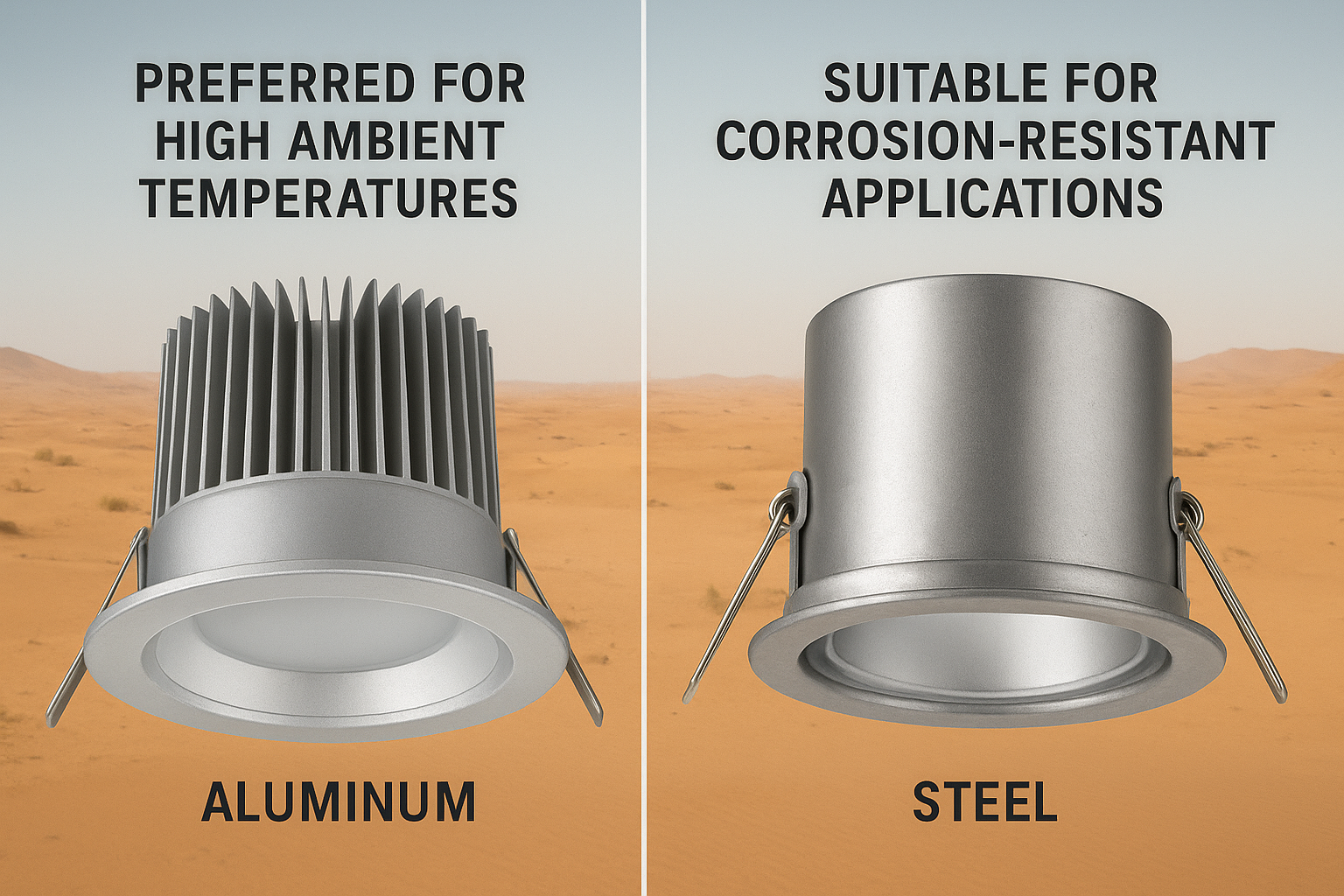
In Gulf and Middle East markets (UAE, Saudi Arabia, etc.), indoor luminaires endure harsher conditions than the term implies: extreme outdoor heat driving up building and ceiling plenum temperatures, frequent dust ingress from sandy environments, and coastal humidity in many cities. For retail and mall projects, buyers often prefer proven commercial accent lighting formats, then tighten the spec around thermal margin, dust control, and corrosion resistance.
Thermal and high-ambient requirements are defined by margins rather than a single wattage. Buyers typically ask about fixture behavior at higher ambient temperatures (Ta), driver case temperature (Tc) in worst-case ceiling conditions, and built-in thermal derating to avoid output loss during summer peaks. In this context, aluminum is often preferred because it helps lower junction temperatures in low-airflow, high-ambient settings.
Dust protection and sealing are prioritized even for indoor projects, with enhanced sealing at joints and cable entries plus pressure-equalization solutions (breather vents or vent membranes) to reduce condensation without trapping dust. In coastal Gulf cities, corrosion control is also key: robust coatings, 316 stainless steel fasteners for chloride-exposed areas, and isolation measures to mitigate galvanic corrosion at aluminum-to-stainless interfaces are common localized requirements.
▋Core Product Specifications
COB recessed downlights: Deeper body and increased metal mass at the same wattage, ensuring stable junction temperatures in warm ceiling voids
Surface/recessed spotlights (feature walls/highlights): High-temperature-tolerant drivers and fast-heat-dissipating housings prioritized over compact form factors
Retail track heads: Slightly larger head or finned rear section, maintaining output without aggressive thermal derating during extended operating hours
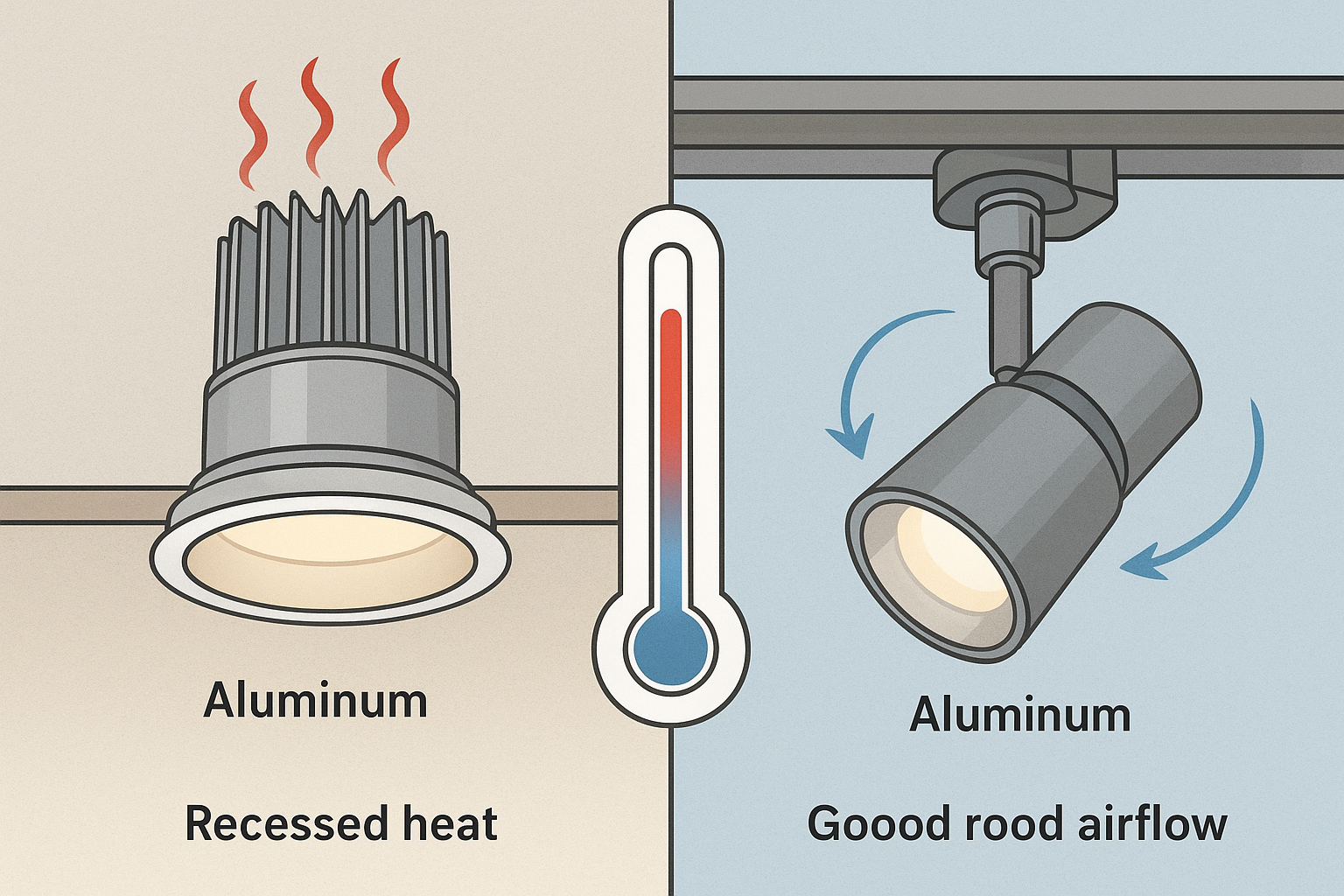
Different form factors encounter different constraints. The same wattage that runs cool in an open track head can struggle in a sealed, recessed can.
Recessed cans limit convection and may share hot plenum air with HVAC or roof cavities. Here, aluminum’s conductivity and fin geometry options reduce thermal resistance and keep junction temperatures closer to the LM‑80 and TM‑21 design envelope. Even when overall power is modest, the safety margin aluminum provides against summer peaks and maintenance of lumen and color stability is often worth the incremental cost.
Open heads enjoy better airflow, and some low‑power designs can tolerate steel backplates if the LED module still couples to an aluminum spreader or MCPCB and temperatures are measured under real conditions. For higher power or when adapters and tracks have strict weight limits, aluminum remains attractive for keeping fixture mass low and articulation smooth over years of aiming and service.
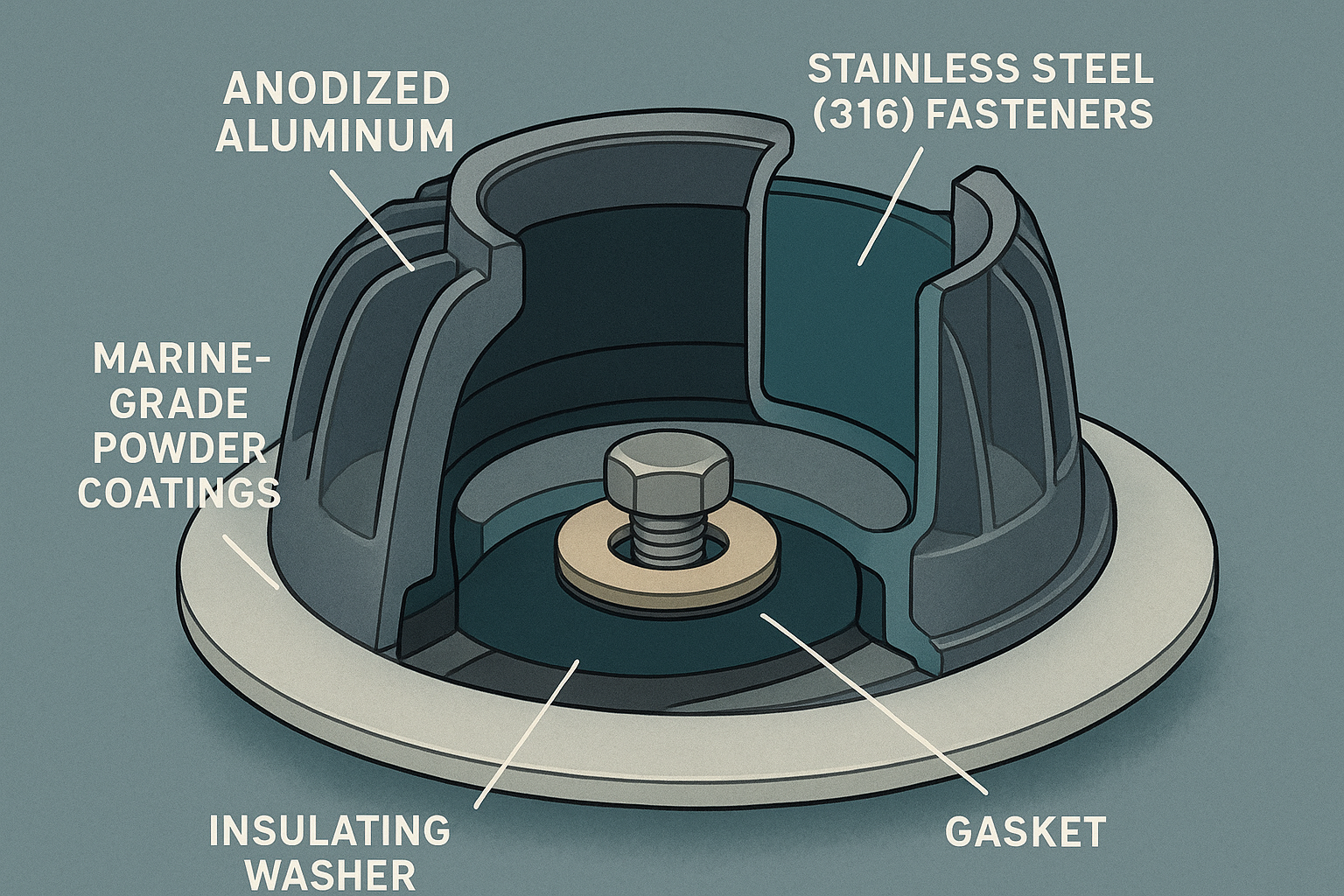
A good thermal design can be undermined by corrosion that degrades fit or compromises the heat path. In coastal and humid interiors, it pays to get the details right.
Black anodize and matte architectural powders increase surface emissivity, which modestly helps radiation‑based cooling and protects against oxidation. Salt‑spray hours in ASTM B117 vary by prep and chemistry; many marine‑oriented powder systems target 1,000 hours or more with appropriate pretreatment. Treat hours as a screening tool, not a guarantee, and always couple coating choice with sealed edges and thought‑through drainage and venting to avoid moisture traps. For a concise overview of B117’s limits and how vendors frame performance targets, see the coatings application guide referenced earlier Greenheck application guide to ASTM B117 and coatings.
Where fasteners contact aluminum, design to mitigate galvanic corrosion in salty or persistently damp interiors. Preferred practices include using corrosion‑resistant stainless fasteners (316 is commonly preferred in chloride‑rich environments), insulating washers or gaskets at interfaces, sealing exposed joints, and avoiding dissimilar‑metal couples that place a large, noble fastener against a small aluminum contact area without isolation. Guidance on 316 stainless suitability is widely documented in marine fastener references Guide to 316 stainless fasteners for chloride environments.
Q1:Which housing material keeps recessed LED downlights cooler
Aluminum usually does, because its thermal conductivity is several times higher than carbon steel or stainless, allowing like‑for‑like housings to spread heat more effectively and lower junction temperature.
Q2:Is steel acceptable for indoor LED downlights and spotlights
It can be for low‑power builds in temperate, inland locations when you maintain an aluminum thermal path at the LED board, specify robust coatings, and verify temperatures under real operating conditions.
Q3:What coatings should I specify for coastal or humid interiors
Architectural anodize or marine‑grade powder systems with clearly stated ASTM B117 salt‑spray performance targets are common choices, paired with good pretreatment, sealed edges, and isolation at fasteners.
Q4:How does junction temperature affect LED lifetime and color
Higher junction temperature accelerates lumen depreciation and can shift chromaticity; LM‑80 and TM‑21 provide the framework for testing and projecting life, which is why thermal headroom in the housing matters.
Q5:Why do track heads often use aluminum instead of steel
Weight and heat. Aluminum reduces mass on the track adapter and improves handling while also providing a better passive heat path for higher‑output heads.


