
Author: Huang Publish Time: 07-02-2026 Origin: Site


Facility teams often ask for a simple way to match fixtures to each zone. This quick guide maps factory LED lighting by area to mounting height, optics, comfort, and durability—so you can make confident choices without drowning in specs.
Use this one-page matcher to pick a starting point, then fine‑tune on site. Illuminance targets reflect widely adopted EN 12464‑1 summaries for industrial interiors; for fine work, step up one notch as needed, as outlined in credible overviews such as the Fagerhult summary of EN 12464‑1 indoor workplaces (2021).
| Area | Typical mounting height | Fixture family | Optics (default) | Target illuminance | Comfort & robustness |
Production lines/work areas | 6–8 m | UFO or linear high‑bay | Medium 90–120° | 300–500 lx | UGR ≤19 preferred; IP54–65; IK08 where impacts likely |
Storage/racking | 8–12 m | Linear high‑bay | Aisle/asymmetric (e.g., 60°×100°) | 150–200 lx | UGR ≤22; IP54–65 |
Aisles/corridors | 5–7 m | Linear high‑bay or strips | Wide 100–140° | 100–150 lx | UGR ≤22; IP54 |
According to EN 12464‑1 summaries frequently used in factory projects, these ranges are a practical baseline; the Fagerhult knowledge page provides helpful context on illuminance steps and UGR guidance for different tasks.

Recommended fixture: UFO or linear high‑bay with a medium (90–120°) beam to balance task and surround.
Targets: 300–500 lx at work plane; push higher for detailed assembly. Keep UGR at or below 19 where operators focus on small parts (aligned with EN 12464‑1 summaries).
Comfort: Favor diffusers or honeycomb anti‑glare where sightlines are long; avoid fully clear covers if glare complaints arise. For a primer on how diffusers affect comfort, see our internal explainer LED Panel Lights: Where To Use Them And How To Choose.
Environment: IP54 is a good baseline; step up to IP65 if dust, humidity, or washdown are present. A short external explainer contrasts IP54 vs. IP65 protection levels in practical terms. Typical IK is IK08 in active workshops.
▋A concise overview of industrial illuminance and UGR expectations is available in the Fagerhult EN 12464‑1 summary, which many specifiers reference as a practical baseline.
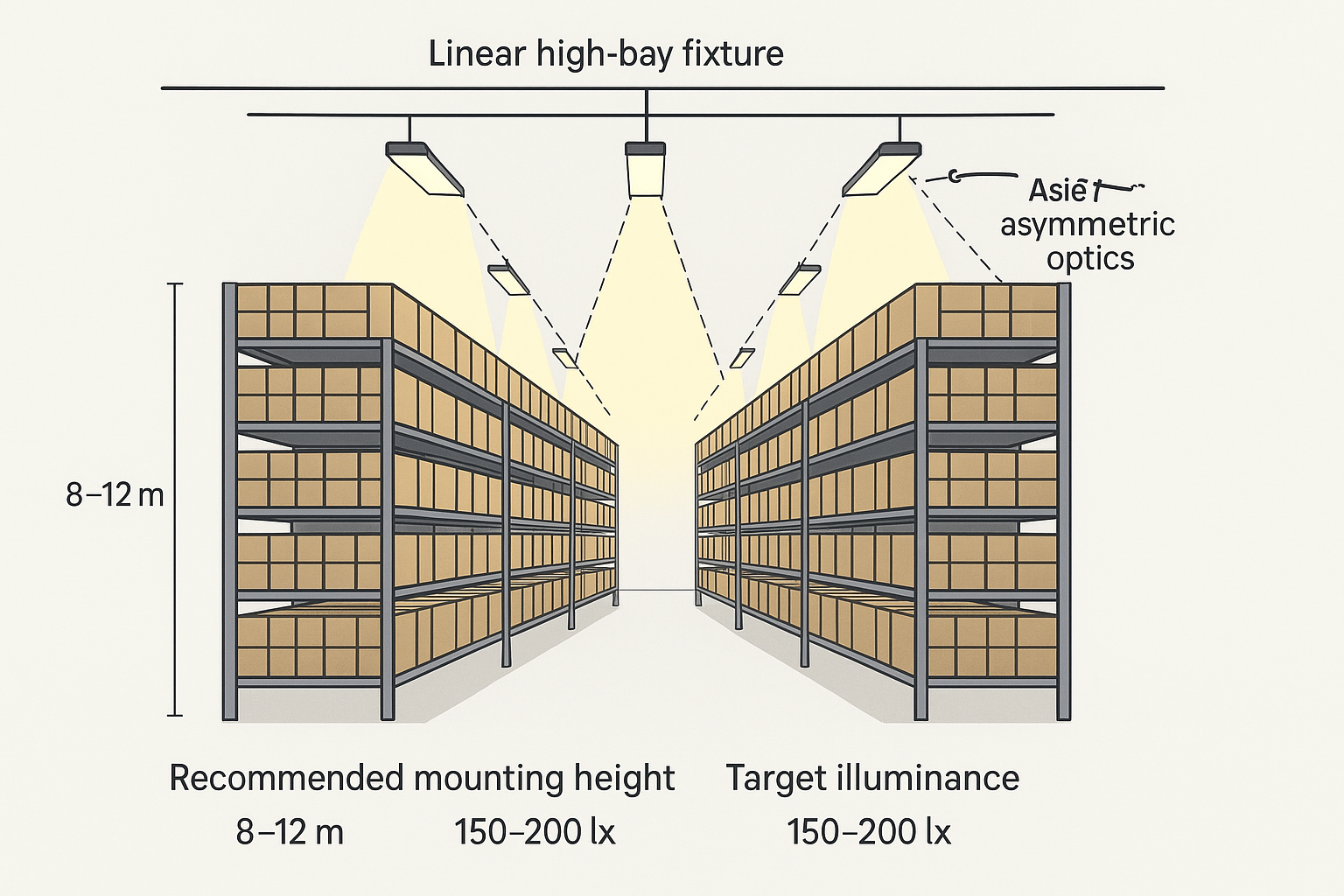
Recommended fixture: Linear high‑bay with aisle/asymmetric optics to light vertical rack faces and the floor uniformly.
Targets: 150–200 lx; UGR ≤22 is usually acceptable in storage zones.
Optics: Narrower vertical beams (e.g., 60°×100° or 25°×85° in narrow aisles) reduce dark trenches between racks—see an engineering explainer on warehouse aisle optic patterns and vertical vs. horizontal distribution.
Environment: IP65 is preferred for dusty interiors; IP54 suffices in clean, conditioned spaces.
▋Disclosure: KEOU Lighting is our product. In practice, a sensor‑ready linear high‑bay at 10–12 m with medium aisle optics, IP65 housing, and 0–10 V dimming can support racking aisles efficiently; KEOU’s Industrial Lighting Solution hub is one neutral place to explore categories and photometric files.
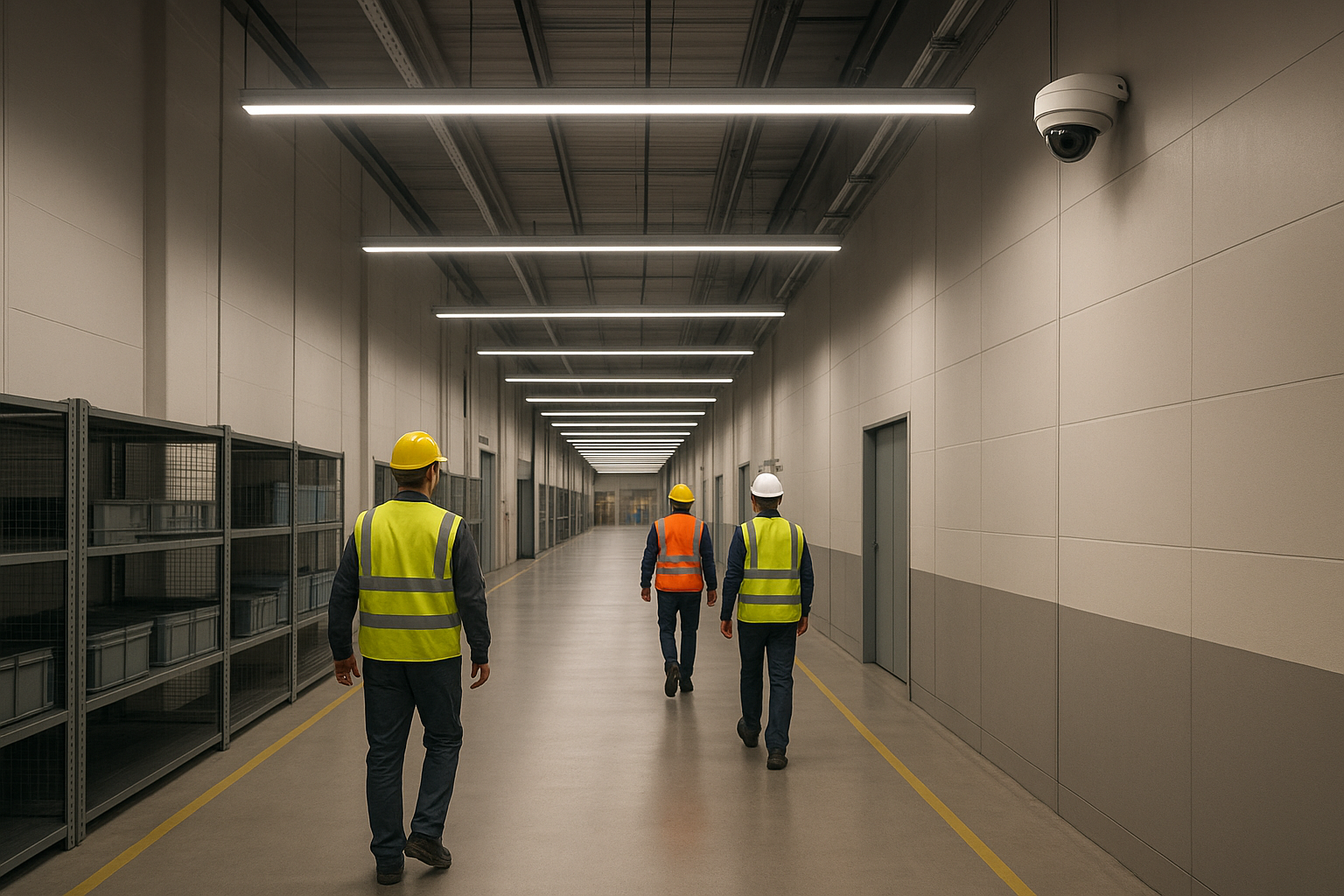
Recommended fixture: Linear high‑bay or continuous strips with wide (100–140°) optics for even background light.
Targets: 100–150 lx; UGR ≤22 to keep circulation comfortable without over‑lighting.
▋Tips: Keep spacing roughly 1.2–1.5× mounting height in open corridors; verify with a quick layout. If cameras are present, request flicker test data and aim for practical limits like PstLM ≤ 1.0 and SVM ≤ 1.6, as outlined in the IES overview of temporal light artifacts.
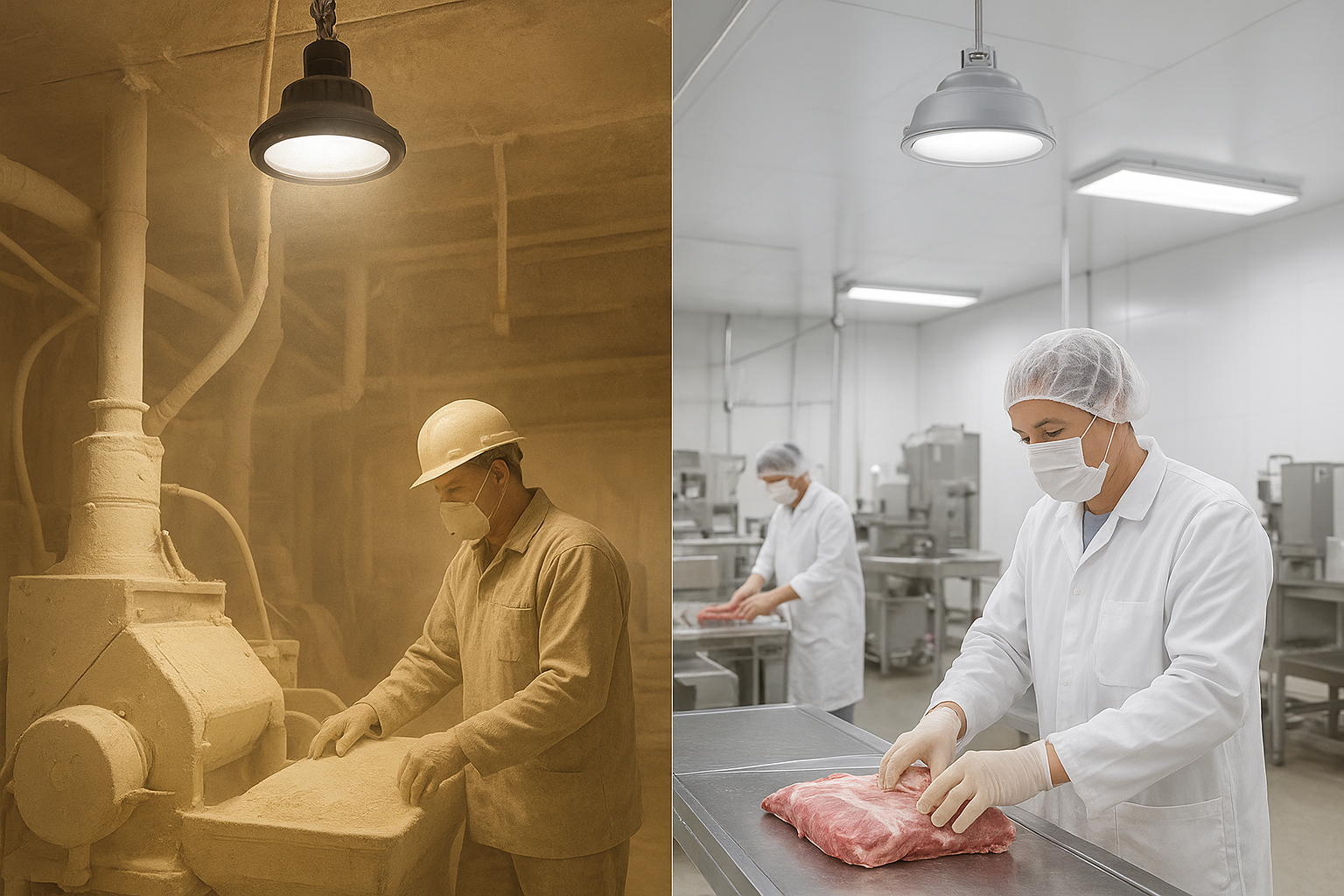
What to pick: sealed, dust-tight high-bay or linear fixtures with smooth housings and minimal external crevices. Choose designs that keep dust out of the LED module and driver compartment and are easy to clean without disassembly.
Why it helps: keeping dust out extends life, reduces maintenance, and lowers the risk of dust accumulation on optics that causes loss of output and hot spots.
Practical features to ask for: full gaskets or sealed housings, tempered glass or rugged lens, and housing finishes that brush or wash clean easily. Prefer fixtures with modular components so lenses and drivers can be serviced without long plant downtime.
Installation tips: mount fixtures where they’re accessible for routine cleaning and avoid placing them directly above primary dust sources if layout allows. Consider enclosures or secondary shields in high-accumulation zones.
Quick note on safety wording: mention of “explosion-proof” or hazardous-area ratings is useful only to the extent it tells you whether a fixture is designed for heavy combustible dust—if you’re unsure about classification, flag the area for a safety assessment before specifying.
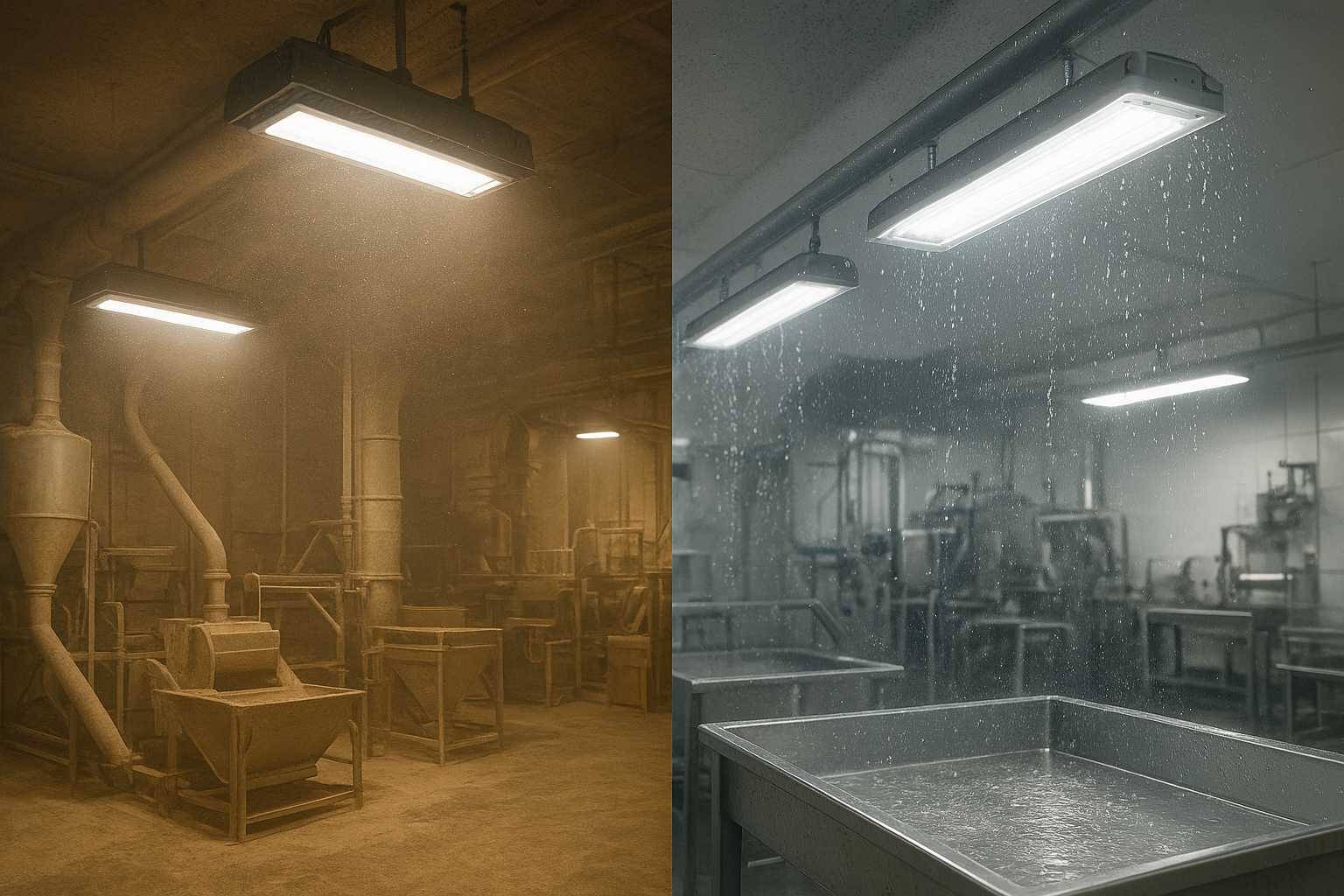
What to pick: hygienic, washdown-capable luminaires with smooth, corrosion-resistant housings and shatterproof lenses. Panel-style or sealed linear fixtures with minimal fasteners on exposed faces work well in production and packaging lines.
Why it helps: smooth, sealed fixtures avoid crevices that trap product residue or bacteria and survive frequent cleaning cycles with caustic detergents or high-pressure rinses.
Practical features to ask for: corrosion-resistant materials, sealed entry points for cables, and quick-disconnect mounts for fast removal during cleaning. For inspection lines choose fixtures with consistent, even distribution and neutral color rendering to help quality checks.
Installation tips: place cleanable fixtures over direct food-contact zones only if they are explicitly rated for that environment; otherwise offset fixtures a short distance and use optics that avoid glare on inspection surfaces.
Minimal compliance cue: if your site performs frequent high-pressure washdowns, tell suppliers you need washdown-capable designs so they can propose fixtures with sealed improvements.
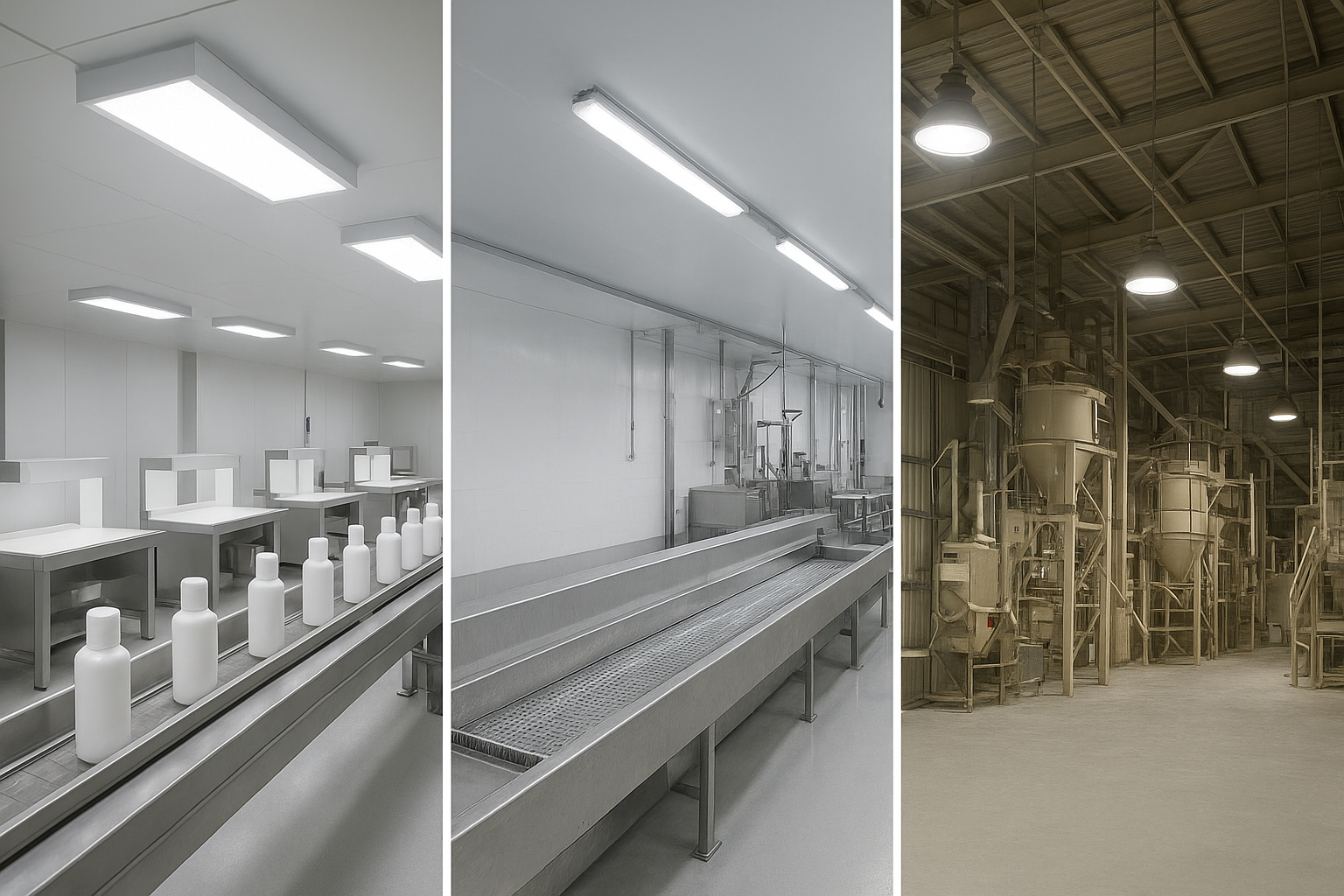
What to pick: low-heat, low short-wave output fixtures and panel-style luminaires that provide even, shadow‑free light for inspection benches and filling lines. For light‑sensitive mixes, consider fixtures or filters that reduce short-wavelength blue/near‑UV without affecting basic color discernment.
Why it helps: reducing short-wave exposure protects light‑sensitive ingredients and preserves accurate color inspection while keeping the work area comfortable for operators.
Practical features to ask for: selectable color temperatures or LED options with reduced short-wave content (or amber-tinted variants for very sensitive formulations); even-diffuse panels for inspection benches; easy-to-clean surfaces similar to food fixtures.
Installation tips: use consistent, non-directional panels over inspection tables and avoid high-glare reflectors that make color checks difficult. For mixed-use rooms, provide local task lighting with adjustable aim rather than over-lighting the whole space.
If the room is dusty and cleaning is occasional, favor sealed, serviceable fixtures with rugged lenses.
If frequent washdown is performed, favor hygienic, corrosion-resistant, quick-disconnect designs meant for cleaning cycles.
If product sensitivity or color inspection is the priority, favor diffuse panels or task lights with controlled spectral output rather than brighter, glare-prone high bays.
When speaking to suppliers, ask these quick questions to narrow choices fast:
Can the fixture be opened and serviced without removing the whole unit?
Does the housing finish stand up to regular washdown or brushing?
Is there a version with reduced short‑wave output or selectable color temperature for inspection use?
Can you provide a simple photometric showing aim/beam options for my mounting height?
(Where helpful, suppliers will reference hygienic or washdown product lines; if you need formal verification for safety-critical areas, ask the supplier for the specific rating rather than relying on marketing phrases.)
If you need photometric files, sensor options, or example spec packages for quick shortlisting, visit the Industrial Lighting Solution hub from KEOU as a neutral resource to browse categories and documentation.
A: Use UFO/round high‑bays for open production bays; choose linear high‑bays for racking aisles or when you need directional, asymmetric beams to control shadows.
A: Light to the higher task requirement near delicate work (often 500 lx) with local glare control, then allow surrounding areas to sit a step lower for balance and energy savings.
A: As a quick start, try 1.2–1.5× mounting height for wide beams in open areas and closer spacing for aisle optics. Always verify with a simple layout before procurement.
A: Use IP65 for dusty, humid, or washdown interiors—otherwise IP54 is typically adequate. If in doubt, favor IP65 to reduce maintenance risk.
A: Begin with mounting height bands and area function, choose fixture family and optics accordingly, set illuminance/UGR goals, then select controls and environmental ratings. This preserves comfort and efficiency while keeping parameters minimal.
External references (each used once):
Fagerhult EN 12464‑1 indoor workplaces summary (2021) — illuminance/UGR context.
Warehouse aisle optic patterns explainer — asymmetric distributions.
IP54 vs. IP65 protection differences — environmental robustness.
DesignLights Consortium — lighting controls best practices — tuning, sensors, zoning.
IES — Temporal Light Artifacts overview — flicker/PstLM/SVM context.
Internal resources (context only):
LED Panel Lights: Where To Use Them And How To Choose — diffuser choices and comfort.
What is Needed to Install LED Panel Lights — mounting primer for surface/suspended.
Ultimate Guide: Office Lighting Fixtures by Area — comfort context and UGR expectations across office zones.


