Author: Huang Publish Time: 13-06-2026 Origin: Site


Buying LED floodlights for the U.S. market has gotten less forgiving. Specs are tighter, controls are more common, and the margin for “good enough” optics is smaller when your customers are installing lights over working yards, drive lanes, façades, and sports areas.
If you’re a distributor or VAR, the real cost of a bad pick isn’t just a change order—it’s returns, emergency swaps, and reputation damage. This guide is built to help you evaluate floodlights the way a lighting designer and a procurement manager would: by photometrics + documentation + risk, not by wattage.

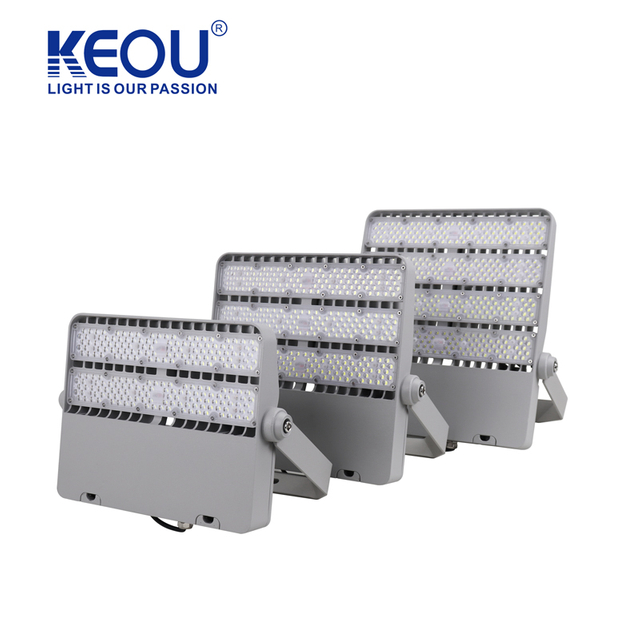
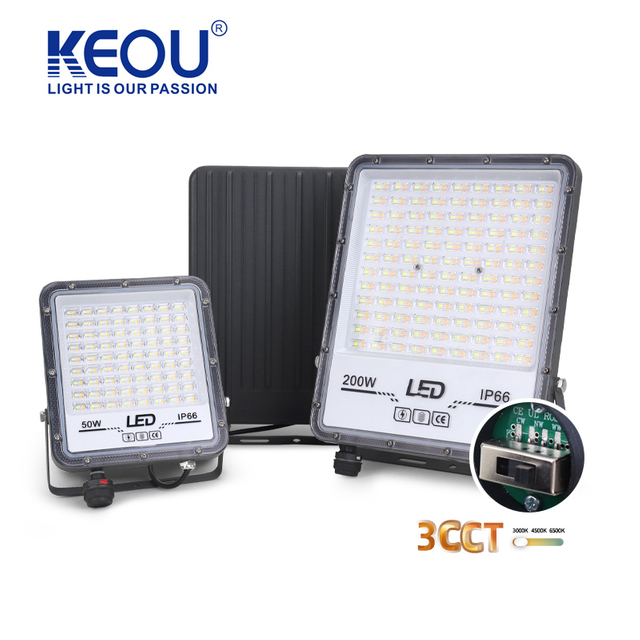
A floodlight isn’t one product—it’s a family of distributions and build choices.
If you buy by wattage or “lumen marketing,” you can end up with any of these outcomes:
A parking lot that looks bright in one spot and unsafe in others
A façade that spills light into the sky (or into windows)
A yard that’s overlit with harsh glare but still has poor visibility
A quick baseline: floodlights are used when you need broad area illumination, which is why beam distribution matters as much as raw output. (KEOU has a plain-language overview of what flood lights are if you want a refresher you can share with customers.)
Before you choose a fixture, force the project into a few concrete inputs. These questions are the difference between a clean submittal and a painful rework.
Parking lot lanes and loading zones don’t need the same approach as façade grazing or sports play areas.
High-mast poles, building corners, and wall packs have different throw and glare behavior. If the mounting height is unknown, your quote is a guess.
Even if the customer doesn’t specify a full design, ask for at least a target range and whether the priority is “bright” or “uniform and comfortable.” Uniformity problems are a common reason for dissatisfaction.
You confirmed IP65+ as a baseline for this guide, which is a sensible starting point for outdoor floodlights. IP ratings are defined by IEC 60529 / ANSI/IEC 60529 and describe an enclosure’s protection against solids and liquids (dust and water). Intertek’s overview of Ingress Protection per IEC 60529 is a good reference for what the rating actually means.
Is this dusk-to-dawn? Photocell? Scheduled dimming? Motion/occupancy? A lot of “compatibility” issues show up late because nobody asked early.
For U.S. projects, that often means a clean submittal package (photometry + test reports + safety listing) and predictable service support.

This is the core of a solid buyer’s guide. It’s also where most returns are prevented.
For floodlights, distribution is everything.
Ask for the IES photometric file and treat it like non-negotiable documentation. The Illuminating Engineering Society explains why IES files matter and how they’re used to deliver appropriate lighting levels and distribution.
If you need a “what exactly is in the file?” reference, ANSI’s overview of IES LM-63 photometric file format (2020) is a useful explanation for buyers.
How to use it in practice (even without full design software):
Confirm the fixture’s distribution type matches the application (area coverage vs. throw)
Avoid choosing optics from product photos—photometrics are the proof
If the project is high-mast, sports, or stadium-adjacent, consider photometric layout support before finalizing
KEOU also has a short explainer on why beam spread matters—see why it’s called a flood light.
Pro Tip: When a spec sheet lists “beam angle,” treat it as a hint—not a design. The IES file is what lets you validate coverage and spill.
Floodlights that “look powerful” can still create poor visibility if the source is harsh or poorly shielded.
What to evaluate:
Can the fixture be aimed without putting the bright source in direct line of sight?
Is there an option for visors/shields or tighter optics where drivers/pedestrians will see the source?
For façade lighting, can you shape the beam to keep it on the surface—not into windows?
Glare is one of the most common “it looked fine on paper” failures—especially when the project goes from an empty lot to a busy site.
Thermal performance is where many cheaper fixtures quietly fail.
Even if you don’t have access to internal temperature test reports, you can sanity-check:
Housing material and heat dissipation approach
Whether the driver and LED module placement is designed for airflow
Whether the fixture will be mounted in a heat-trapping location
If the vendor can’t explain how the fixture manages heat, don’t assume it’s fine.
In many outdoor projects, the driver and surge events—not the LEDs—are what take fixtures down.
You don’t need to quote exact surge numbers to do a good evaluation. You do need to acknowledge exposure and select appropriately.
A practical way to frame it for buyers is by application exposure. CITEL’s guidance on surge protection for stadium LED lighting references ANSI C136.2 categories and explains why more exposed environments call for higher surge immunity.
What to ask for:
Driver type and control compatibility (0–10V, photocell/NEMA socket options if used)
Surge protection approach (fixture-level, pole-level, or layered)
Warranty process clarity for driver-related failures
For this guide we’re using IP65+ as the baseline.
IP ratings matter because outdoor failures often start with water ingress, corrosion at the cable entry, or condensation issues that show up months later.
When a fixture claims IP65, verify:
Gasket and seal design (not just the rating statement)
Cable gland and entry quality
Whether the installation environment includes direct spray, wind-driven rain, or dust
If the site includes washdown or extreme exposure, you may need higher protection than the baseline. The point is to match the IP level to the actual environment—not to treat IP as a marketing icon.
Distributors get burned when controls are an afterthought.
If the customer expects dimming, photocells, or sensors, verify compatibility early. That includes:
Control method (e.g., 0–10V) and expected behavior
Any control accessories required
How flicker and low-load behavior is handled (especially with dimming)
If a vendor can’t clearly state the control scenario they support, assume integration risk.
This is where a buyer’s guide becomes operational.
What it proves: distribution data used for lighting calculations and design verification.
What to do: require it for layouts, especially for high-mast, yard, and sports applications.
What it proves: measured photometric and electrical performance for the luminaire (not just the LED chip).
Why it matters: it helps validate performance claims without relying on brochure numbers.
What it proves: LM-80 tests lumen maintenance for LED packages/arrays/modules, and TM-21 provides a projection method based on that test data.
Why it matters: it’s the responsible way to discuss long-term lumen maintenance.
A solid reference here is the U.S. DOE SSL material on LM-80 testing and TM-21 extrapolations.
Projects commonly require third-party electrical safety certification by an NRTL (such as UL/ETL). DarkSky’s luminaire program is explicit that approved luminaires must have independent third-party electrical safety certification and also requires photometry (IES/LDT files plus test lab report) per distribution type.
Even if the project isn’t targeting DarkSky approval, that guideline is a useful proxy for how specifiers think: safety listing + photometry + lab credibility.
You don’t need to overcomplicate this. Watch for patterns:
No IES file, or a “generic” file that doesn’t match the model
Vague lifetime claims with no LM-80/TM-21 basis or no clear test conditions
Control ambiguity (“dimmable” with no method, no driver detail)
IP rating claimed but weak install details (cable entry, seals, mounting orientation)
No clear warranty process (especially for driver failures)
⚠️ Warning: If a vendor can’t provide documentation until “after the order,” assume the submittal will slip—and your customer will blame you.

Since your goal is sample requests, here’s a practical evaluation process that helps your customers decide—and helps you reduce returns.
Collect:
mounting height and photos of the site
target area dimensions
control requirements (photocell, dimming, schedule)
At minimum:
IES file + photometry/test reference
IP rating statement and installation notes
driver/control scenario statement
During the sample install, check:
coverage uniformity (dark spots, hotspots)
glare from common viewing angles
spill into unwanted zones (windows, neighbors, sky)
Before final sign-off:
inspect cable entry, gaskets, and mounting hardware
confirm aiming stays locked after installation
The distributor question isn’t “does this one sample work?” It’s:
will the vendor support consistent production across batches?
will documentation match the shipped model?
If you want to move this project forward quickly, you can request samples from KEOU Lighting for floodlight applications (general outdoor, industrial yards, façades, and sports-area lighting).
To get the right sample the first time, send:
application type (parking/yard/facade/sports)
mounting height + a quick site photo
target illuminance range (if known)
control needs (photocell, dimming)
baseline requirement: IP65+
That information is usually enough to shortlist optics and propose a sample that’s closer to the final spec—and reduces rework for you and your customer.