Choosing the wrong beam angle on an LED flood light doesn’t just change “how wide the light goes.” It changes uniformity, glare risk, spill/light trespass, pole spacing, and how many fixtures you need to hit target levels.
This guide is written for decision-stage buyers—distributors and project teams who need a spec-ready way to choose flood light optics for sports courts/stadium, parking lots, and logistics yards.
What “beam angle” actually tells you (and what it doesn’t)
Beam angle is the cone where light intensity drops to about half of its peak value. That’s useful—but it’s not the whole story.
Two fixtures with the “same beam angle” can behave differently because of:
-
Optical design (symmetric vs asymmetric)
-
Aiming/tilt angle (especially in sports and perimeter lighting)
-
Shielding/cutoff (glare and spill control)
-
Field angle (the softer outer edge of the beam)
A practical summary from Beyond LED Technology explains the difference between beam angle (50%) and field angle (10%) in their article on beam angle vs field angle (50% vs 10%). When you’re trying to prevent glare and light trespass, the “soft edge” matters.
If you’re looking for a quick flood light beam angle chart, treat it like a starting point—not a final answer. The real decision is “Does this optic hit the target area without creating glare or spill once it’s mounted and aimed?”
Pro Tip: For outdoor projects, don’t approve optics using beam angle alone. Ask for IES/photometrics and verify spill, glare, and uniformity in a layout.
Beam angle vs mounting height: the quick coverage check
If you need a fast “back-of-napkin” way to estimate beam angle vs mounting height (i.e., how big a beam footprint becomes as the pole gets taller), use the common approximation:
-
Beam spread diameter (D) ≈ 2 × H × tan(θ/2)
Where H is mounting height and θ is beam angle.
Example: at a 10 ft mounting height with a 60° beam, Beyond LED Technology’s worked example shows a footprint of roughly 11.5 ft in diameter using D = 2 × H × tan(θ/2).
Important limitations:
-
This estimate assumes a simple cone on a flat plane.
-
It does not replace a photometric layout (especially for asymmetric distributions).
-
Aiming angle changes where that footprint lands.
Before you pick an angle: the 6 inputs that prevent rework
If a project is in the “ready to specify” stage, beam angle selection should start with these inputs:
-
Mounting height (pole height + fixture setback)
-
Target area geometry (length/width + where light is allowed to land)
-
Pole locations and spacing constraints (existing poles vs new)
-
Glare and spill constraints (neighbors, roads, players’ sightlines)
-
Target light levels and uniformity expectations (site safety vs competition play)
-
Distribution pattern preference (symmetric vs forward-throw/asymmetric)
If you’re lighting parking lots, KEOU’s guide on parking lot beam angle and spacing basics also highlights why beam choice and spacing must be planned together (not separately).
LED flood light beam angle chart: how to think in bands
You’ll see many “floodlight beam angle chart” versions online. For quick classification, KEOU’s own reference ranges are:
-
Narrow beam: 10–30°
-
Medium beam: 30–60°
-
Wide beam: 60–120°
Those ranges appear in KEOU’s article on narrow vs medium vs wide beam angle ranges.
For most outdoor LED flood light beam angle decisions, you’ll be choosing inside the medium-to-wide zone—but you’ll often use tighter beams in sports or perimeter throws where control matters.
How to choose beam angle for sports courts and stadium areas
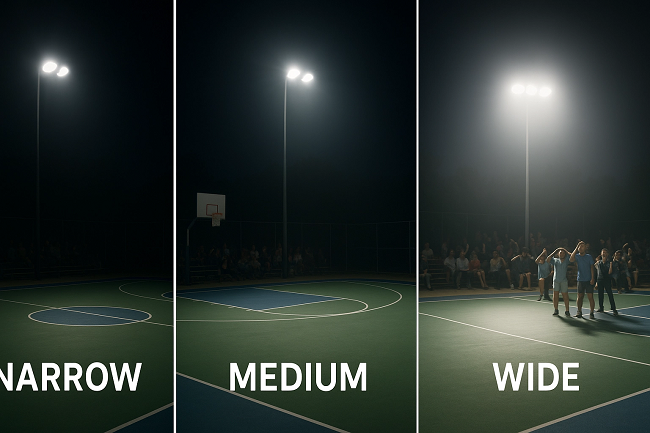
Sports lighting is where beam angle mistakes get expensive. Players and spectators are sensitive to glare, and you often have long throws with specific aim points.
5.1 Start with control, then add fill
-
Use tighter or medium beams for long-throw aim points where you want intensity and controlled spill.
-
Use wider beams only when you can confirm (via layout) that you’re not creating glare into sightlines or wasting lumens beyond the playing area.
5.2 What “too wide” looks like in sports
-
Hot glare near the pole or at high viewing angles
-
Light landing outside the court/field boundaries
-
Bright poles + dim mid-zone (bad uniformity)
5.3 What “too narrow” looks like in sports
-
Bright hot spots with dark gaps between aim points
-
Over-reliance on more fixtures just to smooth uniformity
⚠️ Warning: Sports projects rarely succeed with “beam angle only” decisions. Require IES + aiming diagram and validate uniformity and glare risk before finalizing optics.
How to choose beam angle for parking lot lighting
6.1 Think in patterns, not just angles
Many parking designs use distribution language (often described as “Type II/III/IV/V” patterns) because you’re trying to shape light to the geometry (rows, edges, islands). KEOU’s parking-lot selection page summarizes how different distribution patterns apply in the same guide referenced earlier.
(That same page also uses the common spacing relationship S = H × tan(θ/2) to connect mounting height, beam angle, and fixture spacing—useful as a quick planning check, then validate with photometrics.)
Use this as a practical mapping:
-
Row/area coverage: typically medium-to-wide beams, chosen to maintain uniformity between poles
-
Perimeter/edge control: more controlled forward-throw distributions to reduce spill beyond property lines
-
Islands/central poles: symmetric distributions can work, but verify that you’re not wasting output where it isn’t needed
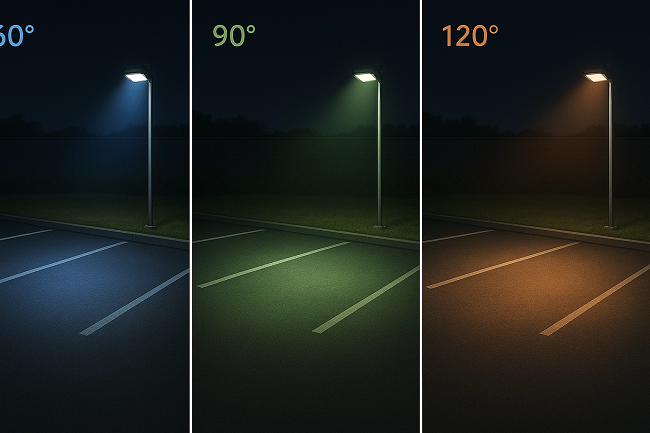
6.2 60 vs 90 vs 120 degree flood light: a decision-stage way to think
-
60°: use when you need more control (longer throws, tighter placement constraints, or stronger spill control), and you can aim precisely.
-
90°: common “general area” choice when pole spacing and height support good overlap.
-
120°: use cautiously—helpful for broad coverage at lower mounting heights or when you need very wide spread, but easy to waste light and increase spill and glare if optics/cutoff aren’t controlled.
The right choice depends on height and spacing—not just preference. A quick sanity check is to estimate the footprint using the diameter approximation above, then confirm with IES-based layouts.
How to choose beam angle for warehouses and logistics yards
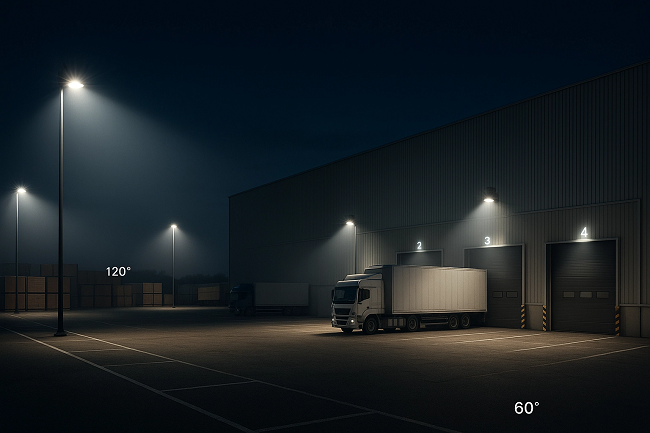
-
Broad coverage for safety and navigation
-
Control to avoid glare into drivers’ sightlines and spilling into adjacent properties
7.1 Practical approach
-
Favor medium-to-wide beams for general wash when mounting heights are higher and you need overlap.
-
Use more controlled beams (or asymmetric distributions) when you’re lighting edges, loading bays, or drive lanes where spill control matters.
An industry guide from Hyperlite discusses how NEMA beam spread types are used for area coverage and spill control in their article on NEMA beam spread types and spill control. While the examples are agriculture-focused, the spill/glare logic translates well to yard lighting.
Red flags: when your beam angle choice is likely wrong
Red flag 1: “We’ll fix uniformity later”
If you pick an angle without considering pole spacing and aiming, you often end up adding fixtures late to patch dark zones.
Red flag 2: Wide beams with no spill plan
If the site has neighbors, roads, or player sightlines, “wide” without cutoff/shielding is a predictable complaint generator.
Red flag 3: Narrow beams everywhere
Narrow optics can look bright on paper but create harsh contrast and hot spots unless placement, overlap, and aiming are well controlled.
What to request from your manufacturer before you lock the spec
Decision-stage projects should treat this as non-negotiable:
-
IES/photometrics files for the proposed optics
-
Layout simulation with your pole heights, setbacks, and aiming
-
Multiple beam options (so you can tune the design instead of redesigning it)
-
Shielding/cutoff options when glare or spill is sensitive
-
Confirmation of consistency (same optic behavior across the SKU/batch you’re quoting)
If your team needs a fast reference for how floodlights compare to narrower “spot” style lighting, KEOU’s explainer on floodlight vs spotlight beam angle ranges is a useful baseline.
Next step: send your project inputs, get a beam recommendation you can submit
If you have a project on the table (sports court, parking lot, or yard), the fastest path is to send:
-
mounting height + pole locations
-
a simple site sketch (or CAD/PDF)
-
target areas + any no-spill zones
Then we can recommend beam angles/distributions and provide photometrics you can use for submittals.
CTA: Contact KEOU Lighting to request beam options + IES/photometrics support for your bid package.