Author: Huang Publish Time: 09-03-2026 Origin: Site


 These words show up in Gulf tenders and shop drawings all the time: “very cool CCT, ultra bright.” Sometimes the request goes as high as 6500K—or even 10000K.
Here’s the deal: in strong sun, glass-and-stone architecture, and frequent dust haze, buyers want light that looks crisp and high-contrast, and fixtures that survive high ambient temperatures. But good visibility and code compliance aren’t only about color temperature.
This guide explains when very cool CCT can help, when it can backfire, and how to meet the intent behind “10000K ultra bright Middle East lighting” without creating glare, discomfort, or compliance risk.
Municipal and roadway supervisors focus on detection distance, uniformity, and glare. Commercial owners care about wayfinding, the “clean” look of cool light on glass and stone, and brand consistency from day to night. Both groups operate in heat, dust, and salt‑air conditions that punish luminaires. This guide distills regional practice, physics, and GCC documentation so you can answer a 10000K ultra bright Middle East lighting request with confidence.
Cool‑white spectra can appear sharper on pale stone, metal, and glass. In daylit atria and façades, high‑CCT electric light reduces the mismatch with cool midday daylight, so surfaces look clearer and letters on signage pop. That perceived clarity often motivates calls for 6500K and above. For many indoor commercial tasks, though, perceived brightness can often be matched at 4000–5000K by raising task luminance with better optics rather than only pushing CCT.
Across parts of the Middle East, the “crisp daylight” aesthetic is associated with cleanliness and modernity. Jewel counters, hotel lobbies, and high‑gloss façades tend to be dressed in cool‑white light because sparkle and edge contrast read stronger to customers. Requests for 10000K ultra bright Middle East lighting often originate from this visual preference.
Earlier LED generations and some commodity imports skewed toward high CCT with abundant blue content. Where those luminaires sold well, buyers learned to equate “coolest white” with “brightest.” As standards tightened and photometry improved, it became possible to achieve the same or better visibility at moderate CCT with superior optics and glare control.
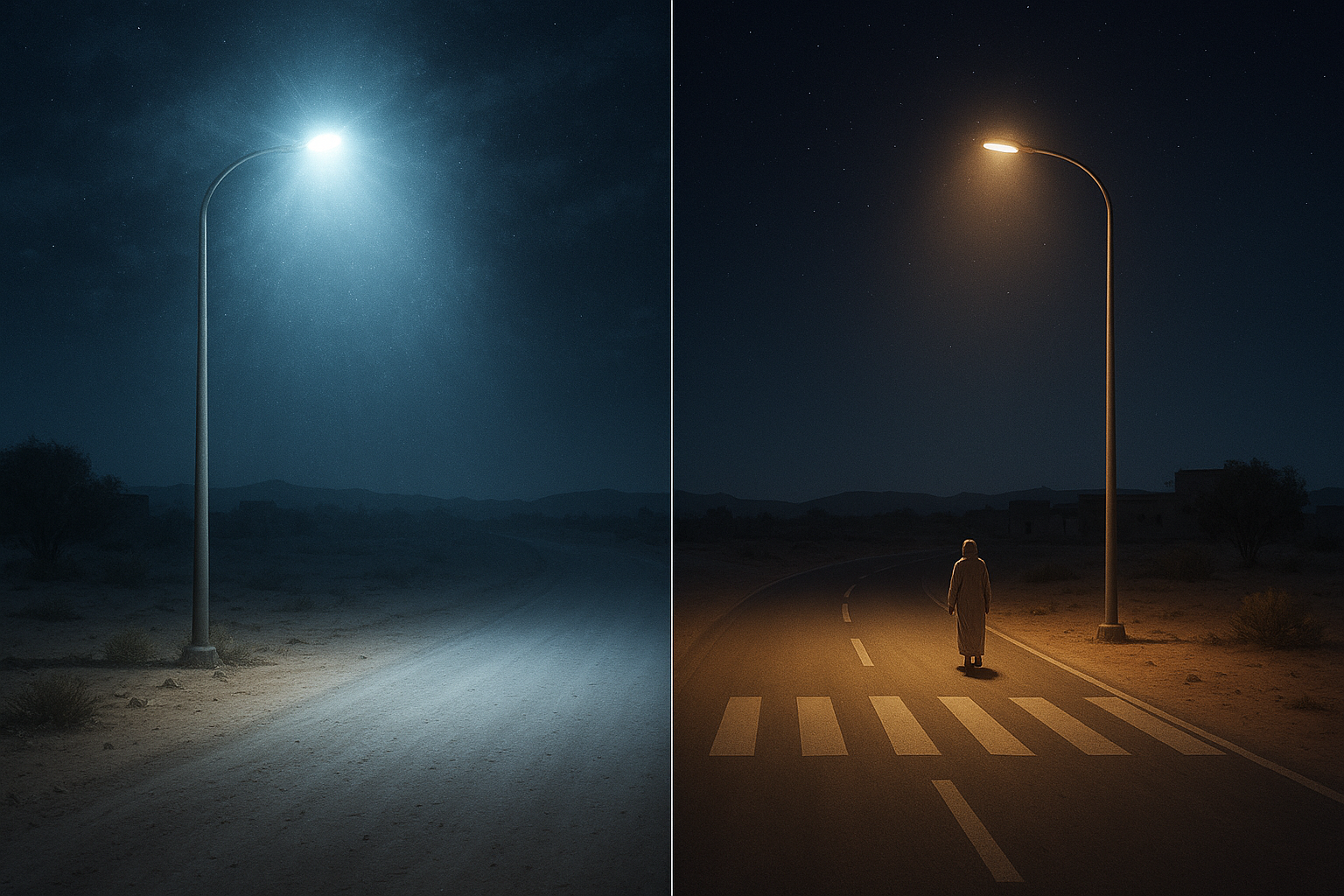
Dust and haze don’t just “dim” light—they can spread it out in the air. That scattered light becomes a faint bright layer over the scene.
In plain terms: the more light you throw into dusty air (especially at angles that go into the driver’s line of sight), the easier it is to create a glowing veil that washes out detail. That can cancel out the safety goal behind an ultra‑cool CCT request.
If you want the physics background, Robert Stull’s Practical Meteorology — Atmospheric Optics explains the main scattering mechanisms.
Think of veiling luminance as a thin “light fog” created by scatter and glare. It doesn’t help you see the target— it sits on top of the view and lowers contrast.
That’s why adding lumens (or pushing CCT higher) can sometimes make a road feel brighter but still make hazards harder to pick out at distance. In many Gulf night conditions, glare control and where the light goes matter more than simply dialing up CCT.
At typical roadway light levels, your eyes aren’t fully in “day mode” or “night mode.” They sit in between. That’s called mesopic vision.
In that zone, cooler, blue‑leaning light can look more efficient on paper at very low light levels. But in dusty air, scatter and glare can wipe out those gains. So don’t chase extreme CCT as a shortcut. Hit the right luminance and uniformity targets, and keep high‑angle glare under control.
For the technical framework, see the CIE’s TN 007‑2017 on mesopic photometry and the CIE 191 mesopic system overview.
The table below compares levers that specifiers can use to achieve the intent of 10000K ultra bright Middle East lighting without escalating CCT.
| Scenario | Primary lever | Expected outcome |
Dusty arterial at night | Reduce high‑angle intensity with cut‑off optics and shielding | Lower veiling luminance and improved detection distance |
Bright glass lobby | Target task luminance on signage and circulation paths | Crisper perception at 4000–5000K without color cast issues |
Coastal road with salt spray | Tempered glass lens with anti‑soiling coating and IP66 | Maintained photometry between cleanings, stable appearance |
Stadium parking | Uniform luminance design with limited glare at high angles | Better facial recognition and wayfinding at moderate CCT |
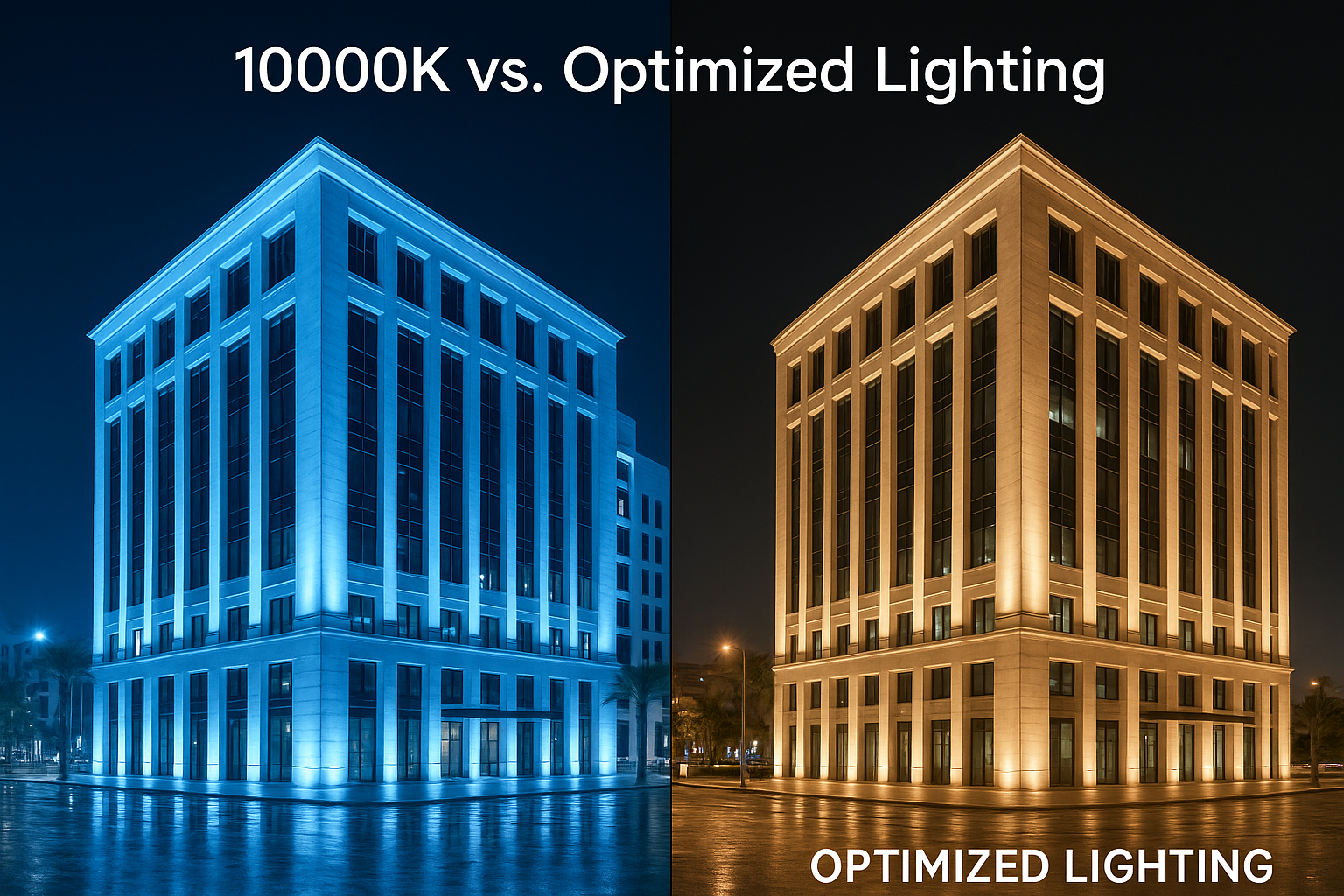
In many Gulf cities, a lot of the built environment is bright by day: pale stone, reflective façades, glossy floors, and large glass surfaces. At night, a very cool CCT can make edges look sharper and can make white materials read “cleaner,” especially in entrances, lobbies, and retail-facing areas.
It’s mostly a perception effect, not magic output. In many projects, you can get a similar “crisp” result with better beam control and targeted luminance at 4000–5000K.
Two habits drive this:
First, market memory. Earlier generations of LEDs and some commodity imports often leaned cooler, and people learned the shortcut: coolest white = brightest.
Second, what gets noticed on site. If glare is high and the scene has strong reflections, a cooler source can feel more intense to the eye—even if the measured light level is comparable. That’s also why glare control and aiming often change “brightness” more than another 1000–2000K of CCT.
In dusty or coastal environments, lenses and covers can haze over. Output doesn’t just drop—it becomes less even. That’s when end users start asking for “ultra bright” as insurance.
A more reliable approach is to treat maintenance as part of the spec:
Choose optical materials and sealing that stay clear longer (IP65/IP66 where appropriate).
Specify distributions that put light on the task, not into the viewing angle.
Plan cleaning intervals so performance doesn’t drift between visits.
If you strip the words down, the intent is usually one of these: longer detection distance, cleaner-looking surfaces, or stronger wayfinding.
So write the requirement around outcomes:
Define the target performance (luminance, uniformity, and glare limits) and require verified photometry.
Set a default CCT range that’s likely to look crisp (often 4000–5000K) unless the project specifically approves otherwise.
One short note: some GCC authorities and standards documents do set CCT caps for certain applications. It’s worth checking tender documents and local policy early so you don’t design around a CCT that can’t be approved later.
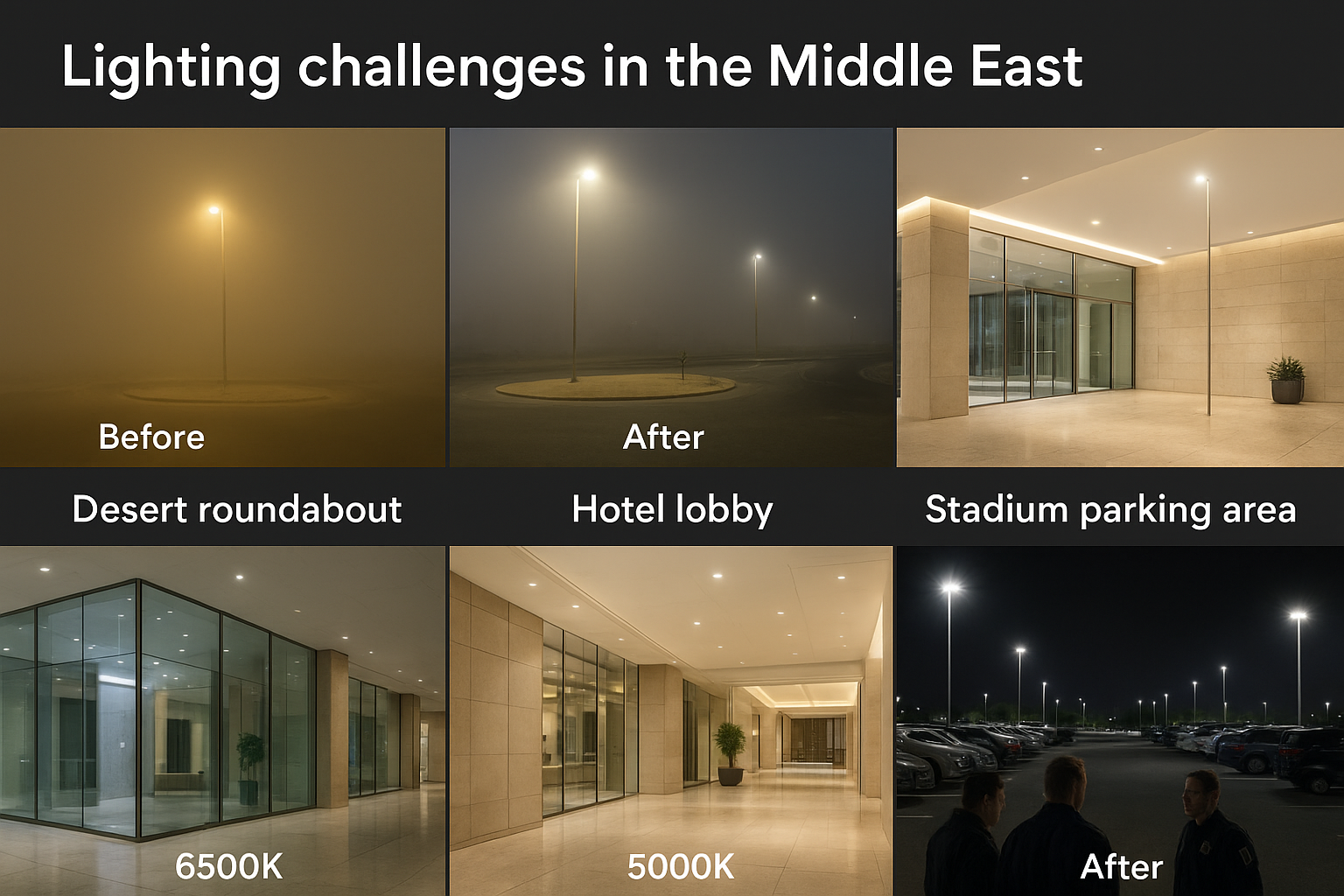
Problem. Nighttime contrast dropped during seasonal dust haze and complaints cited glare. Action. The team replaced a wide flood with an asymmetric road optic, added shields, and set CCT at 4000K within the local cap. Result. Less high‑angle intensity, lower veiling, better sign legibility, and fewer glare complaints.
Problem. Management sought a “crystal bright” look and initially asked for 6500K. Action. Designers targeted higher task luminance on circulation paths and signage, raised vertical illuminance for faces, and selected 5000K with high color fidelity. Result. The space reads crisp and premium without the cold cast or compliance risk for exterior accent zones.
Problem. Patrols reported difficulty recognizing faces at distance and glare near pole bases. Action. The team moved to luminance‑based layout with tighter cut‑off and added house‑side shields while keeping CCT at 4000–4500K. Result. Improved recognition and comfort with less spill to adjacent properties.
Q1. Does 10000K always improve road safety at night in dusty conditions?
A1. No. In dusty or hazy air, forward scatter raises veiling luminance, which can reduce contrast and detection distance. Focus on luminance targets, uniformity, and glare control before escalating CCT.
Q2. Is 6500K legal for public lighting in Saudi Arabia?
A2. The SASO 2927 workshop deck states a 3000–6000 K range for covered LED products. If your luminaire and application are within scope, 6500K can be non‑compliant. Verify scope and project requirements with the latest official documentation such as SASO 2927:2019.
Q3. What about Abu Dhabi’s rules for color temperature?
A3. The Abu Dhabi Dark Sky Policy caps street lighting at a maximum of 4000 K and sets 3000 K for public open spaces and building facades. Confirm the policy’s scope for your project and coordinate with the authority having jurisdiction.
Q4. How can I get the “crisp” look indoors without ultra‑high CCT?
A4. Raise task luminance on key surfaces, improve beam control, and choose high color fidelity at 4000–5000K. Many owners find the space reads just as bright and more comfortable.
Q5. What surge and protection levels are appropriate for Gulf sites?
A5. Coordinate integrated luminaire SPDs with panel‑level protection. Many resilient street luminaires specify common‑mode surge protection up to around 10 kV. Pair that with IP65 or IP66 and robust materials to maintain performance in storms and washdowns. For outdoor spectrum guidance that balances visibility and environmental impact, see DarkSky’s values‑centered outdoor lighting guidance.
Further reading
Saudi Arabia compliance context. See SASO’s Lighting Part III Standard Workshop (SASO 2927:2019) for the CCT and color tolerance notes.
Abu Dhabi policy. Review Abu Dhabi Dark Sky Policy V1.0 for application caps by category.
Roadway design priorities. Consult the IES Lighting Library entry for RP‑8 for luminance, uniformity, and glare guidance.
Mesopic application. See CIE TN 007‑2017 and the CIE 191 overview for applying the mesopic system.
DLC program. Explore DLC LUNA for outdoor spectrum guidance and categories.