Author: Huang Publish Time: 21-08-2026 Origin: Site


Commercial lighting design balances high-contrast emphasis with soft ambient illumination. While LED spotlights rely on parabolic reflectors and TIR lenses to project a tightly focused beam, LED panel lights use Light Guide Plates (LGP) and diffusers to flood spaces with omnidirectional light. Understanding these optical mechanisms helps specifiers select the right fixture, suppress glare, and craft effective lighting layouts.
An LED spotlight is designed around a single objective: maximum beam control and long-throw projection. Unlike legacy halogen lamps, modern LED spotlights utilize high-density Chip-on-Board (COB) LEDs paired with specialized optical reflection engines.
Key Takeaway: Spotlights convert raw, widely scattered light rays into a tightly controlled directional cone using specular parabolic reflection and Total Internal Reflection (TIR) optical lenses.
COB Point Source → Parabolic Reflector Wall → Specular Angle Bounce (θᵢ = θᵣ) → Directional Beam Cone (15°–60°)
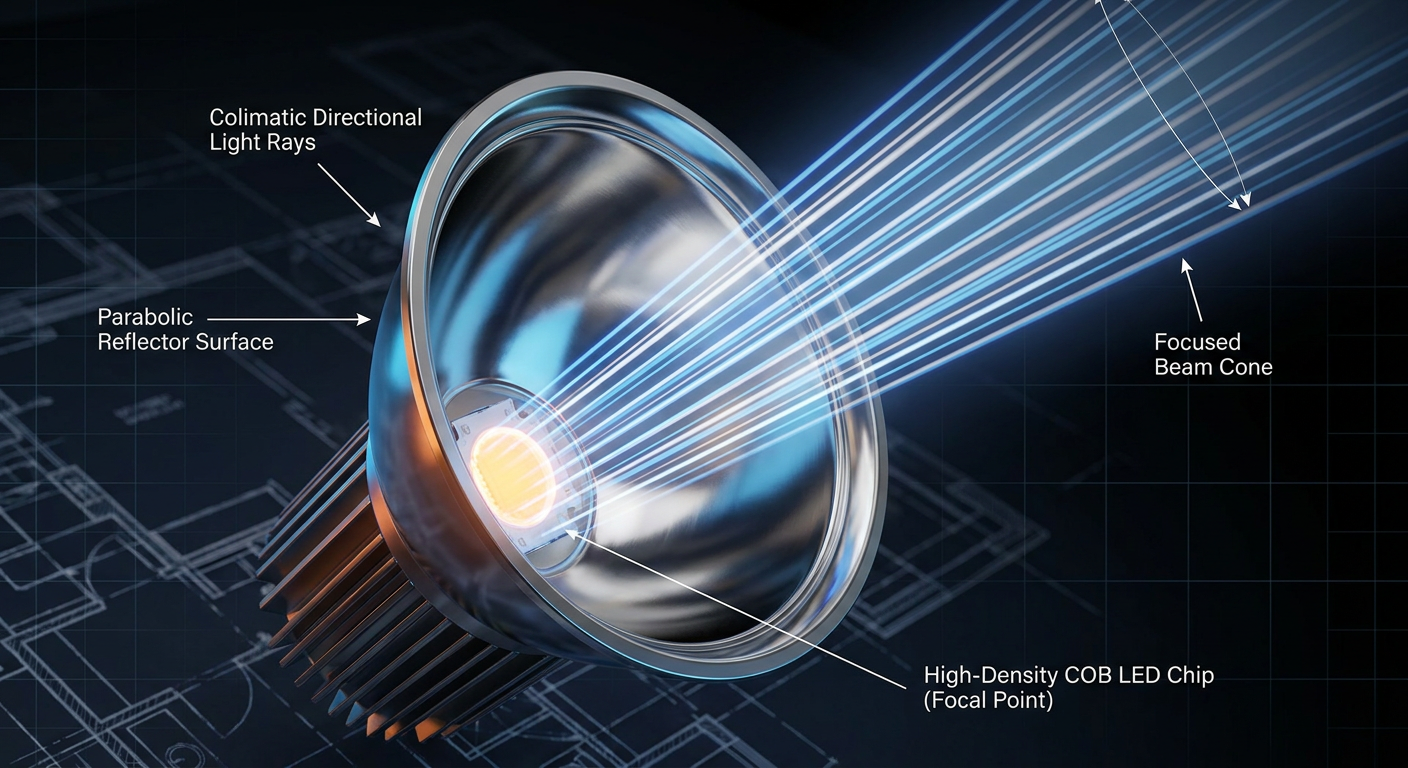
The primary optical engine inside a conventional spotlight is the parabolic reflector cup. The inner wall of the reflector cup is treated with high-reflectivity vacuum aluminum vacuum deposition or optical-grade specular polycarbonate, achieving a reflective efficiency exceeding 90%.
The reflector geometry follows a precise parabolic curve (y = ax⊃2;). When the COB LED is positioned at the parabola's exact focal point, divergent photons radiating from the chip hit the curved specular surface. According to the Law of Reflection, the angle of incidence equals the angle of reflection (θᵢ = θᵣ). Because every point on a parabolic surface redirects rays originating from its focus along parallel paths, the reflector collapses wide-angle emission into a uniform, forward-projected beam cone.
Narrow Beams (15°–24°): Achieved through deeper reflector cups with steeper parabolic curves, keeping light rays tightly concentrated along the central optical axis.
Medium Beams (36°–60°): Created using shallower reflector contours or faceted inner surfaces that deliberately introduce controlled light scatter across a wider spread.
For compact fixtures where deep reflector cups are physically impractical, optical engineers specify Total Internal Reflection (TIR) lenses molded from optical PMMA or PC.
A TIR lens combines dual optical mechanisms:
Central Refraction: The center portion of the lens acts as a collimating convex lens, bending direct forward rays into a parallel beam.
Peripheral Total Internal Reflection: The outer walls of the lens capture wide-angle sideways light. As these rays hit the glass-air boundary at an angle greater than the critical angle, 100% of the light bounces inward via total internal reflection without optical loss.
This hybrid refractive-reflective engine ensures that almost every photon emitted by the COB chip contributes to the central beam candlepower (CBCP).
High luminous intensity can cause visual discomfort if the bare light source is visible to occupants. Professional commercial LED spotlights and downlights solve this through deep optical shielding. By placing the COB chip deep within the fixture housing behind a dark anti-glare reflector cup or honeycomb louver baffle, the optical cutoff angle is restricted. Occupants see bright illumination on walls and merchandise while the ceiling fixture itself remains glare-free.
While spotlights focus light rays toward a specific point, LED panel lights distribute light rays across an entire room. Achieving a uniform, low-brightness surface requires an entirely different optical setup.
Edge SMD LEDs → Light Guide Plate (TIR Trapping) → Micro-Dot Matrix Scattering → Front Diffuser → 120° Lambertian Surface
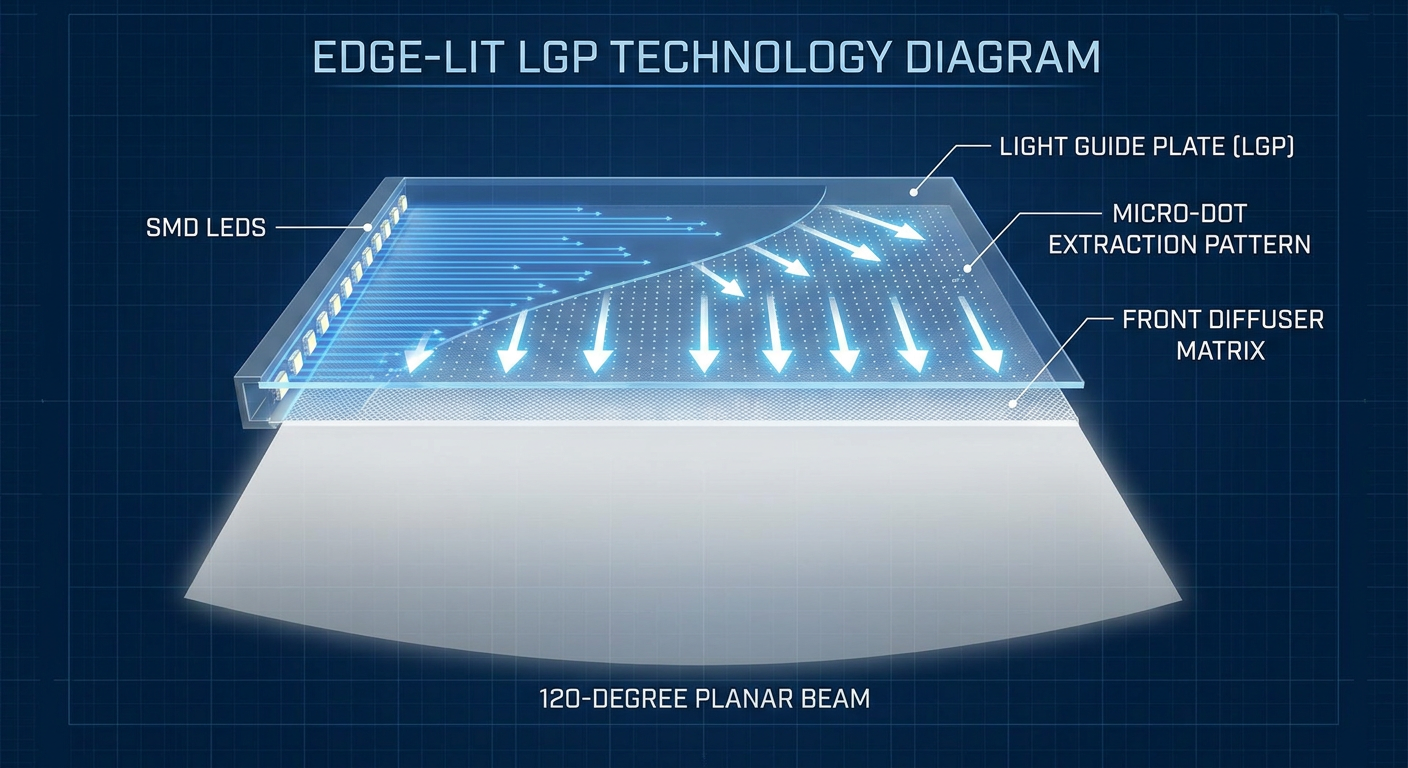
In an edge-lit LED panel light, surface-mounted (SMD) LED strips are installed along the inner perimeter of an aluminum frame, firing light sideways into an optical acrylic (PMMA) panel known as the Light Guide Plate (LGP).
When light rays enter the polished edge of the LGP, they strike the top and bottom interior surfaces at shallow angles. Because the refractive index of PMMA is higher than that of air, light becomes trapped inside the plate, traveling across the panel through continuous Total Internal Reflection (TIR).
To force the trapped light to escape downward toward the room, the back surface of the LGP is pattern-printed or laser-etched with microscopic optical dots.
When trapped light rays strike a micro-dot, their angle of incidence changes, breaking the conditions for total internal reflection.
The scattered photons escape through the front face of the acrylic plate.
A reflective PET backer sheet placed behind the LGP redirects any escaping rear photons back through the front surface.
Finally, the exiting light passes through a frosted PMMA or polystyrene front diffuser plate. The micro-textured diffuser scatters light rays in all directions via diffuse refraction, converting point-source edge emissions into a soft, uniform, 120° wide Lambertian planar beam with zero visible hot spots.
Pro Tip: For office environments requiring strict UGR < 19 glare standards, high-grade edge-lit LED panel light technologies combine laser-etched LGPs with micro-prismatic optical diffusers to redirect high-angle glare away from workers' sightlines.
To help commercial specifiers evaluate these technologies for project tenders, the table below highlights the physical, optical, and performance differences between LED spotlights and LED panel lights.
Optical Dimension | LED Spotlight | LED Panel Light |
|---|---|---|
Primary Light Engine | Single High-Density Point Source (COB LED) | Distributed Perimeter Strip (SMD) or Back-Grid Array |
Main Optical Component | Parabolic Reflector Cup or TIR Lens | Light Guide Plate (LGP) + Front Diffuser Plate |
Beam Angle Range | Narrow to Medium (15°, 24°, 36°, 50°, 60°) | Ultra-Wide / Omnidirectional (110°–140°) |
Beam Profile & Intensity | Concentrated cone with high Center Beam Candlepower (CBCP) | Flat, uniform, low-luminance Lambertian distribution |
Glare Suppression Method | Deep-recessed source, dark reflector cups, honeycomb louvers | Micro-prismatic diffuser matrix, large emitting surface area |
Light Projection Distance | Long throw; retains focused intensity across 3–8 meters | Short to medium throw; rapid intensity drop-off with distance |
Visual Atmosphere Created | Dramatic contrast, crisp shadows, high visual hierarchy | Soft ambient illumination, minimal shadows, high spatial clarity |
Typical Power Ranges | 7W, 12W, 20W, 35W, 50W | 18W, 36W, 40W, 60W, 72W |
Because spotlights offer directional beam control and high central intensity, they are essential tools for architects and lighting designers looking to create contrast, depth, and focus. Below are the primary commercial environments where spotlights are applied.
In retail lighting, general uniform lighting makes merchandise look flat and unappealing. High-end retail displays rely on a 3:1 or 5:1 contrast ratio—meaning the light level on displayed items is three to five times higher than the surrounding ambient light.
Key Beam Angles: 15° to 24° narrow spots.
Application: Pointing adjustable track spotlights directly at mannequins, jewelry showcases, and featured apparel highlights fabric textures, enhances color vibrancy (Ra > 90), and guides customer foot traffic toward premium sales displays.
Art galleries require exact light distribution to illuminate paintings and sculptures without spilling light onto surrounding walls or damaging sensitive pigments.
Key Beam Angles: 15° to 36° precision-cutoff spots.
Application: Spotlights equipped with framing shutters, zoom TIR lenses, and zero-UV optical glass project light exclusively within the boundaries of a canvas. This creates an illuminated artwork effect against darker gallery backdrops while protecting historical artifacts.
Luxury hotels use lighting layer strategies to establish warmth, sophistication, and intimacy.
Key Application Zones:
Hotel Reception Desks: Focused ceiling spotlights cast functional task illumination onto transaction counters without blinding guests.
Accent Wall Washing: Installing adjustable surface-mounted spot downlights along textured marble, stone, or wood feature walls reveals architectural depth through shadow play.
Dining Table Focal Lighting: Narrow 24° spotlights mounted above restaurant tables highlight food presentation while keeping aisle spaces gently dim.
Modern residential design frequently incorporates commercial-grade lighting principles to elevate interior aesthetics.
Cove Niches & Artwork: Recessed mini-spotlights mounted inside cabinetry, display shelves, and wall niches frame decorative accents.
Kitchen Islands: Multi-head adjustable spotlights mounted above kitchen islands provide task lighting for food preparation while creating an inviting gathering center.
For most commercial building projects, the optimal design is not choosing between spotlights or panel lights, but combining them strategically.
Use Panel Lights for Ambient Base Lighting: Install wide-beam LED panel lights in open offices, classrooms, conference rooms, and healthcare corridors to establish compliant, uniform background light (300–500 lux).
Layer Spotlights for Focal Interest: Superimpose narrow-beam spotlights over reception desks, brand logos, product displays, artwork, and seating nooks to break up visual monotony.
Explore Hybrid 2-in-1 Fixtures: For spaces with limited ceiling cutouts, specifiers can utilize 2-in-1 downlight and spotlight specifications that incorporate dual optical zones into a single recessed fitting.
When sourcing commercial luminaires, working with an experienced manufacturer ensures optical consistency, accurate IES photometrics, and reliable thermal management across all project SKUs. Explore KEOU Lighting's complete indoor commercial lighting solutions to request custom beam angle options, photometric layouts, and OEM project support for your next installation.