Author: Huang Publish Time: 31-08-2026 Origin: Site


Most orders that go wrong in LED tube procurement fail on one simple thing: the buyer assumed "T8" described the length. It does not. The number after the T is the tube's diameter in eighths of an inch, so a T8 is 8/8 in, or 25.4 mm across — nothing to do with how long it is.
That single misunderstanding causes reorders, delayed projects, and awkward conversations with customs. For distributors and contractors building an inventory that has to clear across the Middle East, Europe, and Africa, getting the sizing framework right from the start protects both margin and lead time.
This guide lays out the common LED tube lengths, what each T-size actually tells you, and the exact steps to measure a tube before you commit to an order.
The tubular sizing system uses eighths of an inch for the diameter. 1000Bulbs' T8 vs T12 conversion guide uses this same convention to describe the diameters of the three sizes you will most often stock:
T-size | Diameter | Base type | What it tells you |
|---|---|---|---|
T5 | 5/8 in ≈ 16 mm | G5 bi-pin | Slim, compact profile |
T8 | 1 in ≈ 25.4 mm | G13 bi-pin | Standard commercial workhorse |
T12 | 1.5 in ≈ 38.1 mm | G13 (wider) | Older, wider legacy format |
Because the diameter is fixed by the designation, a "T8 4-foot" and a "T8 2-foot" are the same tube diameter — only the length changes. The two things you must match are the diameter/base (which locks the socket) and the physical length (which locks the fit).
The base type is the second half of the puzzle. G5 pins sit 5 mm apart and take T5 tubes; G13 pins sit 13 mm apart and take T8 and T12 tubes. If the socket does not match the base, no length in the world will make the tube fit.
Lengths are quoted in both metric (mm) and imperial (feet), and the two systems do not always line up exactly. In European and Asia-Pacific markets you will chiefly see millimetre standards; in North America and parts of the Gulf you will see feet. Keep both in your catalogue table so your buyers never have to convert on the spot.
Tube size | Common lengths (ft) | Common lengths (mm) | Typical LED wattage |
|---|---|---|---|
T5 | 2 / 3 / 4 / 5 | 550 / 850 / 1150 / 1450 | ~8-20 W |
T8 | 2 / 3 / 4 / 5 / 6 | 600 / 900 / 1200 / 1500 / 1800 | ~10-30 W |
T12 | 4 / 5 / 6 / 8 | 1200 / 1500 / 1800 / 2400 | ~20-40 W |
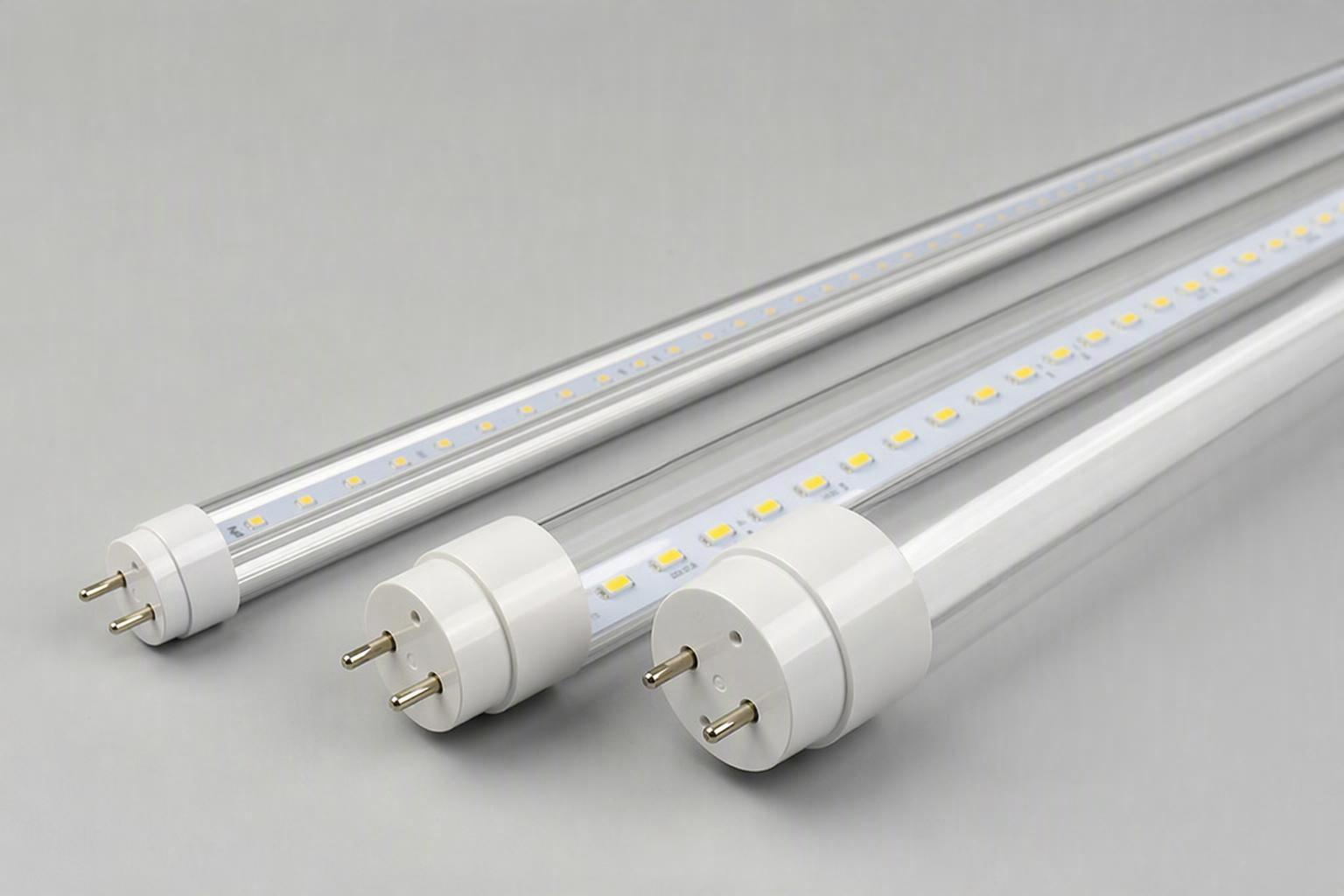
The 4-foot (1200 mm) T8 is the single most common LED tube size in commercial lighting, which is why it dominates troffers in offices, retail, schools, and warehouses. If you are building a broad stock for general resale, the 1200 mm T8 is where your volume sits.
The 1500 mm (5-foot) format appears frequently in the Middle East and European markets, especially in older industrial fixtures and corridor lighting. The 2400 mm (8-foot) T8 and T12 formats are less common but still show up in high-bay and warehouse linear fixtures.
One thing to watch: a nominal "4-foot" tube is not exactly 48 in / 1200 mm of glass. Whether you are checking a T8 LED tube length or a T5 LED tube length, the printed nominal size and the actual pin-to-pin dimension differ slightly — a 4-foot T8 measures roughly 1212 mm end-to-end (about 1198 mm between the pins). This matters when the fixture has tight tolerances, so always confirm the actual drawing dimension rather than trusting the nominal LED tube sizes label when you place a bulk order.
For most retrofit and general stock decisions, T8 is the practical default. PacLights' T5 vs T8 guide makes the rule clear: choose T8 when you are retrofitting a standard G13 fluorescent fixture in offices, retail, corridors, or warehouses; choose T5 only when the existing fixture is specifically built for G5 lampholders or a slim linear design is required.
Put more simply:
T8 — the retrofit standard. Matches the most common existing fixtures, easier to standardize across projects, broadest replacement stock. Your 1200 mm T8 covers most commercial jobs.
T5 — for slim, compact fixtures. Higher native output per length and a smaller diameter, but it only works where the luminaire is designed around G5 dimensions.
For new-build linear lighting where you control the luminaire, T5 can deliver high output in a slim housing. For retrofit and general resale across mixed projects, T8 is the lower-risk choice — fewer compatibility surprises, fewer SKUs to hold.
The single most common procurement error is ordering by remembered length instead of measured length. Take a tape measure, not your memory. Here is the routine to hand your team:
; a G5 base has pins 5 mm apart (T5). This decides whether the socket can accept the tube at all. 4. Check the socket wiring — especially for a Type B (ballast-bypass) LED retrofit, where shunted versus non-shunted tombstones changes the wiring, and whether your chosen tube works with the existing shunted/non-shunted socket configuration. 5. Record both nominal and actual length in your order notes so the factory quotation matches the fixture's tolerance.
If you are handling a volume of retrofit projects rather than one-offs, standardize the sizes you stock. Most job sites can be served by a 600 mm and a 1200 mm T8, with a 1500 mm line for the Middle East and European industrial fixtures. Fewer SKUs means less dead stock when a project changes.
The length and base get the tube into the socket; the ballast strategy decides whether it stays lit reliably. KEOU Lighting's fluorescent-to-LED retrofit guide breaks the retrofit into three classes that buyers should know before specifying:
Type A (plug-and-play) runs on the existing fluorescent ballast — fastest install, but tied to the remaining life of that ballast and its exact compatibility list.
Type B (ballast-bypass, direct wire) removes the ballast entirely and wires line voltage to the sockets — higher install labour but no future ballast failure to worry about.
Type C (external driver) uses a low-voltage tube with a dedicated external driver — the most efficient and the easiest to pair with 0-10V dimming and building controls.
For a cross-border buyer, the retrofit type is as important as the tube length, because it determines rework, spare-part risk, and whether the spec matches what the site's electrician is prepared to install. Confirm the socket type and the ballast strategy on the same call as the length.
If you are sourcing for the Gulf, Europe, or Africa, a few extra checks keep a well-priced tube from becoming a stranded one:
Voltage. Most LED tubes for these regions run at 220-240 V, but always confirm the driver's input range against the project's supply.
Certification. EU buyers typically expect CE/RoHS and relevant ErP reporting; Gulf markets look for SASO/SABER or GCC marks; African projects follow national IEC-derived standards. A tube shipped without the right mark risks hold-up at customs.
Consistency. When you are buying in container volumes, batch-to-batch consistency in length, wattage, and colour temperature matters as much as the first sample. This is where dealing with the manufacturer directly — rather than a trading middleman — pays off, because you can lock the exact specification, get a drawing of the actual dimensions, and request samples to verify before committing a full order.
For projects where you need a dependable linear fixture rather than a bare retrofit tube, your stock can extend into a broader indoor lighting product line that pairs tube replacements with panel and strip solutions across the same commercial spaces.
Pro tip: When your buyer asks for "a T8", the first question back should always be "what length, and what base?" Nail those two before discussing wattage or lumen. It is the cheapest way to avoid a wrong shipment.
Here is a lean way to decide which sizes to carry, sized for a distributor or contractor serving commercial projects:
The generalist's core: stock 1200 mm (4 ft) T8 and 600 mm (2 ft) T8. These cover the majority of office, retail, school, and corridor retrofits.
The regional add-on: carry 1500 mm (5 ft) T8 where your market uses the longer industrial and corridor format.
The specialised line: add a T5 range only if you regularly serve G5 slim fixtures or high-output linear luminaires.
Verify before volume: order samples of each SKU, confirm the actual measured length and base type, and keep the datasheet drawing on file before you place the container order.
If you hold a wide range of standards, this is where engaging a factory that supports OEM/ODM helps: you can have the exact lengths and specs tailored to your target markets rather than trimming your catalogue to whatever is in stock.
What is the most common LED tube length? The 1200 mm (4-foot) T8 is the most common size in commercial lighting, followed by the 600 mm (2-foot) and 1500 mm (5-foot) formats.
What is the meaning of the T in T8, T5, and T12? The number after the T is the tube diameter in eighths of an inch. A T8 is 1 inch (25.4 mm) in diameter; the length is a separate specification.
What is the difference between a T5 and a T8 tube? A T5 tube is slimmer (about 16 mm) and uses a G5 base, while a T8 is about 25.4 mm and uses a G13 base. They are not interchangeable because they have different diameters and bases.
How long is a standard T8 LED tube? The commonly stocked T8 lengths are 600 mm, 900 mm, 1200 mm, 1500 mm, and 1800 mm (roughly 2, 3, 4, 5, and 6 feet). The nominal label and the actual pin-to-pin length differ slightly, so check the drawing.
How do I know what size LED tube I need? Measure the existing tube from end-cap to end-cap in millimetres, and check the pin spacing to confirm the base (G5 vs G13). Then match both the base and the measured length to the replacement.
Getting the length right is the difference between a smooth retrofit and a container full of tubes that do not fit. If you are specifying or sourcing LED tubes for upcoming projects, request a spec pack with the actual dimensional drawings of the T8 and T5 lengths, along with the base and retrofit options, from the KEOU Lighting LED tube range. A quick sample check before your volume order is the surest way to protect your margin and your delivery schedule.