Author: Huang Publish Time: 09-05-2026 Origin: Site


Buying outdoor floodlights for UAE projects isn’t just about wattage and price. Housing material and front-cover material directly affect heat management, sealing stability, corrosion resistance, and how the luminaire looks and performs after years of sun, dust, and rain.
This guide breaks down why the die-cast aluminum housing + tempered glass combination is common in commercial-grade floodlights—and, more importantly, what a buyer should verify before approving a supplier.

Before you compare suppliers, align on the conditions that usually drive premature failures:
High ambient temperature (thermal stress and faster lumen depreciation if heat isn’t managed well)
Dust and fine sand (ingress risk; maintenance burden)
Strong sun / UV exposure (lens aging and discoloration)
Wind-driven rain and washdowns (sealing quality matters)
Coastal salt spray (when applicable) (accelerates corrosion)
If you don’t document these conditions in your RFQ, you’ll end up comparing “IP66” labels and marketing phrases instead of real durability.

A die-cast aluminum housing is attractive for procurement because it can combine structure + heat spreading + sealing surfaces into one rigid part.
LEDs still produce heat. If that heat can’t move away from the LED board into the housing and air, you’ll see faster lumen depreciation and higher failure risk.
Die-casting makes it easier to build a single-piece housing with integrated fin geometry and consistent contact areas, which is one reason aluminum die-cast housings are commonly used for LED fixtures. Neway Precision explains the thermal-management rationale in its overview of the advantages of aluminum die castings in LED lighting.
Buyer check: Ask for thermal design evidence that relates to your ambient temperatures (not just “good heat dissipation”). Examples include temperature test conditions, driver placement details, and whether the housing design supports stable performance in high-heat installations.
Outdoor sealing depends on mating surfaces and gasket compression staying stable over time. A rigid die-cast housing can reduce the chance of housing distortion that creates micro-gaps.
Buyer check: Look for clear sealing details: gasket material, gasket placement, cable entry design, and how the front glass is clamped.
Procurement teams often underestimate handling damage. A stiffer housing is less likely to deform during shipping, warehouse movement, and site installation.
Buyer check: Ask what the supplier does to reduce transit damage (packaging, drop testing, spare glass availability, and how claims are handled).

A front cover isn’t cosmetic. Over time, it affects light output, beam quality, cleaning effort, and perceived quality.
Compared with many plastics, glass tends to maintain clarity better under long-term UV exposure. In procurement terms, this reduces the “it looked fine at install, then got hazy/yellow later” risk.
Revolve LED summarizes practical tradeoffs in its tempered glass vs polycarbonate lens comparison (even though it discusses wall packs, the lens-material logic is similar).
Dust and cleaning can scratch softer lens materials. Scratching increases scattering and can reduce useful light over time.
Buyer check: Ask about cleaning recommendations and whether the supplier has guidance for dusty environments (e.g., dry wiping vs wet cleaning).
For higher-power floodlights, front-face thermal stability matters. Glass generally handles heat well compared with many plastics.
Polycarbonate typically wins for brute-force impact resistance. If your project is vandalism-prone or exposed to frequent debris impact, it’s worth evaluating whether tempered glass is acceptable—or whether you need additional protection (guards) or a different lens strategy.
Pro Tip: Treat lens choice as a risk decision, not a spec-sheet checkbox. If breakage is the main risk, polycarbonate can be the safer option; if UV aging and long-term clarity are the main risk, tempered glass often wins.
Many buyers see “IP66” and assume “fully waterproof.” That’s not what the code says.
An accessible summary of the IEC 60529 Ingress Protection system explains that IP66 indicates dust-tight (6) and protection against powerful water jets (6)—not continuous immersion. See the IP ratings explained (IEC 60529) overview, and the IEC 60529 IP ratings guide for additional context.
IP66 is meaningful for outdoor rain and washdown exposure.
IP66 is not a promise that every weak point is solved (cable glands, venting membranes, driver compartment layout, condensation control).
Two fixtures can both be “IP66” but behave very differently after months of thermal cycling.
Buyer check: Ask what exactly was tested, and request test documentation aligned with the protection claim.
You asked to include operating temperature range—and that’s smart, especially for UAE outdoor installations. In spec language, this is often written as an operating temperature range LED floodlight requirement (with test context).
The mistake is demanding a number without defining the context.
Ask the supplier to state operating temperature range with:
Ambient temperature range (not just a component rating)
Whether the range applies to the full luminaire (housing + driver) in continuous operation
Derating behavior (what happens at high ambient: reduced output, protective shutdown, or shortened lifetime)
Test conditions: mounting orientation, airflow assumptions, and whether it’s enclosed
If the luminaire is intended for high-power use, ask how driver temperature is managed.
Request evidence that the claimed range is supported by testing or validated design.
⚠️ Warning: If a supplier provides an “operating temperature range” with no test context (or it conflicts with the driver’s own rating), treat it as a red flag.
Use this as a practical comparison tool when shortlisting options. If your RFQ explicitly states the outdoor LED flood light housing material (e.g., die-cast aluminum vs sheet metal) and the lens/cover material (e.g., tempered glass vs polycarbonate), supplier comparisons become much easier—and more defensible.
Housing is specified as die-cast aluminum (not “aluminum” generically).
Front cover is specified as tempered glass (and thickness/retention method is described).
Surface treatment/coating process is stated (important for corrosion resistance).
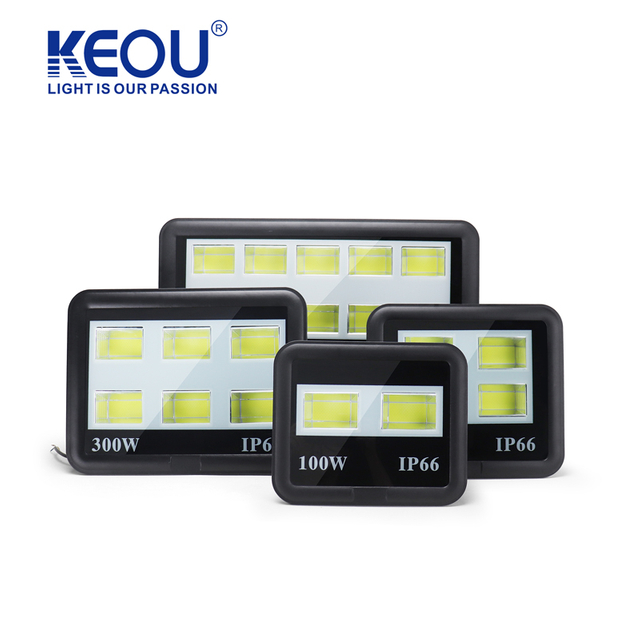
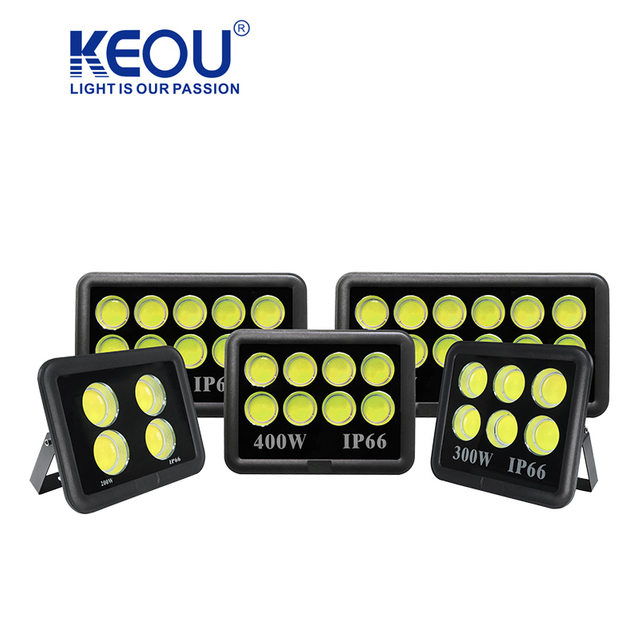
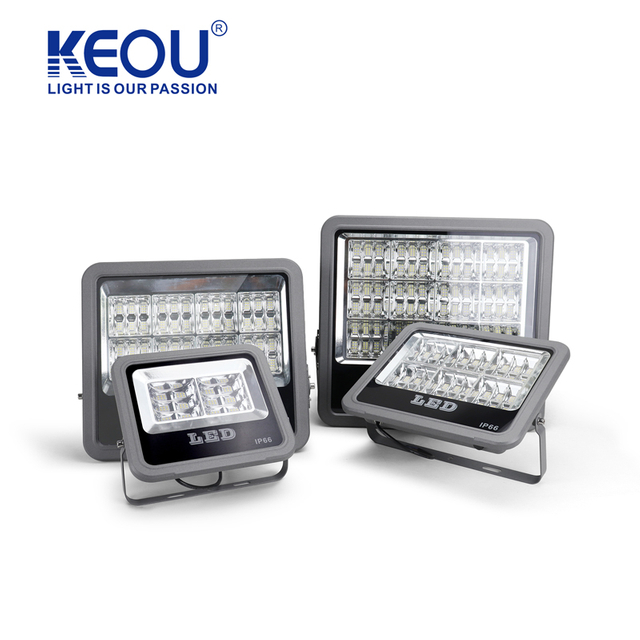
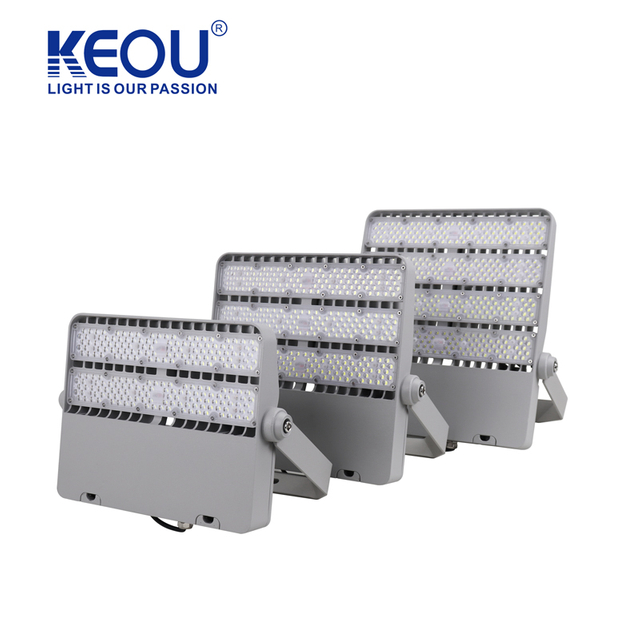
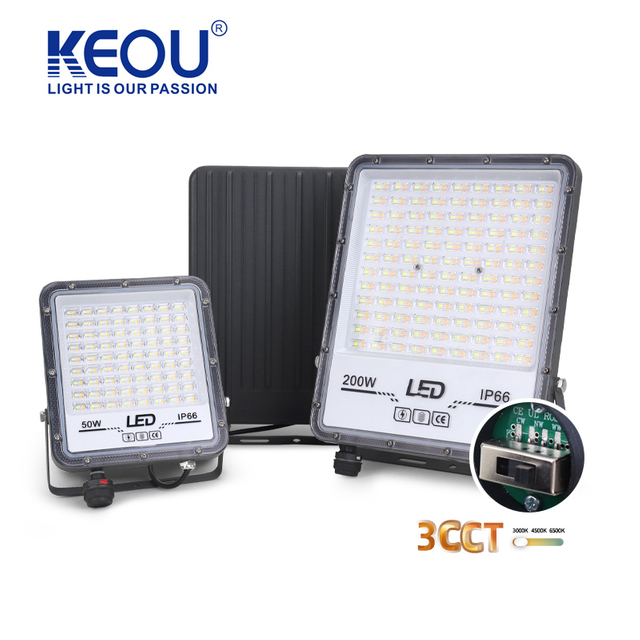
Example of how a supplier might describe this combination: KEOU’s “Three-color DOB LED Floodlight” materials description explicitly mentions a die-cast aluminum body and tempered glass.
IP rating is clearly stated (e.g., IP66 LED floodlight).
The sealing approach is described (gasket, compression method, cable entry).
The supplier can explain where failures usually occur and how their design reduces risk.
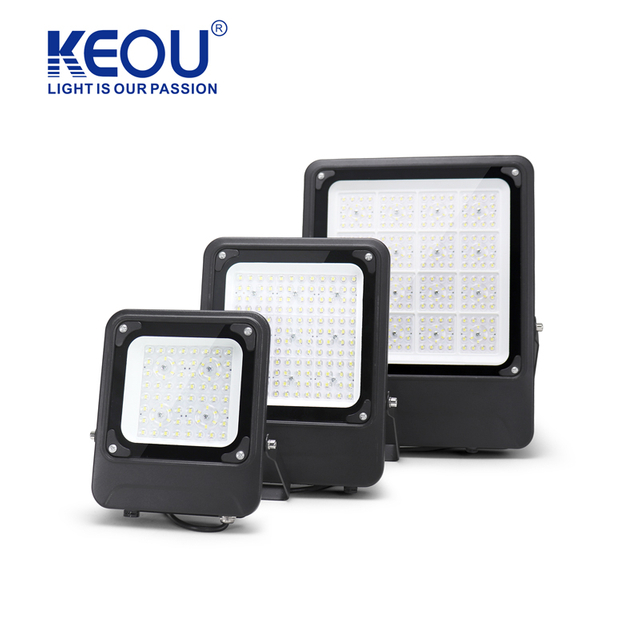
For a product-family reference point, see the KEOU LED flood light series overview.
Supplier can explain the thermal path from LED board to housing.
Heat sink features are functional (not only aesthetic fins).
Driver placement and heat exposure are addressed.
Operating temperature range is provided with context (ambient, mounting, derating).
Supplier supports high-heat installation scenarios relevant to Gulf sites.
Clear QC checkpoints (incoming materials, assembly, sealing inspection).
Stable BOM control (so batch-to-batch performance is consistent).
Spare parts availability and support process (especially for glass).
“IP66” label without clear sealing design explanation.
No mention of how the supplier prevents lens aging (or the lens material is unclear).
Housing described only as “aluminum” with no manufacturing method (die-cast vs sheet metal vs extrusion).
Operating temperature range stated with no ambient/test context.
If you want to shortlist quickly without increasing return risk, collect three inputs and send them to the supplier’s engineering team:
Installation environment (heat, dust, coastal salt exposure)
Required IP rating (IP66 or higher if your use case demands)
Your target lumen/wattage and mounting constraints
If you’re evaluating suppliers now, you can also reference KEOU Lighting as a starting point for outdoor floodlights and OEM/ODM discussions via the Outdoor Flood Light product category.