Author: Huang Publish Time: 16-03-2026 Origin: Site


If you manage or design a leisure/training natatorium, here’s the deal: great lighting is about more than seeing the lane rope.
It’s about comfortable sightlines for lifeguards, safe transitions in wet rooms, and calm, uniform light that doesn’t shimmer or sting.
▌This guide focuses on indoor swimming pool lighting for leisure/training pools (≈200–300 lux targets in EN/IES contexts), plus the wet ancillary areas (showers/changing rooms) and outdoor perimeter circulation.
▌You’ll get practical targets, placement tactics, low‑flicker guidance, and three scenario diagrams you can hand straight to your contractor.
| Scenario | Typical targets (maintained) | Uniformity goal | Glare/optic notes | Protection & materials |
High-bay natatorium (over water) | ≈200–300 lux (EN-aligned); ≈30–50 fc (RP‑6 mapping) | Uo ≥ 0.5–0.6 over water | Avoid shallow angles; use honeycomb/louvers; narrow‑to‑medium beams; consider asymmetry | IP65+ enclosure, sealed drivers, SS316 hardware, corrosion‑resistant coatings |
Showers & changing rooms | Zone 1: IP65 recommended (IPX4/IP44 min); Zone 2: IP44 min; Zone 0: IP67 + SELV ≤12 V | Even, low glare | Opal/microprismatic diffusers; anti‑fog optics | IK08+ housings, SS316 screws, robust gaskets |
Outdoor perimeter paths & entrances | ≈5–10 lux average (up to 15 lux busy areas) | Uo ≥ 0.3–0.4 | Full‑cutoff wall/bulkhead optics; ensure verticals for recognition | IP65/66, IK08–IK10, marine‑grade finish |
▌Notes: Ranges reflect EN 12193 summaries for pools and IES RP‑6 recreational/training mappings via UFC 3‑530‑01; bathroom zones per IEC 60529/BS 7671 practice; outdoor paths aligned with EN 13201 P‑classes and UFC guidance. Exact values depend on local code and class.
Water is a specular mirror. Luminaires aimed at shallow incident angles create mirrored streaks and hot spots that distract swimmers and lifeguards.
To reduce veiling reflections:
Place and aim from the deck zones rather than directly over center lanes; steeper geometry shifts reflections away from typical sightlines.
Control high‑angle luminance with secondary shielding: honeycomb louvers, microprisms, or asymmetrical optics.
Where architecture allows, add a portion of indirect light off a matte ceiling to soften the scene.
For leisure/training quality, CRI ≥ 70–80 at around 4000 K is common; stricter TLCI/CRI is a broadcast topic and out of scope here.
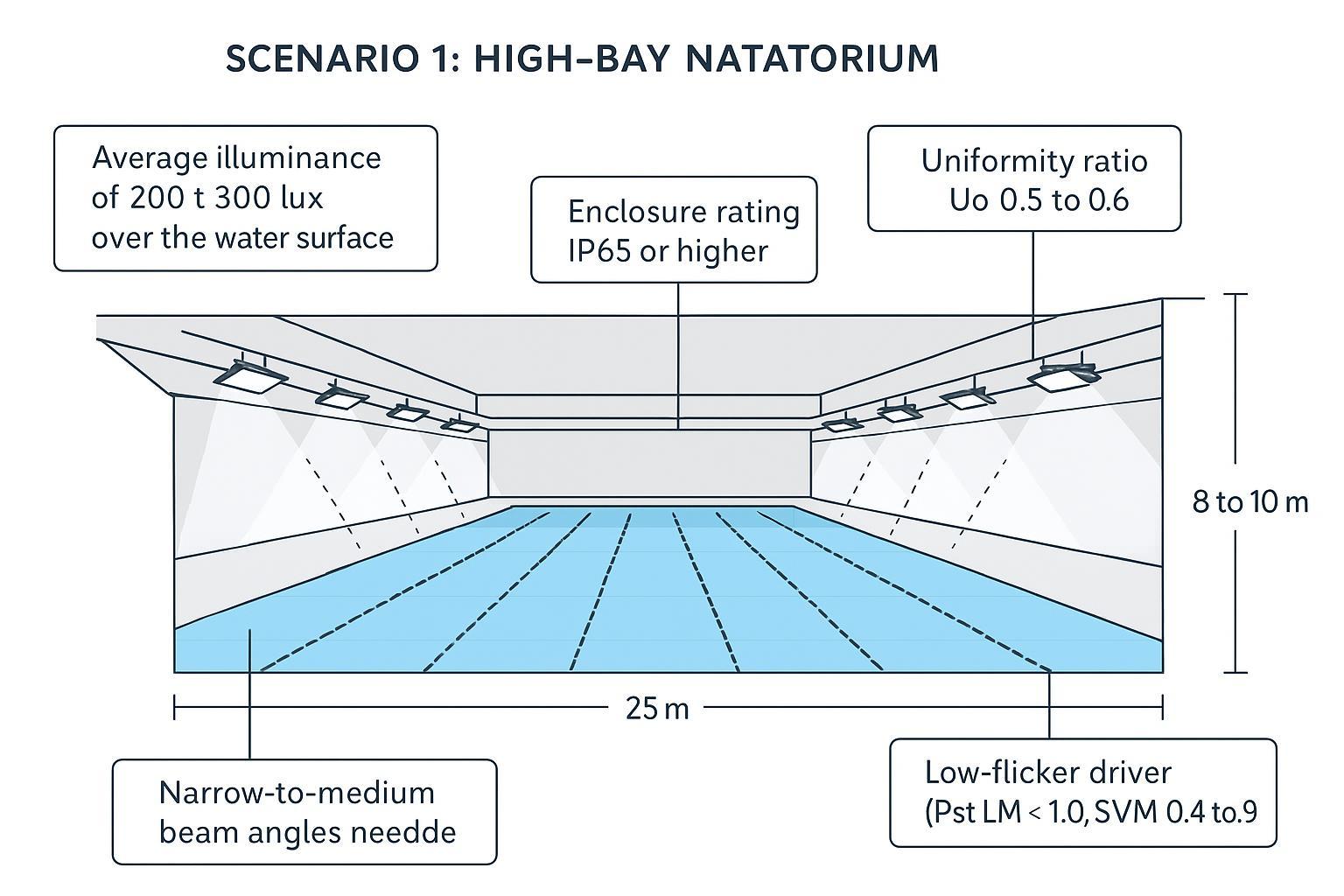
Aim for about 200–300 lux over the water (or roughly 30–50 footcandles) and keep the light as even as possible across the lanes.
For this kind of pool hall, the fixture type that usually fits best is a sealed LED high‑bay (often called a “natatorium-rated” high‑bay) with glare control—think honeycomb or louvered optics—so the water doesn’t sparkle with harsh reflections.
In most leisure facilities with 7–10 m ceilings, place rows along the deck edges and aim the light across the pool, not straight down the center. That layout helps lifeguards see clearly without bright streaks bouncing off the water.
Because pool air is humid and can be corrosive, choose housings that are at least IP65, with corrosion‑resistant hardware (SS316 is common) and good sealing around the driver compartment.
Finally, pick drivers that stay low‑flicker when dimmed. Set up a few scenes—open swim, training, and cleaning—and confirm the lighting still looks stable (no visible shimmer) at the dimmed levels you’ll actually use.
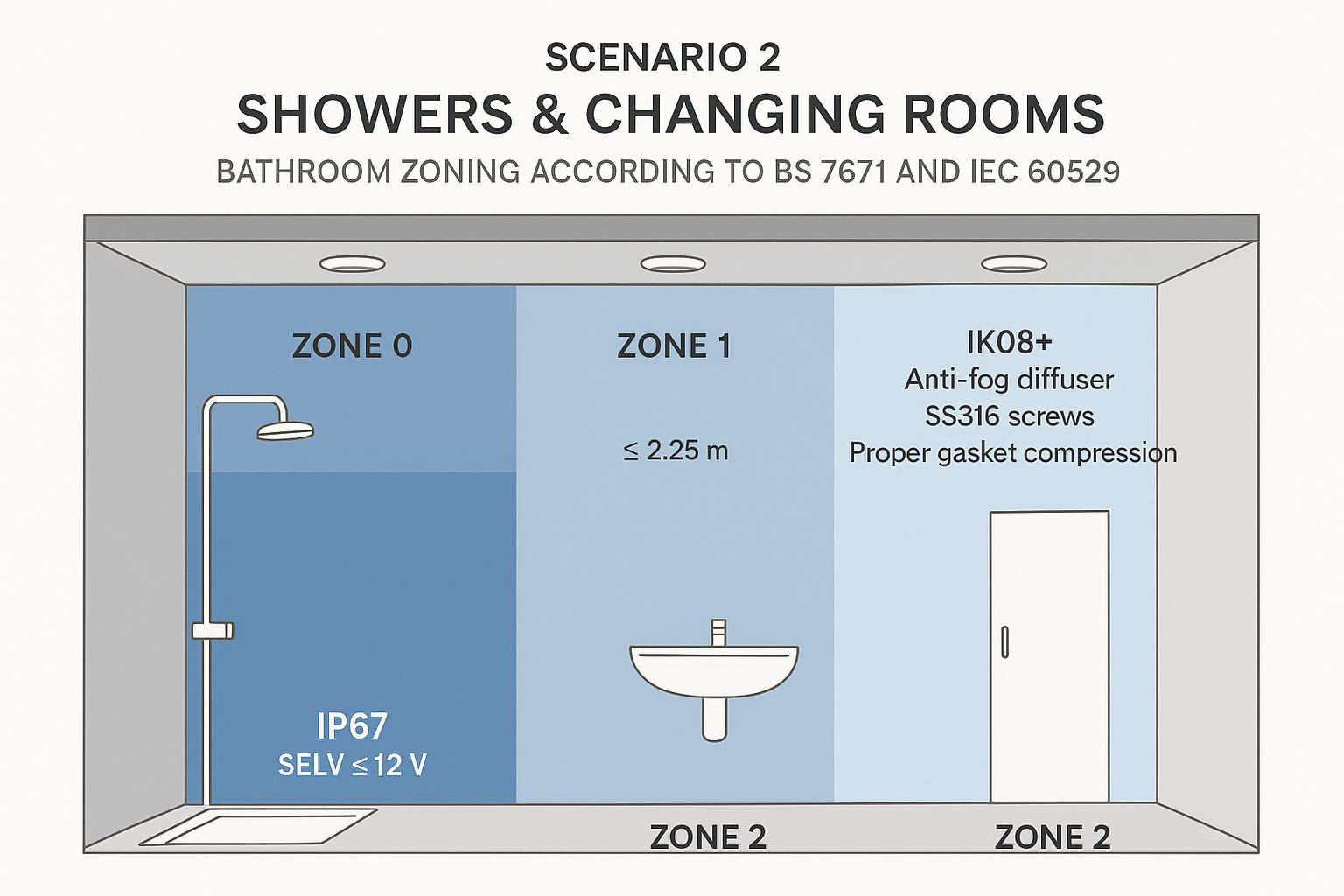
Apply IEC 60529/BS 7671 zoning: inside the shower (Zone 0) use SELV ≤12 V with IPX7/IP67; above the shower up to 2.25 m (Zone 1) specify at least IPX4/IP44, but IP65 is the practical norm in jet/washdown conditions; around the area (Zone 2) maintain IPX4/IP44 minimum. Choose opal or microprismatic diffusers for comfort, and favor IK08+ housings with anti‑fog sealing. Use SS316 screws/hardware and re‑seat gaskets carefully after servicing to preserve ingress protection.
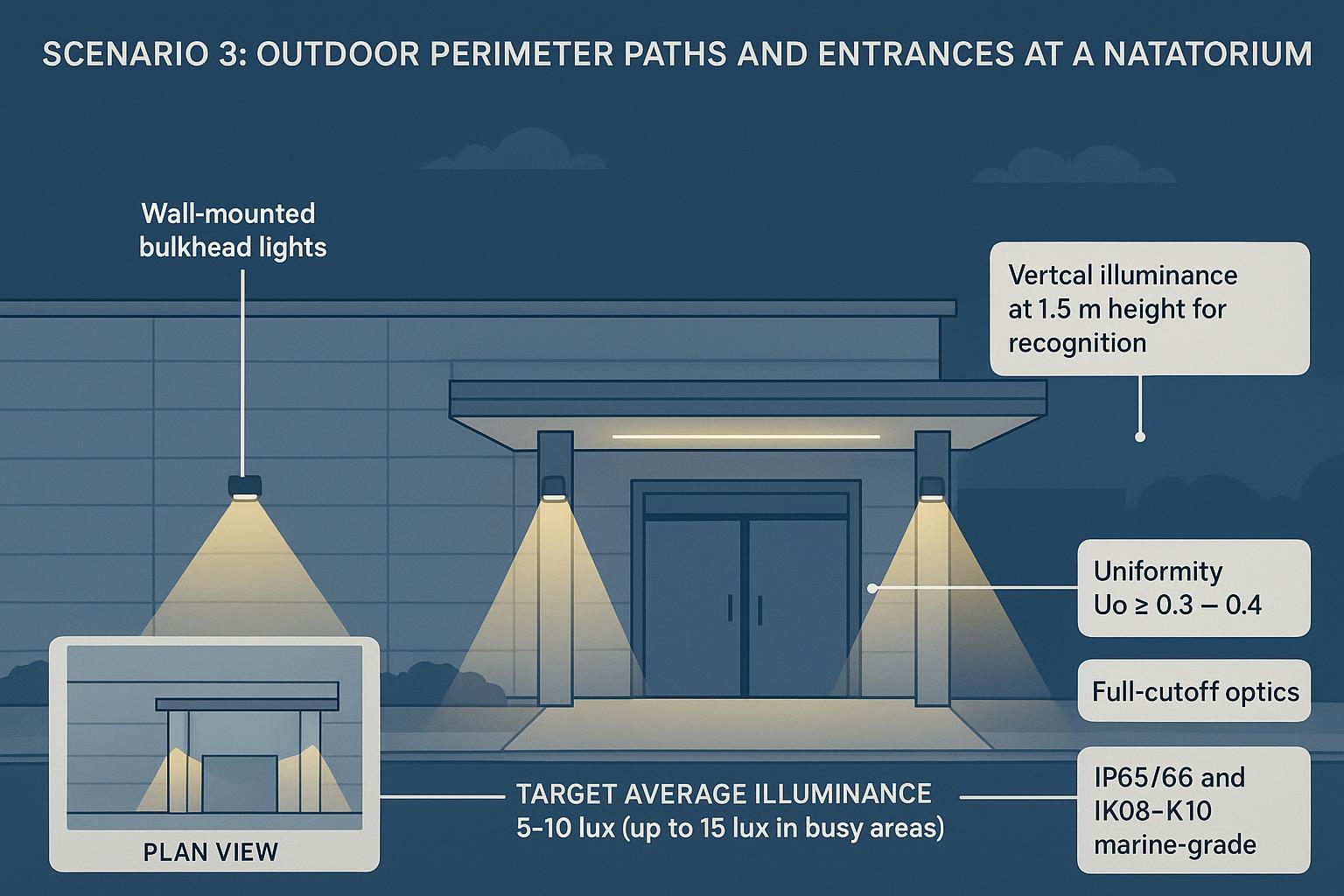
Design toward ≈5–10 lux average (rising toward 15 lux in busy or security‑sensitive segments), with Uo ≥ 0.3–0.4 in line with EN 13201 P‑classes and the UFC’s pedestrian pathway ranges (~0.6–1.0 fc average). Use full‑cutoff wall lights and moisture‑proof ceiling bulkheads under canopies to limit glare and trespass, and ensure useful vertical illuminance at about 1.5 m for recognition at entries. For durability, select IP65/66 housings with IK08–IK10 impact ratings and marine‑grade finishes where chlorides or chloramines are present; seal glands and conduits to prevent ingress.
Temporal light artifacts are distracting around moving water and athletic activity, so specify low‑flicker drivers and validate performance—not just datasheets.
A practical target is Pst LM < 1.0 with SVM ≤ 0.4–0.9 depending on jurisdiction, and—above 100–120 Hz—percent flicker in the ≲10–20% band recommended in IEEE 1789’s low‑risk envelope.
In commissioning, treat flicker like any other performance check:
Measure with a compliant flickermeter per IEC TR 61547‑1.
Capture at least 180 seconds.
Repeat at multiple dim levels on typical site power.
If filming/streaming occasionally occurs, prioritize drivers with high operating frequency and low modulation depth to avoid rolling bands. For methodology and acceptance context, refer to the Gigahertz‑Optik explainer on Pst LM/SVM and Signify’s NEMA77/IEEE 1789 overview.
Q1:How many fixtures do I typically need over a leisure/training pool?
There isn’t a universal count. Start with your pool dimensions, ceiling height, and a target of ≈200–300 lux (maintained), then run a photometric study to check uniformity and glare. In practice, spacing is driven more by optic distribution and aiming than by “watts per square meter.”
Q2:What CCT and CRI make sense for indoor swimming pool lighting?
For leisure/training, 4000 K is a common choice because it reads neutral and supports clear visibility. CRI ≥ 70–80 typically works for this tier. If your facility has broadcast or high-speed filming requirements, you’ll likely need a separate, stricter evaluation.
Q3:How can I reduce glare for lifeguards without over-lighting the space?
Use geometry first (avoid shallow beam angles to the water), then add shielding (louvers/honeycomb) to cut high-angle luminance. A small shift in aiming or optic choice can reduce reflected hot spots more effectively than simply raising light levels.
Q4:Should I worry about corrosion even if a fixture is “IP65 rated”?
Yes. IP is about ingress, not chemical resistance. Natatorium air can be corrosive due to chloramines and high humidity, so specify corrosion-resistant finishes and hardware (often SS316), and treat gasket reseating and seal integrity as part of routine maintenance.