Author: Huang Publish Time: 19-03-2026 Origin: Site


The Canton Fair Lighting Exhibition is where overseas wholesalers and distributors compress months of supplier scouting into days. This guide explains why it matters in 2026, where lighting sits inside Phase 1, how the zones differ, which 2025–2026 LED trends are actually procurement‑ready, and what documents to request on site—plus a soft invitation to connect with our team at the show.
The lighting segment of the Canton Fair (officially the China Import and Export Fair) remains a cornerstone for global sourcing thanks to its breadth of exhibitors, commercial‑grade product depth, and access to compliance documentation.
The Canton Fair was founded in the spring of 1957 and is held biannually in Guangzhou. It is co‑hosted by China’s Ministry of Commerce and the People’s Government of Guangdong Province. In 2007, the fair set up the International Pavilion to foster two‑way trade, a milestone often cited in official materials. For category placement and high‑level background, see the fair’s official introduction hub, which also outlines Phase 1 categories including Light & Electrical and its Lighting Equipment section, as well as buyer guides noting the current structure and change notices: see the official intro hub under Phase 1 categories in the Light & Electrical area in the fair’s overview page at the Canton Fair official introduction hub and the Overseas Buyer Attendance Guide (2024, official).
Lighting vendors exhibit in Phase 1 within the Light & Electrical category under the “Lighting Equipment” section, per multiple session documents. That concentration allows buyers to benchmark commodity SKUs and advanced commercial solutions side by side, gather LM‑79/LM‑80 documentation and safety listings, and map customization feasibility before factory visits.
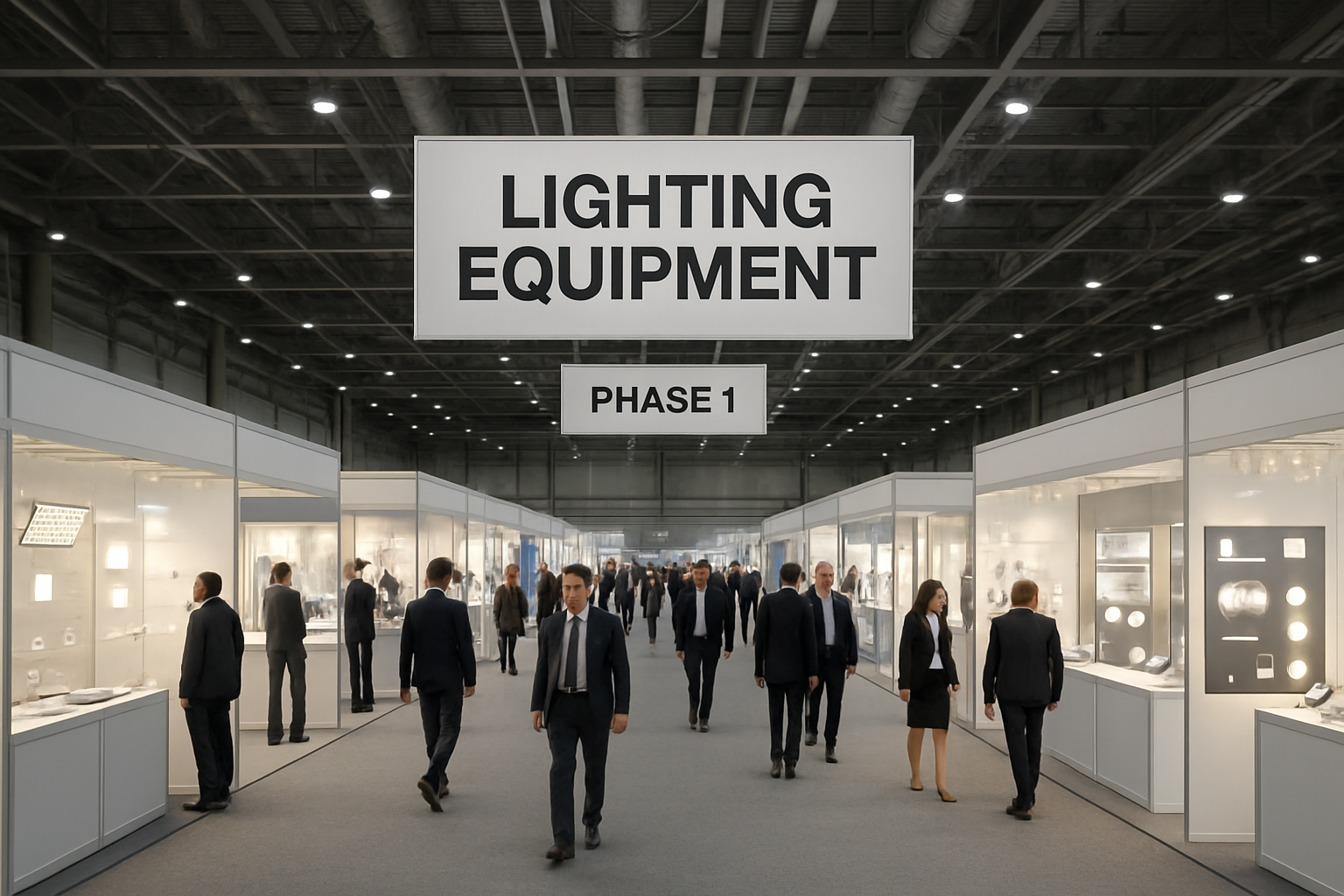
Lighting products are found in Phase 1 under Light & Electrical → Lighting Equipment. Layout and hall numbering can change by session, so rely on the current official maps and exhibitor directory near show time.
For authoritative confirmation of placement, use the official introduction hub’s Phase 1 listing and cross‑check with a recent exhibition sections PDF that includes Lighting Equipment under Light & Electrical (for example, this official session document: Exhibition Sections PDF (2024, official)). Treat hall numbers as provisional until the 2026 map posts.
If you have one day, prioritize: indoor commercial luminaires first (panels/downlights/track), then controls, then outdoor/site. With two days, separate commodity benchmarking from customization scouting: day one for breadth (catalog review and quick samples), day two for deep dives (custom optics, drivers, controls, and contract terms). Think of it like building a funnel: top (broad scan), middle (shortlist), bottom (documentation and samples).
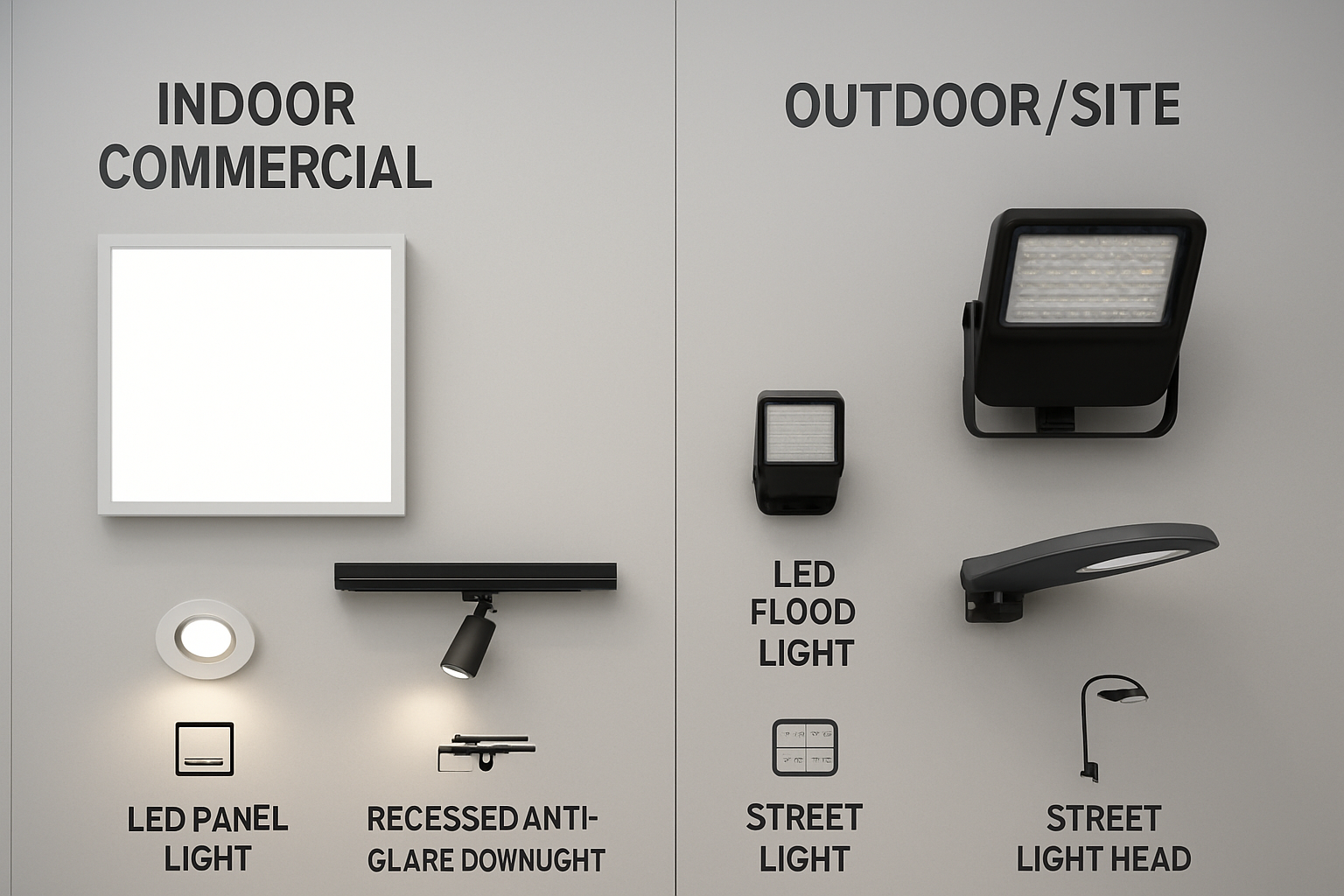
These typologies reflect common Phase 1 lighting exhibits. Use them to structure your walk and your checklists.
What you’ll see: LED panel lights (edge/back‑lit), linear/troffer systems, adjustable and anti‑glare downlights, track heads, and 48V magnetic systems.
How to evaluate on site:
Review photometric files (IES) for distribution and efficacy. Ask for LM‑79 test reports for the finished luminaire.
Check CRI targets and R9 for retail/hospitality SKUs. Assess flicker performance and dimming curves at low levels.
Confirm dimming/control interfaces (0–10V, DALI, phase‑cut). If wireless is needed, ask about Bluetooth Mesh or Zigbee options and commissioning flows. For examples of common commercial form factors and customization levers, see the panel and track categories at Panel Light and Track Light.
What you’ll see: high‑CRI spot modules, beam‑angle options and accessories (honeycomb, snoots), tunable‑white demos, and scene presets.
How to evaluate on site:
Check beam uniformity and edge quality on a wall or mannequin; swap optics to compare angles.
Verify color consistency across CCTs and smooth dimming to low levels without shimmer.
Inspect anti‑glare features: deep regress, baffles, honeycomb, and lensing; request UGR guidance based on IES files.
What you’ll see: flood lights (COB/SMD/DOB), area/street luminaires, wall packs, bollards, and some solar or hybrid solutions.
How to evaluate on site:
Confirm ingress protection, surge ratings, and IK/mechanical robustness. Inspect thermal paths and corrosion protection.
Ask about optics for spill control and light trespass; request cut‑off options and visor kits.
For project categories, cross‑reference destination‑market standards and, where rebates matter, program eligibility pathways.
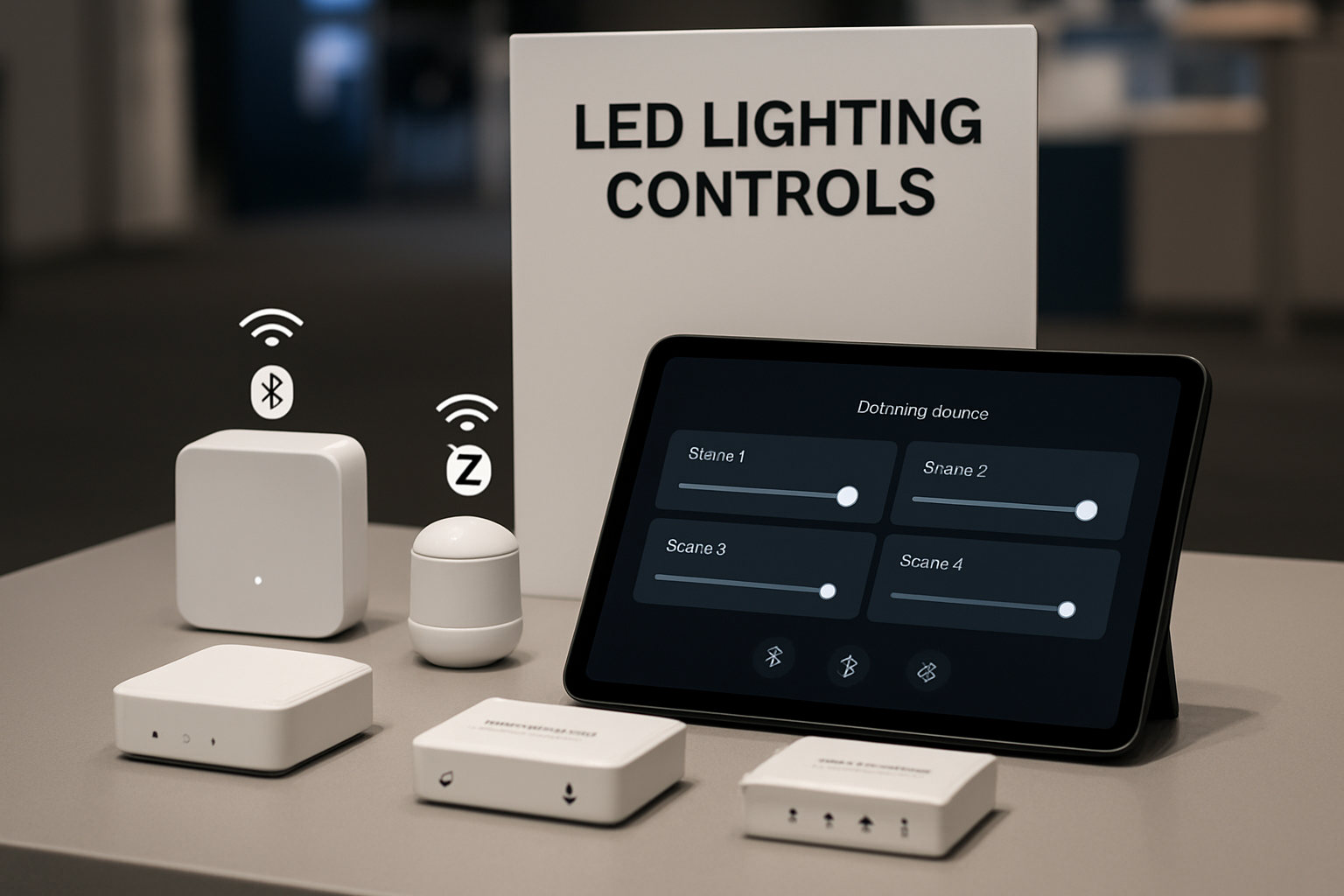
What you’ll see: drivers, dimmers, sensors, gateways, dashboards for group/scene control, and introductions to luminaire‑level lighting controls (LLLC).
How to evaluate on site:
Interoperability claims must be documented. Ask for protocol versions, commissioning apps, and security posture notes.
For North American projects, use the DesignLights Consortium’s networked controls program as a market signal; see the DLC NLC5 technical requirements (2024 update) and the NLC resources hub for rebate program context.
Want a primer on Zigbee concepts before you talk to controls vendors? This plain‑English guide can help: Zigbee lighting dimming beginner’s guide.
Cut through the noise by mapping trends to documents you can actually verify.
NLC systems showing continuous dimming, individual addressability, networking, LLLC, and robust commissioning UX align with the DLC’s NLC5/NLC5.1 technical requirements. Why does it matter? In many North American jurisdictions, rebate programs reference the DLC QPL for eligibility, so a vendor’s conformance path can influence total project cost of ownership. For background reading, see the DLC’s networked lighting controls resources.
The SSL V6.0 and LUNA V2.0 updates raise the bar on efficacy and controllability and offer guidance for exterior/nighttime applications. If you’re sourcing site/area luminaires for sensitive environments, confirm spectrum/optics options align with LUNA guidance. Program overviews and timing are summarized by the DLC here: SSL V6.0 and LUNA V2.0 overview (2025–2026).
Expect tunable white and high‑CRI options in retail and hospitality demos. Translate claims into checks: CRI and R9 values on the data sheet, dimming curves to low levels, and flicker test outcomes. For photometry and color data consistency, ask for LM‑79 test reports for the finished luminaire.
Vendors will showcase anti‑glare designs (deep regress, baffles, honeycomb). Validate with IES files and in‑booth demos. For offices and retail, visually comfortable distributions beat raw lumens.
Wireless: Bluetooth Mesh and Zigbee dominate group/scene control demos. Confirm commissioning UX, firmware update paths, and security options.
Wired: DALI and 0–10V remain practical in many retrofits and new builds. Decide based on project topology and maintenance capabilities.
PoE: IEEE 802.3bt can simplify select office retrofits but stays niche. Don’t assume cross‑vendor interoperability beyond documented integrations.
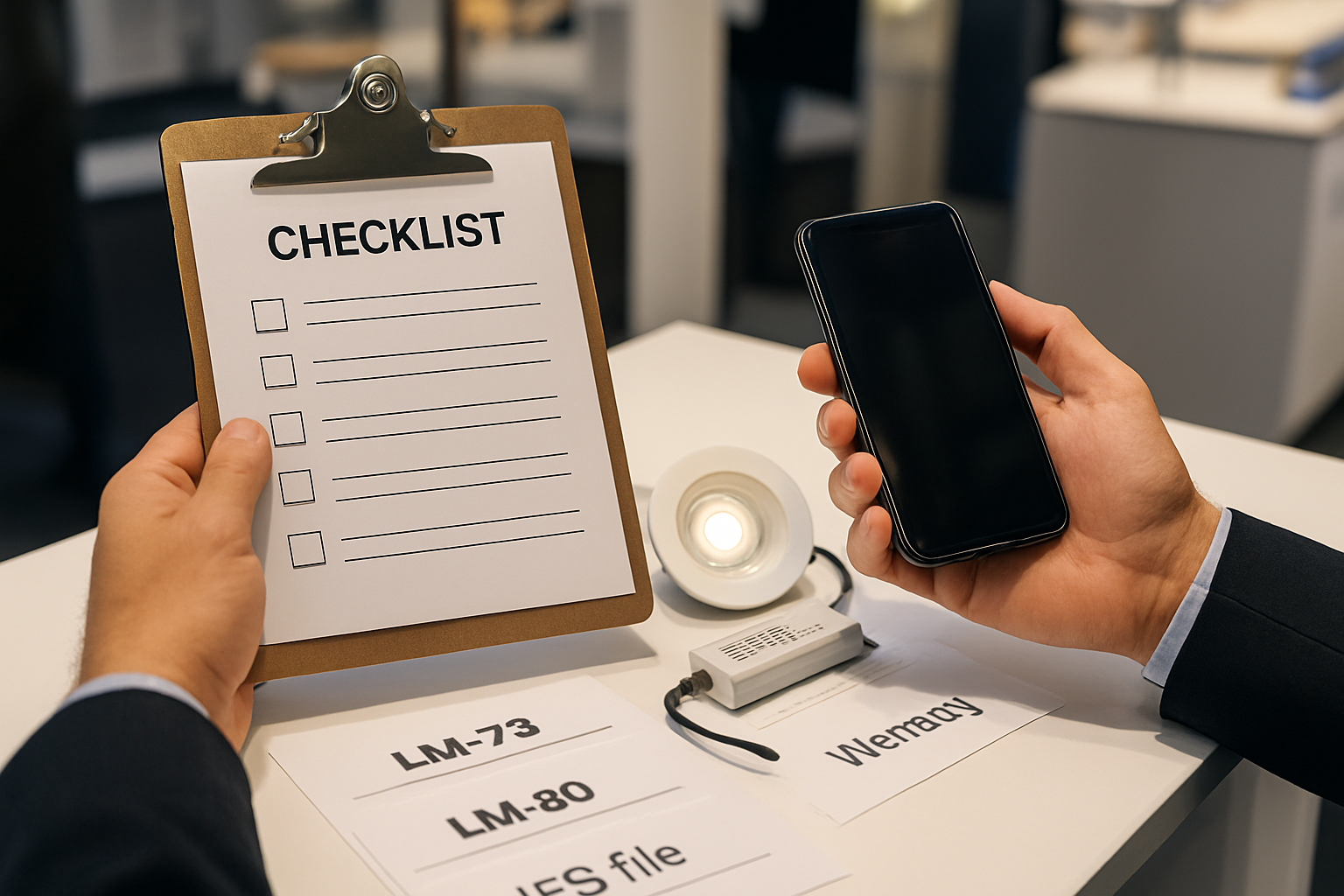
Make every booth visit count with a repeatable workflow.
LM‑79 (finished luminaire electrical/photometric report) and IES files
LM‑80 for the LED packages/modules and TM‑21 projections (if available)
Safety listings for your market (UL/ETL, CE/CB/UKCA as applicable)
Warranty terms and sample policies
For North American rebate projects: any DLC SSL/NLC program identifiers or QPL links. For LM‑79/LM‑80 procurement context, the U.S. DOE’s guidance on exterior lighting provides a helpful baseline: DOE FEMP purchasing guidance; general standard references are cataloged by the IES Lighting Library.
Housing and thermal path: check heat sinks and material quality; look for clean assembly and tight tolerances.
Optics and anti‑glare: assess beam control, regress, baffles, honeycomb accessories; check for consistent cut‑off.
Drivers and controls: verify interface (0–10V/DALI), THD/PF on the data sheet, dimming smoothness, and wireless options where needed.
Labeling and packaging: inspect compliance marks, serial/model labeling, and transit protection for samples.
Data capture: request digital data packs (PDF data sheet, IES, LM‑79/LM‑80) and tag them to your sample IDs.
Customization is often the differentiator for commercial projects. Clarify early:
Scope: what’s changing—dimensions, optics/beam, CCT/CRI, finish, or control interface?
Feasibility and MOQs: confirm minimums for custom bezels, optics, or drivers; ask about tooling for lenses or dies.
Lead times: prototypes (often 2–4 weeks), pilot run, and mass production; document gating approvals.
Compliance: how custom changes affect safety listings and, if relevant, DLC eligibility timelines.
Supply model: for international assembly or tariff optimization, align on SKD/CKD/CBU strategies. If this is new to your team, read this overview: CKD vs SKD vs CBU for LED lighting (2026).
Scenario: You need an anti‑glare downlight with a non‑standard aperture and Zigbee 3.0 control, plus a matching 600×1200 panel variant for corridors.
Evaluation steps:
On site: test beam cut‑off with a honeycomb and deep‑regress trim; compare 24° vs 36° optics.
Documentation: collect LM‑79 for both SKUs, LM‑80 for the LED package, IES files, and a Zigbee commissioning guide.
Controls: verify dimming to 1% without shimmer; confirm firmware update path and security options.
Custom feasibility: confirm MOQ for the non‑standard aperture and the panel size, tooling need for a custom bezel, and prototype lead time.
Neutral supplier example: A manufacturer like KEOU Lighting can support panel, downlight, and track form factors with options for anti‑glare optics and wireless control pathways. Use this kind of category hub page to map your customization parameters before placing samples.
Week 1 post‑show: finalize shortlist; send consolidated RFQs with spec tables and target volumes.
Weeks 2–4: receive and log samples; run photometry checks (if you have a lab partner) and site mockups.
Weeks 4–6: align on custom changes; confirm MOQs, per‑unit ladder pricing, and warranty language.
Weeks 6–10: prototype validation or pilot installation; confirm safety listings and any program eligibility.
We plan to meet wholesalers and project buyers during the 139th session of the Canton Fair Lighting Exhibition in Phase 1. Booth and hall details will be confirmed on the official directory closer to show dates. If you’d like to schedule a focused customization discussion (non‑standard sizes, optics, or control integration), reach out in advance so we can prepare targeted samples and documents. We’ll update this page with the exact booth number once it’s published on the official site.
Q1:How do I find the Canton Fair Lighting Exhibition once I’m on site?
Lighting is in Phase 1 within the Light & Electrical category under the Lighting Equipment section. Use the official app and the current session map to navigate; hall numbers can change by session.
Q2:What documents should I bring or request from suppliers?
Bring your spec templates and a USB/cloud folder. Request LM‑79/LM‑80 reports, IES files, safety listings for your market, warranty terms, and—when relevant—DLC/NLC identifiers.
Q3:What are typical MOQs and sample practices for commercial SKUs?
Catalog SKUs usually have modest MOQs; custom optics/sizes may require higher MOQs and occasional tooling. Samples are commonly paid or rebated against orders—confirm the policy in writing.
Q4:Which certifications matter most for export?
North America: UL/ETL safety and DLC QPL where rebates apply; ENERGY STAR for select categories. EU/UK/other: CE/CB/UKCA as applicable. Always align with the destination market’s rules and your project’s rebate landscape.
Q5:How do I request custom optics or controls integration at the fair?
Prepare a one‑page spec (beam angle options, target UGR, CCT/CRI, dimming/control protocol). On site, verify feasibility, MOQs, and lead times; request a prototype schedule and any documentation impacts (safety listings/DLC).