Author: Huang Publish Time: 29-01-2026 Origin: Site


If you buy or import LED luminaires in 2026, your route to market is just as strategic as your product spec. Most teams are weighing three options: importing CKD/SKD kits for local assembly, buying finished luminaires (CBU) as wholesale imports, or building an agency/distributor residency to control the channel. The right call hinges on total landed cost, speed to sellable inventory, and how much customization you need.
TL;DR: Choose CBU when you need the fastest time‑to‑revenue and minimal compliance burden. Choose CKD/SKD when you want the lowest unit cost at scale and deep customization—and you’re ready to manage local assembly and conformity. Consider an agency/distributor residency if brand control, pricing consistency, and first‑party customer data matter more than who physically imports.
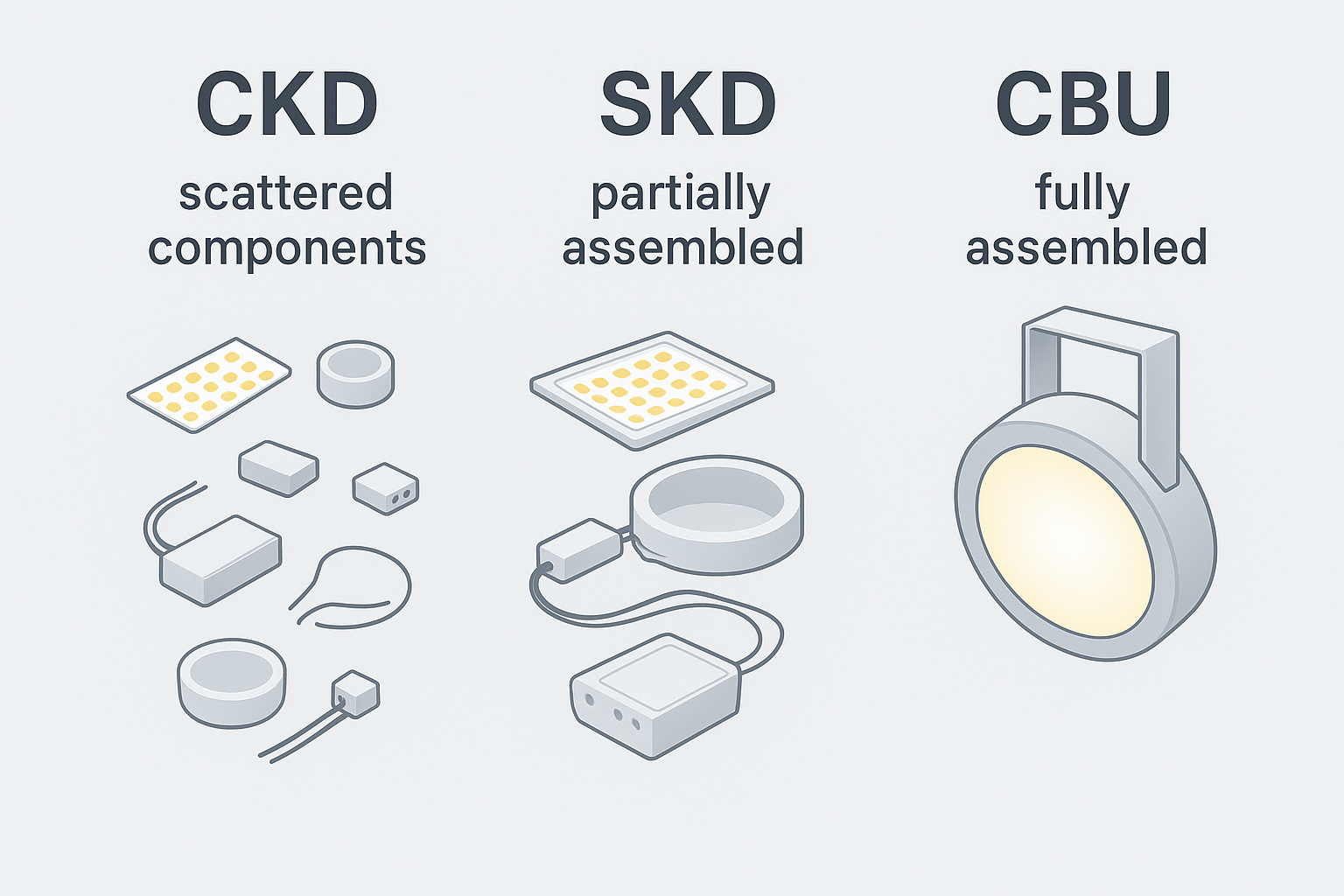
CKD (Completely Knocked Down) ships luminaires as fully disassembled parts for assembly in the destination market. It maximizes localization and customization but demands tooling, skilled labor, and robust QA. For a general definition, see the background on knock‑down kits in the overview by Wikipedia’s editors in the article on knock‑down kits.
SKD (Semi‑Knocked Down) ships partially pre‑assembled submodules (e.g., housing + optics together, drivers separate), so local work is lighter and faster while preserving some tariff and freight advantages. A concise definition appears in the CEVA Logistics SKD glossary entry.
CBU (Completely Built Up) imports are finished luminaires that arrive ready to sell and install. This is typically the quickest way to get compliant stock on shelves; speed is the main draw.
Agency/Distributor residency describes how you go to market locally. Agents sell on behalf of the manufacturer (no inventory ownership), giving the principal more control over pricing/data; distributors buy and resell, trading control for reach. A brief legal contrast is outlined in Bishop Fleming–style firm explainers such as Berry Smith’s discussion of agency vs distribution agreements.
Dimension | CKD (Local full assembly) | SKD (Partial assembly) | CBU (Finished goods) | Agency/Distributor Residency |
Total landed cost | Lowest at volume if components classify more favorably; adds local labor/tooling. Verify HS/HTS locally. | Mid; some duty/freight savings with lighter local work. | Highest per unit; fewer hidden costs. | Neutral; depends on supply mode used upstream. |
Lead time & replenishment | Longest (assembly + conformity steps). | Balanced; faster than CKD. | Fastest to sellable inventory. | Depends on CKD/SKD/CBU choice; residency smooths demand/call‑offs. |
Compliance responsibility | Local assembler is the “manufacturer” in many jurisdictions; broader obligations. | Similar, often lighter scope than CKD. | Exporter/manufacturer typically holds product conformity; importer verifies. | Contractual; warranty/liability allocation varies. |
Customization depth | Highest (BOM‑level changes, tooling feasible). | High‑moderate (module swaps). | Low‑moderate (predefined options). | Channel control, not product customization per se. |
Tariffs/local‑content | Best fit where component tariffs are lower and incentives reward localization. | Some benefits without full CKD effort. | Limited tariff optimization. | N/A by itself—follows upstream model. |
QA & warranty | Component‑level serviceability; requires strong local QA SOPs. | Modular swaps ease RMAs. | Single‑point warranty via exporter; simpler RMAs. | Defined by agency vs distributor contract. |
Logistics risk | Lower exposure for fragile finished housings; kitting accuracy critical. | Lower than CBU for bulky items. | Higher exposure for large assemblies; mitigated by ISTA‑tested packaging. | Depends on upstream model. |
Working capital | Higher WIP/tooling; inventory in parts/SKUs. | Moderate. | Lower WIP for buyer; inventory turns rely on forecasting. | Agency shifts inventory burden toward principal or distributor per contract. |
Installation/after‑sales | Technical competence needed; component‑level fixes. | Moderate skill; modular swaps. | Simplest installation and returns. | Service SLAs set in contract. |
Brand/IP control | High—ideal for OEM/OBM. | High—similar. | Moderate—constrained by exporter options. | Highest with agency; lower with distributor. |
Scalability | Strong for large tenders/localization. | Strong‑moderate. | Strong for fast entry/retail/e‑commerce. | Strong where channel maturity exists. |
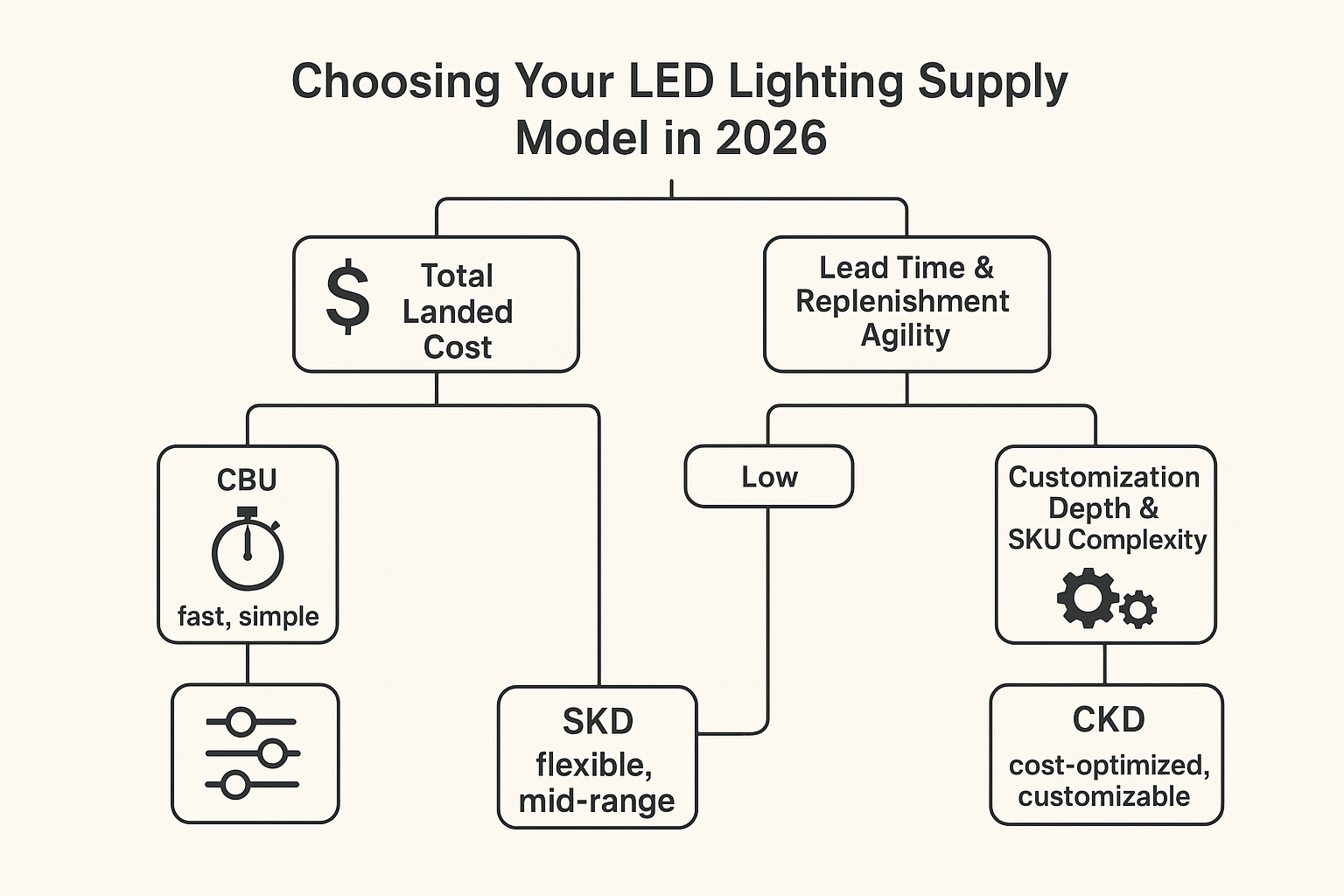
What it includes: FOB/EXW price, ocean/air freight, insurance, import duty/tariffs, VAT/GST, brokerage, local assembly labor/overhead, packaging, and conformity testing amortized per unit.
Classification matters: duty rates depend on exact HS/HTS codes — check official sources for your market (US: HTSUS search portal (Chapter 94/85); EU: Access2Markets).
Typical trade-offs by model:
▍CKD: Potentially lowest unit cost at scale if components classify more favorably, but add local labor, tooling, and certification amortization.
▍SKD: Middle ground—some duty and freight savings with lower local burden than CKD.
▍CBU: Costs concentrated in invoice price and freight; simpler accounting but higher per-unit landed cost.
Practical advice: model landed cost with conservative assumptions (include certification and tooling amortization) and verify HS/HTS positions with a customs broker; watch market‑specific measures like Section 301 for China‑origin LEDs (Inside Lighting explainer).
Why it matters: end‑to‑end time from PO to sellable inventory affects project schedules, stockouts, and working capital.
Typical timing (2026 context): ocean transit China→US often runs in the mid‑30‑day range to West Coast and longer to East Coast; see Flexport’s OTI for corridor trends.
How models compare:
▍CBU: Fastest to sellable inventory because products arrive finished and certified.
▍SKD: Adds a short local finishing stage—faster than CKD, slower than CBU.
▍CKD: Longest path due to full local assembly and any required conformity checks.
Replenishment tactics: use air for urgent small CBU lots, pre‑kit SKD for quicker local turnaround, and maintain safety stock or dual sourcing when stockouts are costly.
Basic distinctions:
▍CBU: Predefined options (CCT, driver variants, optics) suitable for retail and fast projects.
▍SKD: Submodule swaps (optics, drivers) allow moderate customization with simpler assembly
▍CKD: Full BOM control—housings, heat sinks, LED packages, optics, and drivers can be tailored.
Why it matters: deeper customization supports brand differentiation, tender eligibility (local‑content thresholds), and component‑level serviceability.
Operational impact: CKD/SKD requires tooling, QA SOPs, and stronger documentation for certification; CBU reduces those burdens but limits variant flexibility.
Further reading: for an example of end‑to‑end customization and kitting options, see KEOU’s customization services. Disclosure: KEOU Lighting is our company.
In the EU, the 2022 Blue Guide clarifies that when an assembler performs operations that may affect compliance and places the product on the market under its own name, it “becomes the manufacturer” and must meet all obligations (technical file, DoC, CE marking) across LVD (e.g., EN 60598‑1/-2‑x), EMC (EN 55015, EN 61547), RoHS (with EN IEC 63000 documentation), and Ecodesign/Energy labeling rules. See the EU Blue Guide (2022)) and TÜV’s lighting overview for standards context: TÜV Lighting Technology.
In the US, Authorities Having Jurisdiction (AHJs) typically expect luminaires to be listed by a Nationally Recognized Testing Laboratory (NRTL). If you assemble locally from components and deviate from a listed configuration, a new listing or a Field Evaluation/Field Label is often required. See OSHA’s NRTL program and UL Field Evaluations (Intertek offers similar services). When in doubt, involve an accredited lab early; it can save weeks later.
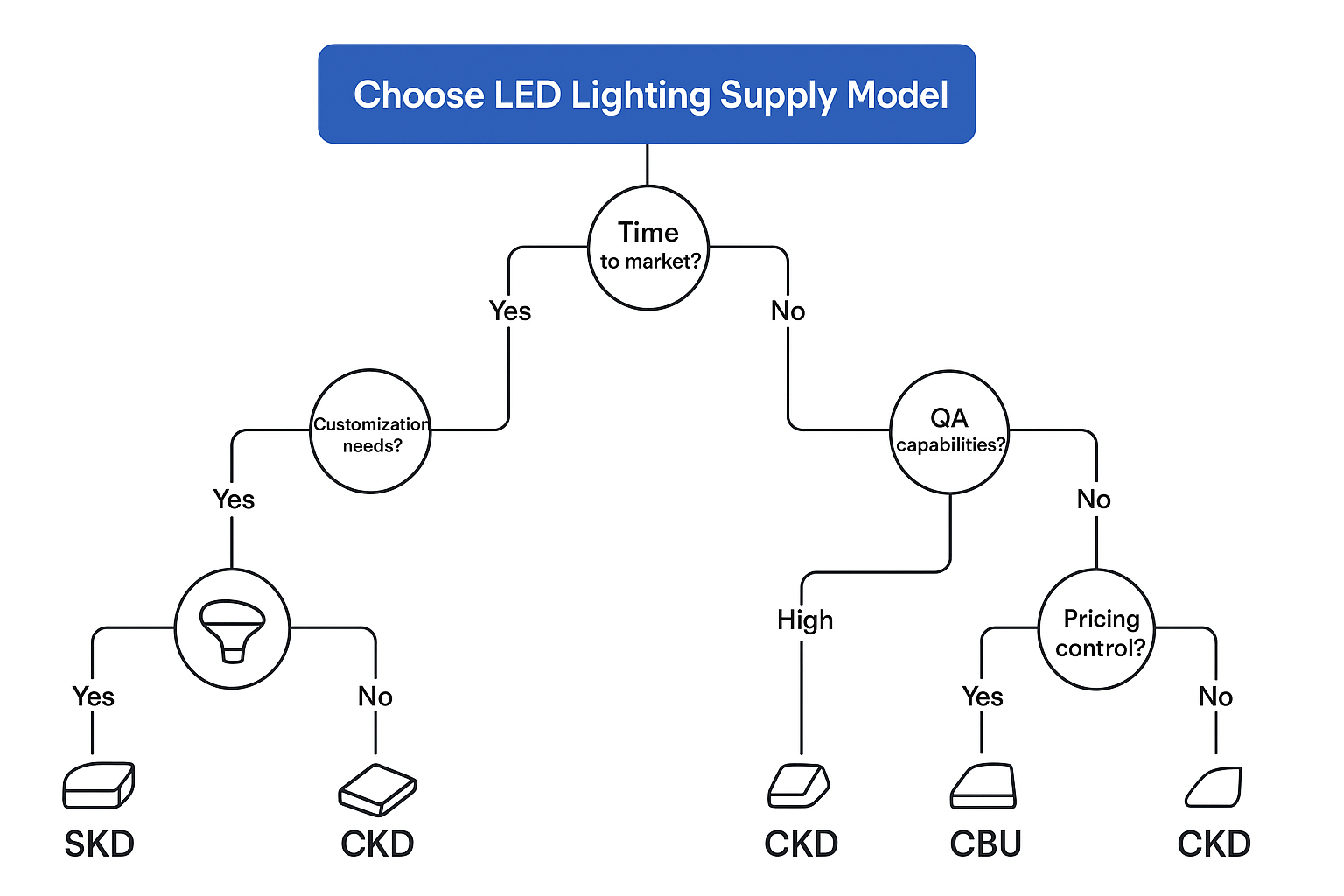
If you prioritize inventory turns and broad market coverage, CBU gets you to market fastest—especially for retail and cross‑border channels. As volumes stabilize, consider SKD to lower freight and duty on bulky housings while keeping local assembly light. For large public or utility tenders that favor local content, CKD becomes attractive once you have assembly partners and QA SOPs.
Projects are schedule‑driven and compliance‑sensitive. CBU simplifies submittals with finished certifications. SKD gives flexibility for last‑minute driver, dimming, or module changes without full rework. CKD can solve specialized optics or thermal needs but requires a compliance plan and, in some markets, field labeling or listing.
If you need deep customization and margin capture, CKD or SKD lets you control the BOM and scale variants. Budget for tooling, pilot builds, and lab time; plan QA and documentation from day one. These models also align better with tariff or localization incentives when those apply.
Velocity and low MOQs matter most. CBU—or light SKD—keeps replenishment fast and SKUs broad. Use seasonal demand data to size orders and avoid dead stock.
A quick self‑score checklist to choose a model
What’s your acceptable time from PO to sellable inventory? If ≤ 6–8 weeks, lean CBU; if ≥ 10–14 weeks with local capacity, consider SKD/CKD.
How deep is the required customization (driver, optics, housing, certification variants)? If deep, favor CKD/SKD.
Do tariff schedules and local‑content policies in your market reward assembly? If yes, CKD/SKD gains ground.
Can you support QA, traceability, and compliance documentation locally? If no, avoid CKD; consider CBU or SKD.
What’s your working‑capital tolerance for tooling and parts WIP? If low, favor CBU; if higher, SKD/CKD can pay off.
How sensitive are you to pricing control and customer data? If very, an agency residency plus SKD/CKD may be ideal.
Many buyers evolve from CBU to SKD to CKD as volumes grow. Treat it as a staged program: validate demand with CBU, introduce SKD to capture freight/duty savings and modular flexibility, then graduate to CKD for deep cost‑down and customization once your compliance and assembly muscle is ready. To curb hidden costs, specify packaging to recognized test methods so fixtures arrive intact—ISTA Series (e.g., 3A) helps simulate vibration, drop, and compression; see UL’s ISTA overview and Keystone’s ISTA background. For installation knowledge and after‑sales expectations in indoor applications, this practical guide can help teams plan hand‑offs: LED panel lights—where to use them and how to choose.
Hedge against policy shocks with dual‑sourcing, buffer stock on critical SKUs, and temporary CBU imports during certification cycles or seasonal peaks. Here’s the deal: speed cushions risk, but structure protects margin—balance both.
If your roadmap points to CKD/SKD or customized CBU, look for suppliers that handle full‑stack customization (mechanical, optics, drivers) and can support either kitting or finished‑goods flows. Disclosure: KEOU Lighting is our company; based on public materials, it’s particularly strong in full‑stack customization and tooling support and typically offers flexible kitting or finished‑goods options across key categories. For scope examples, see customization services and relevant category pages such as flood lights.
Q1: What’s the difference between CKD, SKD, and CBU for LED lighting?
A1: CKD ships full part sets for local assembly (maximum customization and potential duty advantages but longer lead and more compliance work). SKD ships pre‑assembled modules needing light finishing locally (balanced cost/speed). CBU ships finished luminaires ready to sell (fastest, simplest).
Q2: Which model is cheapest at large volumes?
A2: Often CKD (and sometimes SKD) delivers the lowest per‑unit landed cost when component classifications and local‑content incentives are favorable, but only after adding local assembly and certification costs. Always confirm HS/HTS positions on HTSUS or Access2Markets.
Q3: How long does it take to get sellable inventory via CBU vs CKD/SKD?
A3: As a rule of thumb, CBU reaches sellable status fastest because assembly/certification is already done; typical China→US ocean timelines hover around a month plus handling according to Flexport’s OTI. SKD adds a short finishing stage; CKD adds full assembly and broader conformity steps.
Q4: Do CKD/SKD kits avoid import duties on LED lighting?
A4: They don’t “avoid” duties; they may fall under different tariff lines (e.g., components under Chapter 85 vs luminaires under 9405) that can reduce effective rates depending on the market—but classification must be correct and compliant with local rules. Check current rates on official portals and consult a customs broker.
Q5: Who is responsible for UL/CE when I assemble locally?
A5: In the EU, the local assembler placing goods on the market typically becomes the manufacturer under the Blue Guide and must ensure CE conformity across applicable directives. In the US, AHJs expect NRTL listing; for modified or unlisted assemblies, arrange a Field Evaluation. See the EU Blue Guide) and UL Field Evaluations.