Author: Huang Publish Time: 13-02-2026 Origin: Site


If you’re planning or retrofitting a facility, choosing the right fixture type by area is the fastest way to get reliable results without drowning in specs. This contractor-focused guide organizes sports lighting by area so you can match each space to the most suitable LED family—quickly and confidently.
This 2026 guide targets training and daily-use venues (non-broadcast). We’ll prioritize glare control, retrofit friendliness, environmental suitability (e.g., humidity/chlorine for pools, cold for rinks), and simple controls. Think of it as a practical “sports lighting by area” checklist you can take on site.
Soft CTA: Need tailored photometrics or fixture customization? Contact the project team via the KEOU page: customization and project support.
We evaluated fixture families using a transparent blueprint designed for training/daily-use facilities. Scores prioritize comfort and practicality so contractors can deliver uniform, neighbor-friendly light with minimal rework.
| Criterion | Weight |
Glare control & visual comfort | 22 |
Customization & application engineering | 18 |
Durability & environmental suitability | 15 |
Installation simplicity & retrofit friendliness | 15 |
Light quality for sport | 15 |
Controls & interoperability | 8 |
Documentation & support | 7 |
These criteria reflect recognized practices in sports lighting. For further context on recommended practices and performance targets, see the landing for ANSI/IES RP‑6 on lighting for sports and recreational areas: IES RP‑6 overview.
Disclosure: KEOU Lighting is our product. We evaluated it using the same criteria as other solutions in this list. First mention links to the official site: KEOU Lighting.
Each area below gives a concise, area-specific recommendation: the best-fit fixture family, typical mounting approaches, practical glare-control tactics, and why the choice works—kept intentionally light on technical specs so contractors can decide quickly on site.
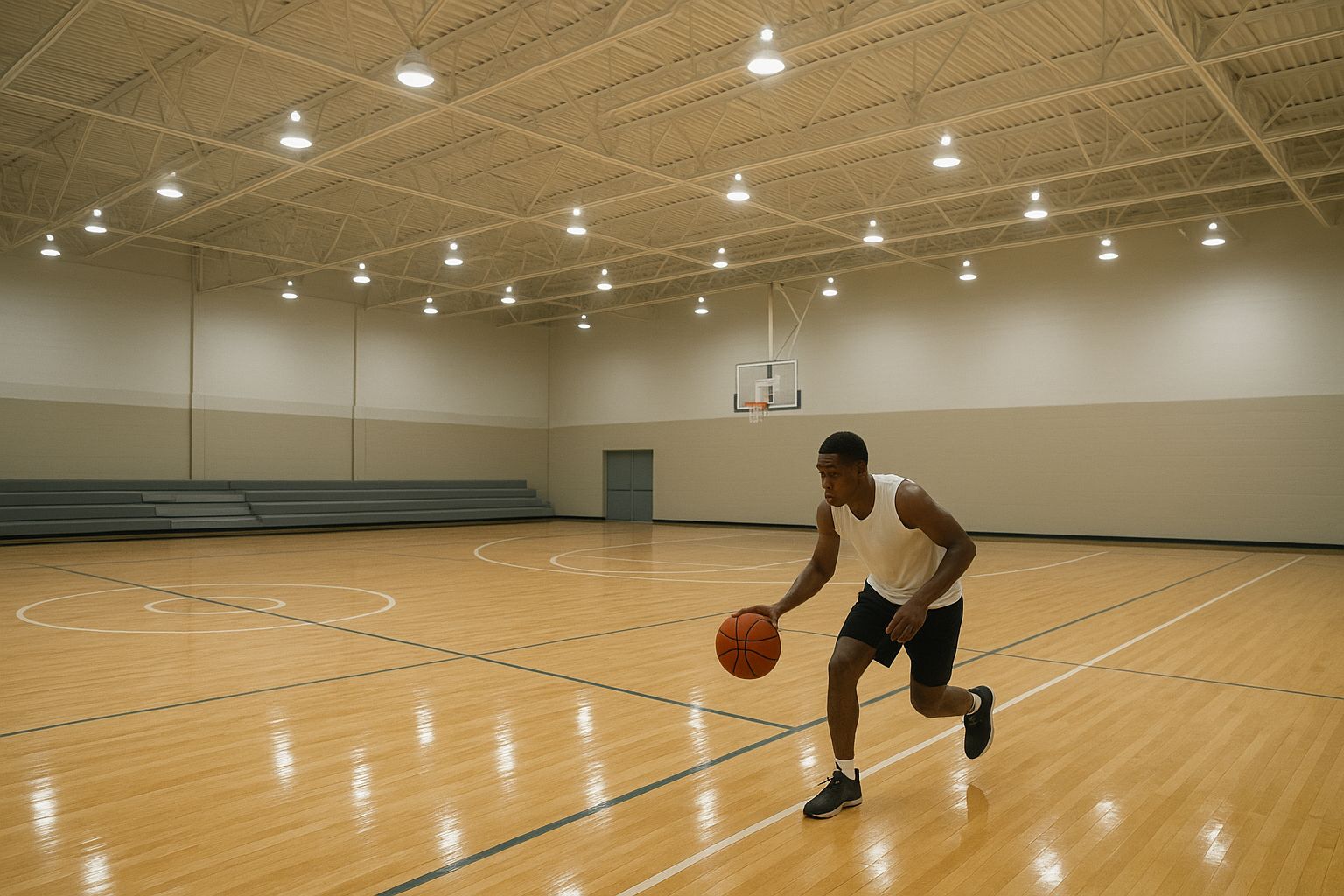
Recommended fixture types: LED high-bay (UFO or linear); direct/indirect systems where possible
Mounting approach (range): Ceiling or roof truss; space evenly to maintain uniformity
Optics/beam pattern: Wide symmetric; consider indirect components to soften sparkle on glossy floors
Glare strategy: Diffusers or microprismatic lenses; careful aiming to limit veiling reflections
Controls: 0–10V or DALI scenes for drills vs. scrimmage
Why it fits: High-bays offer even coverage, instant-on control, and low maintenance for training use
Not ideal for: Very low ceilings with heavy obstructions—consider indirect or specialized optics
Evidence: Quick background on practice is summarized by the IES RP‑6 overview
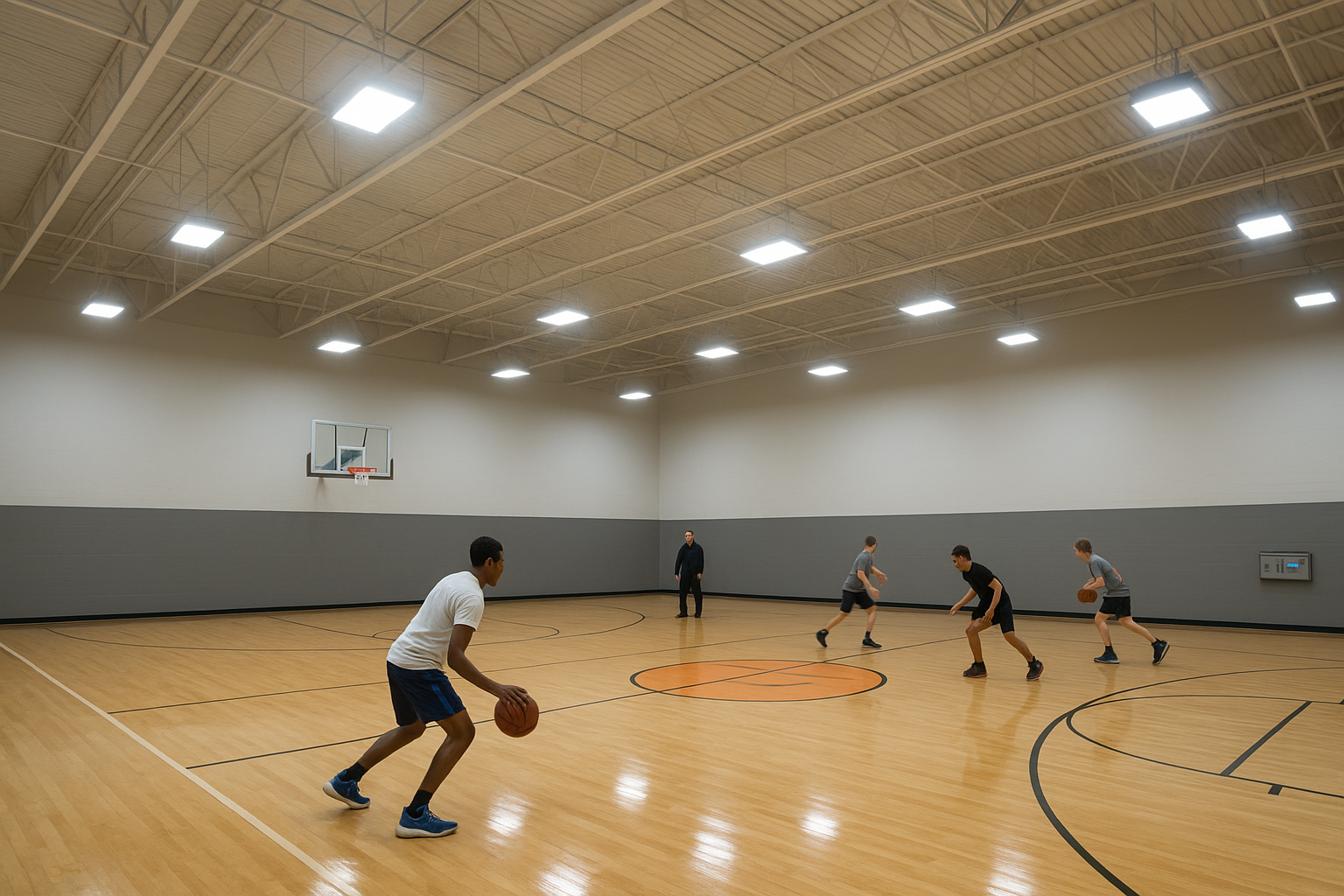
Recommended fixture types: UFO or low-profile linear high-bays
Mounting approach (range): Pendant or surface-mounted to existing trusses
Optics/beam pattern: Wide distributions for mixed activities and events
Glare strategy: Diffusers/honeycomb-style accessories to improve visual comfort during non-sport events
Controls: Simple scenes and reduced levels for assemblies or cleaning
Why it fits: Compact form factors and broad beams simplify retrofits and keep light comfortable across uses
Not ideal for: Narrow-beam layouts that create hot spots or striping
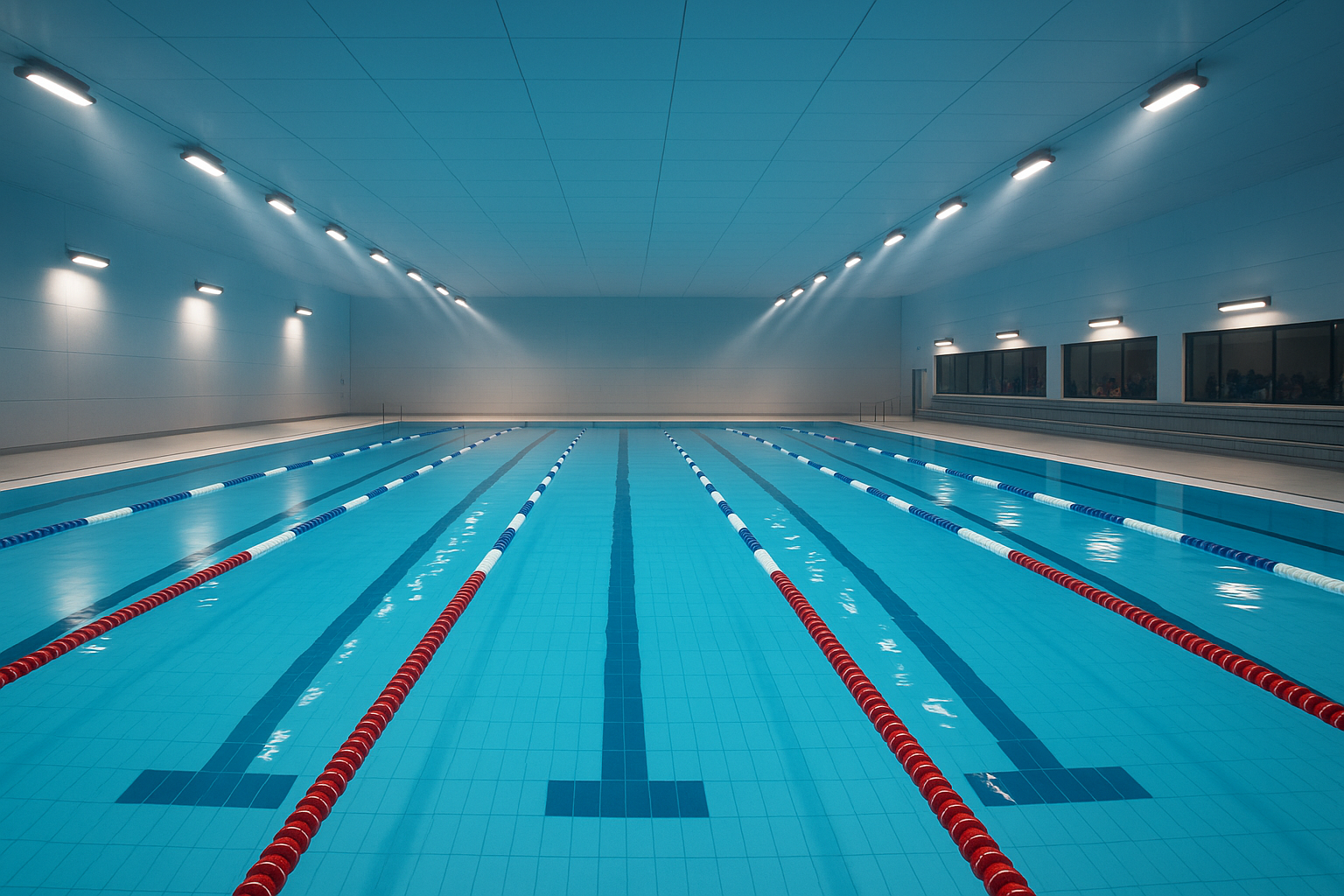
Recommended fixture types: IP65+ LED luminaires; asymmetric LED floodlights from side walls/rafters
Mounting approach (range): Wall or ceiling positions that minimize direct view of sources from water level
Optics/beam pattern: Asymmetric beams to push light across lanes without sparkling on the water surface
Glare strategy: Sealed optics with shields/visors; aim to avoid specular reflections
IP/IK suitability note: High IP and corrosion-resistant materials are critical for humid/chlorine environments
Controls: Scheduling and dimming for meets, practice, and maintenance
Why it fits: Robust housings and asymmetric optics improve comfort and longevity in harsh natatorium conditions
Not ideal for: Open‑vented fixtures or low‑IP products in humid/chlorinated air
Evidence: Practical pool guidance from Pierlite’s swimming pool lighting guide
▍Soft CTA (mid-list): Want a quick overview of floodlight families commonly used around fields and rinks? See KEOU’s page on LED flood lights for reference categories.
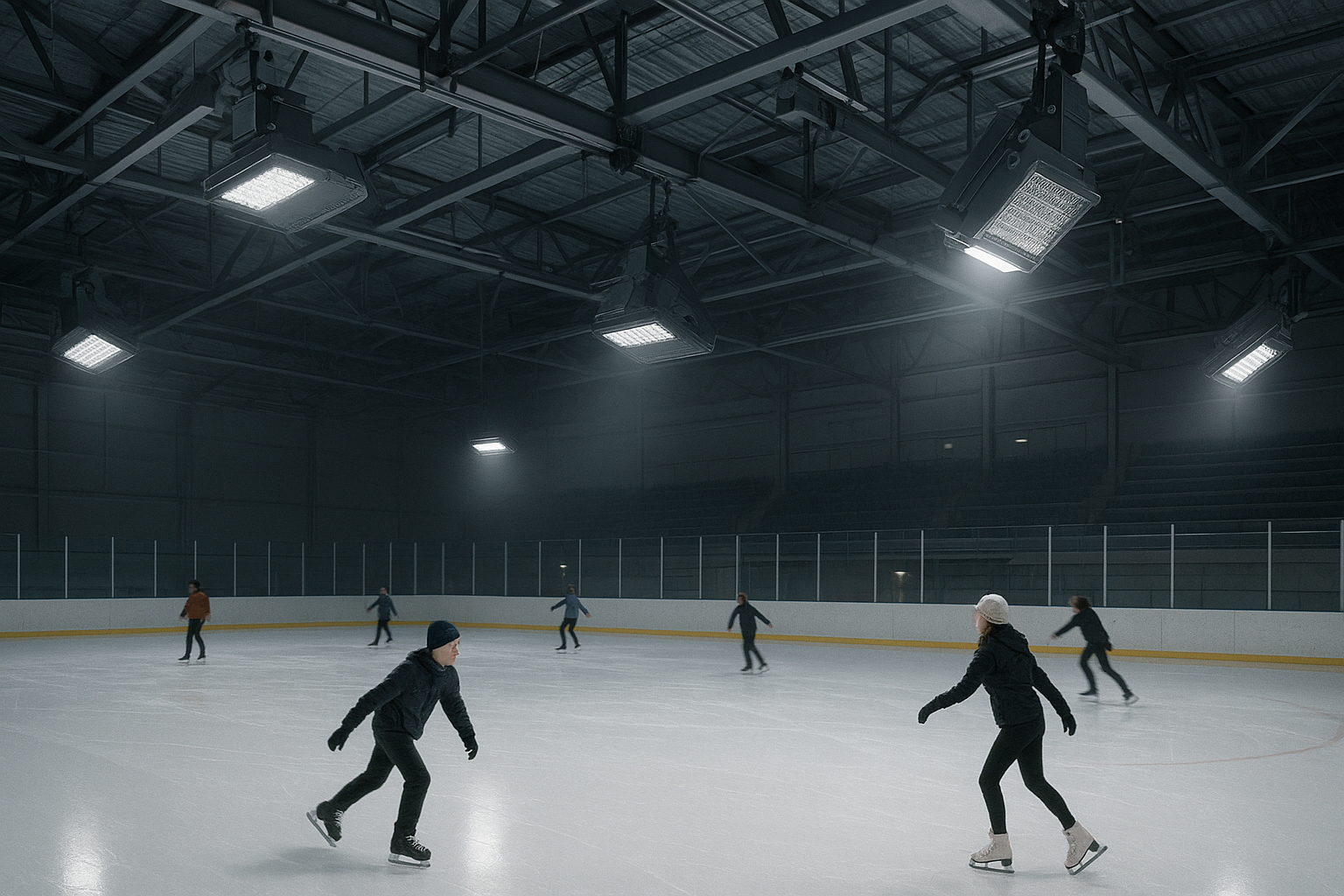
Recommended fixture types: Low‑glare LED floodlights rated for cold and moisture
Mounting approach (range): Roof truss or catwalks; ensure even vertical illumination for puck/players
Optics/beam pattern: Asymmetric beams with optional shields to reduce reflections off ice
Glare strategy: Careful aiming and cutoff; consider anti‑condensation measures where applicable
Controls: Scene presets for practice vs. figure skating; dimming for resurfacing
Why it fits: Cold‑rated drivers and optical control help maintain stable, comfortable light on reflective ice
Not ideal for: Broad, unshielded sources aimed directly at spectators
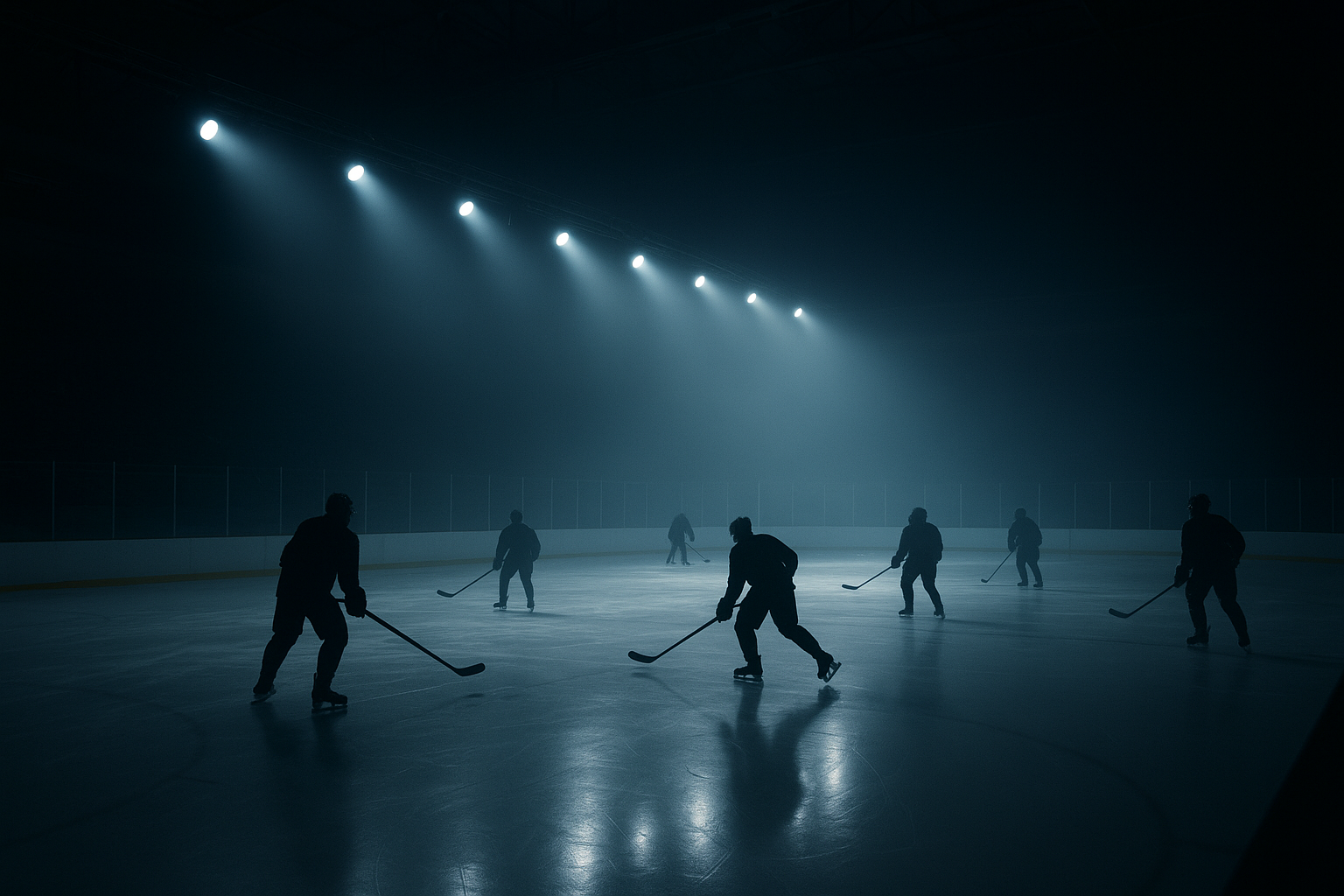
Recommended fixture types: Linear area lights, canopy fixtures, and local step/aisle accents
Mounting approach (range): Ceiling/wall for general light; low‑level path lights on stairs
Optics/beam pattern: Distributions emphasizing vertical illumination for faces and signage
Glare strategy: Shielding and cutoff to avoid dazzling spectators in circulation paths
Controls: Zoning and scenes for pre‑event, in‑event, and egress
Why it fits: Balanced vertical light improves recognition and safety for crowds
Not ideal for: Overlighting that causes adaptation issues when moving from dark seating to bright concourses
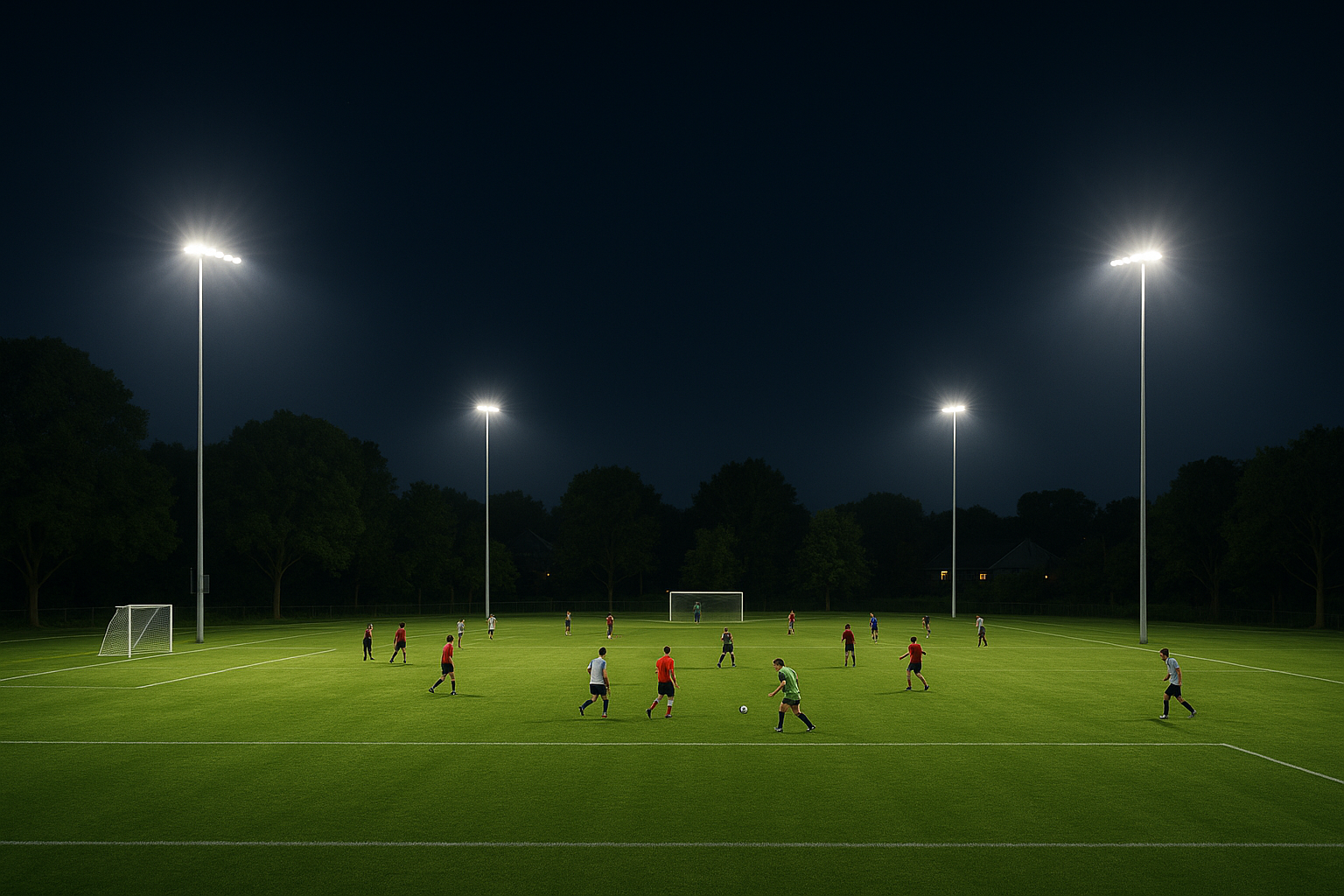
Recommended fixture types: Stadium‑class LED floodlights with asymmetric optics and visors
Mounting approach (range): Typical poles ~12–30 m depending on field size/layout; fewer, taller poles can help uniformity
Optics/beam pattern: Forward‑throw asymmetric beams to keep light on the pitch with minimal uplight
Glare strategy: Shields/visors and precise aiming to limit spill and skyglow; follow DarkSky containment principles
Controls: Scene presets and event scheduling to reduce off‑hours output
Why it fits: Proven field solution balancing performance, uniformity, and neighborhood-friendly operation
Not ideal for: Unshielded symmetrical floods that create spill/trespass
Evidence: Practical layouts and levels summarized in the FSG sports field guide
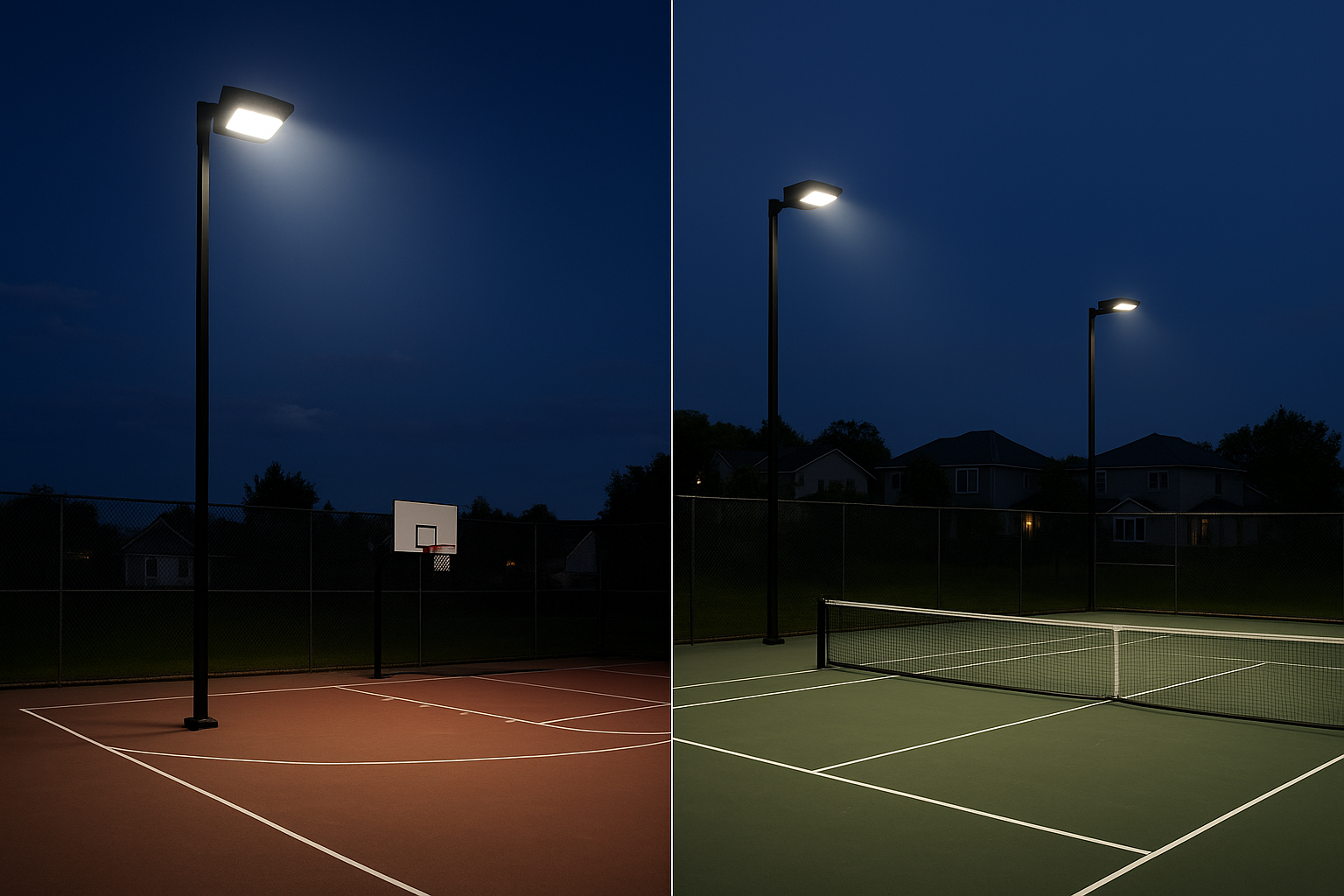
Recommended fixture types: Pole‑mounted LED floodlights with narrow‑to‑medium beams and shielding
Mounting approach (range): Common single‑court poles ~6–12 m; place on sides/corners to limit glare
Optics/beam pattern: Narrower beams for tennis; medium beams for basketball to improve uniformity
Glare strategy: Visors and careful aiming; adhere to neighbor-friendly, low‑uplight designs
Controls: Timers and dimming for curfew compliance
Why it fits: Simple, repeatable layout that balances visibility and spill control for residential contexts
Not ideal for: Too‑low poles, which increase glare and shadowing
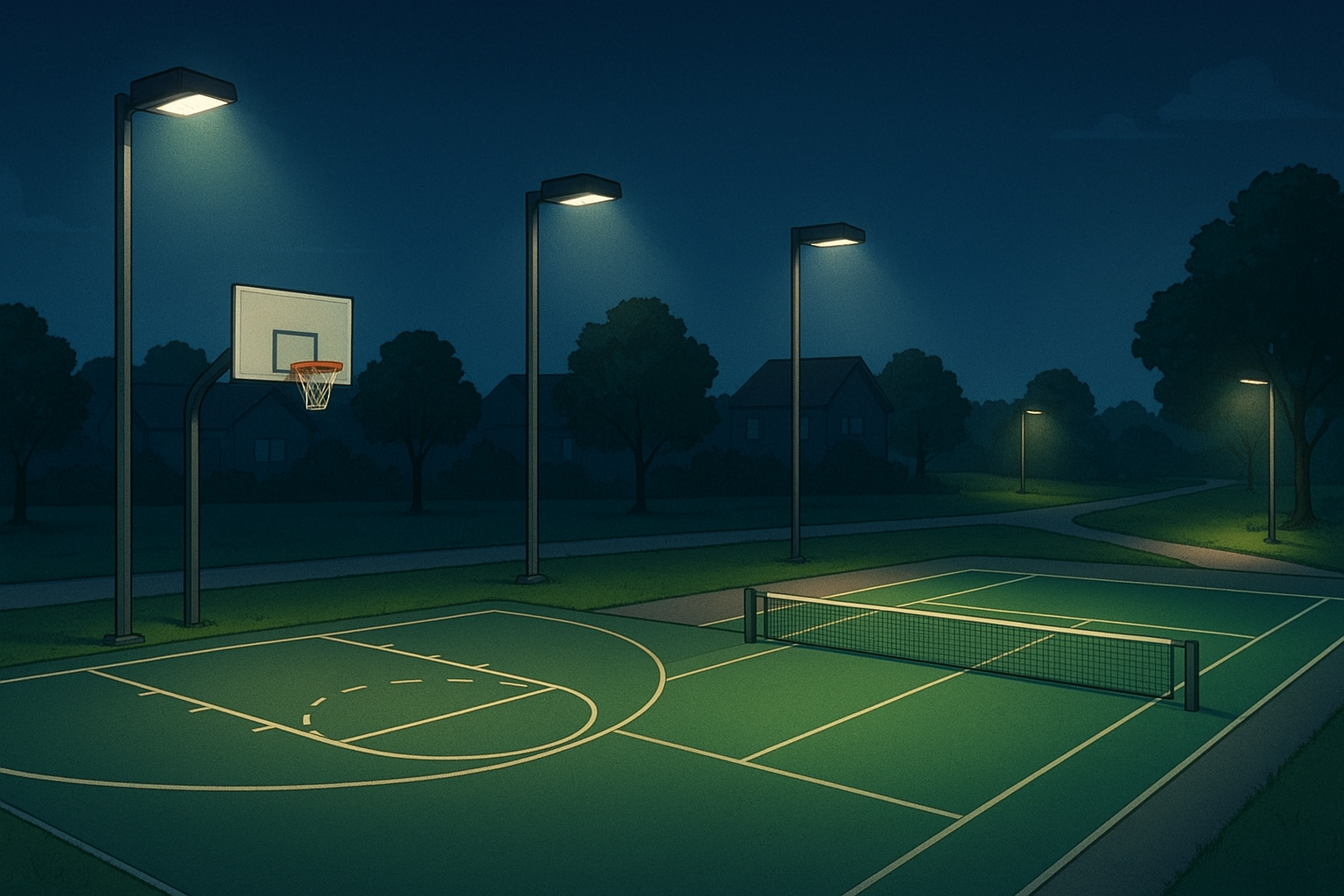
Recommended fixture types: Area/site lights with Type III (forward throw) or Type IV (perimeter) distributions
Mounting approach (range): Typical poles ~15–30 ft for paths/perimeters; bollards/low wall lights for near‑field guidance
Optics/beam pattern: Full‑cutoff optics for uniform paths and fence lines
Glare strategy: Shielding and lower CCT where appropriate for comfort and adaptation
Controls: Motion sensing and photocells to reduce energy during off‑hours
Why it fits: Standard site‑lighting approach that avoids overlighting and trespass
Not ideal for: High‑uplight luminaires near dark-adapted areas
Internal reference: For street/perimeter fixtures, see KEOU’s street and area lighting.
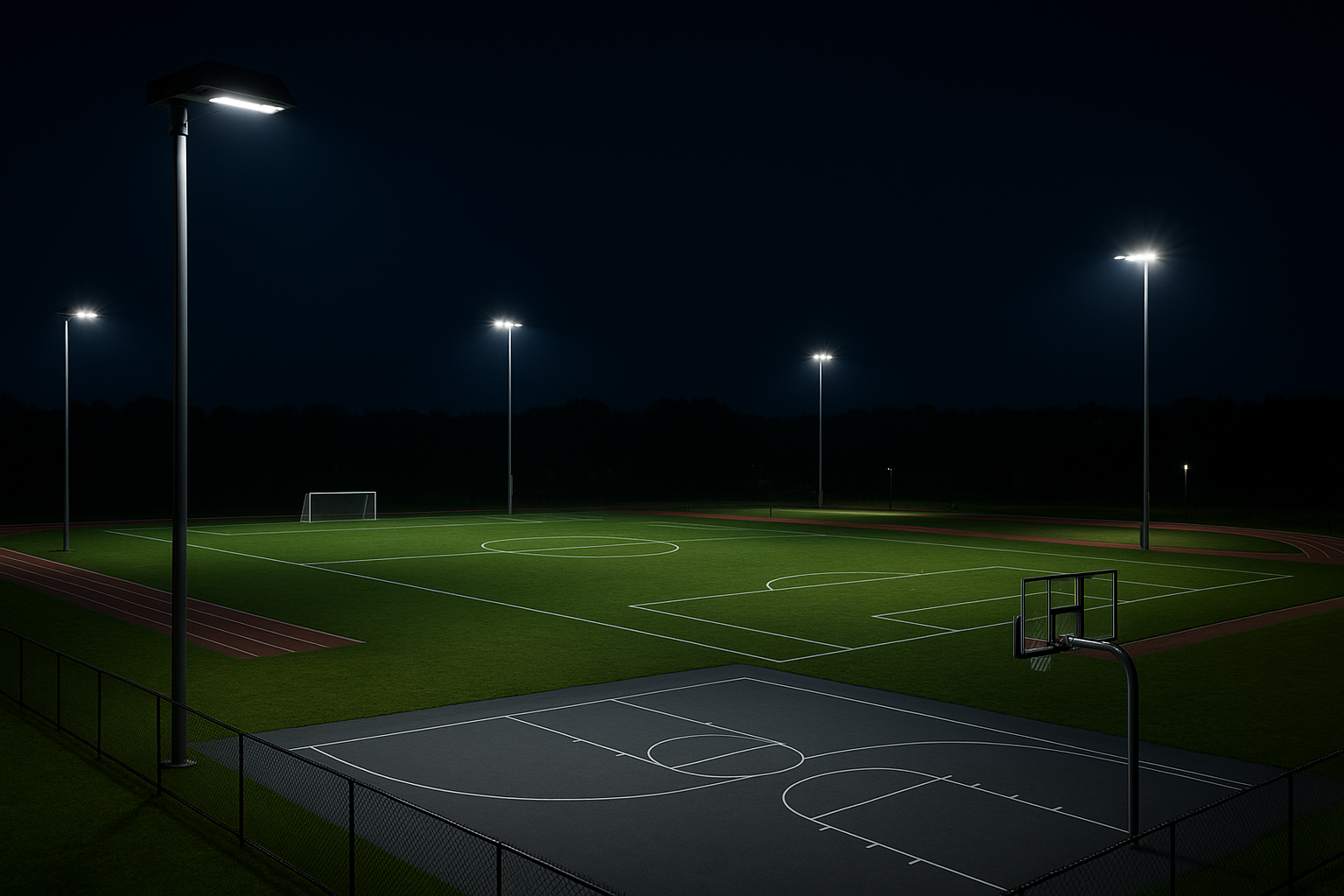
Recommended fixture types: Full‑cutoff LED shoebox/area luminaires
Mounting approach (range): Typical poles ~15–35 ft depending on lot geometry
Optics/beam pattern: Type III/IV for lots and drives; keep uplight at or near zero
Glare strategy: House‑side shields near residences; balanced CCT for comfort
Controls: Scheduling and occupancy sensing based on event traffic
Why it fits: Improves safety and wayfinding while keeping spill under control
Not ideal for: High‑glare fixtures near entrances that impair adaptation
| Area | Fixture type | Mounting | Glare | Typical illuminance band (training/rec) | Controls | Notes/Evidence |
Indoor training courts | High‑bay LED; direct/indirect | Ceiling/truss | Diffusers; indirect component | ~20–30 fc | Scenes (0–10V/DALI) | |
Multipurpose gyms | UFO/linear high‑bay | Pendant/surface | Microprismatic diffusers | Contextual (rec) | Simple scenes | Contractor practice; uniformity focus |
Swimming pools | IP65+ LEDs; asymmetric floods | Wall/ceiling | Shields; asymmetric aiming | Contextual (rec) | Scheduling/dim | |
Ice rinks | Low‑glare LED floods | Truss/catwalk | Asymmetric beams; shields | Contextual (rec) | Scenes/dim | Contractor practice for reflective ice |
Stands/concourses | Linear/canopy; path lights | Ceiling/walls; steps | Shielded; vertical Ev emphasis | Safety‑oriented | Zoning/scenes | |
Soccer/football | Asymmetric stadium floods | ~12–30 m poles | Visors; low uplight | ~20–50 fc (rec) | Scenes/scheduling | |
Community courts | Pole‑mounted floods | ~6–12 m poles | Visors; narrow/medium beams | ~20–50 fc (rec) | Timers/dim | Tennis/basket guidance (industry practice) |
Track/walkways | Area/site (Type III/IV) | ~15–30 ft poles | Full cutoff | 0.5–2 fc (perimeter) | Motion/photo | Site‑lighting practice |
Parking | Shoebox/area | ~15–35 ft poles | Full cutoff; shielding | Min safety bands | Scheduling/occupancy | DarkSky‑aligned practice |
All illuminance bands above are indicative for training/recreational contexts. Confirm with local code and photometric design before specification.
Use asymmetric optics and shields to contain light on the field and reduce uplight/skyglow. DarkSky’s guidance for outdoor sports emphasizes containment and zero uplight for ground sports; see the program’s approved luminaires guidelines.
For general practice ranges and methodology context, reference the IES RP‑6 overview. Where televised play is expected, consult league/association requirements; a concise framing appears in the NCAA 2024 summary.
Commissioning tip: Aim fixtures to the provided photometric points and verify both horizontal and vertical measurements on site before handover.
Controls: Create scenes (practice, event, cleaning) and add scheduling and photocells where appropriate. Consider “flicker‑free sports lighting” drivers if slow‑motion video or high‑speed photography is anticipated.
Commissioning: Verify pole/plenum wiring, confirm DMX/0–10V/DALI mapping, and run on‑site light checks for uniformity and glare.
Maintenance: Document aiming angles, clean lenses and visors seasonally (especially in pools/ice), and re‑check scenes after firmware updates.
For training courts, wide‑beam LED high‑bays (UFO or linear) provide uniform coverage and simple scenes for drills/scrimmage. Add diffusers or an indirect component to reduce glare on glossy floors, and verify vertical illuminance around the key for better ball tracking.
Use asymmetric stadium floodlights with visors, aim carefully to keep light on the pitch, and target zero uplight. Follow DarkSky containment principles and commission with on‑site measurements to confirm spill and uniformity are within plan.
In natatoriums, choose sealed, corrosion‑resistant luminaires (commonly IP65+). For rinks, use moisture‑resistant housings and cold‑rated drivers. In both cases, robust lenses and gasketing help withstand condensation and cleaning cycles.
Single outdoor courts often use poles in the ~6–12 m range. Lower poles increase glare and shadows; taller, well‑aimed poles with shields typically improve uniformity and neighbor friendliness.
Yes—if you plan to record at high frame rates (e.g., 120–240 fps), specify drivers with very low flicker factor and high‑frequency modulation. Even training venues benefit when players or coaches capture slow‑motion clips.