Author: Site Editor Publish Time: 16-09-2026 Origin: Site


Stepping into a dimly lit closet ruins morning routines. Poor lighting creates harsh shadows across your wardrobe, making it nearly impossible to distinguish navy blue from black. In enclosed spaces, inadequate fixtures also present safety hazards when reaching for top-shelf items. Selecting the right fixture among thousands of options feels overwhelming. You need a solution that balances accurate color representation, straightforward installation, and reliable power delivery without demanding constant battery replacements.
This guide provides a direct evaluation framework for selecting closet lighting. We evaluate technical specifications like Color Rendering Index and color temperature. You will learn how to compare form factors, including flexible strips, rigid under-cabinet bars, and targeted pucks. By understanding these components and power delivery methods, you can build a scalable setup that transforms your wardrobe space into a highly functional area.
Color Rendering is Critical: A Color Rendering Index (CRI) of 90 or higher is essential in closets to accurately distinguish between similar colors (e.g., navy blue vs. black).
Power Source Dictates Reliability: While battery-powered lights offer easy installation, hardwired or plug-in LED solutions eliminate the maintenance overhead of constant recharging.
Form Factor Alignment: LED strip lights and rigid under-cabinet bars provide the most even illumination for shelves and hanging rods, whereas puck lights are better suited for targeted accent lighting.
Safety and Compliance: Enclosed spaces require low-heat output fixtures; selecting LEDs with proper heat dissipation (like aluminum channels) ensures compliance with residential fire safety standards.
The Color Rendering Index measures how accurately a light source reveals the true colors of objects compared to natural sunlight. The scale runs from 0 to 100. Natural daylight scores a perfect 100. In a wardrobe setting, visual accuracy dictates your daily outfit choices. You need to see the exact shade of a garment before wearing it outside.
Standard fixtures often feature a CRI between 70 and 80. These lower scores wash out vibrant tones. They make reds look dull and blues appear muddy. This happens because low-CRI diodes lack the proper spectrum output, specifically in the R9 (red) values. High-CRI LED Lights score between 90 and 97+. These premium diodes render colors exactly as they appear in daylight. High CRI stands as the primary differentiator between budget and premium closet lighting. Upgrading to a 90+ CRI fixture eliminates the guesswork from your daily routine.
Brightness requirements vary heavily based on your specific closet architecture. A small reach-in closet requires a different approach than a sprawling walk-in wardrobe. Walk-in closets need a strong ambient baseline from the ceiling. Reach-in closets rely entirely on directional task lighting mounted near the door header or under shelves. We measure this output in lumens.
For strip applications, you evaluate lumens per foot. Primary lighting requires high output. Aim for 130 or more lumens per foot for main hanging rods. Softer accent lighting requires less intensity. Use 50 to 80 lumens per foot for shoe racks or upper display shelves. This prevents over-illumination and harsh glare reflecting off glossy cabinetry. Dimmability plays a major role here. A dimmable driver allows you to manage brightness levels across different times of day. You can lower the intensity during early mornings to avoid eye strain while your eyes adjust to the light.
Closet Type |
Lighting Layer |
Recommended Lumens |
Placement Strategy |
|---|---|---|---|
Walk-In |
Ambient (Ceiling) |
30-50 lumens per sq. ft. |
Center of the ceiling, flush mount or recessed |
Walk-In |
Task (Shelves/Rods) |
130+ lumens per linear ft. |
Under shelves, facing downward or angled 45 degrees |
Reach-In |
Primary Task |
150+ lumens per linear ft. |
Inside the door frame header, facing the back wall |
Display |
Accent (Shoes/Bags) |
50-80 lumens per linear ft. |
Recessed into shelf channels, diffused |
Color temperature defines the visual warmth or coolness of the light. We measure this on the Kelvin (K) scale. Selecting the right temperature dictates the entire mood of your closet space and affects how you perceive your clothing.
Warm White ranges from 2700K to 3000K. This temperature creates a cozy, residential aesthetic. It casts a soft ambient glow similar to traditional incandescent bulbs. However, it can make white fabrics appear slightly yellow, which skews color matching. Neutral or Natural White sits around 4000K. This represents the most accurate simulation of midday daylight. It is the ideal choice for makeup application and outfit selection because it provides a clean, unbiased light. Cool White starts at 5000K and goes higher. This temperature provides intense clarity and high contrast. Unfortunately, it often appears sterile, harsh, or bluish in small enclosed spaces, making it better suited for utility rooms or garages rather than residential wardrobes.
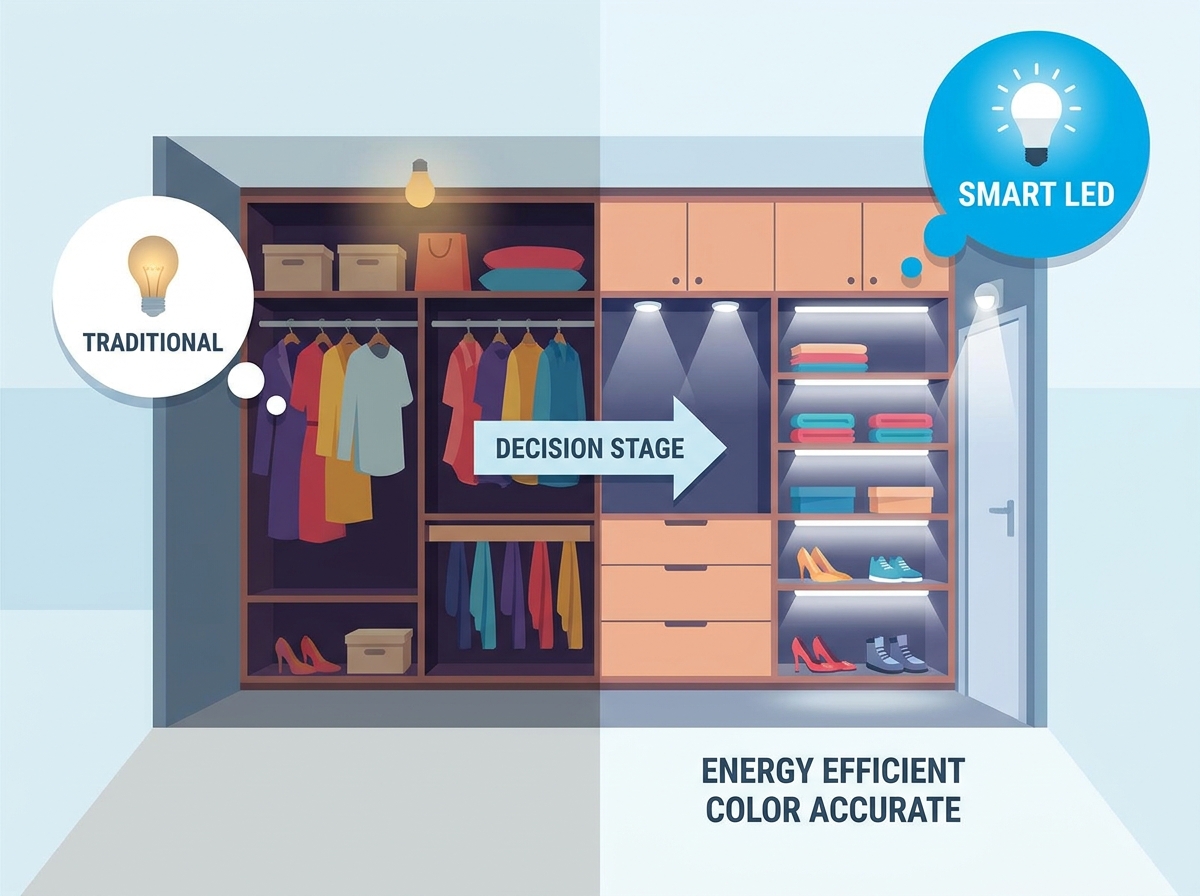
Flexible strips provide continuous, shadow-free lighting. You can run them along closet perimeters, under shelves, or framing the door casing. They offer unmatched versatility for custom spaces. Modern strips utilize Chip-on-Board (COB) technology or Surface Mounted Devices (SMD). COB strips pack hundreds of tiny diodes together to create a seamless line of light.
Bare SMD strips often produce a harsh "dot effect" where individual diodes reflect off glossy surfaces. To eliminate this, you must mount the strips inside slim aluminum channels paired with opaque or milky diffusers. This creates a modern, sleek finish while protecting the diodes from dust and physical damage. A growing premium trend involves using heavy-duty aluminum extrusions as actual illuminated hanging rods. This integrates the light directly into the structural hardware, casting light directly down onto the hanging garments.
Feature |
Advantage |
Disadvantage |
|---|---|---|
Customization |
Cut to exact lengths for perfect fit |
Requires precise measurement and cutting |
Light Distribution |
Perfectly even wash across long spans |
Voltage drop on runs longer than 16 feet |
Aesthetics |
Low profile, easily hidden behind trim |
Requires aluminum channels for a finished look |
Rigid bars serve as sturdy, easy-to-mount alternatives to flexible strips. They are ideal for solid wood shelving or custom built-in cabinetry. These units come pre-housed in protective aluminum or plastic casings, complete with built-in diffusers.
When evaluating rigid bars, consider the mounting system and the linking method. Magnetic mounting systems offer quick removal for cleaning or repositioning. Screw-in brackets provide superior long-term stability. Screw mounts prevent the fixture from shifting when you accidentally bump it with a hanger. Many rigid bars allow for daisy-chaining. You can connect multiple bars end-to-end using small jumper cables, running them off a single power supply.
Feature |
Advantage |
Disadvantage |
|---|---|---|
Installation |
Mounts perfectly straight with two screws |
Cannot bend around corners |
Durability |
Hard outer casing protects internal components |
Fixed lengths limit custom sizing |
Connectivity |
Easy plug-and-play daisy chaining |
Jumper cables can look messy if not hidden |
Puck lights offer quick additions to deep shelves, dark corners, or rental properties. They require zero existing electrical infrastructure. You simply stick them where you need light. They work well for highlighting specific items like a display of expensive shoes or handbags.
You must choose between push-button activation and remote control operation. Push-button models require physical contact, which becomes annoying for high shelves. Remote-controlled models allow you to turn on multiple pucks simultaneously. However, you must keep track of the remote. Puck lights also create a scalloping effect on the back wall. The beam angle is narrow, creating distinct pools of light rather than an even wash.
Feature |
Advantage |
Disadvantage |
|---|---|---|
Wiring |
Zero electrical work required |
Relies entirely on batteries |
Cost |
Highly affordable upfront |
Ongoing cost of battery replacement |
Beam Spread |
Great for targeted accent lighting |
Creates uneven "spotlight" shadows |
Motion-sensor bars provide automated lighting for reach-in closets or pantries. They are perfect for situations where your hands are often full of laundry. You open the door, and the space illuminates instantly.
Analyze the sensor range and auto-shutoff timers before purchasing. Most units use passive infrared (PIR) technology. PIR detects body heat movement. Reliable PIR sensors trigger instantly when you open the door. They shut off shortly after you leave, preserving power. Some advanced models use microwave sensors, which can detect motion through thin doors, turning the light on before you even open the closet.
Feature |
Advantage |
Disadvantage |
|---|---|---|
Convenience |
Hands-free operation |
Sensors can be blocked by clothing |
Efficiency |
Auto-shutoff saves power |
May turn off while you stand still |
Technology |
PIR is highly reliable for body heat |
Cheap sensors have delayed reaction times |
Walk-in closets require primary ambient lighting from above. Hardwired ceiling fixtures fill this role perfectly. They flood the center of the room with broad illumination, allowing you to navigate the space safely.
Standard low-profile panels sit flush against the drywall, maximizing vertical clearance. This is critical in closets where you might be lifting boxes onto top shelves. Discreet track lighting offers another excellent option. Track heads allow you to aim specific beams at different wardrobe zones. You can highlight a shoe display while washing the main hanging rods with light. Always verify that recessed fixtures are IC-rated (Insulation Contact) if they will touch attic insulation.
Feature |
Advantage |
Disadvantage |
|---|---|---|
Output |
Massive lumen output for whole-room lighting |
Can create shadows under deep shelves |
Compliance |
Meets all residential building codes |
Requires professional electrician installation |
Clearance |
Flush mounts keep the ceiling clear |
Requires cutting into drywall |
Battery-powered fixtures offer the path of least resistance for installation. You avoid drilling holes for wires or hiring contractors. However, you must analyze the long-term maintenance. Disposable AA or AAA batteries drain quickly in high-traffic closets. The constant replacement cycle becomes tedious and environmentally wasteful.
USB-rechargeable lithium-ion models present a better alternative. Evaluate the milliamp-hour (mAh) rating of the internal battery versus your daily usage. A 2000mAh battery might last a month in a guest closet but only a week in a primary bedroom wardrobe. When the battery dies, you must physically detach the fixture, plug it into a wall charger, and reinstall it later. This routine tests the patience of most homeowners over time. Battery power works best as a temporary fix or for spaces accessed infrequently.
Plug-in systems bridge the gap between temporary batteries and permanent wiring. You route a plug-in power supply to an existing bedroom or closet outlet. This provides unlimited power without opening walls. You simply mount the lights, run the low-voltage wire to the transformer, and plug it in.
Cable management remains the primary challenge here. You must route low-voltage wires neatly to maintain a clean aesthetic. Utilize adhesive cable raceways to hide the wires along baseboards or door casings. Raceways protect the cables from snagging on hangers or shoes. When running long distances, pay attention to voltage drop. A 24V plug-in system pushes power much further than a 12V system before the diodes at the end of the run start to dim. Use 18/2 AWG wire for most standard closet runs to maintain consistent brightness.
Hardwiring represents the ultimate standard for custom closet lighting. This process involves tying low-voltage transformers into your existing home electrical circuits. An electrician mounts a Class 2 power supply in a hidden, accessible location, such as an attic, basement, or behind a structured wiring panel.
Hardwired setups offer unmatched long-term reliability. They integrate seamlessly with standard wall switches, occupancy sensors, or smart home dimmers. You walk into the room, flip a switch, and the entire wardrobe illuminates instantly. This permanent infrastructure significantly increases property value and elevates the daily user experience. It also allows you to hide all wiring behind the drywall, resulting in a flawless, high-end finish that looks like it belongs in a luxury boutique.
Standard 3M adhesive backing on flexible strips often fails over time. This risk increases on heavily textured walls, raw wood shelving, or in humid environments. When the adhesive degrades, the strips peel away, hang loosely, and look terrible.
Never rely solely on the factory adhesive tape. Surface preparation is mandatory. Always clean the mounting surface with isopropyl alcohol to remove dust and oils before application. For raw wood, apply an adhesion promoter or a thin layer of clear polyurethane to create a smooth bonding surface. Better yet, use mechanical mounting clips spaced every twelve inches. The most reliable method is installing aluminum extrusions with screw mounts. The extrusion stays permanently attached to the shelf, and the strip sits securely inside.
Closets are tightly enclosed, poorly ventilated spaces filled with highly flammable materials. Overheating is a serious risk. Cheap, high-output diodes can experience thermal runaway if they cannot shed heat efficiently. The National Electrical Code (NEC) has strict rules regarding fixture placement near storage spaces.
Verify NEC 410.16 compliance for all closet luminaires. The code dictates specific clearance distances between the light fixture and the storage space to prevent fires. Mandate the use of low-voltage LED Lights. You must use aluminum heat sinks or channels for any high-output strips. The aluminum absorbs the heat from the diodes and dissipates it safely into the air. This prevents the fixture from reaching dangerous temperatures and extends the lifespan of the diodes.
Mounting bare diodes directly in your line of sight causes severe visual discomfort. Glare makes it difficult to focus on your clothing. It defeats the purpose of adding illumination. If you mount a strip flat on the ceiling of a reach-in closet, the light shines directly into your eyes rather than onto the clothes.
Employ strategic placement techniques to mitigate glare. Mount strips facing the back wall to create a soft, indirect wash. Utilize opaque diffuser covers to scatter the light evenly and eliminate hot spots. You can also use 45-degree corner channels mounted at the front edge of a shelf. These channels direct the beam inward toward the clothing rather than outward into your eyes. Hide fixtures behind the front lip of shelves or behind custom wooden valances to keep the light source completely out of sight.
Measure all your shelving and hanging rods to calculate the exact linear footage required for your project.
Locate the nearest electrical outlet or ceiling junction box to determine if you will use a plug-in transformer or a hardwired power supply.
Purchase a small sample strip of 4000K, 90+ CRI lighting to test the color accuracy against your specific wardrobe fabrics before committing to a full build.
Order aluminum extrusions and milky diffusers to house your strips, ensuring proper heat dissipation and a professional, glare-free finish.
A: Neutral White (4000K) is the best color temperature for closets. It closely mimics natural daylight, providing the most accurate color representation for your clothing. Warm White (3000K) is acceptable for cozy ambient lighting, but it casts a yellow hue over white fabrics, making color matching difficult.
A: Yes, they are highly safe when installed correctly. They operate on low voltage and generate significantly less heat than traditional incandescent bulbs. To ensure maximum fire safety and comply with building codes, mount high-output strips inside aluminum channels to facilitate proper heat dissipation away from flammable clothing.
A: A walk-in closet requires a layered approach. Aim for 30 to 50 ambient lumens per square foot from your ceiling fixture. For task lighting over hanging rods or shelves, use strips providing 130 or more lumens per linear foot to eliminate shadows and illuminate the garments clearly.
A: Hardwired lights are vastly superior for permanent reliability, brightness, and wall switch integration. Battery-powered lights are only better if you are renting, lack nearby electrical access, or need a temporary installation without routing cables or opening drywall.
A: Use rigid bars for perfectly straight, solid wood shelves where you want a quick, durable screw-in installation. Choose flexible strips if you need custom lengths, continuous runs around corners, or want to integrate the lighting into specialized aluminum extrusions like illuminated hanging rods.
A: Do not rely solely on the factory adhesive backing. Clean the shelf surface with isopropyl alcohol first. For permanent adhesion, use heavy-duty double-sided acrylic tape, mechanical mounting clips, or install the strips inside screw-mounted aluminum channels.
A: This happens because your closet lighting has a low Color Rendering Index (CRI). Low-CRI fixtures fail to reflect the full color spectrum, washing out reds and blues. Upgrading to fixtures with a CRI of 90 or higher ensures your clothes look exactly the same indoors as they do in natural sunlight.