
Author: Huang Publish Time: 07-01-2026 Origin: Site


You might wonder how long do led bulbs last. Most led light bulbs work for 25,000 to 50,000 hours, which means you can use them for 8 to 17 years if you run them 8 hours a day. Some led bulbs even reach 100,000 hours with perfect conditions. Lifespan depends on factors like usage and environment.
Typical lifespan: 25,000–50,000 hours (8–17 years at 8 hours/day)
L70 standard: bulbs still work but with less brightness after their rated hours
LED light bulbs usually last 25,000 to 50,000 hours. This means they can work for 8 to 17 years if used 8 hours each day. - To help them last longer, keep LED bulbs in cool places. Try not to turn them on and off a lot. This stops them from getting too hot and wearing out. - Pick LED bulbs with longer warranties. These bulbs are often better and more reliable. This helps you get the best value for your money.
You probably ask yourself, how long do led bulbs last when you shop for new lighting. The answer depends on where and how you use them. Most led light bulbs offer an average rated life between 25,000 and 50,000 hours. In some cases, you can see bulbs rated for up to 100,000 hours, but these numbers reflect ideal conditions. The average life of leds in homes is usually lower because of heat, power changes, and how often you turn them on and off.
Here is a table showing the most commonly cited average lifespans for led light bulbs:
| Lifespan Estimate | Description |
|---|---|
| 4 to 7 years | Average lifespan under normal usage |
| Up to 10 years | Possible lifespan with proper usage habits |
| 25,000 hours+ | Average lifespan in commercial settings |
You can expect a 50,000 hour lifespan only if you use the bulbs in cool, stable environments. Real-world lifespans often fall below the highest ratings because of daily wear and tear.
Manufacturers use several methods to estimate the average rated life of led light bulbs. They test bulbs in labs and measure how long it takes for the brightness to drop to 70% of the original level. This point is called the L70 standard. You will see ratings like "50,000 hours" on packaging, but this means the bulb will still work, just with less light.
Note: The L70 rating does not mean the bulb stops working after 50,000 hours. It means the bulb will be dimmer but still usable.
Here is a table showing how daily use affects the expected lifespan of led bulbs:
| Daily Usage (hours) | Lifespan (years) |
|---|---|
| 4 | 17.1 |
| 7 | 9.7 |
| 12 | 5.7 |
Most households use led light bulbs for about 3 to 5 hours each day. Under these conditions, the average life of leds is between 25,000 and 50,000 hours. This means you can expect your bulbs to last from 8 to 17 years, depending on your habits.
Manufacturers rely on industry standards to report the average rated life of led bulbs. Here is a table showing the main testing methods:
| Methodology | Description |
|---|---|
| LM-80 | Tests LED chips for longevity at different temperatures for 6,000 hours. |
| TM-21 | Uses LM-80 data to predict life expectancy and lumen depreciation (L70, L80, L90). |
| LM-79 | Reports performance characteristics but does not address lifetime ratings. |
Environmental factors like temperature, usage patterns, and component quality play a big role in the actual lifespan. High temperatures can cause bulbs to fail sooner. If you use bulbs for long periods or in hot places, you may see a shorter average lifespan. The weakest part of the bulb, often the power supply, can fail before the led itself.
When you compare led light bulbs to other types, you see a big difference in average rated life. Here is a table showing the average lifespans of common bulbs:
| Bulb Type | Average Lifespan (hours) |
|---|---|
| Incandescent | 1,000 |
| Halogen | 2,000 |
| CFL | 12,000 |
| LED | 25,000 |
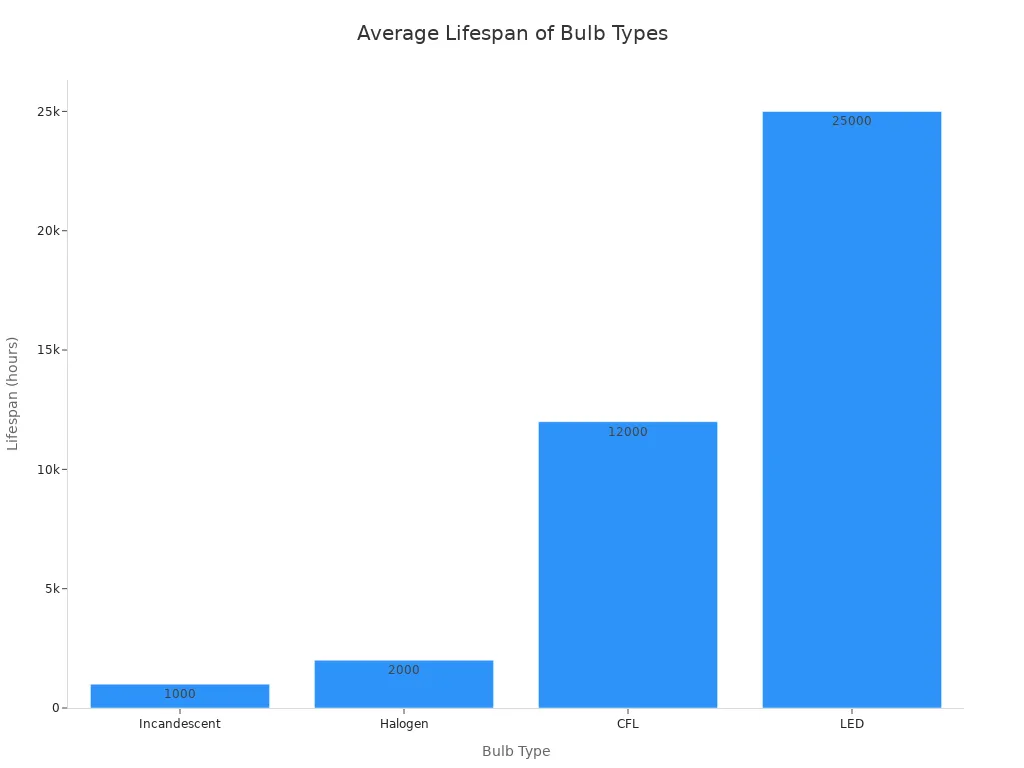
Incandescent bulbs last about 1,000 hours.
Halogen bulbs last about 2,000 hours.
CFL bulbs last about 12,000 hours.
LED bulbs last about 25,000 hours.
A single 12W led light bulb can last as long as:
25 traditional 60W incandescent bulbs
25 traditional 60W halogen bulbs
15 energy saving 43W halogen bulbs
2.5 15W CFL bulbs
The average life of leds is much longer because they use less energy and produce less heat. LEDs work best at lower temperatures, which helps them last longer. They also use strong materials that resist impacts and vibrations. This makes them a good choice for places where bulbs get bumped or moved.
You will find that led light bulbs are more energy-efficient than other types. They turn more electricity into light and less into heat. This saves you money and helps the environment. New technology, like the integration of IoT and sustainable materials, keeps improving the expected lifespan of leds.
Manufacturers offer warranties for led bulbs that usually last 3 to 5 years. The actual lifespan can reach up to 50,000 or even 100,000 hours. Shorter warranty periods reflect the fact that real-world lifespans depend on how and where you use the bulbs.
The average rated life of led bulbs in commercial settings is higher than in homes. Commercial applications often see bulbs last 15 to 20 years with daily use of 8 to 12 hours. In homes, the average life of leds is about 10 to 14 years, but this varies with your usage.
Tip: To get the most out of your led light bulbs, use them in cool places and avoid turning them on and off too often. Choose bulbs with longer warranties for better quality and reliability.
Heat can make led bulbs not last as long. If you put led bulbs in places with bad airflow or high heat, they get hotter. This extra heat makes the bulb wear out faster. Scientists say leds give off about 55% of their energy as heat. If the inside of the bulb gets too hot, called the junction temperature, the bulb will not last as long.
| Evidence Description | Key Findings |
|---|---|
| Heat Generation in LEDs | LEDs give off 55% of energy as heat, which can make them not work as well and not last as long. |
| Junction Temperature (Tj) | Higher junction temperatures mean leds do not last as long. |
| Thermal Resistance | Keeping thermal resistance normal helps leds work better. |
| Design Considerations | Good cooling systems help leds last longer. |
Manufacturers use different ways to keep leds cool:
Shiny coatings send heat away from the bulb
Heat sinks and pads soak up extra heat
Spacing leds apart helps air move around them
Temperature checks help spot overheating
How you use your led bulbs changes how long they last. If you turn them on and off a lot, or use them where power is not steady, they may not last as long.
Bad power, like voltage changes, can make led bulbs fail early. This can waste energy and cost you money.
You should watch how you use your bulbs. Using dimmers or smart controls that do not fit leds can make them flicker and not last as long.
| Usage Pattern | Description |
|---|---|
| Proper Installation Techniques | Use the right voltage and wattage; do not screw bulbs in too tight. |
| Environmental Considerations | Keep bulbs at good temperatures; keep them dry. |
| Maintenance Practices | Clean bulbs and fixtures often; do not turn them on and off too much. |
| Dimming and Controls | Use dimmers that work with leds; use smart controls for slow dimming. |
The fixture you use can change how long your led bulbs last. Good fixtures help heat move away from the bulb. If the fixture keeps heat in, the bulb gets hotter and wears out faster. The driver inside the bulb can break early if it gets too hot. Using the wrong dimmer or control can make bulbs flicker and break over time.
| Aspect | Impact on Performance and Longevity |
|---|---|
| Fixture Design | Changes how the light looks and cuts down on glare and shadows. |
| Driver Technology | Better drivers help bulbs last longer. |
| Material Durability | Strong materials help bulbs work in tough places and last longer. |
Some fixtures use motion sensors or controls to save energy. Good led bulbs with better drivers last longer and save you money because you do not have to buy new ones as often.
How long you use your led bulbs each day changes how long they last. If you only use your lights for a few hours, they can last 10 to 20 years. If you leave outdoor lights on all night, they may wear out faster. Most leds are rated for 25,000 to 50,000 hours. You get the best value when you use them smart. Watching how you use your bulbs helps them last longer.
You might notice that your led light bulbs do not shine as brightly as before. This is called lumen depreciation. Unlike old bulbs that burn out suddenly, long-lasting led lights lose brightness slowly. You may see a once-bright area now looks dull or shadowy. Sometimes, parts of the fixture appear dimmer than others. Colors in your room can look faded or off. These changes mean the bulb is aging. You should check the brightness if you feel your space is not as well lit as before.
Tip: Replace led bulbs when they become too dim for your needs. Many experts suggest changing them when brightness drops below 70% of the original level.
Flickering is another sign that tells you when to replace leds. This can happen if the power in your home is not steady or if the bulb’s parts are getting old. Sometimes, you may see the color of the light change. The light might look more yellow or blue than before. These problems can make your room uncomfortable and can even hurt your eyes. Flickering and color shifts often mean the bulb’s driver or other parts are wearing out.
| Method | Description |
|---|---|
| Compatible dimmer switches | Use dimmers made for LEDs to stop flickering. |
| High-quality LED drivers | Good drivers keep the color and brightness steady. |
| Careful selection of materials | Strong materials help prevent color changes as the bulb ages. |
Knowing when to replace leds helps you keep your home bright and safe. Here are some tips:
Avoid using led bulbs in enclosed fixtures unless they are made for that use.
Use dimmers that work with led technology.
Make sure the voltage in your home stays steady.
Clean your lights and fixtures often to keep them bright.
Watch for signs like dimming, flickering, or color changes.
Replace bulbs that no longer meet your lighting needs.
Long-lasting led lights save you money and time. If you follow these tips, you can enjoy long-lasting, bright light and know exactly when to replace leds.
Led light bulbs usually last between 25,000 and 50,000 hours. How long they last depends on heat, the power supply, and how good the parts are. If you want your bulbs to last longer, keep them cool. Clean your fixtures often. Try not to turn your lights on and off too much. Look at the table below for important facts.
| Key Takeaway | Details |
|---|---|
| Average Lifespan | 25,000–50,000 hours (9–17 years at 8 hours/day) |
| Optimal Conditions | Up to 100,000 hours possible |
| Cost Efficiency | Fewer replacements, lower energy costs |
Make sure there is good airflow.
Clean your fixtures often.
Do not switch your lights on and off a lot.
You see dim light, flickering, or color changes. The bulb may not light up right away. These signs show you need a new bulb.
You can use LED bulbs in most fixtures. Make sure the fixture allows heat to escape. Check if the bulb fits and matches the fixture’s voltage.
Yes, you save money with LED bulbs. They use less energy and last longer than other bulbs. You buy fewer replacements and pay lower electric bills.


