Author: LD Publish Time: 04-09-2026 Origin: Site


Replacing an old incandescent bulb used to be a simple task. You grabbed a standard 60-watt bulb off the shelf and screwed it in. Today, walking down the lighting aisle feels like reading a technical manual. You face a wall of confusing choices. Pick the wrong one, and you get harsh, flickering light that ruins the room. The shift to modern lighting technology changed everything. We no longer buy based on wattage. We have to navigate a matrix of lumens, Kelvin, CRI, and enclosure ratings. Most homeowners lack a clear framework to match these specifications to their actual fixtures and room layouts. They end up guessing, which leads to poor lighting and wasted energy. This guide provides a definitive, room-by-room evaluation framework. We will decode the technical specifications and eliminate compatibility risks. You will learn exactly how to select the right LED Lights for optimal ambiance, task performance, and energy savings.
Brightness is measured in lumens, not watts: To replace a standard 60W incandescent, evaluate LED lights outputting roughly 800 lumens.
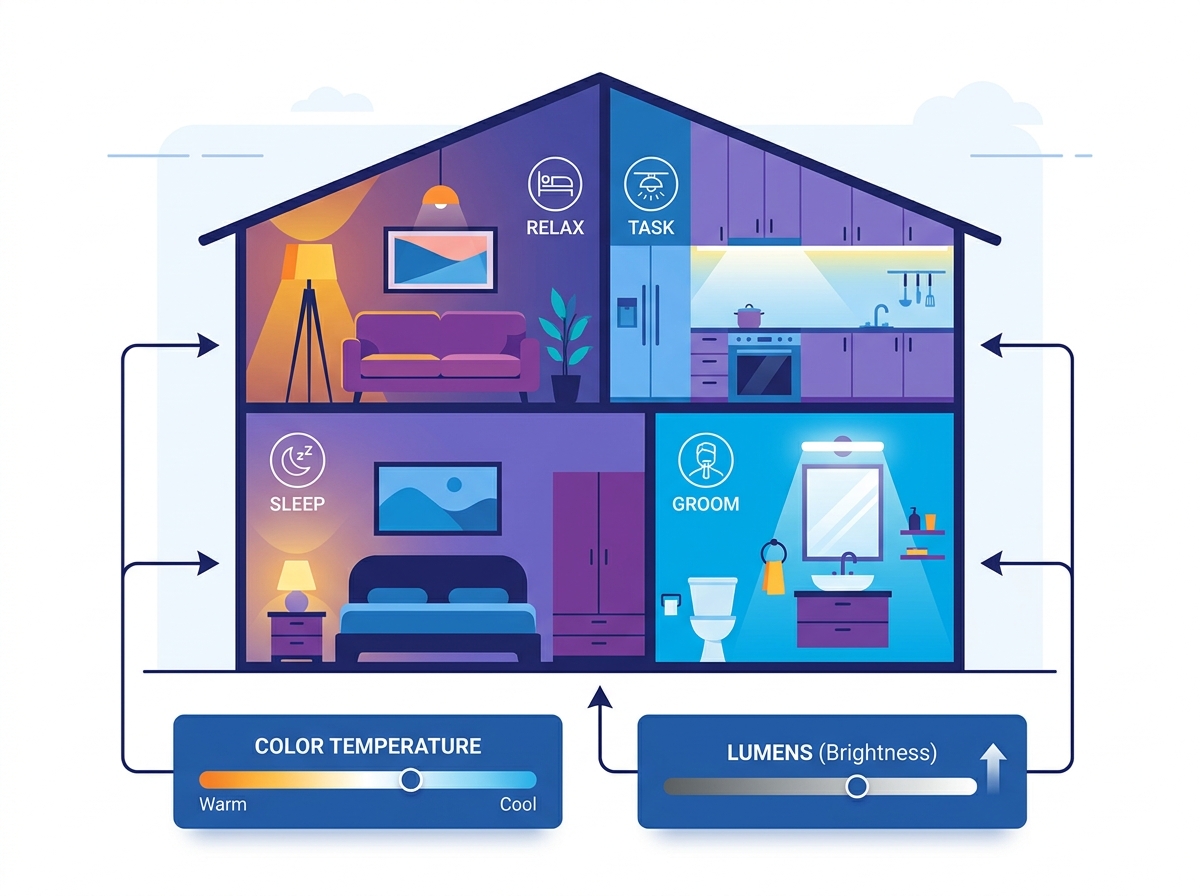
Color temperature dictates room utility: Select 2700K–3000K for relaxation and dining areas, and 3500K–4000K for task-heavy spaces like kitchens and bathrooms.
CRI (Color Rendering Index) impacts visual quality: Prioritize LED lights with a CRI of 90 or higher for interior living spaces to prevent colors from appearing washed out or unnatural.
Hardware compatibility is critical: Not all LEDs are dimmable or rated for enclosed fixtures; verifying switch compatibility, fixture wattage limits, and enclosure ratings prevents flickering and premature bulb failure.
Certifications guarantee performance: Look for Energy Star and UL-listed LED lights to ensure safety, maximize energy efficiency, and qualify for local utility rebates.
We used to measure brightness by energy draw. A 100-watt bulb was naturally brighter than a 40-watt bulb because it burned more energy. Modern technology completely decouples energy consumption from light output. Watts measure the electricity required to power the internal driver. Lumens measure the actual visible brightness you see in the room. Evaluating a bulb based on wattage alone no longer works. You must train yourself to look for the lumen rating on the packaging.
Lumen Output (Brightness) | Incandescent Equivalent | Typical LED Energy Draw |
|---|---|---|
450 Lumens | 40W | 4-5W |
800 Lumens | 60W | 8-10W |
1100 Lumens | 75W | 11-13W |
1600 Lumens | 100W | 14-17W |
2600 Lumens | 150W | 20-25W |
You calculate total lumen requirements based on room square footage and purpose. A standard living room needs about 20 lumens per square foot for comfortable ambient light. A kitchen demands 50 to 75 lumens per square foot for safe food preparation. Simply multiply your room's square footage by these target numbers to determine the total lumens required for the space. If you have a 100-square-foot kitchen, you need roughly 5,000 to 7,500 total lumens spread across your overhead and under-cabinet fixtures.
Understanding "Max Wattage" labels saves you from unnecessary fixture replacements. A lamp rated for "60W Max" refers to the physical heat generated by a traditional incandescent bulb. You can safely install a 1600-lumen LED in that same fixture. The modern bulb only draws about 15 watts of actual electricity. It stays well under the thermal safety limit while providing significantly more light.
The Kelvin (K) scale measures the color appearance of light. This metric directly impacts human circadian rhythms. It also changes how we perceive spatial dimensions and interior paint colors. Lower Kelvin numbers produce warm, yellow light. Higher numbers emit cool, blue tones.
Kelvin Range | Common Name | Best Application Areas |
|---|---|---|
2700K | Soft White | Bedrooms, living rooms, table lamps |
3000K | Warm White | Dining rooms, hallways, general ambient lighting |
3500K - 4000K | Cool White | Kitchens, bathrooms, home offices |
5000K+ | Daylight | Garages, basements, exterior security |
Mixing different color temperatures within a single open-concept space creates visual chaos. It confuses the eye and disrupts the room's aesthetic flow. Pick one color temperature for your primary overhead lighting. Stick to it throughout interconnected spaces to maintain a cohesive design. If your kitchen opens directly into your living room, a 3000K bulb in both spaces bridges the gap between task visibility and evening relaxation.
The Color Rendering Index (CRI) measures how accurately a light source reveals true colors. The scale runs from 0 to 100. Natural sunlight scores a perfect 100. CRI is the hidden specification separating cheap bulbs from premium lighting. When you buy bargain bin bulbs, you usually get a CRI of 80 or lower.
Standard 80 CRI bulbs are sufficient for garages, utility closets, or unfinished basements. They are entirely inadequate for kitchens, bathrooms, or art displays. Under 80 CRI light, fresh produce looks dull. Skin tones appear sickly or washed out. Expensive paint colors shift unexpectedly, often taking on a muddy appearance.
Establish 90+ CRI as your baseline benchmark for interior living spaces. High-quality residential LED Lights should always hit this mark. Some premium bulbs also advertise high R9 values. The R9 metric specifically measures how well the bulb renders deep reds. High R9 values make wood finishes look rich and skin tones look healthy in bathroom vanity mirrors.
Switching to certified lighting drastically alters your home's energy profile. The long-term return on investment comes from massive energy savings over the bulb's lifespan. Quality bulbs last 15,000 to 25,000 hours. This longevity eliminates the constant cycle of buying and replacing burnt-out incandescent bulbs every few months.
Safety testing matters just as much as efficiency. Look for UL (Underwriters Laboratories) or ETL listings on the packaging. These marks guarantee the internal components meet strict fire safety and electrical compliance standards. Uncertified bulbs often cut corners on thermal management, increasing the risk of overheating and electrical shorts.
Energy Star-certified bulbs undergo rigorous independent testing. They must prove their color consistency, light output, and longevity. Purchasing Energy Star products often qualifies you for local utility rebates. This further accelerates your return on investment and guarantees you are buying a reliable product that will not degrade in brightness after a year of use.
The A19 bulb is the omnidirectional standard for residential lighting. It fits table lamps, floor lamps, and basic ceiling fixtures perfectly. The "A" stands for arbitrary, and the number denotes the diameter in eighths of an inch. These bulbs cast light evenly in all directions, making them the workhorse of home illumination.
You will also encounter A21 bulbs. These deliver higher lumen outputs but feature a larger physical footprint. This size difference creates problems in older fixtures. An A21 bulb often protrudes from shallow lampshades. It can also press against the glass in flush-mount ceiling domes. Always measure your fixture clearance before upgrading to high-lumen A21 models to ensure the glass envelope does not touch the fixture housing.
Recessed ceiling cans require specific directional bulbs. BR (Bulged Reflector) bulbs provide wide, diffused ambient light. The frosted lens softens the beam edge. This makes them ideal for general illumination in living room ceilings or finished basements. They wash the walls with light without creating harsh shadows.
PAR (Parabolic Aluminized Reflector) bulbs serve a completely different purpose. They project focused, hard-edged beams. Use PAR bulbs for highlighting artwork, illuminating kitchen islands, or exterior security lighting. They push light down precisely where you need it, cutting through the darkness with a concentrated beam.
Beam angle dictates how the light spreads from recessed LED Lights. A narrow spot (15 degrees) highlights a single object. A wide flood (60 degrees) covers broad floor areas. Choosing the wrong beam angle creates harsh dark spots or overlapping glare zones across your ceiling. For standard 8-foot ceilings, a 40-degree beam angle usually provides the most even coverage.
Chandeliers and wall sconces typically require an E12 candelabra base. These fixtures expose the bulb directly to the viewer's eye. This makes aesthetic evaluation just as important as technical performance. You must consider how the bulb looks both when turned on and when turned off.
Exposed-filament, Edison-style bulbs offer a vintage aesthetic. They look beautiful when dimmed. However, they produce severe glare at full brightness. Frosted glass candelabra bulbs minimize this direct line-of-sight glare. They provide a softer, more elegant diffusion for formal dining rooms and bathroom vanity sconces.
Kitchens and bathrooms are highly functional, task-oriented spaces. They demand high visibility and shadow reduction. You need accurate color representation for food prep, cooking, and daily grooming routines. Poor lighting in these rooms leads to eye strain and mistakes.
Success Criteria: High visibility, accurate color representation, shadow reduction, and safety.
Color Temperature: Select a 3000K–4000K range. This provides clean, energetic light without feeling overly sterile.
CRI Requirement: Demand a 90+ CRI rating. This ensures makeup application is accurate and fresh food looks appetizing.
Lumen Output: Aim for high lumen output, roughly 800 to 1100 lumens per primary fixture. Supplement overhead lighting with under-cabinet strips for dedicated task lighting.
These rooms serve as relaxation and ambient spaces. The lighting must support your evening wind-down routine. It should reduce glare and adapt easily for entertaining guests. Layering your light sources is the best approach in these areas.
Success Criteria: Warmth, glare reduction, circadian rhythm support, and adaptability.
Color Temperature: Stick to a 2700K–3000K range. This mimics the comforting glow of traditional incandescent bulbs.
Fixture Strategy: Use dimmable A19 bulbs for table and floor lamps. Choose lower lumen outputs for bedside tables, typically 400 to 600 lumens, to prevent sleep disruption.
Dining rooms require specific attention. You must install dimmable candelabra or A-series bulbs in your chandelier. This allows the space to transition seamlessly. You can shift from bright homework lighting in the afternoon to soft, ambient dinner lighting in the evening. A high-quality dimmer switch is non-negotiable for dining spaces.
High-focus environments require lighting that promotes alertness. You need sharp contrast for reading documents, working on monitors, or performing detailed mechanical work. Minimal eye strain is the ultimate goal for productivity.
Success Criteria: Alertness, sharp contrast, minimal eye strain, and broad coverage.
Color Temperature: Choose a 4000K–5000K range. This cooler light suppresses melatonin production and keeps you focused.
Fixture Strategy: Maximize your lumen output. Install PAR bulbs in recessed cans or utilize T8 tube replacements for garage workspaces to eliminate shadows over workbenches.
Exterior lighting faces harsh environmental conditions. Broad visibility and security camera compatibility are your primary concerns. The wrong bulb will fail after its first exposure to freezing temperatures or heavy rain.
Success Criteria: Weather resistance, broad visibility, and camera compatibility.
Environmental Ratings: Always verify "Damp" or "Wet" location ratings on the packaging. Damp ratings are for covered porches. Wet ratings are for fixtures exposed directly to rain.
Security Strategy: Utilize PAR38 bulbs in 4000K–5000K for motion-sensor floodlights. This specific temperature maximizes contrast for nighttime security footage, making it easier to identify faces and license plates.
Smart lighting offers unprecedented control over your home environment. Tunable white technology allows you to adjust the Kelvin temperature throughout the day automatically. You can wake up to crisp 4000K light and wind down with warm 2700K light. This dynamic shifting supports natural circadian rhythms far better than static standard bulbs.
You must evaluate the infrastructure requirements before buying into an ecosystem. Wi-Fi bulbs connect directly to your router. They are easy to set up but can congest your home network if you install dozens of them. Zigbee or Thread-based systems require a dedicated hub connected to your router. The hub improves response times, reduces router strain, and ensures network stability for larger whole-home installations.
Smart bulbs carry a significant upfront cost premium. You must weigh this expense against the operational lifespan and daily utility. A standard bulb requires a minimal investment. A comparable smart bulb demands a premium upfront cost. You are paying for the internal wireless radio and the software ecosystem.
You also face the risk of vampire draw. Smart bulbs consume a small amount of standby power constantly to maintain their wireless connection to your network. Furthermore, software obsolescence is a real threat. If a manufacturer stops updating their app or shuts down their cloud servers, your expensive smart bulb reverts to a basic, static light. Always choose established brands with a proven track record of software support.
Flickering is the most common complaint after a lighting upgrade. This happens due to a technical mismatch. Legacy incandescent dimmer switches use leading-edge technology. They chop the electrical waveform to reduce power. Modern electronic drivers require smooth, consistent voltage to operate correctly.
You can mitigate this risk easily. First, verify the packaging explicitly states the bulb is dimmable. Non-dimmable bulbs will fail quickly on a dimmer circuit. Second, cross-reference the bulb manufacturer’s compatible dimmer list. You will often need to upgrade your wall switch to a trailing-edge or LED-specific dimmer model. This small electrical upgrade ensures smooth, silent dimming down to one percent brightness.
Thermal management dictates the lifespan of modern lighting. The light beam itself is cool to the touch. However, the internal driver hidden in the base generates significant heat. This heat must escape for the sensitive electronics to survive.
Never place standard bulbs in fully enclosed glass ceiling domes or sealed outdoor lanterns. The trapped heat will cook the internal components. The bulb will fail in months rather than decades. You must purchase LED Lights explicitly marked with an enclosed fixture rating for these specific applications. These specialized bulbs feature advanced heat sinks designed to survive in high-temperature environments.
Audit your current fixtures to identify maximum wattage limits, physical clearance space, and base types before heading to the store.
Map out the primary function of each room to determine the ideal Kelvin temperature and calculate the total lumen output required.
Verify your existing wall switches and upgrade any legacy incandescent dimmers to modern trailing-edge models to prevent flickering.
Check the packaging for 90+ CRI ratings and enclosed fixture certifications to ensure long-term performance and visual comfort.
A: Yes. Fixture wattage limits refer to the physical heat generated by old incandescent bulbs. An LED producing 100 watts of equivalent light only draws about 15 actual watts of power. As long as the actual wattage draw is below the fixture's maximum rating, it is perfectly safe.
A: Buzzing indicates a compatibility issue between the bulb's internal driver and your wall dimmer switch. Older dimmer switches were designed for the heavy electrical load of incandescent bulbs. Upgrading your wall switch to an LED-compatible trailing-edge dimmer usually eliminates the buzzing noise.
A: Soft white bulbs measure around 2700K on the Kelvin scale. They produce a warm, yellowish glow ideal for relaxing spaces like bedrooms. Daylight bulbs measure 5000K or higher. They emit a crisp, bluish-white light that mimics noon sunlight, making them better suited for garages and security lighting.
A: For primary living spaces, yes. A Color Rendering Index (CRI) of 90 or higher ensures that colors appear natural and vibrant. Lower CRI bulbs can make food look unappetizing, skin tones look washed out, and paint colors appear dull or slightly shifted.
A: No. Indoor bulbs lack the necessary seals to protect their internal electronics from moisture and extreme temperature fluctuations. For outdoor fixtures, you must use bulbs explicitly rated for damp locations (under a covered porch) or wet locations (exposed directly to rain).
A: While the light beam is cool, the base of the bulb generates heat. If placed in a fully sealed glass dome, this heat cannot escape and will destroy the bulb's electronics. An enclosed fixture rating means the bulb is engineered to withstand those higher internal temperatures safely.