Author: Huang Publish Time: 29-12-2025 Origin: Site


You may wonder if led lights burn out like old bulbs. Instead of suddenly dying, led lights slowly lose brightness. The table below shows less than 1% of LEDs fail after 10,000 hours. Many LEDs last 20,000–60,000 hours, while regular bulbs last only 1,000 hours.
| Type of Bulb | Average Lifespan (hours) |
LED Lights | 20,000 - 60,000 |
Incandescent Bulbs | 1,000 |
LED lights get dimmer slowly instead of going out fast, so they are a good choice for using a long time. - To make LED lights last longer, use the right voltage, keep them cool, and be careful when putting bulbs in. - Good LED bulbs work for more years and use less energy, so you pay less for power and do not need to change them as often.
When you ask, "do led lights burn out," you might expect them to stop working suddenly like old bulbs. LED lights work differently. Instead of a quick end, most led lights lose brightness slowly. The main part inside an LED is a semiconductor chip. This chip makes light, but it can degrade over time. Overheating, too much current, and exposure to UV rays can damage the chip. As the chip wears out, led lights lose brightness and sometimes change color. You may notice the light looks dimmer or different than before.
The packaging around the LED, including the lens and connections, can also fail. Heat, moisture, or rough handling can break these parts. If the packaging fails, the led lights burn out or stop working. Another important part is the LED driver. This driver changes the power from your wall into the right kind for the LED. If the driver uses poor parts or has design problems, you might see flickering or the light may go out completely.
Electrical overstress is another way led lights burn out. Power surges or using the wrong voltage can damage the LED. Overheating is a big problem. If the LED gets too hot, the chip breaks down faster. You may see the light fade or stop working sooner than expected.
| Bulb Type | Failure Process |
LED | Gradually dims over time |
CFL/Fluorescent | Turns on and off (cycling) before failing |
You might wonder why led lights do not burn out suddenly. The answer comes from how LEDs work. Incandescent bulbs fail when their thin wire breaks. This causes the bulb to stop working right away. LED lights, on the other hand, slowly lose efficiency. Defects build up in the semiconductor chip, and the phosphor particles age. This process causes led lights to lose brightness over time.
▉LEDs, by contrast, slowly lose efficiency as semiconductor defects accumulate and phosphor particles age. The light dims so gradually that most homeowners swap fixtures for décor reasons long before the diode truly expires.
Most led lights reach the end of their useful life because they get dimmer, not because they stop working. The L70 standard helps you understand this. When an LED bulb gives off only 70% of its original brightness, it is considered at the end of its life. You may not notice the change right away, but over time, the light becomes too dim for your needs.
LED lights do not burn out suddenly like incandescent bulbs.
Traditional bulbs fail abruptly, while LEDs gradually lose brightness over time.
You will find that led lights burn out less often than other bulbs. Instead, led lights lose brightness and become less useful. This slow fading or color shift means you often replace the bulb for better light, not because it stopped working.
Incandescent bulbs fail when filaments thin and snap suddenly.
LEDs experience gradual lumen depreciation due to semiconductor defects and aging phosphor particles.
This gradual dimming means that LEDs often outlast their perceived lifespan, leading to fewer maintenance issues.
When you ask, "do led lights burn out," remember that led lights lose brightness slowly. You will likely notice dimmer light before the bulb ever stops working. This makes led lights a reliable choice for your home.
You might ask, "how long do led lights last in years?" The answer depends on several factors. Manufacturers use the L70 standard to measure led lifespan. This standard tells you when an LED produces only 70% of its original brightness. You can see this in the following explanation:
▉L70 is a lifetime measurement criteria developed by IESNA to evaluate the useful lifetime of an LED luminaire in terms of the expected number of operating hours until the light output has diminished to 70% of initial levels.
▉The industry has decided that 30% light loss, or 70% of light remaining, should be that line in the sand. This is commonly called the L70 metric.
For example, if you see an LED rated for 25,000 hours, it means the bulb will still give you 70% of its original light after that time. This helps you understand how led lifespan measured works in practice.
The average lifespan of led lights ranges from 20,000 to 60,000 hours. If you leave led lights on 24/7, they can last from 2 to 7 years, depending on the quality and environment. High-quality led light bulbs last longer because they use better materials and designs. Low-quality led bulbs may fail sooner, causing you to replace them more often.
Several things affect how long led lights last in years:
Ambient temperature affects led lifespan. If you use led lights in a room that is too hot or too cold, the lifespan drops.
Power source matters. Using a bulb with too much wattage for the fixture can cause overheating and premature failure.
Usage patterns play a role. If you leave led lights on 24/7, they may last longer than if you turn them on and off many times a day.
Heat sink material is important. Good heat sinks help manage temperature and extend the lifetime of your led lights.
You may wonder why led lights burn out or fail before their expected lifetime. Here are some common reasons:
High temperature affects led lifespan. If the room gets too hot, the led chip can break down faster.
Voltage fluctuations can cause varying brightness and damage internal parts. This leads to a shorter lifespan.
Poor heat sinks allow heat to build up, which can cause the bulb to burn out.
Frequent on-off cycles wear out the components faster.
Using low-quality led bulbs increases the risk of premature failure.
Heat is a major factor. If you use led lights in a place with poor ventilation, the temperature rises and the led lights burn out sooner. Electrical issues like power surges or incorrect voltage also damage the bulb. When a bulb burns out, you lose light and need to replace it.
Heat sinks play a big role in how long led lights last in years. They help move heat away from the led chip. If the heat sink works well, the temperature stays low and the led lights last longer. If the heat sink is too small or made from poor material, heat builds up and the led light bulbs fail early.
High temperatures can cause complete failure of LEDs if they go above safe limits.
Lumen degradation happens faster at high temperatures. For example, at 75°C, lifespan may drop to 39,000 hours, but at 50°C, it can reach 90,000 hours.
Poor heat sinks can cause immediate performance loss, with some LEDs losing up to 70% efficiency.
Color temperature changes may happen, making white LEDs look unnatural.
Heat sinks are usually made from aluminum because it is affordable and conducts heat well. Some designs use copper, which works even better but costs more. The size, shape, and placement of the heat sink also matter. If you overdrive LEDs by using too much current, they get hotter and fail faster. Good heat sinks and proper current help you get the most out of your led lights.
Many modern led lights come in integral fixtures. This means the led and the fixture are built together. When led lights burn out in these fixtures, you cannot just replace the bulb. You may need to replace the whole fixture.
Replacing integral LED fixtures can be hard because there are no standard sizes. You may need to contact the original manufacturer.
Some manufacturers stop supporting old products, making replacement even harder.
You pay the full cost for new fixtures, since rebates do not cover replacements.
Integrated systems need special thermal management. If the design is poor, replacements become more complicated.
You may have to replace the entire fixture, which costs more and takes more time.
Good thermal management is key for reliable integrated LED systems.
Engineers must match the power supply and LED module for smooth replacements.
Fixtures must meet safety and performance standards.
Replacing entire fixtures costs more at first, but led lights last much longer than regular bulbs. The long lifetime of LEDs—often 50,000 to 100,000 hours—means you spend less on replacements and maintenance over time. This makes led lights a smart investment for your home or business.
If you want to avoid frequent replacements, choose high-quality led light bulbs and fixtures. Make sure your fixtures have good heat sinks and use the right power source. This helps you get the longest lifespan from your led lights.
You can help your LED lights last longer. How you use and care for them matters a lot. Try these easy tips to stop early burn out:
Use the right voltage and wattage for your fixtures. This stops overheating and damage.
Do not twist bulbs too tightly when you put them in. Gentle handling keeps the inside parts safe.
Clean bulbs and fixtures often. Dust holds heat and makes bulbs die sooner.
Keep the room temperature steady. High heat can make LEDs fail faster.
Keep bulbs dry, especially outside. Water can hurt the electronics.
Do not turn lights on and off too much. This can make bulbs wear out quicker.
Pick dimmer switches that work with LED bulbs. This lets you change brightness safely.
Use smart controls for slow dimming and saving energy.
Buy good quality bulbs with strong warranties. Better materials and design help bulbs last longer.
Check wiring and connections often. Wires should be tight and not rusty for long life.
▉Cleaning and installing bulbs the right way helps them work well. If you see flickering or dimming, look for loose wires or broken parts.
LED bulbs last longer and save more energy than other bulbs. You can see big differences when you compare them to incandescent and CFL bulbs.
| Bulb Type | Average Lifespan (hours) | Comparison to Incandescent |
Incandescent | 1,500 | 1x |
CFL | 10,000 - 15,000 | ~10x |
LED | 25,000 - 35,000 | 25 - 35x |
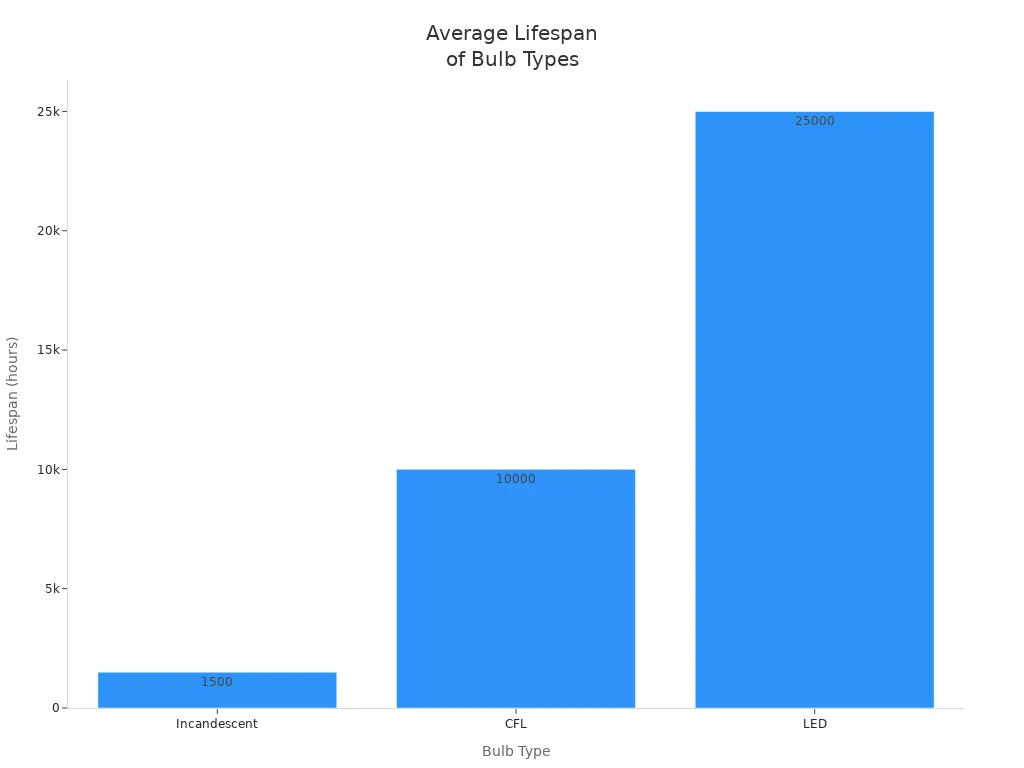
LED bulbs use much less energy than incandescent bulbs. You save money on your electric bill and help the planet. Most LED bulbs have at least a two-year warranty, so you know they are reliable. You usually get your money back in 6 to 18 months after switching to LED bulbs. Over time, you can save hundreds of dollars on energy.
▉When you pick LED lights, you help the earth and get lights that last longer and cost less.
LED lights almost never stop working suddenly. Good LEDs can work for many years. They do not break easily. You should clean your fixtures often. Keep the room cool and use surge protectors. This helps your LEDs last longer.
▉Pick strong LEDs and take care of them. You will save money and have steady light.
▉You cannot restore brightness once an LED dims. You should replace the bulb for best light quality.
▉LED lights work well in cold weather. You get better performance and longer lifespan in cooler temperatures.
You can leave LED lights on all night.
LEDs use little energy and do not get hot like old bulbs.