Author: Huang Publish Time: 24-08-2026 Origin: Site


Modern architectural and commercial lighting design relies heavily on contrast, focal emphasis, and visual hierarchy. While ambient panel lights and linear fixtures provide uniform general illumination, LED spotlights deliver the tight directional control required to draw the eye toward specific products, architectural details, and artwork.
However, selecting the right spotlight involves balancing beam precision against visual comfort. Improperly specified directional fixtures can cause harsh peripheral glare, visual fatigue, and uneven illumination. Understanding how LED spotlights perform across diverse real-world environments—and evaluating key optical features such as deep baffle regression, honeycomb louvers, and COB chip integration—is essential for electrical contractors, lighting specifiers, and commercial distributors.
Key Takeaway: LED spotlights are directional fixtures designed for accent and task lighting. Unlike general ambient downlights, their primary value stems from beam angle control, high Center Beam Candlepower (CBCP), and anti-glare optical engineering that maintains visual comfort across commercial and residential spaces.
An LED spotlight is a specialized directional luminaire engineered to emit a concentrated beam of light toward a targeted surface or object. While ambient lighting fixtures spread light across a wide spatial angle (typically 90° to 120°), spotlights restrict light dispersion to narrow or medium beam spreads (ranging from 15° to 45°).
The fundamental difference between general lighting and spotlighting lies in the ratio of ambient to accent illumination. Professional lighting designers use spotlights to establish a 3:1 or 5:1 focal contrast ratio. This contrast makes illuminated objects appear significantly brighter than their surrounding environment, creating depth and visual interest.
According to research published by PacLights' analysis on focused commercial display illumination (2025), directional spotlights allow commercial operators to guide customer navigation and emphasize product textures without over-illuminating the entire floor area.
The core light engine inside a modern spotlight determines its beam quality and shadow definition:
COB (Chip-on-Board) LEDs: Integrate dozens of LED diodes onto a single ceramic or metallic substrate under a single phosphor layer. This creates a dense, single point-light source. When paired with a parabolic reflector or TIR (Total Internal Reflection) lens, COB spotlights produce a clean, uniform light beam with sharp shadow edges and intense center-beam punch.
SMD (Surface Mounted Device) LEDs: Mount multiple separate LED packages across a circuit board. When used in spotlighting, SMD arrays can produce multiple overlapping secondary shadows (often referred to as "ghosting") and wider beam spill, making them better suited for diffuse panel lights than precision accent spotlights.
For commercial distributors and project specifiers, opting for precision-engineered COB LED spotlights ensures crisp beam boundaries, superior heat dissipation through die-cast aluminum bases, and consistent color rendering across long production runs.
Because LED spotlights combine high directional intensity with flexible mounting formats—including recessed ceiling mounts, track systems, surface-mounted cans, and exterior stakes—they serve critical roles across commercial, cultural, hospitality, and residential environments.
Application Scenario | Recommended Beam Angle | Target Illumination (Lux) | Color Rendering (CRI) | Key Optical Feature |
|---|---|---|---|---|
Luxury Retail & Showrooms | 24° – 36° | 750 – 1,500 Lux | Ra > 90 / R9 > 50 | COB reflector + High CRI |
Art Galleries & Museums | 15° – 24° | 200 – 500 Lux | Ra > 95 | Honeycomb louver + Low UGR |
Hotels & Hospitality | 24° – 45° | 150 – 300 Lux | Ra > 90 (2700K–3000K) | Deep-set baffle + Smooth dimming |
Architectural Facades | 15° – 30° | 300 – 800 Lux | Ra > 80 | IP65/IP66 weatherproof housing |
Residential Accent Lighting | 24° – 36° | 200 – 400 Lux | Ra > 90 | Anti-glare regressed trim |
In retail stores, jewelry boutiques, and automotive showrooms, lighting directly impacts customer purchasing behavior. Spotlights are positioned above display tables, mannequins, and wall racks to reveal rich fabric textures, metallic lusters, and true product colors.
As documented in UPSHINE's guide to directional beam control in retail environments (2025), directional fixtures with a Color Rendering Index (CRI) above Ra 90 ensure that apparel and merchandise appear vibrant and accurate under artificial store lighting. High Center Beam Candlepower allows retail displays to cut through ambient window daylight and overhead ceiling fill.
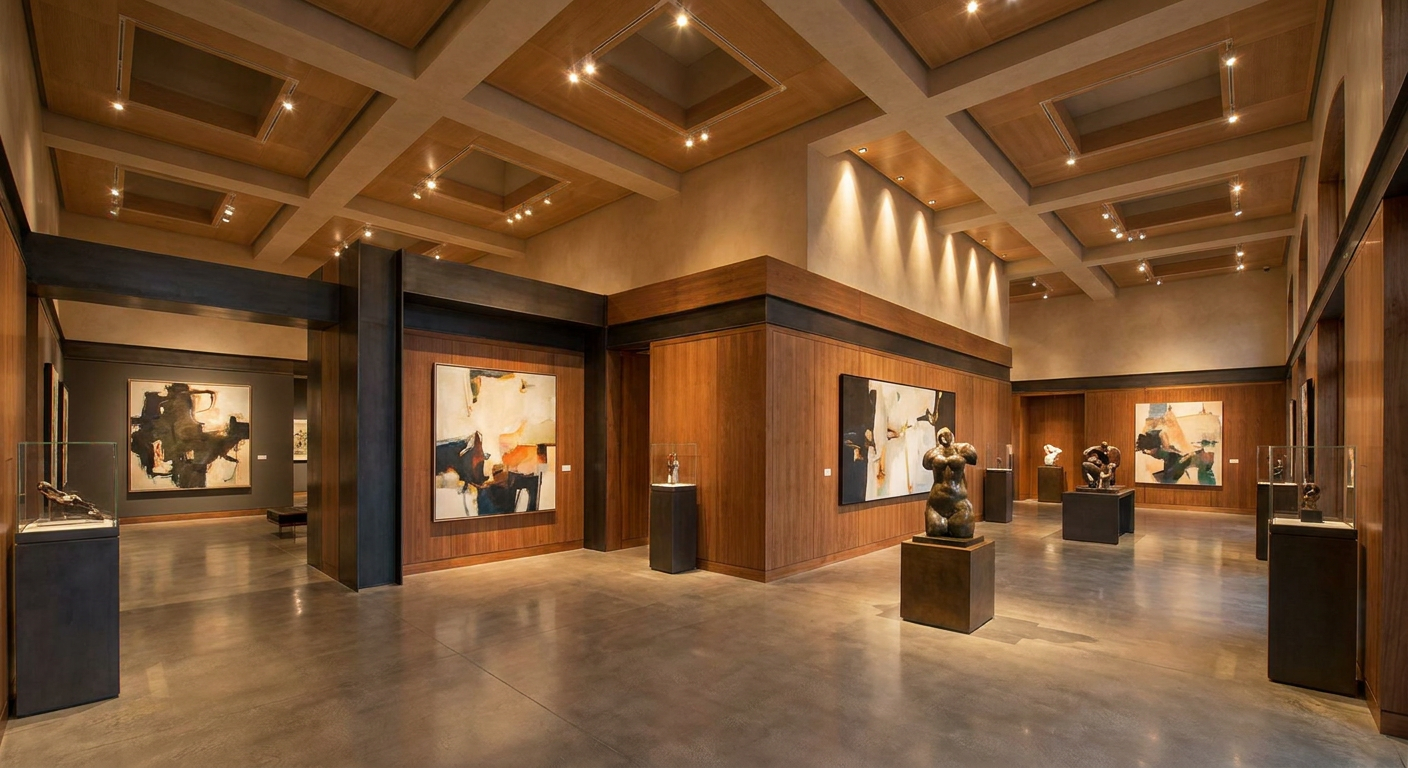
Museums and art galleries demand extreme optical precision. The primary objective is to illuminate paintings, sculptures, and historical artifacts without allowing light to spill onto surrounding wall surfaces or cause harsh glare on protective glass cases.
Furthermore, valuable canvas paintings and organic historical materials are sensitive to photochemical degradation. LED spotlights emit zero ultraviolet (UV) or infrared (IR) radiation. When fitted with anti-glare honeycomb louvers, these fixtures direct light exclusively onto the artwork while shielding gallery visitors from direct lens brightness.
Hospitality venues use lighting to craft atmosphere and emotional resonance. In hotel lobbies, spotlights highlight reception counters, floral installations, and architectural stonework. In fine dining restaurants, narrow-beam spotlights illuminate individual dining tables, keeping neighboring circulation pathways in softer ambient shadow.
Many modern hospitality projects specify 2-in-1 spot-downlight hybrid fixtures or track-mounted spots with 2700K to 3000K warm CCT options. This allows venue managers to adjust lighting scenes from functional daytime check-in hours to relaxed evening lounge atmospheres.
Exterior spotlights highlight the structural verticality of commercial buildings, columns, archways, and outdoor signage. Mounted on ground stakes or exterior wall brackets, weather-sealed exterior spotlights transform building facades after dark.
Exterior spotlights require die-cast aluminum enclosures with IP65 or IP66 ingress protection ratings to withstand rain, dust, and extreme temperature fluctuations in regions like the Middle East and Southeast Asia.
In residential architecture, spotlights have evolved from simple ceiling accents into essential components of layered interior design:
Living Room Feature Walls: Recessed adjustable spotlights wash stone, wood paneling, or wallpaper behind TV units and sofas.
Kitchen Islands & Countertops: Focused spotlights provide crisp task lighting for food preparation areas without casting shadows from cabinet overhangs.
Hallways & Art Alcoves: Recessed spots create guided light pools along corridors while drawing attention to family photos or sculpture niches.
While early spotlight iterations suffered from blinding off-axis glare, advances in optical engineering have made modern LED spotlights exceptionally comfortable for human vision.
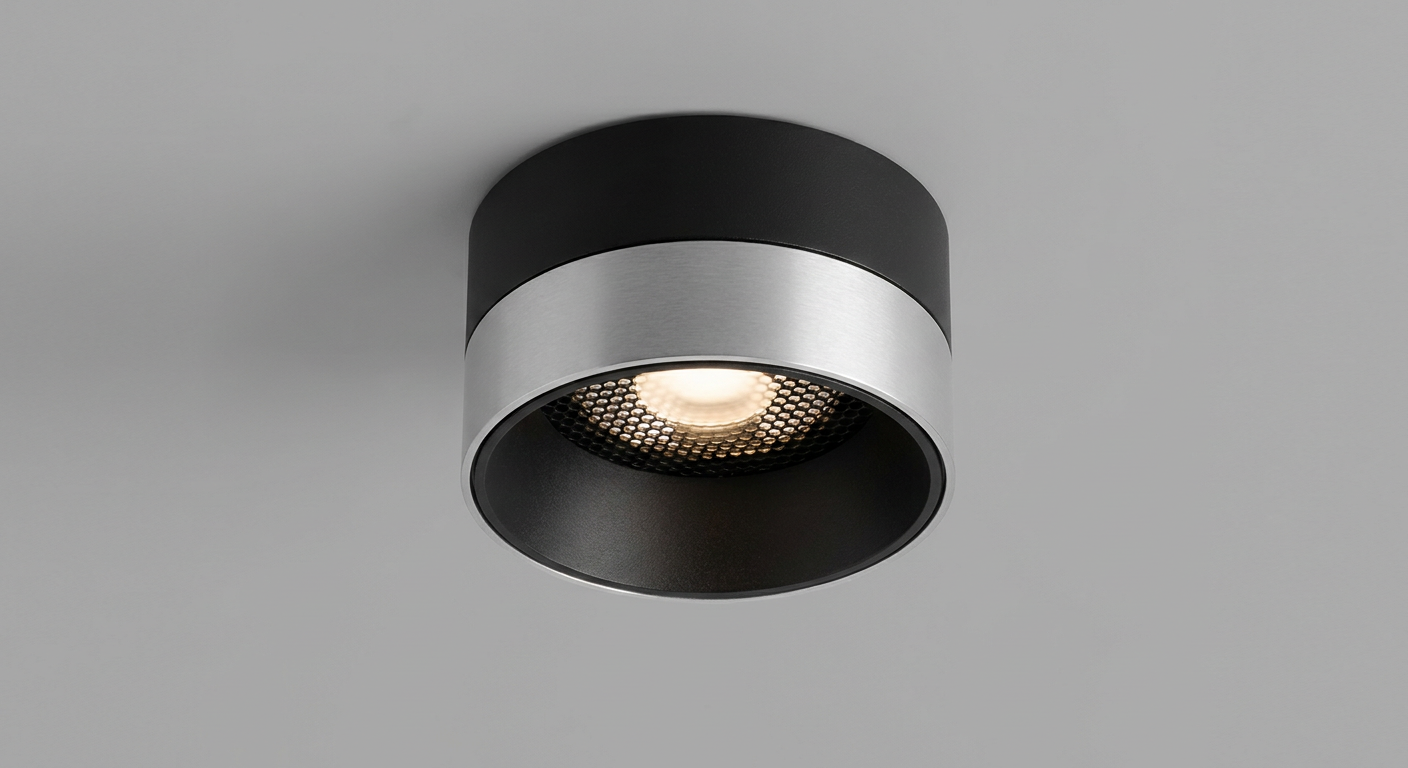
Direct glare occurs when a high-luminance light source enters a person's field of view at a shallow angle, causing visual discomfort and reducing contrast perception. In commercial standards (such as EN 12464-1), glare is quantified using the Unified Glare Rating (UGR). Offices and commercial spaces generally require UGR < 19, while high-comfort gallery and hospitality spaces target UGR < 16.
Modern anti-glare spotlights employ three primary engineering techniques to achieve low UGR ratings:
Deep Regression Cutoff: The COB LED chip is physically set deep within the luminaire body (often 30mm to 50mm recessed from the ceiling plane). This physical barrier creates a cutoff angle (typically 30° to 45°), preventing observers from seeing the bright LED emitter unless standing directly beneath the fixture.
Matte-Black Non-Reflective Chambers: The inner conical baffle surrounding the LED is treated with a matte-black, light-absorbing finish. Any stray light rays striking the internal wall are absorbed rather than reflected outward as stray glare.
Secondary Optical Reflectors: Multi-faceted secondary reflectors shape the primary beam while cleanly truncating peripheral light halos.
As explained in Fullamps' guide to deep regression physical cutoff angles (2025), combining deep regression with secondary reflector optics isolates the light source, giving ceiling installations a sleek, "quiet" visual aesthetic.
Pro Tip: When specifying spotlights for spaces with reflective flooring (such as polished marble or epoxy retail floors), always choose deep-recessed fixtures with matte-black inner baffles to prevent secondary floor reflections.
For demanding applications where direct lens visibility must be completely eliminated, manufacturers attach a honeycomb louver grid over the optical reflector.
A honeycomb louver consists of a thin aluminum disk fabricated with hundreds of tiny hexagonal cells. According to technical data from Kupo Optics' technical report on hexagonal honeycomb louver glare control (2026), these hexagonal channels act as micro-baffles:
Parallel Axis Transmission: Light rays traveling parallel to the main beam axis pass through the open cell structures with minimal attenuation (retaining over 90% of center-beam lumens).
High-Angle Stray Blocking: Light rays attempting to exit at off-axis angles (greater than 30° or 45°) strike the cell walls and are absorbed.
Installing honeycomb louvers allows lighting designers to aim track spots at steep angles toward store displays without blinding shoppers walking in the opposite direction.
Choosing the correct beam angle is critical for achieving the intended lighting effect. Selecting a beam angle that is too wide dilutes the accent contrast, while a beam angle that is too narrow creates harsh hot-spots.
Spotlight Beam Angle Distribution | Detail |
|---|---|
15° Narrow Spot | |
24° Spot | / \ (Retail displays, mannequins, features) |
--- | --- |
36° Medium Flood | / \ (Wall washing, reception desks, task areas) |
60° Wide Flood | / \ (Broad accent, residential living spaces) |
15° Narrow Spot: Delivers a tightly concentrated beam over long distances. Ideal for high ceilings (above 4 meters), key artwork framing, and architectural column highlighting.
24° Spot: The industry standard for retail merchandise displays, accenting localized product groups from standard 2.8m to 3.5m ceiling heights.
36° Medium Flood: Provides a softer edge transition. Used for feature wall washing, kitchen island task lighting, and conference table accenting.
60° Wide Flood: Offers broad directional illumination, blending the focused nature of a spotlight with the coverage of a downlight.
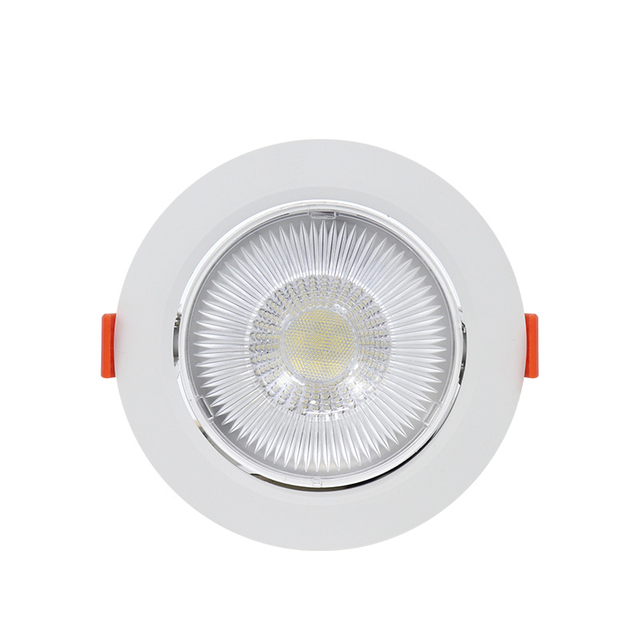
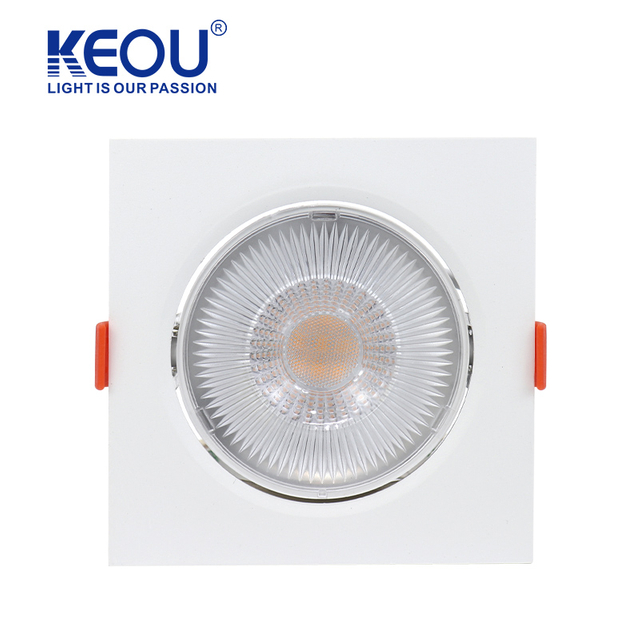
Specifiers looking for operational versatility often select adjustable-angle spotlights and recessed downlights that allow manual tilt adjustment (typically 30° vertical tilt and 355° horizontal rotation) to re-aim beams when floor displays change.
Because COB LEDs concentrate high electrical power into a compact ceramic surface, effective heat dissipation is vital to prevent thermal degradation and color shifting (CCT drift).
High-performance commercial spotlights feature precision die-cast aviation aluminum housings with integrated cooling fins. Aluminum provides a thermal conductivity rating exceeding 200 W/m·K (compared to less than 1.5 W/m·K for basic thermal plastics). Efficient heat dissipation maintains LED junction temperatures below 75°C, ensuring a stable operational lifespan exceeding 50,000 hours (L70/B10).
When sourcing commercial LED spotlights for project tenders or wholesale distribution, commercial buyers must evaluate manufacturers based on rigorous technical standards rather than unit price alone.
Optical Certification: Does the supplier provide accredited IES/LDT photometric files confirming beam angle accuracy and UGR ratings (< 19 or < 16)?
Color Quality Metrics: Is the fixture rated at CRI Ra > 90 with positive R9 values (above 50) for true red rendition in retail and hospitality settings?
Thermal Architecture: Is the housing constructed from heavy-duty die-cast aluminum with a dedicated thermal path away from the driver compartment?
Driver Compatibility: Does the integrated driver support flicker-free dimming across standard commercial protocols (TRIAC, 0-10V, DALI-2)?
Modular Customization: Can the fixture accommodate interchangeable optical accessories, such as honeycomb louvers, oval spread lenses, and color-temperature filters?
For project contractors seeking versatile inventory management, sourcing anti-glare modular LED spotlight fixtures enables swift field customization to meet varying client specifications without maintaining excessive SKU counts.
A downlight is designed primarily for general ambient illumination, producing a wide, diffuse beam spread (typically 60° to 120°) that covers an entire room evenly. A spotlight produces a focused, directional beam (typically 15° to 45°) intended to create contrast, highlight specific objects, or wash specific feature walls.
A honeycomb louver consists of a grid of tiny hexagonal cells that absorb only peripheral, high-angle stray light rays that cause direct visual dazzle. Because the central beam rays pass straight through the open cells, the fixture retains over 90% of its center beam candlepower while eliminating off-axis glare.
A 24-degree or 36-degree beam angle is ideal for retail clothing displays mounted at standard ceiling heights (2.8m to 3.5m). A 24-degree spot provides punchy contrast for individual mannequins, while a 36-degree medium flood offers even coverage across folded apparel tables and wall racks.
Commercial office spaces and educational environments generally require a Unified Glare Rating (UGR) of less than 19 to prevent eye strain during screen work. Premium retail showrooms, art galleries, and luxury hospitality venues often target UGR < 16 for maximum visual comfort and an invisible light source aesthetic.
LED spotlights play an indispensable role in modern lighting design by combining high directional intensity with precise optical control. Whether highlighting luxury merchandise in retail showrooms, protecting delicate artwork in galleries, or creating warm ambient layers in residential living spaces, selecting the correct combination of beam angles, COB light engines, and anti-glare optical accessories ensures both visual impact and long-term operating efficiency.
For commercial lighting distributors, contractors, and project specifiers seeking high-performance LED spotlight solutions, partnering with experienced semiconductor and LED manufacturing facilities ensures certified quality, reliable thermal engineering, and comprehensive customization options.
To explore complete technical specifications, photometric reports, or custom OEM/ODM spotlight solutions for your upcoming commercial lighting project, contact the engineering team at KEOU Lighting today.