
Author: Huang Publish Time: 04-08-2026 Origin: Site


When specifying commercial outdoor luminaires for municipal highways, urban avenues, industrial parks, or commercial developments, electrical engineers and project procurement managers frequently face a fundamental architectural choice: Chip-on-Board (COB) street lights vs. Surface-Mounted Device (SMD) LED street lights.
While both technologies fall under the umbrella of solid-state LED lighting, they differ significantly in semiconductor packaging, thermal dissipation physics, optical beam shaping, and maintenance logistics. Choosing the wrong packaging architecture can lead to excessive glare, premature thermal degradation in high-ambient desert environments like the UAE, or failure to satisfy strict municipal road illumination standards (such as IES Type II or Type III photometric distributions).
This guide provides an engineering-grade comparison of COB and SMD LED street light luminaires to help B2B distributors, contractors, and municipal lighting engineers make informed, specification-driven purchasing decisions.
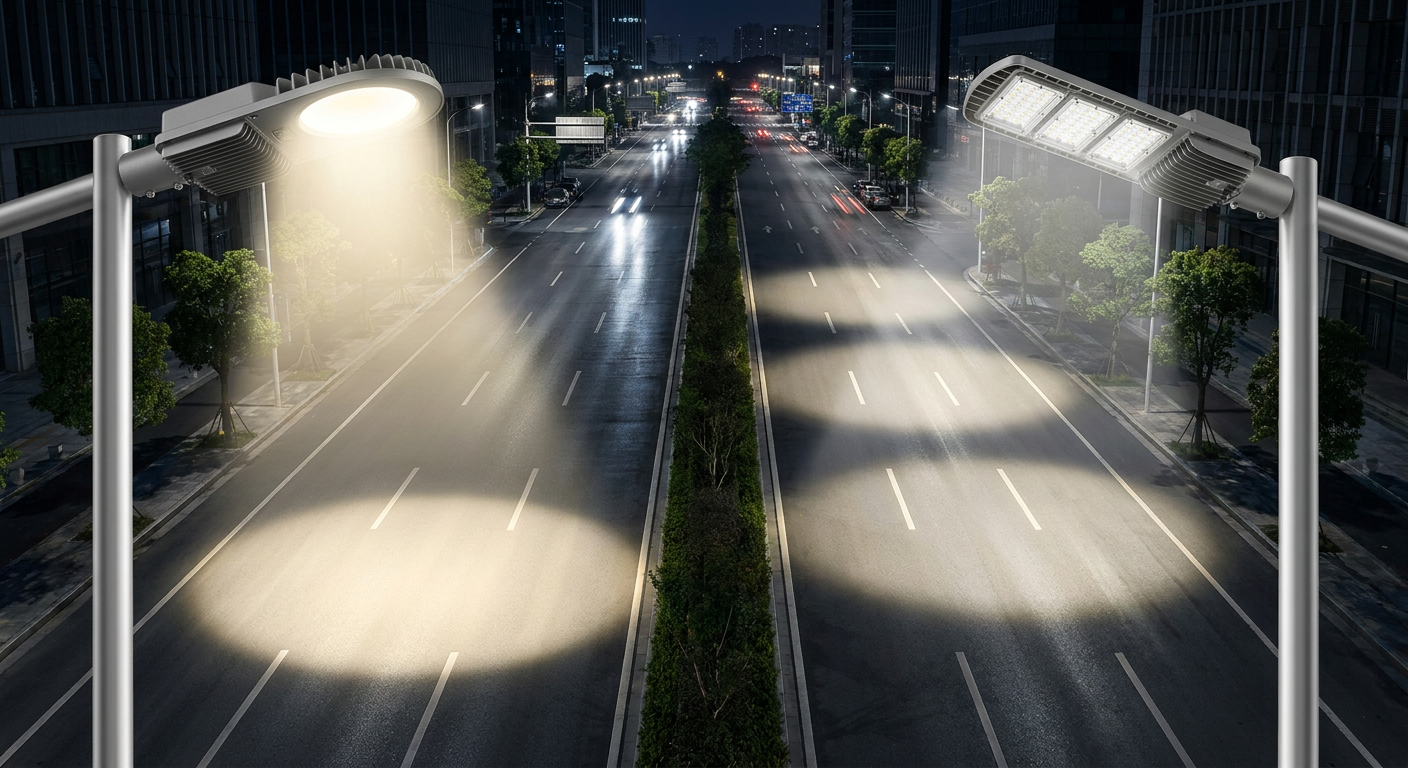
The table below summarizes the core performance characteristics, optical behaviors, and operational trade-offs between COB and SMD outdoor street lighting fixtures:
Performance Metric | COB Street Lights (Chip-on-Board) | SMD LED Street Lights (Surface-Mounted) |
|---|---|---|
Emitter Architecture | Multi-chip dies packed directly onto a single substrate under one phosphor layer | Discrete LED packages (e.g., SMD 3030 / 5050) distributed across a circuit board |
Luminaire Efficacy (lm/W) | 110 – 140 lm/W (system level) | 130 – 160+ lm/W (system level) |
Center Intensity & Throw | High center luminance density; excellent forward throw for long distances | Moderate center density; wide lateral spread optimized for multi-lane roads |
Beam Shaping & Optics | Primary reflector cups or toughened glass masks; natural anti-glare continuous surface | Individual PMMA secondary optical lenses for precise IES Type I–V distribution patterns |
Thermal Concentration | High thermal flux density concentrated in a single central "hot spot" | Heat distributed across a wide aluminum printed circuit board (PCB) surface area |
Glare & Uniformity | Smooth, continuous light-emitting surface (LES); reduced point-source glare | Potential point-source dotting and high single-point luminance unless diffused |
Maintenance & Servicing | Single-piece optical engine replacement; highly robust sealed module | Modular PCB panel replacement; individual diode or driver channel servicing |
Best Application Fit | High pole mounting heights (10m–15m+), perimeter security, intersections, long-throw areas | Multi-lane highways, urban arterials, municipal road networks requiring strict lateral uniformity |
The primary physical difference between COB and SMD street lights lies in how the light-emitting semiconductor dies are packaged and how their light output is optically directed onto the road surface.
In a Chip-on-Board (COB) street light, dozens or hundreds of raw LED chips are mounted directly onto a ceramic or metallic substrate in close proximity. The entire cluster is covered by a single continuous coating of yellow phosphor, creating a dense, uniform light-emitting surface (LES).
Because the light emerges from a single integrated area, COB luminaires function optically as a high-density surface source. When paired with high-transmittance toughened glass masks or parabolic reflector cups, COB street lights deliver high center luminance density with a smooth, continuous beam. This minimizes the visual "dotting" effect associated with multiple individual diodes, producing soft, comfortable light with lower direct glare.
Key Takeaway: COB street lights excel in high-mount or long-throw applications where high center beam intensity is required to project light across wide intersections or high-mast poles without creating harsh point-source glare.
In Surface-Mounted Device (SMD) street lights, individual LED chips are enclosed in discrete ceramic or plastic packages (such as SMD 3030 or 5050) and soldered across a wide printed circuit board (PCB) with physical spacing between each diode.
To direct the light effectively onto a multi-lane roadway, manufacturers fit each individual SMD diode or diode array with custom PMMA (polymethyl methacrylate) secondary optical lenses. As noted in Sunlurio's Street Lighting Engineering Guide (2026), secondary lenses allow SMD fixtures to achieve precise asymmetrical "batwing" photometric distributions (such as IES Type II, Type III, or Type IV). This spreads light laterally along long stretches of road while preventing waste light from falling outside the pavement area.
However, if an SMD fixture uses low-quality optics or lacks a proper diffuser, the exposed individual diodes can create harsh point-source glare for approaching drivers.
Thermal management is the single most critical factor determining the operating lifespan, lumen maintenance (LM-80), and driver stability of outdoor street lights—especially in high-ambient temperature regions such as the United Arab Emirates (UAE) and the broader Middle East, where summer ambient temperatures frequently top 45°C to 50°C.
Because a COB module packs multiple LED dies onto a compact substrate (often less than 5 cm²), it generates a concentrated thermal flux at a single central location on the luminaire body. If the junction temperature (Tⱼ) exceeds manufacturer limits (typically 85°C to 105°C), the LED will suffer rapid lumen depreciation, color shifting, or premature bond-wire failure.
To overcome this thermal concentration, high-quality COB street lights rely on advanced thermal path engineering:
Aviation Die-Cast Aluminum Housings: Using high thermal conductivity die-cast aluminum alloys with deep, aerodynamically spaced cooling fins to maximize natural convection.
Direct Substrate Copper Bonding: Eliminating intermediate thermal resistance layers to draw heat away from the COB chip directly into the heat sink.
Toughened Glass Seals & IP66 Protection: Protecting the COB light engine against fine desert sand, dust accumulation, and coastal moisture while allowing high thermal radiation.
For instance, the KEOU die-cast aluminum street light series incorporates heavy-duty aviation aluminum heat sinks combined with temperature-controlled driver protection to ensure stable operation in demanding tropical and desert environments.
SMD street lights distribute their heat load across a much larger physical aluminum PCB. Because the discrete SMD 3030 or 5050 packages are spaced across several hundred square centimeters, thermal stress is spread evenly across the housing backplate. This larger surface area lowers the local thermal resistance, making passive cooling straightforward even under standard outdoor conditions.
A common point of confusion among procurement managers is the distinction between raw LED chip package efficacy and complete luminaire system efficacy.
Raw Chip Efficacy (180+ lm/W)
→ Minus Secondary Optical Lens Transmission Loss (~8–12%)
→ Minus Driver Conversion Loss (~8–10%)
→ Minus Thermal Derating at 85°C Junction Temp (~5–8%)
= Real-World Luminaire System Efficacy (110–160 lm/W)
Raw Chip Level: Modern SMD 3030 chips tested in laboratory conditions at 25°C can reach efficiencies exceeding 180 to 200 lm/W. COB chip arrays typically deliver 140 to 170 lm/W at chip level.
Luminaire Level: When installed inside a weatherproof IP66 street light fixture, real-world efficiency is reduced by three primary factors:
Optical Lens Losses: PMMA lenses on SMD fixtures absorb or reflect approximately 8% to 12% of total light.
Driver Efficiency: High-efficiency LED drivers lose 8% to 10% of input power as heat.
Thermal Derating: High operating temperatures reduce semiconductor photon emission efficiency.
In real-world street lighting installations:
Commercial SMD Street Lights achieve a complete fixture efficacy of 130 to 160 lm/W, making them highly energy-efficient for long highway stretches where total wattage reduction is the primary metric.
Commercial COB Street Lights achieve a complete fixture efficacy of 110 to 140 lm/W. However, because COB fixtures often use reflector cups or simple glass covers instead of dense optical lens arrays, they recover a portion of their optical transmission efficiency, delivering high usable lux on target areas.
When managing large-scale municipal or commercial street lighting networks comprising thousands of fixtures, maintenance logistics and spare parts inventory represent a significant portion of Total Cost of Ownership (TCO).
SMD street lights are built using modular sub-assemblies. If a single LED module or driver channel fails due to grid voltage surges, maintenance crews can replace the individual LED PCB board or driver block on-site without removing the entire luminaire arm. As highlighted in ZGSM China's LED Optical Uniformity Study, this modularity lowers long-term component replacement costs for city maintenance departments.
While SMD fixtures offer component-level modularity, their large number of individual solder joints (often 200 to 600+ surface solder pads per fixture) increases exposure to micro-crack solder failures caused by thermal expansion and contraction over years of outdoor thermal cycling.
COB street lights feature a streamlined internal electrical structure with far fewer external solder connections. A single, factory-sealed COB optical engine provides high mechanical structural integrity. When a COB engine eventually reaches the end of its service life, swapping out the sealed optical engine or fixture head restores 100% factory optical performance and IP66 seal integrity in a single maintenance pass.
Pro Tip: To safeguard street light drivers against electrical grid fluctuations and lightning strikes in outdoor installations, always specify fixtures equipped with 10kV or 20kV surge protection devices (SPD) and over-current protection.
Selecting between COB and SMD LED street lights requires evaluating project geometry, pole mounting heights, and total life-cycle costs rather than upfront fixture price alone.
Evaluate Project Geometry & Lighting Goals
High-Mast / Long-Throw / Anti-Glare Intersections Select COB Street Lights (Focused intensity, soft beam, heavy-duty die-cast aluminum)
Multi-Lane Highway / Wide Municipal Arterials Select SMD LED Street Lights (Wide IES Type II/III distribution, maximum lm/W system efficacy)
High Mounting Heights (10m – 15m+): You require high center beam intensity to reach the road surface from high poles or high-mast installations.
Anti-Glare & Visual Comfort: The project prioritizes reduced visual glare for drivers, such as urban residential streets, commercial plaza perimeters, or pedestrian crossings.
High Wattage Applications (200W – 400W): You need compact, high-output luminaires like COB Cobra street lights that provide dense lumen packages in a streamlined fixture body.
Simplified Assembly & Structural Integrity: The customer prefers a single, robust optical engine with fewer internal solder joints.
Wide Multi-Lane Highways: You must meet strict municipal uniform illumination standards (U₀ ≥ 0.4) across multi-lane roads using precise IES Type II or Type III PMMA lenses.
Maximum Energy Savings (lm/W): Lowering kilowatt-hour consumption across thousands of highway poles is the primary procurement metric.
Modular Maintenance Strategy: City maintenance teams require modular PCB replacement capabilities to stock standardized spare parts.
COB street lights are not inherently "brighter" in total lumen output for a given wattage, but they deliver a higher center luminance density. Because all light originates from a compact single-surface source, a COB street light creates a more intense, focused beam spot. In contrast, an SMD street light spreads the same total lumens over a wider lateral area to cover multiple lanes uniformly.
Both COB and SMD street lights can achieve operational lifespans exceeding 50,000 hours (L70 rating at 25°C) if properly engineered. However, in high-ambient desert environments like the UAE (where temperatures reach 50°C), COB fixtures require heavy-duty aviation die-cast aluminum heat sinks to dissipate concentrated central heat. SMD fixtures spread heat across a larger PCB backplate, but require high-grade aluminum substrates and quality thermal interface materials to prevent thermal degradation.
Yes. Modern COB street lights use custom asymmetric reflectors or optical glass lenses designed specifically for roadway illumination to achieve IES Type II or Type III light distribution. To verify compliance before placing bulk orders, always request full LM-79 test reports and IES photometric files from the manufacturer.
For over 13 years, KEOU Lighting has operated state-of-the-art semiconductor and LED manufacturing facilities, delivering high-performance outdoor luminaires and customized OEM/ODM lighting solutions to B2B distributors and contractors across 116 countries and regions.
Whether your project requires high-intensity COB Cobra street lights with precision aviation die-cast aluminum heat dissipation or SMD lens-type street lights engineered for multi-lane highway uniformity, KEOU provides factory-direct quality, comprehensive customization services, and full compliance certifications (CE, RoHS, IP66).
Explore the complete KEOU die-cast aluminum street light series for detailed product specifications.
Download the complete KEOU outdoor lighting product catalog and IES files for dialux lighting simulation and project bidding.
Learn more about KEOU Lighting B2B factory solutions and request custom engineering samples for your next outdoor lighting contract.


