Author: Site Editor Publish Time: 14-09-2026 Origin: Site


Table of Contents
Urban lighting design constantly balances competing priorities. Specifiers must ensure pedestrian safety, enable hazard detection, and deter crime while meeting strict mandates to eliminate light pollution and reduce energy consumption. Over-illuminated public spaces create severe operational burdens. They disrupt local ecosystems, trigger community complaints, and fail to comply with rigorous municipal codes like Dark Sky ordinances. Poorly specified fixtures produce high glare, which reduces actual visibility and diminishes the perceived safety of a space.
Solving this requires a shift from legacy illumination methods to responsible, precision-engineered outdoor lighting. The Illuminating Engineering Society (IES) and DarkSky International developed five foundational principles to guide this transition. These principles serve as a rigorous technical evaluation framework for modern public spaces. Integrating these Park Lighting tips into your specification process is a mandatory strategy for shortlisting reliable lighting vendors and ensuring strict regulatory compliance.
Utility & Targeting Dictate ROI: Every fixture must serve a verifiable purpose (safe navigation, hazard detection, or enjoyment of spaces) and utilize precise optics to eliminate light trespass and wasted energy.
Brightness ≠ Safety: Specifying the minimum viable lumen output reduces glare, improving visual acuity and the psychological "sense of reassurance" far more effectively than over-lighting.
Adaptive Controls are Mandatory: Future-proofing park lighting requires networked controls (timers, motion sensors, dimming protocols) to ensure spaces are lit *only when needed*.
Warm Color Temperatures (CCT) are Standard: Strict adherence to sub-3000K color temperatures is now critical for ecological preservation, human health, and Dark Sky compliance.
Defining success in park and plaza lighting requires a clear understanding of the space's primary objectives. Public illumination must facilitate pedestrian wayfinding, provide a psychological sense of reassurance, allow for early hazard detection, and encourage the nighttime enjoyment of civic spaces. These goals must be achieved without compromising the nocturnal environment. The success of a lighting installation is measured by how well it balances human utility with ecological stewardship.
To evaluate lighting proposals effectively, specifiers must rely on concrete baseline metrics. You cannot manage what you do not measure. When reviewing a submittal package from a manufacturer, you must look past the aesthetic design of the luminaire housing and dig into the performance data. Proposals that fail to meet baseline metrics should be immediately rejected during the submittal review phase.
Photometric Performance: Analyze the uniformity of light distribution. You are looking for a low max-to-min ratio. A ratio of 4:1 or 3:1 ensures there are no harsh dark spots or blinding hot spots along a pathway.
Energy Efficiency: Measured in lumens per watt (LPW), this dictates the operational sustainability of the system. Modern fixtures should easily exceed 120 LPW.
Regulatory Adherence: Strict compliance with local environmental regulations and National Park Service (NPS) night sky guidelines is non-negotiable.
A common misconception plagues public lighting design: the belief that brighter spaces are inherently safer spaces. This is technically false. Raw brightness often introduces severe glare. When a pedestrian looks toward a glaring light source, their pupil constricts, drastically reducing the eye's ability to see into the surrounding shadows. The true drivers of nighttime safety and community satisfaction are high visual contrast and rigorous glare reduction. By prioritizing uniform, low-glare illumination, specifiers create environments where hazards are easily identified, and pedestrians feel genuinely secure.
The first step in any lighting project is questioning whether artificial light is actually required. Every fixture installed carries an initial installation burden—trenching, laying conduit, pouring concrete bases, and pulling wire—along with ongoing maintenance requirements. Lighting a pathway, monument, or plaza zone must serve a distinct, verifiable purpose. If a specific area does not support active nighttime enjoyment, safe navigation, or critical security functions, it should remain dark. Avoiding unnecessary lighting is the most effective way to reduce energy consumption and protect the nocturnal ecosystem.
Assessing utility requires a deep understanding of site context and physical site walks. A primary pedestrian thoroughfare connecting a transit hub to a residential neighborhood requires continuous, reliable illumination. Conversely, a remote nature trail within the same park may only need wayfinding bollards at major intersections, or perhaps no lighting at all. Specifiers must categorize park zones based on anticipated nighttime utilization. This zoning strategy dictates where light is deployed and prevents the over-saturation of public spaces.
Evaluating a vendor's capability begins with their approach to site audits. A qualified manufacturer or lighting designer will prioritize strategic placement over maximizing fixture counts. They should provide comprehensive photometric studies that justify the location and necessity of every pole and luminaire. When reviewing vendor proposals, look for detailed analyses of pedestrian flow, hazard points, and architectural features.
Identify primary pedestrian arteries that require continuous illumination for wayfinding.
Locate secondary trails where intermittent lighting or low-level bollards are sufficient.
Designate ecological preservation zones where artificial lighting is strictly prohibited.
Map out gathering spaces and plazas that require task-specific illumination for nighttime events.
Vendors who simply recommend replacing legacy fixtures on a one-to-one basis without evaluating current site needs are failing to apply the principle of purposeful illumination. A one-to-one replacement often perpetuates the mistakes of the original design. You must demand a fresh photometric layout based on current utilization patterns.
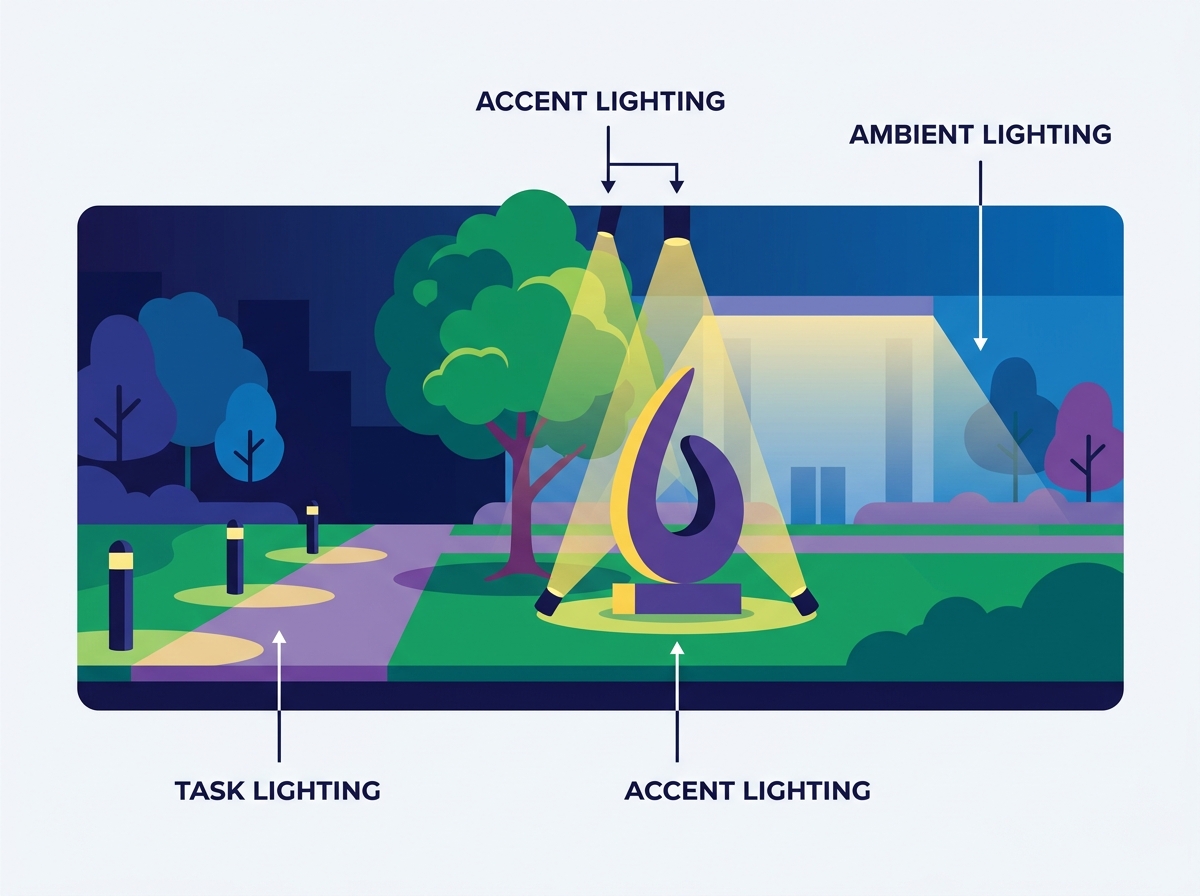
Once the necessity of a fixture is established, the light it produces must be strictly controlled. Targeted distribution ensures that illumination lands exactly where it is intended—on the pathway or plaza surface—and nowhere else. This requires a deep understanding of optics, shielding, and the Backlight, Uplight, and Glare (BUG) rating system. Specifiers must mandate recessed and fully shielded, or full-cutoff, fixtures. These designs ensure that light is directed exclusively downward, entirely preventing skyglow and wasted energy.
The BUG rating system is a standard tool for evaluating luminaire performance. Backlight refers to the light spilling behind the fixture, which is problematic when poles are placed near property lines. Uplight contributes directly to artificial skyglow and must be kept at absolute zero (U0) for Dark Sky compliance. Glare refers to the high-angle light that causes visual discomfort and reduces visibility. By specifying fixtures with low BUG ratings (e.g., B1-U0-G1), you guarantee that the illumination is highly targeted and environmentally responsible.
Mitigating light trespass is essential for being a respectful neighbor. When lighting plazas or perimeter pathways, improper optic selection often leads to light spilling into adjacent residential properties. This triggers community complaints and disrupts local wildlife habitats. To prevent this, specifiers must carefully select the correct optical distribution type based on the geometry of the space.
Optical Distribution Type | Ideal Application | Characteristics |
|---|---|---|
Type I | Narrow pedestrian pathways and trails. | Long, narrow, linear distribution. Ideal for placing fixtures centrally on a walkway. |
Type II | Wider walkways, jogging paths, and narrow internal park roads. | Slightly wider lateral distribution. Excellent for perimeter lighting where backlight must be minimized. |
Type III | Standard park roadways, medium-sized plazas, and parking areas. | Projects light forward and outward. The most common distribution for general public space lighting. |
Type IV | Perimeter boundaries, building facades, and security zones. | Asymmetric forward throw with minimal backlight. Perfect for mounting on walls or park boundaries. |
Type V | Large open plazas, central courtyards, and major intersections. | Symmetrical 360-degree circular or square distribution. Requires careful placement to avoid light trespass. |
Applying the correct distribution type eliminates the need for physical house-side shields in many cases, relying instead on precision-molded internal optics. This results in a cleaner aesthetic and more efficient light delivery. Always require vendors to submit point-by-point photometric calculations to verify that light trespass at the property line remains at or near zero footcandles. During installation, contractors must ensure the pole is perfectly plumb and the luminaire head is leveled; even a two-degree tilt can throw the optical distribution off and create unintended glare.
The transition from legacy High-Intensity Discharge (HID) lighting to LED technology often resulted in massively over-lit spaces. Because LEDs are highly directional and efficient, matching the raw lumen output of an old 250-watt metal halide fixture creates an unbearably bright environment. Optimizing lumen output means calculating the minimum viable illuminance required for a specific task. Specifiers should utilize the IES recommended footcandle or lux levels for specific park zones, rather than relying on outdated legacy baselines.
Evaluating long-term performance is necessary when specifying low-level brightness. Look closely at the lumen maintenance data, specifically the L70 and L90 metrics. These figures indicate how many hours the fixture will operate before its light output degrades to 70% or 90% of its initial value. High-quality LEDs maintain their output for decades. You do not need to over-light a space initially to compensate for future degradation. Specify the exact lumens required for day-one compliance and trust the longevity of modern solid-state lighting.
The relationship between physical features and human outcomes is most apparent in glare reduction. Specifying lower lumen outputs, combined with high-quality diffusers and recessed optics, drastically improves the eye's ability to adapt to the dark. Human vision in low-light conditions relies on a process called mesopic vision. When a pedestrian encounters a glaring, high-lumen light source, their mesopic vision is shattered, rendering the surrounding shadows impenetrable. It takes the human eye up to 30 minutes to fully readapt to the dark after being exposed to severe glare.
By keeping brightness levels low and uniform, you bridge the gap between actual hazard detection and perceived safety. A uniformly lit pathway at 0.5 footcandles with zero glare feels significantly safer than a pathway with 5.0 footcandles directly under the pole and deep shadows in between. Low-level brightness enhances peripheral vision, allowing pedestrians to scan their environment comfortably. This approach directly supports the psychological sense of reassurance while minimizing energy draw.
A modern park lighting system is incomplete without adaptive controls. The concept of leaving public lights burning at 100% output from dusk until dawn is obsolete. Future-proofing your infrastructure requires integrating sensors and networked controls to ensure spaces are lit only when occupied or actively needed. This principle dramatically reduces off-peak energy consumption and minimizes nocturnal light pollution during the late-night hours when parks are empty.
Specifiers must evaluate different solution categories based on the scale of the project. Standalone sensors, such as Passive Infrared (PIR) or Microwave detectors, offer a simple, localized solution. They can brighten a specific luminaire when motion is detected and dim it back down after a set timeout period. Microwave sensors are highly sensitive but can be triggered by moving tree branches in high winds, so PIR is often preferred for heavily wooded parks. For larger plazas, Centralized Networked Lighting Controls (NLC) provide superior functionality. NLC systems allow facility managers to monitor energy usage, receive automated maintenance alerts, and adjust lighting profiles remotely across the entire campus.
Implementing aggressive dimming schedules is a highly effective strategy. A plaza might be programmed to operate at 100% output from sunset until 10:00 PM. After 10:00 PM, as foot traffic decreases, the system automatically dims to 50%. After midnight, the output can be reduced to 20%, maintaining just enough light for security cameras and basic wayfinding. If motion is detected, the lights smoothly ramp back up to 50% or 100% to provide immediate visibility for the pedestrian.
Scalability and maintenance are critical factors when deploying controls. You must assess the interoperability of the chosen systems. Relying on proprietary, closed-loop technology creates severe vendor lock-in, making future upgrades difficult. Specifiers should mandate open-protocol architectures. Standards like DALI-2 (Digital Addressable Lighting Interface) and Zhaga Book 18 nodes ensure that sensors and controllers from different manufacturers can communicate. When specifying fixtures, require a 7-pin NEMA receptacle or a Zhaga socket on the luminaire housing. This allows maintenance crews to easily plug in new control nodes in the future without replacing the entire fixture.
The color of light emitted by an outdoor fixture has profound implications for both the environment and human health. The scientific consensus is clear: blue-rich white light, typically anything above 3000K, is detrimental to nocturnal ecosystems. High-Kelvin light scatters more easily in the atmosphere, significantly increasing skyglow. It also disrupts the circadian rhythms of local wildlife, alters the migratory patterns of birds, and severely impacts insect populations, which form the base of the food web.
For human populations, exposure to blue-rich light at night suppresses melatonin production, leading to sleep disruption. To mitigate these issues, specifiers must establish 2700K to 3000K as the absolute maximum acceptable Correlated Color Temperature (CCT) for all park and plaza lighting. In highly sensitive ecological areas, such as coastal parks near turtle nesting sites or deep nature reserves, amber LEDs or CCTs as low as 2200K should be mandated. Manufacturers achieve these warmer temperatures by applying specific phosphor coatings over the LED diodes to filter out the blue spectrum.
Specifying sub-3000K LED fixtures is now the industry standard for responsible outdoor design. Managing color temperature does not mean sacrificing visual clarity. When evaluating warm LEDs, you must also assess the Color Rendering Index (CRI). CRI measures how accurately a light source reveals the true colors of objects compared to natural light.
Historically, warm-colored legacy sources like High-Pressure Sodium had abysmal CRI ratings, casting a muddy orange glow that made it impossible to distinguish colors. Modern warm LEDs easily achieve a CRI of 70, 80, or even higher. Maintaining a high CRI is essential for security cameras to capture accurate vehicle and clothing colors. If a security incident occurs, police need to know if a suspect's jacket was red or brown. A high CRI rating, specifically a strong R9 value for rendering reds, ensures that the warm-colored light provides a safe, welcoming, and visually accurate environment.
Translating these five principles into a physical installation requires navigating complex procurement processes and mitigating adoption risks. Municipal codes regarding outdoor lighting are becoming increasingly stringent. Many cities now legally require adherence to specific environmental standards to combat light pollution. Specifiers must ensure that their chosen fixtures comply with these local ordinances to avoid project delays and forced retrofits.
The most effective way to verify compliance is to require the DarkSky Approved certification (formerly known as the IDA Fixture Seal of Approval). Fixtures carrying this certification have been independently verified to emit zero uplight and utilize acceptable warm color temperatures. Writing the DarkSky Approved requirement directly into your procurement specifications prevents contractors from substituting non-compliant fixtures during the value engineering phase of a project. Contractors often try to swap specified fixtures for alternatives to improve their margins, but you must hold the line on performance metrics.
When evaluating submittals, specifiers must look beyond the initial fixture housing. You must evaluate the internal components. Ensure the luminaire utilizes reliable LED drivers and robust thermal management systems (heat sinks). Poor thermal management causes the LED diodes to overheat, leading to rapid color shift and premature system failure. These deficiencies result in increased maintenance labor and a higher likelihood of community complaints regarding glare and light trespass.
Factor in the massive operational efficiency generated by adaptive controls and aggressive dimming schedules. Account for the reduced maintenance cycles provided by high-quality, surge-protected LED drivers. By presenting a comprehensive analysis of long-term operational performance, specifiers can easily justify the specification of premium, responsible lighting solutions that adhere to the five core principles.
Audit existing public spaces using a calibrated light meter to identify areas exceeding IES footcandle recommendations and generating unnecessary glare.
Revise master specification documents to mandate DarkSky Approved certifications and sub-3000K color temperatures for all future luminaire submittals.
Require contractors to submit point-by-point photometric plans demonstrating zero light trespass at property lines before approving any installation.
Implement a pilot program testing Zhaga Book 18 nodes and microwave sensors on a small cluster of pathway lights to evaluate dimming schedules and operational efficiency.
Consult with a certified lighting designer to integrate these Park Lighting tips into your standard operating procedures for all municipal projects.
A: Improving safety relies on uniform light distribution, high color rendering (CRI), and the strict elimination of glare, rather than simply increasing raw brightness. High glare blinds pedestrians and creates deep shadows. Uniform, low-glare lighting improves actual hazard detection and enhances peripheral vision, which significantly boosts the psychological sense of reassurance in public spaces.
A: Dark Sky compliance refers to lighting practices designed to minimize light pollution and protect the nocturnal environment. Compliant fixtures must be fully shielded or recessed, pointing light strictly downward with zero uplight. They must also utilize warm color temperatures (3000K or lower) and be controlled by sensors or timers to ensure light is only used when necessary.
A: The recommended color temperature for parks and plazas is between 2700K and 3000K. These warm white tones minimize harmful blue light emissions. Sub-3000K lighting protects nocturnal wildlife, respects neighboring residential areas by reducing harsh glare, and complies with modern environmental guidelines without sacrificing visual clarity for pedestrians.
A: BUG stands for Backlight, Uplight, and Glare. These ratings help specifiers evaluate how a luminaire controls light distribution. By selecting fixtures with low BUG ratings, designers can prevent light trespass onto adjacent properties, eliminate artificial skyglow, and reduce visual discomfort, thereby avoiding community complaints and environmental disruption.
A: Adaptive controls, such as timers and motion sensors, ensure that public spaces are illuminated only when actively needed. By implementing dimming schedules during off-peak hours (e.g., reducing output by 50% after midnight), municipalities can drastically reduce energy consumption and nocturnal light pollution without compromising necessary security or wayfinding.
A: Lighting requirements are calculated using Illuminating Engineering Society (IES) standards, advanced photometric software, and site-specific audits. Specifiers determine the exact footcandles needed per zone based on pedestrian traffic and hazard risks. This ensures the illumination is truly necessary, perfectly targeted, and avoids the wasteful practice of over-lighting.