
Author: Huang Publish Time: 29-07-2026 Origin: Site


Installing industrial high bay luminaires in open-air facilities, port terminals, logistics yards, and elevated outdoor structures exposes fixtures to mechanical stress and environmental forces far beyond standard indoor warehouse conditions. When high bay lights mounted at heights of 8 to 15 meters fail due to water ingress, wind-induced fatigue, or sub-zero driver freeze, the costs extend well beyond replacement hardware—maintenance crews, boom lift rentals, and operational downtime quickly erode project margins.
Specifying outdoor high bay lights for severe weather requires evaluating three primary environmental forces: gale-force winds, driving rain, and freezing snow or ice accumulation. This engineering and procurement guide breaks down the physical design criteria, international test standards, and component requirements necessary to ensure long-term reliability in harsh climates.
Key Takeaway: Standard indoor high bays—even those with basic splash resistance—are unsuited for severe outdoor exposure. True severe-weather luminaires combine high structural vibration ratings, pressure-equalized ingress sealing, sub-zero cold-start drivers, and impact-resistant optical masks.
Wind force at elevated installation heights creates severe structural loads and continuous high-frequency vibration. In open outdoor facilities like shipyard gantries, outdoor loading docks, and stadium perimeters, gusts can generate significant aerodynamic drag and mechanical shear on mounting hardware.
The wind drag exerted on an outdoor fixture depends directly on its housing geometry and Effective Projected Area (EPA). Traditional bulky high bay housings act as wind sails, transferring high torque loads to mounting brackets, poles, and support trusses.
Contoured Housing Geometry: Modern weather-resistant luminaires feature low-profile, aerodynamically sloped die-cast aluminum bodies that channel airflow smoothly over the fixture.
EPA Calculation: Lowering the EPA reduces the total surface drag coefficient, allowing project engineers to specify lighter, cost-effective mounting poles while staying within local structural wind load codes.
Continuous wind buffeting induces structural resonance that can loosen threaded fasteners, shear mounting bolts, or cause micro-fractures in internal PCB solder joints over time.
To prevent mechanical fatigue, severe-weather high bay luminaires must comply with the ANSI C136.31 3G vibration rating. This standardsubjects the complete luminaire assembly to 100,000 continuous vibration cycles across X, Y, and Z planes at 3.0G acceleration. Fixtures passing this rigorous test guarantee structural integrity when mounted on high-vibration bridge structures, crane gantries, or high-mast poles subject to violent wind storms.
Pro Tip: Always pair wind-rated high bay luminaires with heavy-gauge 304 or 316 stainless steel mounting brackets and secondary safety retention cables when installing above active outdoor work zones.
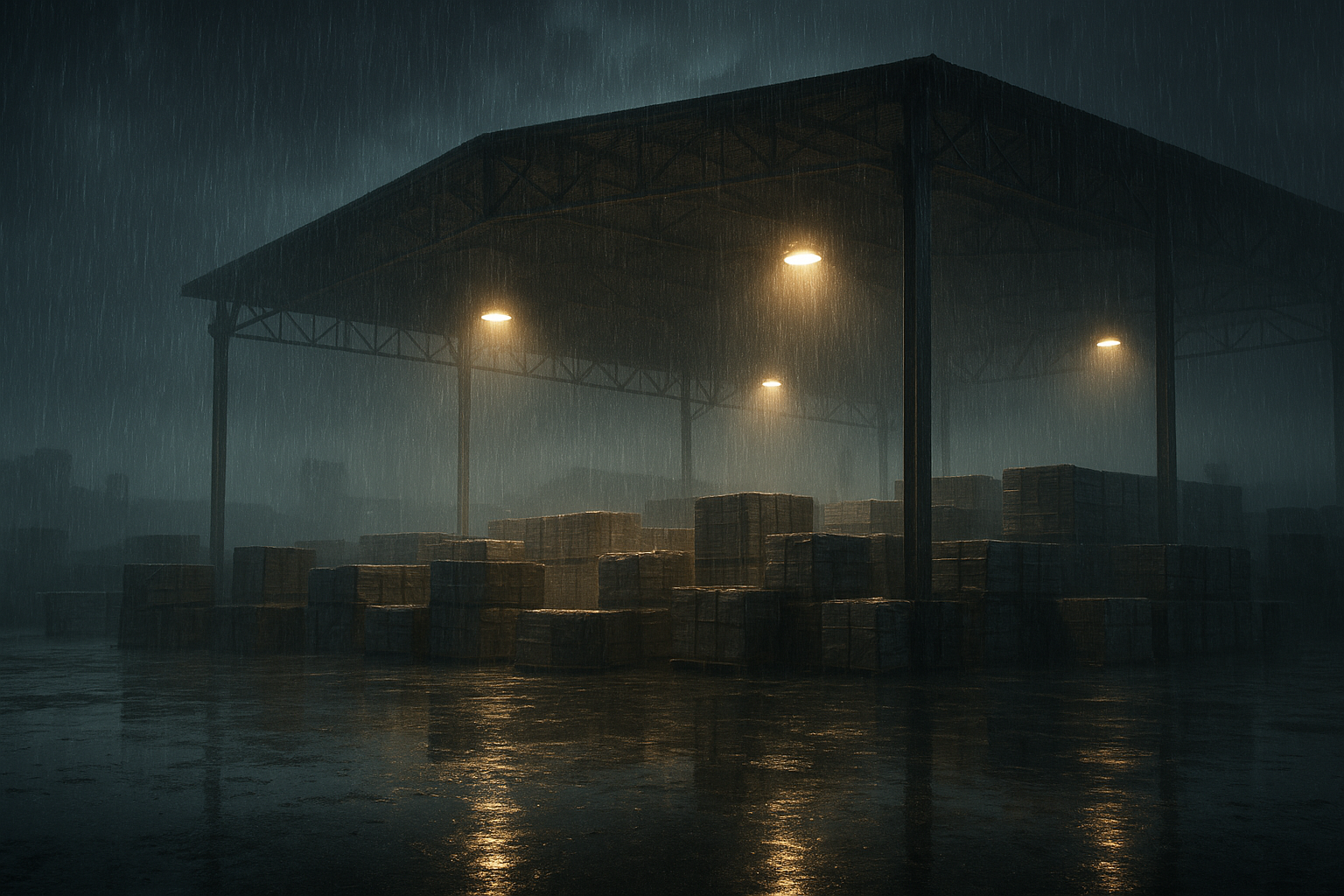
Heavy rain, driving monsoons, and high-pressure washdown procedures present constant threats of moisture ingress. Water entering an electronic luminaire housing causes immediate driver short-circuits, electrolytic corrosion, and rapid LED chip degradation.
Ingress Protection (IP) ratings defined under IEC 60529 classify the mechanical sealing capability of electrical enclosures against solid objects and water:
IP Protection Level | Solid Ingress | Liquid Protection Capability | Outdoor Environment Suitability |
|---|---|---|---|
IP65 | Dust-tight (6) | Protected against low-pressure water jets (5) | Sheltered outdoor overhangs & covered docks |
IP66 | Dust-tight (6) | Protected against powerful high-pressure water jets (6) | Fully exposed outdoor sites, heavy rain & monsoons |
IP67 | Dust-tight (6) | Protected against temporary water submersion up to 1 meter | Flood-prone low areas & extreme marine spray |
For fully exposed outdoor industrial spaces, specifying IP66 weatherproof outdoor LED high bays ensures that torrential downpours and high-velocity water spray cannot breach the internal optical or electronic driver compartments.
A common cause of fixture fogging and internal water accumulation is thermal cycling. When a high bay light operates, internal temperatures rise, causing internal air to expand. When turned off during a rainstorm, the housing cools rapidly, creating an internal vacuum. Standard rubber gaskets subjected to vacuum pressure eventually fail, pulling ambient water vapor directly inside the sealed housing.
High-performance outdoor luminaires solve this by integrating ePTFE pressure equalization breather valves. These specialized vents allow air molecules to pass freely to equalize internal and external pressure differentials while completely blocking liquid water droplets and dust particulates. This breathing capability protects gasket integrity and eliminates internal lens condensation.
In cold climates, outdoor high bays face heavy snow accumulation, ice crusting, and extreme sub-zero ambient temperatures. Thermal management in winter requires balancing heat distribution to melt ice while keeping internal electronics operating safely.
Heavy wet snow accumulating on flat top surfaces of high bay fixtures creates substantial static weight loads that strain mounting brackets and block cooling fins.
Sloped Radial Fins: Severe-weather luminaires utilize sloped, self-draining radial cooling fins that prevent snow and ice from packing between heat sinks.
Controlled Thermal Conduction: Heat generated by the LED driver and COB/SMD array is conducted through the die-cast aluminum body to maintain surface temperatures slightly above freezing, promoting natural snow shedding without overheating internal components.
Standard LED drivers experience dramatic voltage drops or failsafe shutdowns when exposed to temperatures below -20°C. Industrial cold-climate high bays require specialized wide-temperature range drivers capable of reliable cold starts down to -40°C (-40°F).
These drivers incorporate active thermal compensation and high-grade solid-state capacitors that deliver immediate full luminous output without flickering or delayed ignition during freezing winter nights.
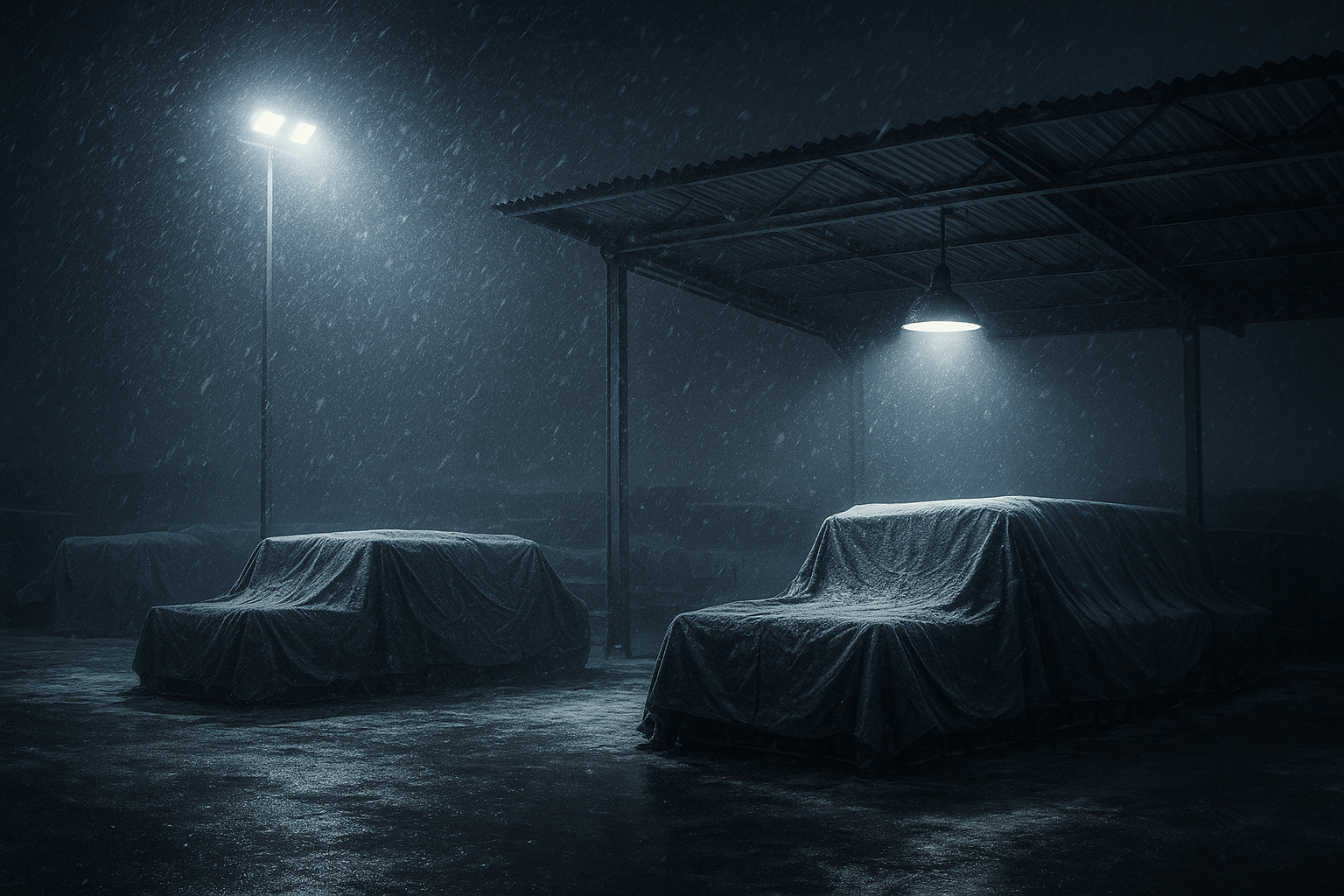
Severe weather is rarely limited to rain or snow; windblown gravel, hail, lightning strikes, and atmospheric salt fog represent additional operational hazards for outdoor luminaires.
Mechanical impact resistance is rated on the IK scale (IEC 62262), ranging from IK01 up to IK10. In severe outdoor environments, hail storms and windborne debris can easily shatter fragile glass lenses.
Specifying IK08 to IK10 impact-resistant luminaires—constructed with high-grade toughened glass or UV-stabilized polycarbonate lenses—guarantees protection against mechanical impacts up to 20 Joules of impact energy.
Severe storms frequently generate indirect lightning strikes and high-voltage grid transients. Standard internal driver surge protection (typically 2kV to 4kV) is insufficient for elevated outdoor installations.
Industrial outdoor high bays require integrated or modular 10kV / 20kV Surge Protection Devices (SPD). This surge barrier redirects high-voltage spikes safely to ground, protecting the sensitive LED emitter board and power supply from permanent voltage destruction.
Coastal facilities and chemical industrial zones subject outdoor fixtures to corrosive salt spray and acid rain. Unprotected aluminum oxidation compromises housing seals and thermal dissipation.
Die-Cast ADC12 Aluminum: High-purity die-cast aluminum alloys provide high mechanical strength and rapid heat dissipation.
Electrophoretic Anti-UV Powder Coating: Fixtures must pass ISO 9227 salt spray testing (minimum 500 to 1,000 hours exposure) to verify that surface coatings will not peel, bubble, or corrode in harsh outdoor atmospheres.
When sourcing fixtures for commercial projects or distributor inventory, comparing hardware specifications against environmental requirements ensures long-term performance:
Feature / Metric | Standard Outdoor Luminaire | Severe-Weather Industrial Luminaire |
|---|---|---|
Ingress Rating | IP65 (Splash proof) | IP66 / IP67 with ePTFE Breather Valve |
Vibration Standard | Unrated / 1.5G standard | ANSI C136.31 3G (3-axis 100,000 cycles) |
Impact Rating | IK06 / IK07 | IK08 / IK10 (Toughened Glass / PC) |
Surge Protection | 2kV – 4kV internal | 10kV / 20kV SPD integrated protection |
Operating Temp | -20°C to +40°C | -40°C to +50°C continuous operating range |
Housing Finish | Standard paint | ISO 9227 Anti-Corrosion Powder Coating |
For project distributors and OEM buyers seeking reliable manufacturing support, partnering with an established supplier is critical. As an experienced LED factory with 13 years of operational experience, the KEOU Lighting OEM/ODM manufacturing facility engineers robust KEOU commercial high-wattage LED fixtures built with high-grade ADC12 aluminum, honeycomb anti-glare optics, precision IP66 silicone seals, and customizable mounting brackets designed for extreme global climates.
An IP65 rating protects against low-pressure water splashes, making it acceptable for covered outdoor loading docks or sheltered overhangs. However, for completely uncovered outdoor installations subjected to heavy driving rain, monsoons, or directional hose-down cleaning, an IP66 or IP67 rating with a pressure equalization valve is required to prevent water breach.
Wind affects luminaires in two ways: physical drag and structural vibration. Continuous wind buffeting causes micro-vibrations that can loosen mounting screws, fatigue brackets, and stress electronic solder connections. Choosing luminaires tested to ANSI C136.31 3G vibration standards prevents mechanical failure under high-wind conditions.
When an LED light turns on and off, temperature changes cause the air inside the housing to expand and contract. This creates pressure differentials that can pull moisture past rubber gaskets over time. A breathable ePTFE vent valve equalizes internal pressure while keeping liquid water and dust out, protecting seals and preventing internal glass fogging.
An IK10 impact rating certifies that the fixture lens and housing can withstand a direct mechanical impact of 20 Joules (equivalent to a 5kg mass dropped from 400mm). This level of protection prevents catastrophic glass breakage from large hail, falling ice, or windblown branches during severe storms.
Selecting outdoor high bay luminaires for severe weather environments requires balancing mechanical structural strength, verified ingress sealing, and thermal performance. To evaluate hardware suitability or explore customized OEM/ODM options for upcoming commercial project bids:
Review Photometric & IES Files: Verify beam distributions and spacing criteria for elevated outdoor mounting heights.
Confirm Environmental Certifications: Ensure test reports validate IP66/IP67 ingress ratings, IK10 impact resistance, and 10kV surge protection.
Request Factory Engineering Samples: Test physical housing seals, bracket thickness, and low-temperature driver ignition under local site conditions.
Explore the complete industrial outdoor LED high bay and floodlight lineup at KEOU Lighting or contact their technical sales team to request custom BOM matching, photometrics, and OEM factory pricing for your regional distribution network.


