Author: Huang Publish Time: 15-02-2026 Origin: Site


Unstable lead times and choppy replenishment are what hold many loose parts wholesale lighting programs back. If you sell components or kits, your shelves (or job sites) need the right mix at the right moment—not three weeks late. This playbook focuses on overseas small-to-mid distributors and contractors/system integrators, mapping pain points and supplier-side solutions you can put to work today. Along the way, we’ll use practical workflows, checklists, a compact table, and quick calculators. If you’ve been searching for a steadier way to run loose parts wholesale lighting, you’re in the right place.

Loose parts programs exist because flexibility wins: you can stock modules, drivers, housings, optics, and accessories independently to match local demand.
Distributors operate stores and regional agencies where on-shelf availability and predictable replenishment keep turns healthy. They value broad SKU coverage without extreme cash lock-up, predictable lead time windows to avoid stockouts, and documentation that makes resale simple (GTIN/UPC/EAN, safety marks).
Project-driven buyers need deliveries aligned to milestones, spec-compatible components, and stable lead times that protect critical paths. They prioritize integration-ready parts (driver type, dimming protocol, voltage/current ranges), staged shipments that match site schedules, and clear RMAs and documentation to minimize rework risk.
Cross-border e-commerce sellers need fast turns, clean labeling, and certification clarity; repair shops and hardware stores want small-quantity, high-availability replacements with unmistakable part IDs. We’ll touch these segments in the workflows.
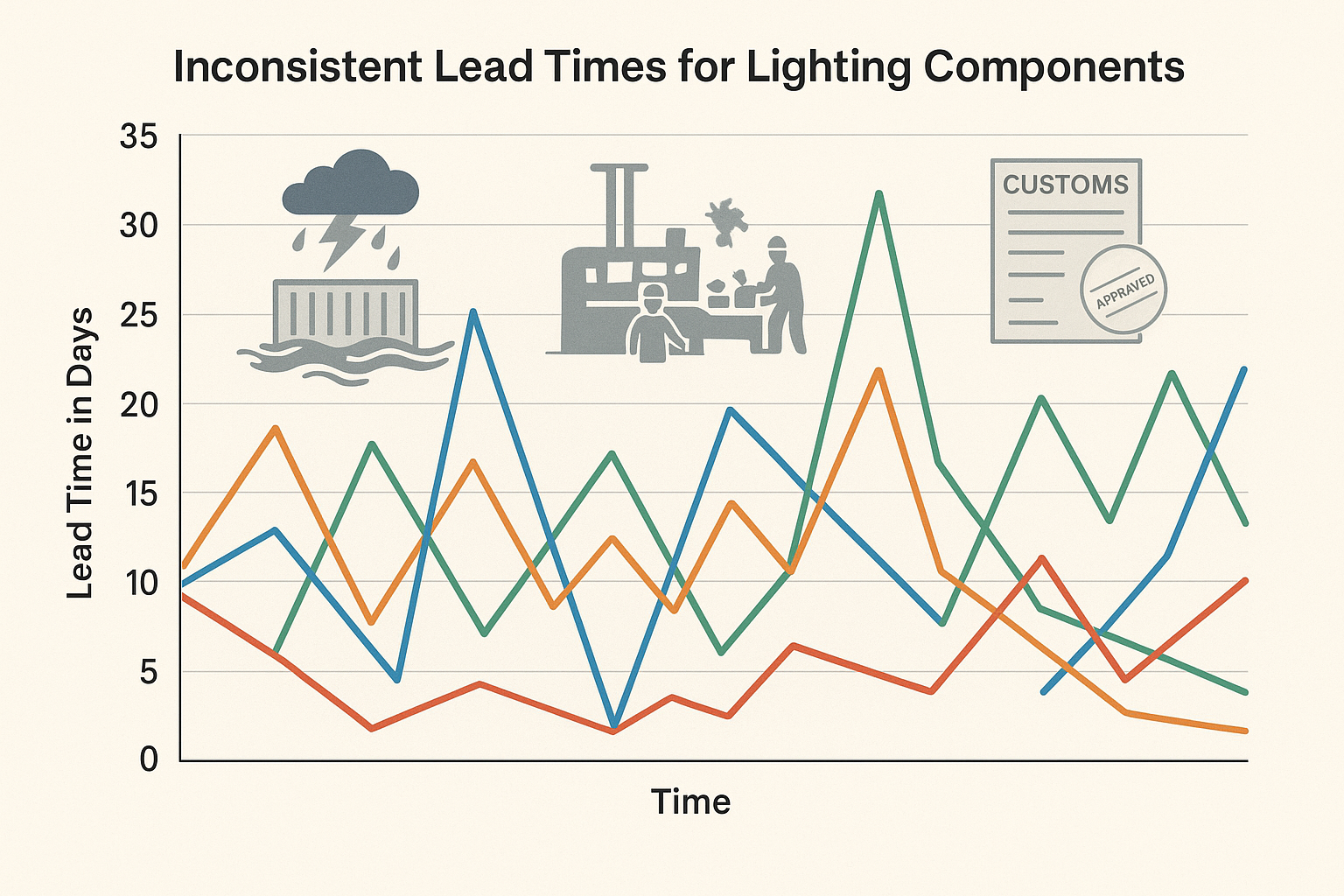
When replenishment swings, shelves go empty and projects slip. The primary obstacle for A and B segments is inconsistent lead time.
Lead times stretch or wobble due to factory batching, material constraints, ocean schedule reliability, customs clearance timing, and peak-season congestion. For Asia→US West Coast, ocean FCL can be roughly 14–21 days port-to-port and air 4–8 days airport-to-airport under typical conditions (ranges vary by service level and season), per forwarder route data such as the public China–US West Coast and SZX–LAX air lanes described by Flexport in 2026; see the forwarder’s published route pages for indicative transit ranges on lanes like Yantian→Los Angeles and SZX→LAX air in 2026 in the Flexport route listings. For background on air/ocean timing rules of thumb and market indices, consult the Freightos shipping guides and FBX index portal. Always verify current schedules before setting buffers.
Distributors face outsized stockout risk and forced expedites; contractors risk crews idling and rescheduling trades. The fix isn’t simply “order earlier.” It’s to design supplier programs—customization where it matters, standardized packaging/labeling for speed, and simple math for reorder points and safety stock—to absorb shocks.
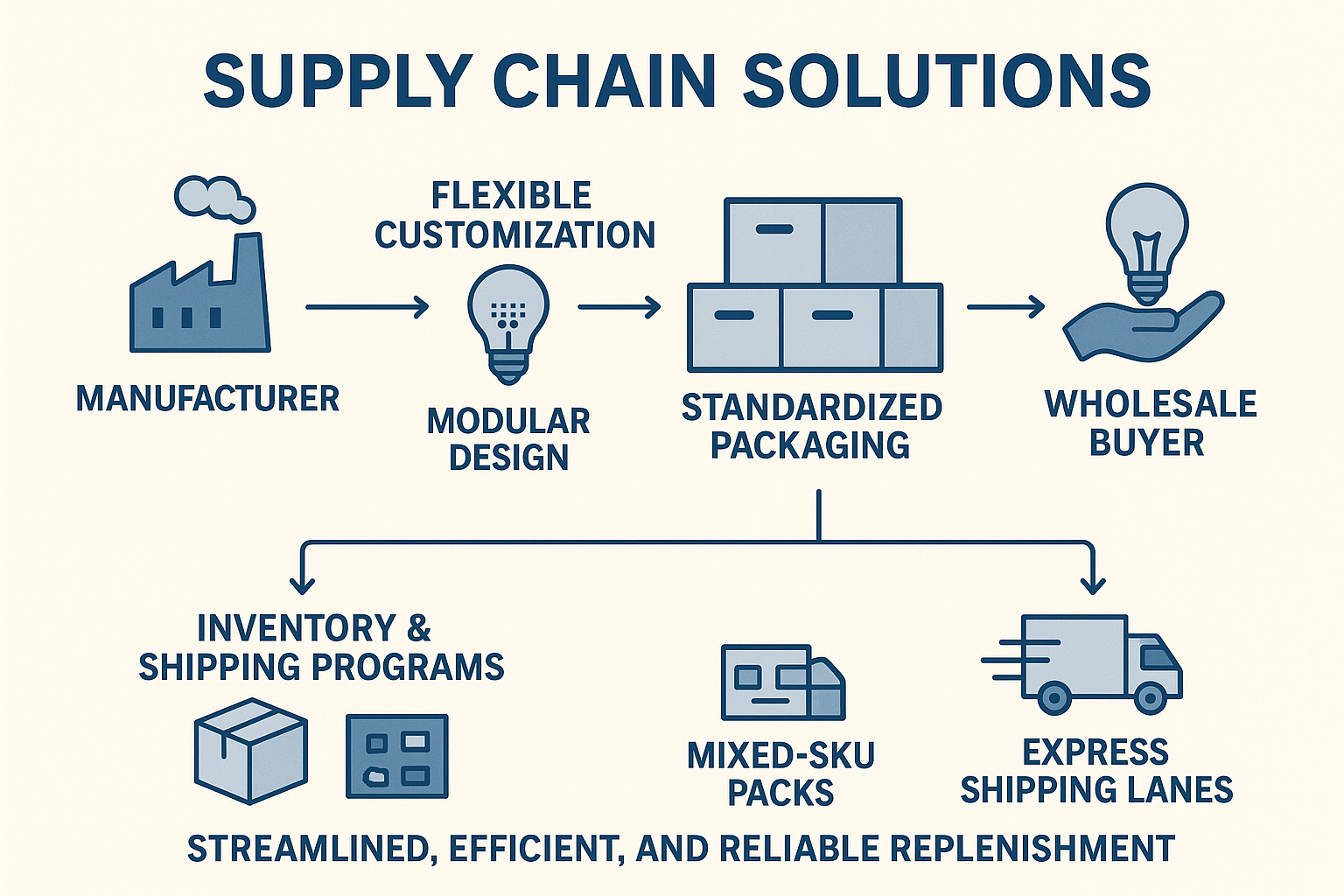
Customization doesn’t need to slow you down. Keep it modular and standardized: limit custom options to configurable parameters (CCT range, optics, driver dimming type, lead wire length) and keep the rest common. White-labeling with preapproved artwork shortens artwork cycles and reduces relabeling errors. For spec discipline on drivers and control gear, align with standards such as IEC 62384/61347 and North America’s UL 8750, and refer to DALI Alliance device-type guidance when relevant; see the DALI Alliance overview of IEC 62386 and UL’s market access updates for LED equipment.
Standardized cartons and labels reduce damage and receiving errors. Carrier guidance converges on double-boxing and cushioning for fragile components; follow practices like inner-carton cushioning (~3 inches/8 cm) and H-tape sealing as outlined in the FedEx General Packaging Guidelines and DHL’s fragile packing guide. For retail/wholesale traceability, assign GTINs and encode them in UPC/EAN for items, and apply GS1-128 with SSCC on cartons so warehouse scans tie into ASNs; see GS1 US guidance on GS1-128 and SSCC.
Mixed-SKU packs with rationalized MOQs lower cash strain and smooth reorder cadence.
Partial shipments unlock critical SKUs without waiting for the full bundle, especially for contractors.
Express lanes for low-cube urgencies (e.g., drivers) alongside ocean for bulk replenishment balance cost and speed.
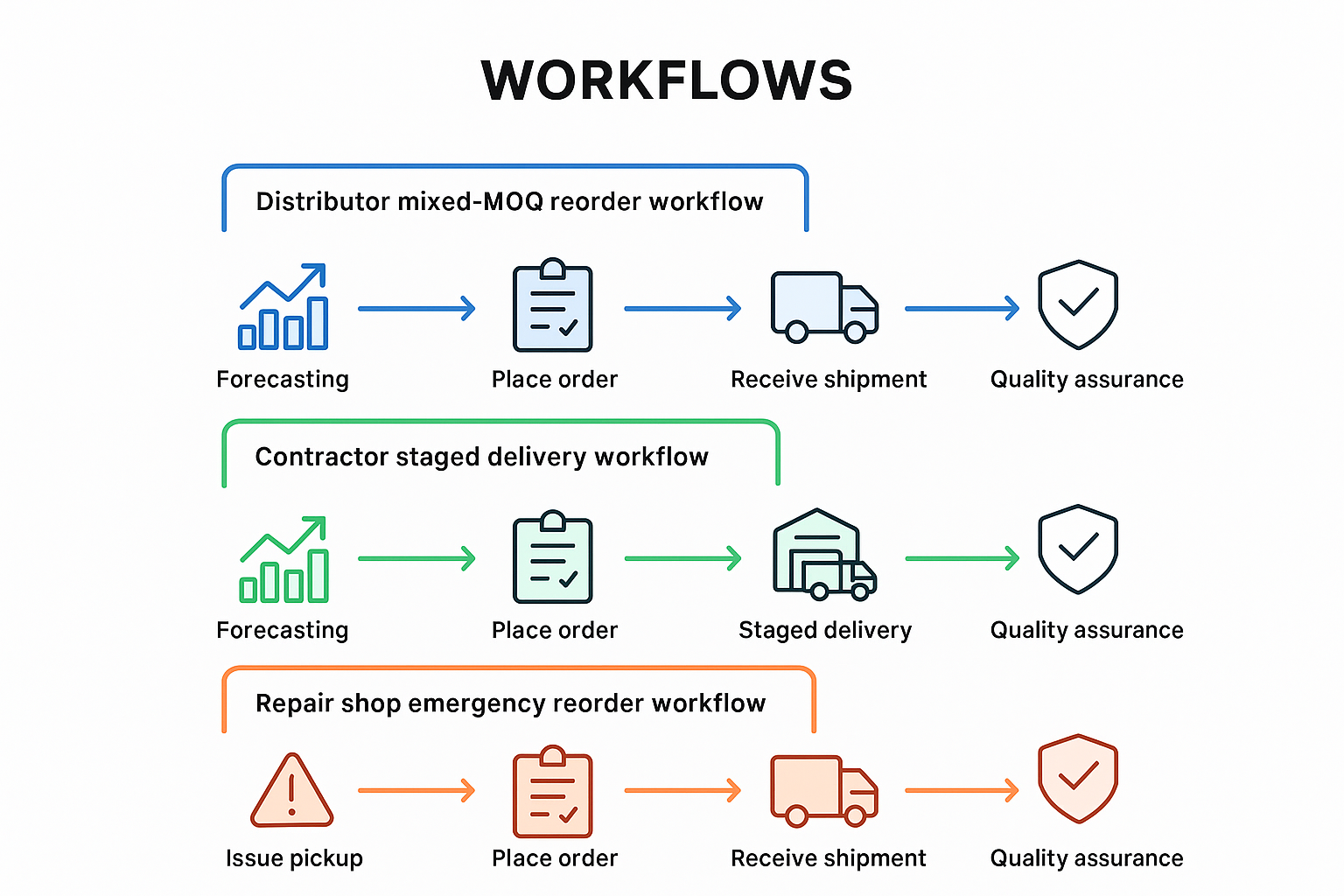
Forecast monthly demand per SKU (rolling 3–6 months). 2) Compute reorder points and safety stock (see Section 6.1). 3) Build mixed-SKU POs to hit carton layers or volumetric breaks. 4) Approve pre-set white-label artwork and barcodes before PO. 5) Allow partial shipment of top 10% movers via air if projected to stock out before the ocean lot lands. 6) On receipt, scan GS1-128 labels to trigger automatic put-away and price label printing.
▍Quick win: Preconfigured “A-mover” mixed packs (e.g., top 12 drivers + popular optics) cut pick/pack time and reduce miss-picks.
Split the bill of materials into long-lead, critical-path, and standard items. 2) Place an early PO for long-leads; tie remaining items to site milestones (rough-in, ceilings closed, commissioning). 3) Require pre-shipment photos and datasheets; book factory tests for dimming/flicker limits where needed. 4) Accept partials that unblock the next trade while holding non-urgent items for the following tranche. 5) Use on-site QA checkpoints—test dimming range, check thermal limits, confirm IP ratings before advancing.
What’s the payoff? You reduce idle-labor risk and keep the schedule moving even if a non-critical accessory lags behind.
Maintain a micro-safety stock of fast-moving replacements (drivers, LED strips, connectors). 2) If a stockout is projected, trigger an emergency PO with a defined air-express lane. 3) Use standardized cartons and SSCC labels so receiving takes minutes. 4) Close the loop with a short RMA protocol: photo, lot code, failure description—so replacements can be authorized quickly.
Use this list during sourcing and incoming inspection:
Driver type: constant current vs. constant voltage; output ranges meet design
Dimming: 0–10V, DALI, or TRIAC as required; minimum dim level and flicker metrics documented
Safety/standards: IEC 61347/62384 or UL 8750 marks as applicable; IP/IK ratings as needed
Power quality: THD/PF targets stated on datasheet
Thermal and ambient rating match application
Documentation: datasheet, wiring diagram, and installation guide present; warranty/RMA terms written
▍For deeper specification context on panel assemblies and controls, see the internal resource on comparing efficacy, CRI, dimming, and lifetime in the LED panel specifications comparison.
Double-box fragile assemblies; ≥3 in/8 cm cushioning around inner carton
H-tape seal with 2–3 inch pressure-sensitive tape; orientation/fragile labeling
Item-level GTIN/UPC or EAN; carton-level GS1-128
SSCC (carton license plate) on GS1 logistics label; scannable at receiving
Lot codes for traceability; barcodes verified before shipment
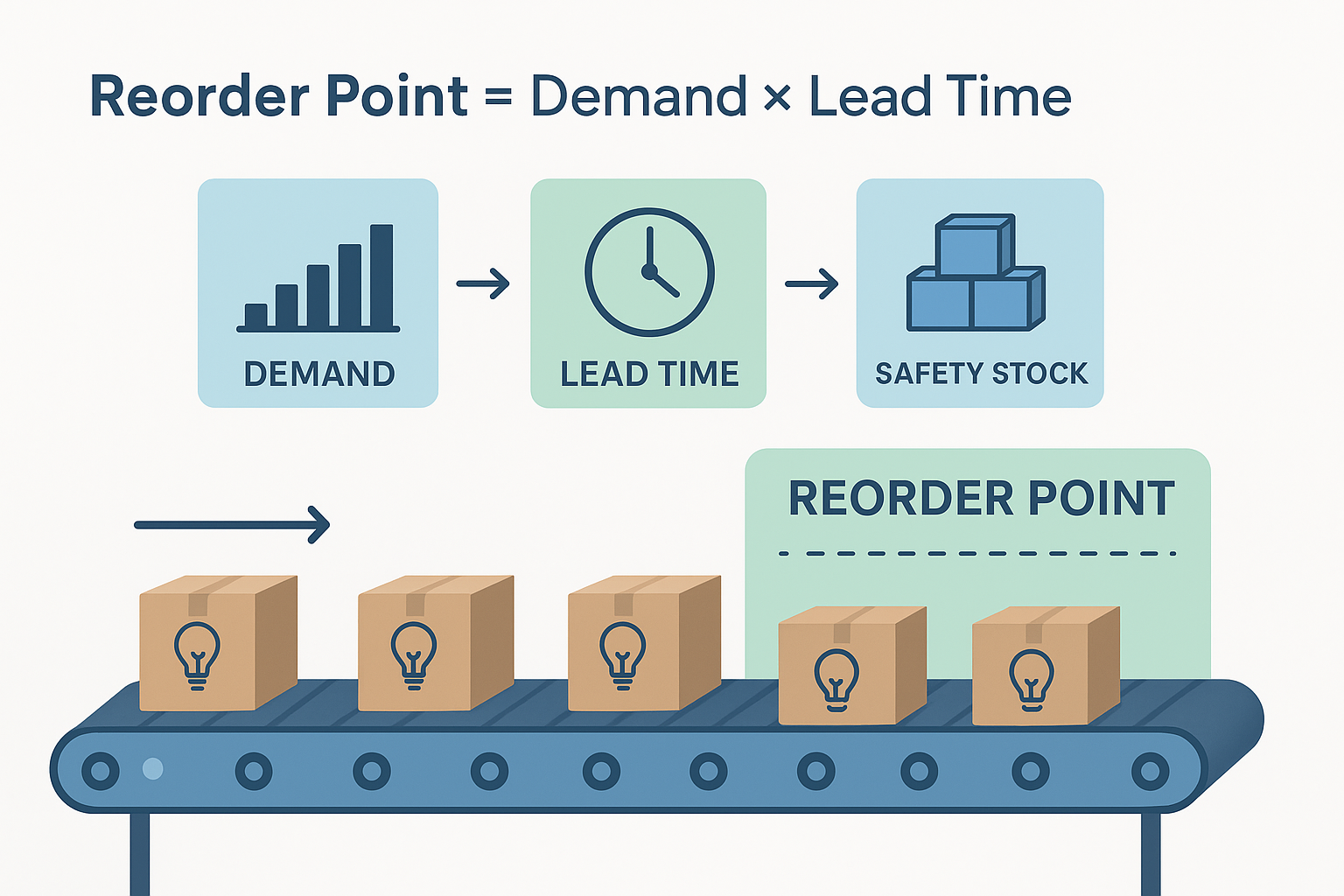
Assume average weekly demand (D) = 200 units, demand standard deviation (σd) = 60, lead time (L) = 3 weeks, target service level 95% (Z ≈ 1.65).
Safety Stock ≈ Z × σd × √L = 1.65 × 60 × √3 ≈ 171 units.
Reorder Point (ROP) ≈ D × L + Safety Stock = 200 × 3 + 171 = 771 units.
These are illustrative, based on widely taught ASCM order-point logic; for fundamentals and structure, see the ASCM safety stock primer (2025). Adjust Z for your service goals and recalc monthly. When L varies a lot, incorporate lead-time variability into the formula or add a buffer.
Service level reference table (illustrative):
| Target service level | Z value (approx.) |
90% | 1.28 |
95% | 1.65 |
97.5% | 1.96 |
99% | 2.33 |
Distributor example: If mixed packs cut miss-picks and receiving time by 30 minutes per carton and you receive 80 cartons/month at $25 labor/hour, that’s roughly $1,000/month saved and fewer stockouts from put-away delays.
Contractor example: A partial shipment that prevents a two-day crew delay at $2,800/day effectively “pays” for a small airfreight uplift on a critical driver batch.
For transit-time planning, consult forwarder route pages that show typical ranges (e.g., Yantian→Los Angeles ocean mid-teens days; SZX→LAX air about 4–8 days) in the Flexport route listings and sanity-check with market updates before setting buffers.
Disclosure: KEOU Lighting is our product.
Here’s a neutral example of how a supplier can fit into these workflows. A distributor builds a mixed order of drivers, LED modules, and several panel components with preapproved white-label artwork and item-level barcodes. The supplier prepares standardized cartons with GS1-128 and SSCC labels to support rapid receiving. The distributor requests one small partial by air for two fast-movers projected to stock out, with the balance on ocean. On arrival, the warehouse scans SSCCs to trigger put-away, while item barcodes generate price labels for stores. For component guidance or deeper spec comparisons on panels and accessories, distributors often review category pages and spec articles—see the panel lights category hub and a technical panel specifications comparison for efficacy, CRI, dimming, and lifetime considerations.
▍Set a target service level, calculate safety stock and ROP for your top 30 SKUs, then align your supplier on staged shipments and standardized labels. A steadier program usually starts working within one or two replenishment cycles.
▍If you need a neutral, modular supplier option, consider KEOU Lighting for spec references and category overviews.
Define and enforce reorder points and safety stock while enabling partial shipments on critical SKUs. That combination absorbs demand spikes and lead-time wobble.
If you want faster receiving and fewer errors—yes. GTIN/UPC/EAN at item level and GS1-128 with SSCC on cartons make scans reliable across warehouses and partners; see GS1 US guidance.
Reserve air for low-cube, high-urgency parts (drivers, controls) and batch the rest on ocean. Review lane times quarterly and tweak buffers accordingly, checking forwarder route pages such as Flexport’s China→US listings for current ranges.
Look for IEC 61347/62384 or UL 8750 safety marks, verify dimming protocol (0–10V or DALI) per the DALI Alliance guidance, and review flicker guidance such as IEEE 1789 when dimming deep.
Many distributors begin at 95% for A-movers and 90% for B/C items, then adjust after they see actual stockout and carrying-cost tradeoffs. For the math, see the ASCM safety stock primer.