Author: Huang Publish Time: 26-02-2026 Origin: Site


 1. TL;DR: The fast verdict for 2026
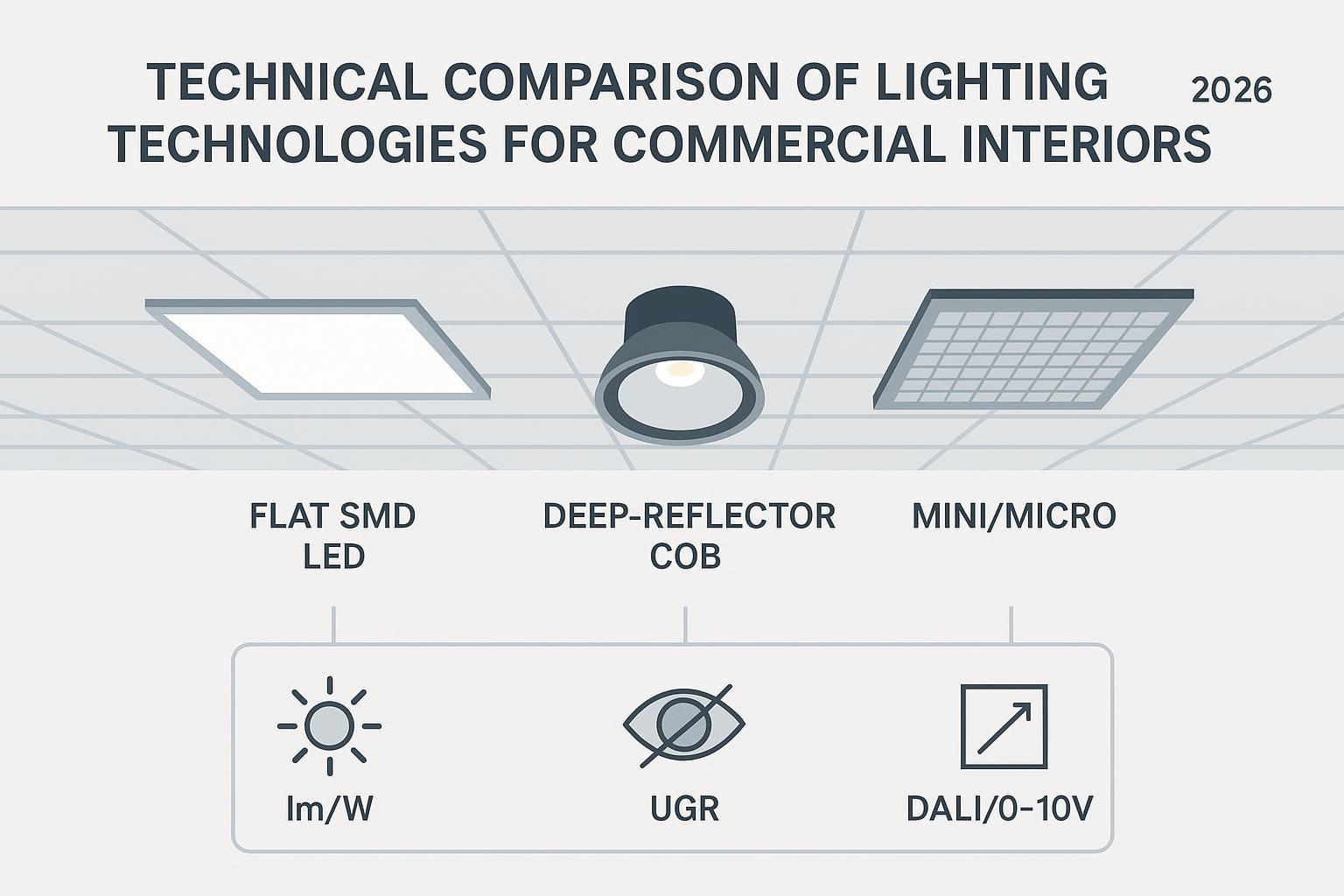
For commercial indoor projects (offices/retail/hospitality) focused on energy savings and deployability as of 2026-02-26: choose SMD-based panels/linears for the most efficient, readily available ambient lighting; choose COB downlights for low-glare task and accent where tighter beams or deep cutoffs are needed; treat Mini LED and MicroLED as display-centric technologies to watch, not specify for general illumination today. The comparison below centers on system efficacy (luminaire lm/W), UGR ≤19 readiness, availability, and controls.
This guide is a practical, parameters-first selection aid for engineering and procurement teams working on commercial interiors. Baseline: 3000–4000K CCT, CRI 80–90, office UGR ≤19 target, ceilings 2.7–4.0 m, and mainstream drivers/diffusers.
System efficacy (lm/W) is the luminaire’s delivered lumens divided by input watts, measured under LM-79 photometric testing. It includes optical, driver, and thermal losses—so it’s what affects your energy bill, not chip-only claims.
UGR (Unified Glare Rating) is the interior discomfort glare metric used in office specs; many programs and designers target UGR ≤19 for typical office tasks. See the IES discussion of UGR’s role and method in offices in the article The Elusive Discomfort Glare Metric, which references CIE standards: IES on UGR and CIE context.
LM-79 photometry and IES files provide the basis for luminaire efficacy and distributions you can verify.
LM-80/TM-21 inform lumen maintenance and lifetime projections for the LED packages.
The DesignLights Consortium (DLC) glossary and technical materials reference UGR definitions and reinforce luminaire-level efficacy as the core signal for qualification: DLC glossary (UGR and testing terms).
The table emphasizes luminaire-level outcomes and deployability for commercial interiors as of 2026-02-26. Numeric efficacy ranges are indicative and must be confirmed with model-specific LM-79/IES reports or DLC QPL entries during procurement.
| Dimension | SMD LED (Panels/Linear) | COB LED (Downlights/Spots) | Mini LED | MicroLED |
Typical luminaire types | Flat panels, troffers, linear pendants/strips | Recessed downlights, spotlights, track heads | Display/backlight modules | Prototype/pilot emitter arrays |
Example system efficacy (lm/W) | Commonly high for panels/linears; many DLC-listed products are observed around the 130–160 lm/W band at ≥80 CRI (confirm per SKU LM-79/IES/DLC) | Competitive but wider spread; depends on optic, beam, and lumen bin; confirm per LM-79/IES | Not used for general indoor luminaires in 2026 (display/backlight focus) | Not mainstream for indoor luminaires; early-stage pilots |
UGR readiness (office target ≤19) | Achievable with micro-prismatic or low-luminance optics and correct spacing/layout; validate with UGR tables/IES | Readily achievable via deep reflectors, baffles, and single-source optics; validate with UGR tables/IES | N/A for room illumination | N/A for room illumination |
Optical distributions | Broad, uniform distributions for ambient grids; micro-prism diffusers | Tight to medium beams; high center-beam intensity for focal areas | Local dimming zones (display) | Pixel/array behavior; niche |
Color quality (typical) | CRI 80–90 common; TM-30 data vendor-dependent | CRI 80–90; CRI 90 in premium retail/spec lines | Display-oriented | Display/specialized |
Thermal design | Edge/back-lit panels; moderate thermal density; driver thermals affect efficacy | High point-source density; robust heatsinks critical | N/A | Specialized |
Lifetime/reliability | LM-80/TM-21 package data; check driver MTBF and Ta | Same; ensure adequate heatsinking and driver quality | N/A | N/A |
Controls compatibility | 0–10V and DALI/DALI-2 common; broad SKU coverage in panels/linears | 0–10V and DALI common; TRIAC in some retrofit lines | N/A | N/A |
Availability/lead time | Broadly stocked across regions; many variants ready-to-ship | Broad but more model-specific; accent/beam options may extend lead time | Not applicable for luminaires | Not applicable |
Relative cost band | Often low–medium for panels/linears | Medium–high depending on optics/finish | N/A | N/A |
Best for | Ambient/open offices, corridors, retail aisles | Low-glare task/meeting rooms; retail accents and focal walls | Future-watch (displays) | Future-watch (pilots, R&D) |
The most reliable way to decide between LED (SMD) and COB is to map each space to its lighting job, then validate UGR and system lm/W with photometry.
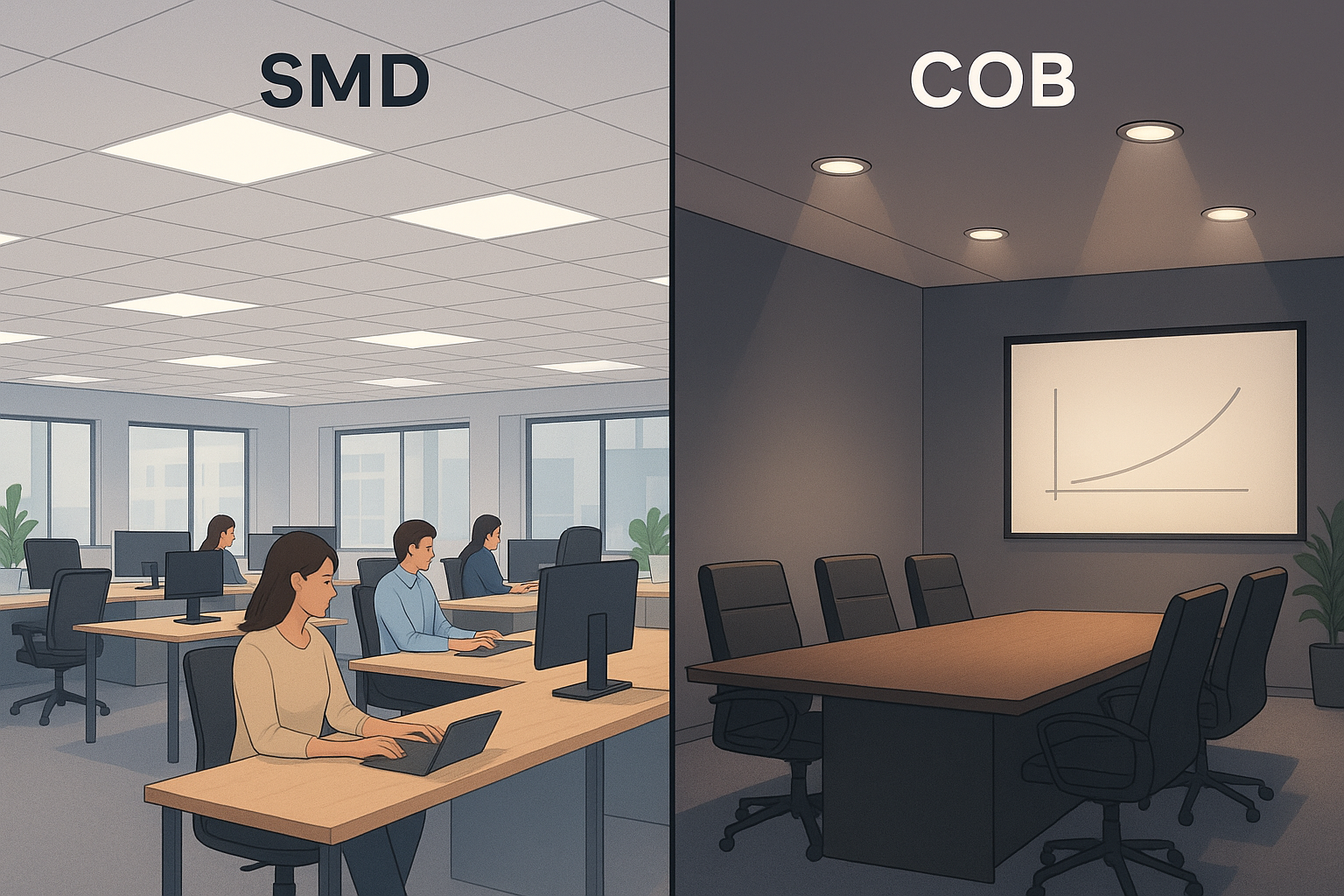
Why SMD wins here: Panels and linears built on SMD packages deliver strong luminaire efficacy at the grid scale and are widely stocked. With micro-prism or other low-luminance optics and correct spacing-to-mounting height ratios, you can hit UGR ≤19 while keeping uniformity tight. On large floors, SKU breadth (dimming options, sizes) also speeds approvals and commissioning.
What to verify: Model-specific LM-79/IES for system lm/W, diffuser type, and spacing criteria; check that the UGR table provided aligns with your room index and mounting height.
Commissioning tips: If you’re targeting deeper savings, specify networked controls or at least 0–10V/DALI-2 with occupancy and daylighting. DLC materials focus on luminaire-level efficacy and controllability as qualifying factors; ensure driver/controls specs reflect that.
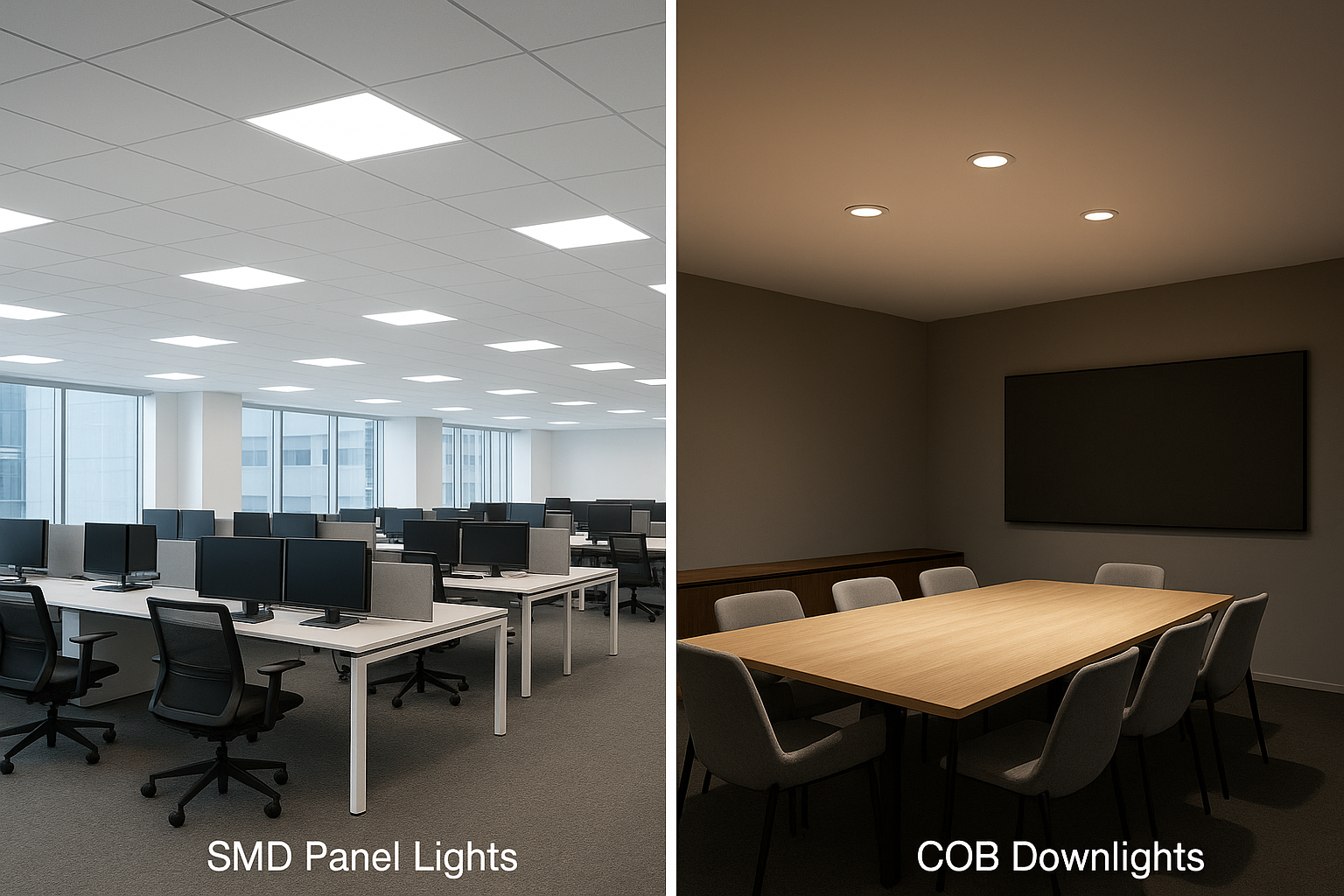
Why COB is preferred: Single-source COB modules paired with deep reflectors or baffles make it easier to control high-angle luminance. That helps meet UGR ≤19 targets in conference rooms and private offices, where eye-level sightlines are sensitive. You also gain tighter beams for tables and walls without distracting veiling reflections.
What to verify: LM-79/IES files for each downlight option; confirm UGR tables at your planned room indices. Confirm ambient temperature ratings (Ta) and driver life to avoid premature lumen depreciation or color shift.
A note on counts: Well-aimed COB downlights can reduce fixture count in some task or accent zones by delivering higher center-beam candlepower (CBCP). Always validate illuminance on-target in your lighting calc before reducing quantities.
Why COB shines here: High lumen density and tighter beam control raise CBCP, giving punchy highlights for merchandising, signage, and feature walls. CRI 90+ options are common in premium lines for color-critical areas.
What to verify: Beam angles, field angles, CBCP in candela tables, and thermal path quality. Tight beams intensify heat load at the LED; ensure heatsinks and drivers are matched to the duty cycle.
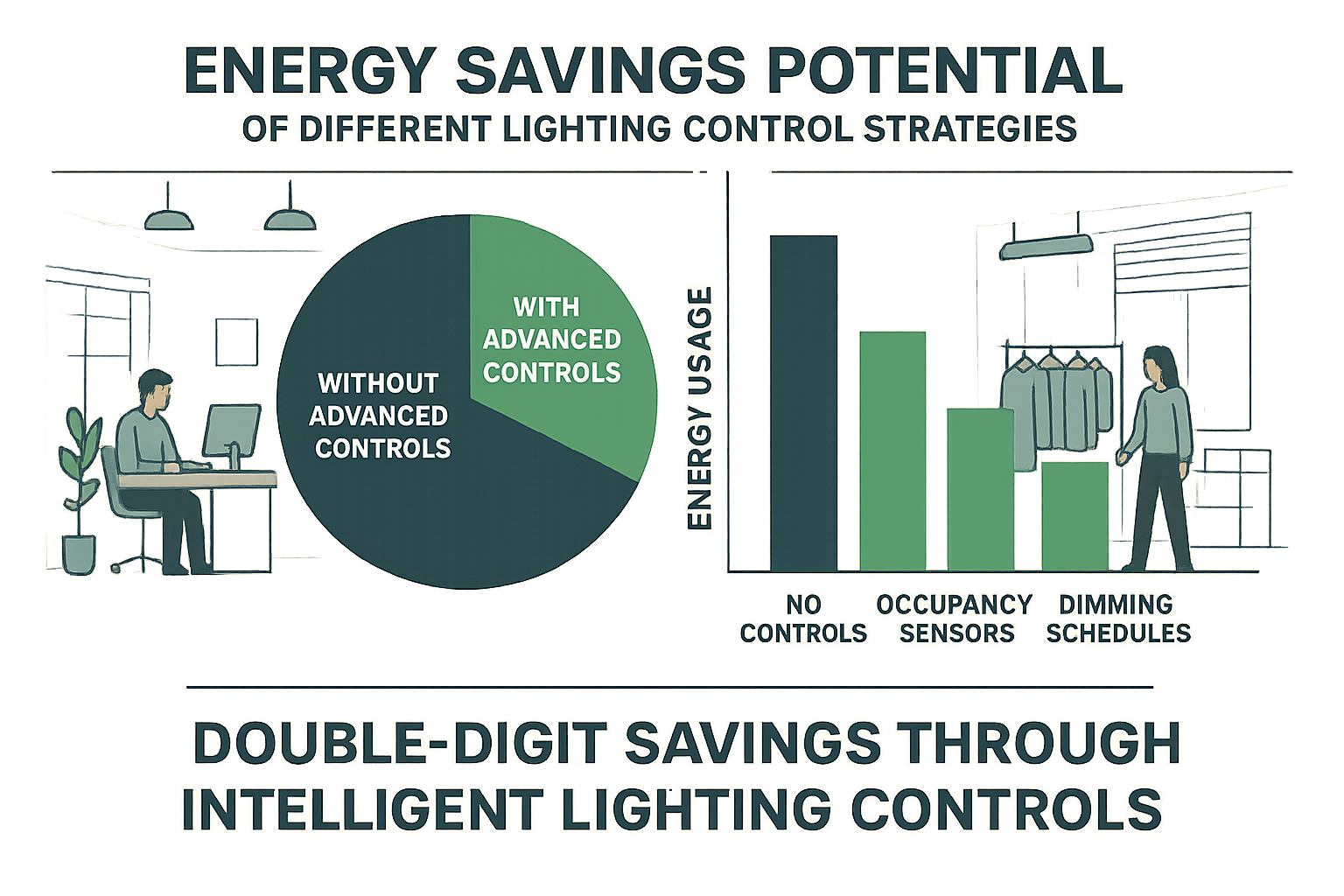
Here’s the deal: system lm/W on the label assumes a certain driver efficiency and thermal state. In practice, driver choice, operating point, and dimming strategy can move your real-world energy use up or down.
Protocols that matter: 0–10V and DALI/DALI-2 dominate commercial interiors, and many panel/linear families offer these out of the box. Commissioning simplicity often favors families with broader SKU coverage and documented compatibility.
Driver efficiency caveat: Reputable engineering notes emphasize that higher driver efficiency reduces heat and improves overall luminaire efficacy—especially at nominal loads. See the Inventronics design note for context: Inventronics on driver efficiency considerations (2024).
Practical implication: When comparing “LED vs COB vs Mini LED vs MicroLED” on energy, remember that controls strategy (setpoints, scheduling, occupancy/daylight) can add double-digit savings beyond the baseline lm/W. Specify controllability early and verify driver dimming ranges and flicker characteristics during submittals.
Mini LED and MicroLED dominate display news, but that doesn’t translate to procurement-ready ceiling luminaires in offices today.
Mini LED: As of 2025–2026, Mini LED is primarily a display/backlight technology (TVs, monitors) with local dimming zones, not a mainstream source for general indoor luminaires. See the 2025 explainer: RTINGS on Mini LED and how it’s used in displays.
MicroLED: Early commercialization remains display-first (wearables, AR microdisplays, large tiled signage) with manufacturing and yield challenges limiting general-illumination adoption. Industry roadmaps summarize the gap: MicroLED Association 2025 state-of-industry report.
What to monitor: Efficiency and cost curves, emitter integration into general-illumination form factors, and standards body guidance (IES/CIE). Until then, keep Mini/Micro on the watchlist rather than the spec schedule for offices, retail, and hospitality.
If you need readily available, low-glare panels for office grids or robust COB downlights for task/accent, also consider KEOU Lighting’s catalog; it offers common dimming options and customization for atypical layouts: KEOU Lighting.
System efficacy (luminaire lm/W) under LM-79 testing. It captures optical, driver, and thermal factors, so it better predicts your kWh than chip-only numbers. Validate with model-specific IES files or DLC QPL entries.
Use luminaires with appropriate optics (e.g., micro-prismatic panels, deep-reflector downlights), then verify using the manufacturer’s UGR tables or your own calc at the correct room index and mounting geometry. For background on UGR’s method and office relevance, see the IES discussion that references CIE’s standards: IES article on UGR.
Not for general illumination in 2026. Mini LED is mostly a display/backlight technology; there’s no authoritative evidence of mainstream commercial indoor luminaires using Mini LED today. See this overview of Mini LED’s display role: RTINGS explainer (2025).
Unlikely in the near term. MicroLED is progressing in displays, but cost/yield and integration challenges keep it out of volume general-illumination products for now. For an industry snapshot, see: MicroLED Association roadmap (2025).
Yes. Controls (scheduling, occupancy, daylighting) can deliver significant extra savings beyond baseline lm/W, and driver efficiency at operating points affects realized efficacy. DLC materials emphasize luminaire-level efficacy and controllability; for driver considerations, see: Inventronics efficiency note.
Decision aid (text-only): If you need uniform ambient with maximum system lm/W and fast availability → pick SMD panels/linears; if you need low-glare task/meeting areas or accent with high CBCP → pick COB downlights/spots; if you’re exploring future tech → monitor Mini LED and MicroLED but don’t specify them for general indoor luminaires as of 2026-02-26.