Author: Site Editor Publish Time: 02-09-2026 Origin: Site


Table of Contents
Working in a dark attic presents massive operational risks for homeowners and maintenance professionals. You are not just storing holiday decorations up there. The attic serves as a core infrastructure zone housing your HVAC system, ductwork, plumbing runs, and complex electrical wiring. When you cannot see what you are doing, routine maintenance turns dangerous. One wrong step off a joist means a foot through the drywall ceiling below. Legacy lighting makes this environment even more hazardous. Old incandescent bulbs run dangerously hot, creating severe fire hazards when placed near loose-fill insulation or exposed wood framing. Fluorescent tubes fail constantly in freezing winter temperatures and leave you with poor, flickering visibility. Upgrading to purpose-built LED Lights fixes these problems immediately. However, you cannot just screw in any standard bulb. You must evaluate thermal tolerance, insulation compatibility, and strict installation safety protocols to execute the upgrade correctly.
Thermal and Fire Safety: Purpose-built LED lights operate at significantly lower temperatures than legacy bulbs, mitigating fire risks when installed near exposed wood and insulation.
Insulation Contact (IC) Compliance: Selecting IC-rated fixtures is a non-negotiable requirement for recessed or flush-mounted attic installations to ensure building code compliance and prevent thermal overload.
Environmental Durability: Attic lighting must be evaluated on its ability to withstand extreme seasonal temperature swings and high dust accumulation without degrading component lifespan.
Installation Integrity & Safety: Safe deployment requires strict adherence to air-sealing protocols, strategic timing to avoid heat exhaustion, and physical safety measures (sturdy flooring, handrails, and backup lighting) during the upgrade process.
Traditional incandescent bulbs generate light by heating a tungsten filament until it glows. This process wastes up to 90 percent of the consumed energy as raw heat. In a confined, unconditioned attic space, this localized heat generation creates an immediate fire hazard. The surface temperature of a standard 60-watt incandescent bulb easily exceeds 250 degrees Fahrenheit during normal operation. When left on for extended periods, that thermal output bakes the surrounding environment.
Attics are packed with highly combustible materials. You have dry wood framing, cardboard storage boxes, and various types of insulation. While modern fiberglass and mineral wool resist fire, older homes frequently contain cellulose insulation made from shredded, recycled paper products. Manufacturers treat cellulose with fire retardants, but decades of baking in a hot attic degrades those chemicals. If an unprotected incandescent bulb touches loose-fill cellulose or shifted batt insulation, the concentrated heat can easily reach the ignition threshold of the surrounding materials.
Furthermore, attics lack the active airflow necessary to dissipate this excess heat. When someone accidentally leaves a bare bulb on for days, the localized temperature buildup compromises the structural integrity of nearby wiring jackets and plastic junction boxes. Eliminating these thermal hazards remains the primary driver for upgrading attic illumination systems.
Fluorescent lighting presents a completely different set of operational failures in unconditioned spaces. These fixtures rely on a ballast to regulate the electrical current and excite mercury vapor inside the glass tube. In extreme cold, the mercury vapor pressure drops, making it difficult for the electrical arc to strike. As a result, fluorescent tubes in freezing winter attics suffer from severe flickering, delayed warm-up times, and significantly reduced lumen output. You flip the switch, and the space remains dangerously dim for ten minutes.
Beyond temperature sensitivity, fluorescent tubes pose a severe environmental hazard if broken. Navigating an attic often involves carrying bulky storage items, maneuvering long PVC pipes, or swinging tools. An accidental strike against a fragile glass tube releases toxic mercury dust and sharp glass shards directly into the surrounding insulation. Cleaning up hazardous materials from loose-fill fiberglass or blown-in cellulose is nearly impossible without hiring a professional remediation crew.
The ballasts used in older fluorescent fixtures also fail rapidly in high-heat environments. Summer attic temperatures easily degrade the internal capacitors of electronic ballasts and melt the tar inside magnetic ballasts. This leads to loud humming noises, premature failure, and potential electrical short circuits. These environmental vulnerabilities render fluorescent technology entirely unsuitable for reliable utility lighting.
Transitioning to solid-state lighting addresses the fundamental structural and operational flaws of legacy bulbs. Modern LED Lights do not rely on fragile glass enclosures, pressurized gases, or delicate filaments. Instead, they generate illumination by passing electrical current through a semiconductor mounted on a rigid circuit board. This makes them highly resistant to physical impacts and the constant vibrations caused by roof movement or heavy foot traffic on the floor below.
Contractors view this shift primarily as a risk mitigation strategy rather than a simple energy-efficiency upgrade. Solid-state fixtures provide instant, full-brightness illumination regardless of ambient freezing temperatures. Their directional light output eliminates the need for bulky metal reflectors, allowing for lower-profile fixture designs that maximize your headroom in cramped utility spaces.
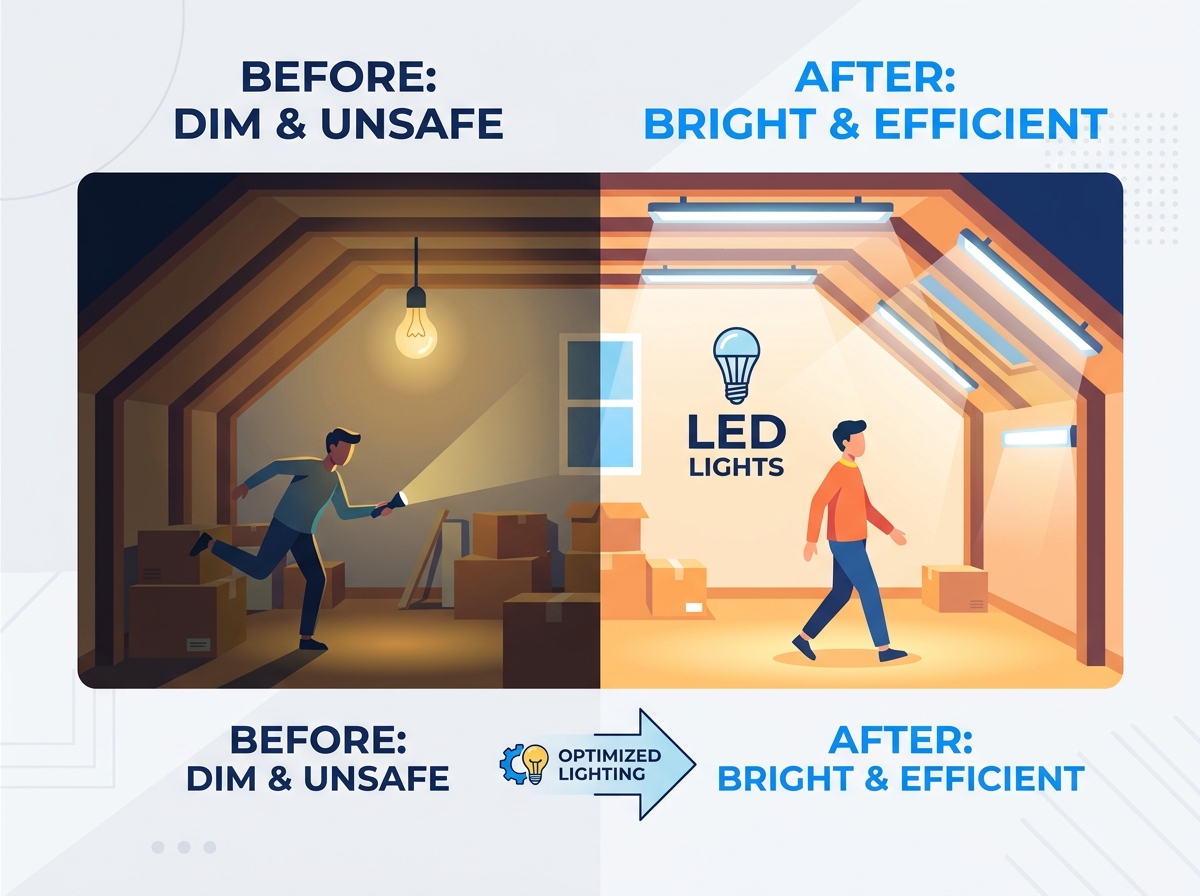
Establishing clear visibility requires precise calculations of lumen output based on the attic's square footage and intended use. For utility spaces requiring safe navigation and equipment maintenance, the target baseline is 75 to 100 lumens per square foot. Total lumen output must be paired with appropriate beam angles to be effective. Attics are structurally complex, featuring low-hanging rafters, cross-bracing, and bulky HVAC ductwork that easily obstruct light.
To properly calculate and layout your lighting, follow these steps:
Measure the total square footage of the usable attic floor space.
Multiply that square footage by 80 to establish a reliable baseline lumen target.
Divide the total target lumens by the output of your chosen fixture to determine the exact fixture count required.
Space the fixtures evenly across the ridge beam or upper truss chords to ensure overlapping light pools.
Fixtures with narrow beam angles create harsh spotlights, leaving dangerous dark zones behind structural members. Selecting fixtures with wide beam angles of 120 degrees or greater ensures broad, overlapping light distribution. This overlapping geometry guarantees that if one sightline is blocked by a furnace or a stack of boxes, ambient light from an adjacent fixture fills the void.
While solid-state lighting runs significantly cooler than incandescent technology, the diodes and internal drivers still generate internal heat that must be managed. High-quality fixtures utilize integrated aluminum heat sinks to draw thermal energy away from the sensitive semiconductor components. Efficient thermal management prevents premature diode degradation and maintains consistent color rendering over the fixture's lifespan.
Attic environments test the absolute limits of these thermal management systems. During peak summer months, radiant heat from the roof deck can push ambient attic temperatures above 130 degrees Fahrenheit, and sometimes up to 150 degrees in poorly ventilated spaces. If the ambient temperature exceeds the fixture's maximum operating rating, the internal driver will overheat, leading to thermal shutdown or permanent component failure.
Before procurement, you must evaluate the manufacturer's specified operating temperature range. Utility-grade fixtures designed for harsh environments typically carry maximum ambient temperature ratings of 122°F (50°C) to 140°F (60°C). Installing standard residential indoor fixtures in an unconditioned attic guarantees a shortened lifespan and frequent replacement cycles.
Airborne particulates present a constant threat to electronic components in utility spaces. Attics are inherently dusty environments, filled with deteriorating fiberglass particles, blown-in cellulose dust, and general atmospheric debris drawn in through soffit and ridge vents. If this dust settles on the internal circuitry of a lighting fixture, it acts as an insulator, trapping heat and accelerating component failure.
Ingress Protection (IP) ratings dictate a fixture's ability to withstand these environmental contaminants. The first digit represents protection against solids, and the second represents protection against liquids. For enclosed attic spaces, fixtures should carry a minimum rating of IP44, which protects against solid objects larger than 1mm, including most heavy dust and debris. This ensures the internal drivers and diode arrays remain clean and functional.
In attics with active ridge ventilation systems that may occasionally draw in fine mist during severe storms, upgrading to IP65-rated vapor-tight fixtures provides an impenetrable barrier against both fine dust and moisture. Protecting the diodes from particulate buildup also ensures the lumen output does not degrade over time due to a dirty lens.
IP Rating | Solid Protection Level | Moisture Protection Level | Attic Suitability |
|---|---|---|---|
IP20 | Fingers and large objects | None | Poor. Dust will quickly coat internal components. |
IP44 | Objects larger than 1mm (heavy dust) | Splashing water from any direction | Good. Suitable for standard dry, dusty attics. |
IP65 | Completely dust-tight | Low-pressure water jets | Excellent. Best for attics with active ridge vents. |
Hardwired utility luminaires represent the most robust and permanent solution for attic illumination. These include vapor-tight fixtures featuring polycarbonate lenses and wraparound linear lights that mount directly to the ceiling joists. Because they are hardwired directly into the home's electrical circuit, they comply with strict building codes for continuous, permanent use in utility zones.
The primary advantage of these fixtures is their exceptional durability. Vapor-tight models are entirely sealed against dust, fiberglass, and moisture, making them ideal for unfinished attics housing critical infrastructure like water heaters or air handlers. They provide massive lumen output and can be controlled by a standard wall switch located safely at the attic entrance.
The main drawback is the installation requirement. Deploying hardwired fixtures requires running new Romex cabling, installing junction boxes, and tying into the main breaker panel. This necessitates hiring a licensed professional to ensure National Electrical Code (NEC) compliance, which increases the upfront deployment time and effort.
For expansive attics requiring broad light distribution without the effort of a complete electrical rewiring, linkable shop lights offer a highly scalable alternative. These plug-and-play fixtures come with standard three-prong cords and can be daisy-chained together. A single grounded receptacle can often support up to six or eight linked fixtures, depending on the specific wattage draw of the units.
This modular approach is highly favored for its rapid deployment. Users can suspend the fixtures from the roof rafters using included chains or flush-mount them directly to the trusses. As storage needs expand, additional lights can be linked to the end of the run, pushing illumination deeper into the dark corners of the roofline.
However, linkable fixtures rely on the pre-existence of a code-compliant, grounded receptacle within the attic. Additionally, if suspended by chains, the fixtures can sway or become obstructive in low-clearance areas. You must take care to secure the linking cords tightly along the framing to prevent snagging hazards when moving boxes.
When an attic is being converted into a habitable loft or a finished storage room, aesthetics and clearance become primary concerns. Ultra-low-profile recessed retrofits, commonly known as wafer lights, provide high-end architectural lighting without sacrificing headroom. These fixtures feature a remote junction box and a flat panel that is often less than an inch thick.
The critical feature of these fixtures is their Insulation Contact (IC) rating. An IC rating certifies that the fixture's housing is designed to dissipate heat efficiently enough that it can be completely buried in attic insulation without causing a fire. This is a strict building code requirement for any recessed light penetrating an insulated ceiling boundary.
Deploying recessed wafer lights requires precise layout planning and drywall cutting. While they offer superior aesthetics and safe insulation contact, they are generally not suitable for raw, unfinished attics with exposed joists, as they require a finished ceiling surface for mounting.
Lighting Category | Primary Advantages | Notable Limitations | Best Application Scenario |
|---|---|---|---|
Hardwired Utility (Vapor-Tight) | Maximum durability, IP65+ dust/moisture resistance, permanent code compliance. | Requires professional electrical installation and new circuit wiring. | Unfinished utility attics housing HVAC, plumbing, or heavy storage. |
Linkable Shop Lights | Plug-and-play installation, highly scalable, easy to daisy-chain. | Requires existing grounded outlets; hanging chains reduce headroom. | Expansive storage attics requiring broad coverage without rewiring. |
IC-Rated Recessed (Wafers) | Zero headroom loss, safe for direct insulation contact, clean aesthetic finish. | Requires drywall ceiling for mounting; precise cutting required. | Habitable attic conversions, finished lofts, and climate-controlled spaces. |
Installing lighting in an attic directly impacts the building's thermal envelope. Any penetration through the ceiling drywall—whether for a junction box, a wire run, or a recessed fixture housing—creates a pathway for conditioned air to escape into the unconditioned attic. This stack effect drives up heating and cooling demands and allows warm, moist air to migrate into the cold attic during winter, leading to severe condensation, wood rot, and mold growth on the roof decking.
To maintain the integrity of the thermal envelope, you must meticulously seal all ceiling penetrations. Use fire-blocking expanding polyurethane foam or high-temperature silicone caulk around the perimeter of all electrical boxes and wire holes. This air-sealing protocol is a mandatory step in modern energy codes and prevents moisture-laden air from bypassing the vapor barrier.
If fixtures are mounted flush against the ceiling or recessed into the drywall, the strict necessity of IC-rated housings cannot be overstated. Non-IC rated fixtures require a minimum clearance of three inches from any insulation. Attempting to keep loose-fill blown insulation away from a non-IC fixture is practically impossible over time, making IC-rated LED Lights the only safe choice for insulated ceiling boundaries.
Electrical wiring in attics is subject to specific National Electrical Code (NEC) regulations designed to prevent physical damage. When running non-metallic sheathed cable (commonly known as Romex) across an unfinished attic floor, you cannot simply lay the cables over the top of the joists if the area is accessible by stairs or a permanent ladder. You must protect them by installing wooden guard strips or routing them through bored holes in the framing.
For lighting circuits routed along the roof trusses or rafters, you must secure the cables tightly to the sides of the framing members using approved insulated staples. Keeping the wiring out of the direct path of foot traffic or storage boxes prevents accidental crushing of the insulation jacket, which could lead to arcing and electrical fires. The NEC also requires cables to be secured within 12 inches of every junction box.
All electrical splices must be contained within approved, accessible junction boxes. Burying a junction box under insulation or leaving wire splices exposed is a severe code violation. Every junction box must be fitted with a secure cover plate to contain any potential sparks and protect the connections from dust and moisture ingress.
Working in an attic presents unique physical and environmental hazards that require strict mitigation strategies. Timing the upgrade is your first line of defense against heat exhaustion. Attic temperatures can spike dangerously high by mid-morning during the summer months. Schedule all installation work during the early morning hours or wait for cooler seasonal weather to ensure a safe working environment.
Navigating the space requires deliberate preparation. Never step directly on the drywall ceiling between joists, as it cannot support human weight. Lay secure, heavy-duty walk boards or thick plywood across multiple joists to create a stable working platform. Bring temporary portable drop lights to illuminate the work area before the new system is active, and always keep a battery-powered backup flashlight on your person in case the main breaker trips unexpectedly.
Accessing the attic safely requires strict adherence to ladder protocols. Maintain three-point contact at all times while climbing, never stand on the top two rungs, and avoid overreaching while carrying heavy fixtures. To prevent falls through the access hatch, install a sturdy handrail or guardrail around the attic opening. This provides a secure handhold when transitioning from the ladder to the attic floor.
Finally, mandate the use of appropriate Personal Protective Equipment (PPE). Attics are filled with respiratory and dermal irritants. Wear a well-fitted N95 or P100 respirator to block airborne fiberglass and mold spores. Long sleeves, heavy-duty work gloves, and wrap-around safety glasses are required to protect your skin and eyes from protruding roofing nails, splinters, and abrasive insulation materials.
Procuring utility-grade solid-state fixtures requires a higher initial capital outlay compared to purchasing basic incandescent porcelain receptacles. A heavy-duty, vapor-tight fixture carries a premium price tag due to its sealed polycarbonate housing, integrated heat sinks, and high-output drivers. However, evaluating this upgrade solely on upfront cost ignores the extended operational lifecycle.
Quality solid-state fixtures boast operational lifespans exceeding 50,000 hours. In an attic environment where lights are used intermittently for storage retrieval or HVAC maintenance, this translates to decades of reliable performance. The durability of the semiconductor components ensures that the fixtures survive harsh seasonal temperature swings without the glass breakage or filament burnout associated with cheaper alternatives.
The true value of upgrading attic illumination lies in the drastic reduction of maintenance requirements. Changing a burnt-out bulb in a standard living room is a trivial task. Changing a bulb in a 130-degree attic while balancing on exposed joists over a fragile drywall ceiling is a hazardous chore. Eliminating routine bulb replacements removes the homeowner or maintenance technician from a high-risk environment.
Furthermore, the sealed nature of IP-rated utility fixtures eliminates the need for internal cleaning. Dust and fiberglass cannot penetrate the housing to degrade the reflectors or coat the diodes. This zero-maintenance profile ensures the lighting system remains fully operational and at peak brightness exactly when it is needed for emergency plumbing or electrical inspections.
Solid-state lighting consumes up to 80 percent less electricity than legacy incandescent bulbs while delivering superior lumen output. While this energy efficiency is a documented benefit, it is rarely the primary driver for attic upgrades, given the infrequent use of the space. The electrical savings accrued from running attic lights for a few hours a month are minimal.
Instead, the primary return on investment stems from risk mitigation. The energy efficiency of solid-state technology directly correlates to its low thermal output. By consuming less wattage, the fixtures generate a fraction of the heat, thereby eliminating the fire hazards associated with legacy bulbs. The return is measured in safety, usability, and reduced liability, rather than mere kilowatt-hour reductions.
Optimizing attic lighting hinges on a complete departure from hazardous legacy technologies. Replacing heat-generating incandescent bulbs and fragile fluorescent tubes with durable, temperature-rated solid-state fixtures is critical for both fire safety and operational visibility. Success requires tailoring the fixture type to the space's specific function, balancing the need for broad illumination in unfinished storage areas with strict building code compliance for insulated boundaries. When shortlisting solutions, prioritize IC-rated housings for any recessed applications to prevent thermal overload near insulation. For raw, unfinished spaces, prioritize high-lumen, dust-resistant utility fixtures or scalable linkable shop lights that can withstand extreme temperature fluctuations and airborne particulates.
To move forward with your attic lighting optimization, follow these actionable next steps:
Assess your current attic wiring capacity to determine if existing circuits can handle additional hardwired fixtures.
Measure the total square footage of the usable attic space to calculate the required total lumen output, targeting 75 to 100 lumens per square foot.
Inspect your current insulation type and depth to verify if IC-rated fixtures are mandatory for your specific ceiling boundary.
Consult a licensed electrician to ensure all new junction boxes, wire routing, and hardwired installations comply with the latest National Electrical Code standards.
A: For unfinished attics, linkable LED shop lights or hardwired vapor-tight fixtures are the best options. They provide broad, wide-angle coverage to eliminate shadows behind trusses. Vapor-tight fixtures offer superior dust resistance, while plug-and-play linkable lights offer a beginner-friendly, highly scalable installation using existing grounded receptacles.
A: Yes, but only if they carry an Insulation Contact (IC) rating. IC-rated fixtures are specifically engineered to dissipate internal heat safely, allowing them to be completely covered by fiberglass or cellulose insulation without posing a fire hazard. Non-IC rated fixtures must maintain a strict three-inch clearance from all insulation.
A: A safe baseline for utility spaces and attics is 75 to 100 lumens per square foot. For example, a 200-square-foot attic requires a total output of 15,000 to 20,000 lumens. Distribute this total across multiple wide-beam fixtures to ensure even coverage and eliminate dangerous dark spots.
A: Yes, extreme ambient temperatures can degrade internal drivers and cause thermal shutdown. Summer attics can easily exceed 130°F. It is critical to check the manufacturer's maximum operating temperature rating before installation and select utility-grade fixtures designed to survive harsh, unconditioned environments.
A: It depends on the fixture type. Linkable plug-and-play fixtures that plug into an existing, code-compliant receptacle can be installed by beginners. However, installing hardwired utility lights, running new Romex circuits, or adding junction boxes requires a licensed electrician to ensure strict adherence to the National Electrical Code.
A: Use fire-rated expanding polyurethane foam or high-temperature silicone caulk to seal the gaps between the electrical junction box and the drywall ceiling. Properly sealing these penetrations stops conditioned air from escaping the living space and prevents moisture buildup and mold growth in the cold attic.
A: Always wear a well-fitted respirator (N95 or P100), long sleeves, gloves, and safety glasses to protect against airborne fiberglass and dust. Lay sturdy walk boards across the joists to prevent falling through the ceiling, keep a battery-powered backup flashlight handy, and never overreach while on a ladder.