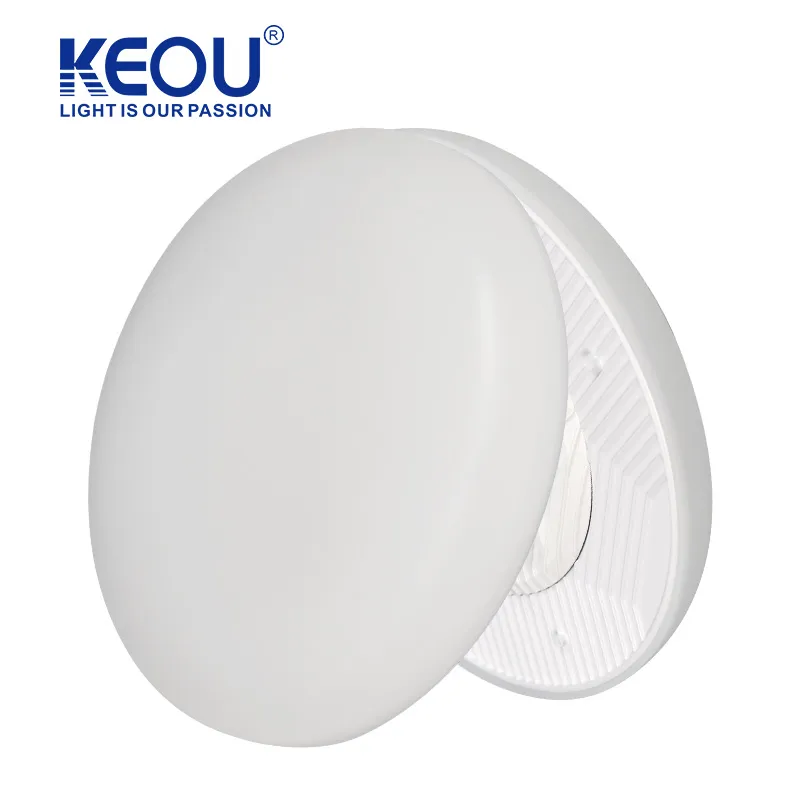
A flat-pack furniture box and a finished cabinet can hold the same table. The box is denser, cheaper to ship and stores flat; the cabinet arrives ready to use but has already paid freight on its own empty space. LED panel lights work the same way. A finished panel is a big, thin, protected slab that ships mostly as air and packaging; the same panel shipped as a knock-down kit — die-cast housing, LED board, diffuser, driver, terminals and clips — packs tighter and leaves the buyer to do the last few minutes of assembly.
That shift is happening fastest in the flat round panels and downlights that fill hotel corridors, office ceilings and retail ceilings. This article covers two things: why the model makes commercial sense for a distributor selling LED panel lights, and what a Chinese panel light factory must actually build to support it. It is a commercial and engineering explainer — not a tariff ruling or a certification opinion — and the compliance section flags what must be confirmed rather than assumed.
The Flat-Pack Logic: Why a Box of Panel Parts Beats a Finished Panel
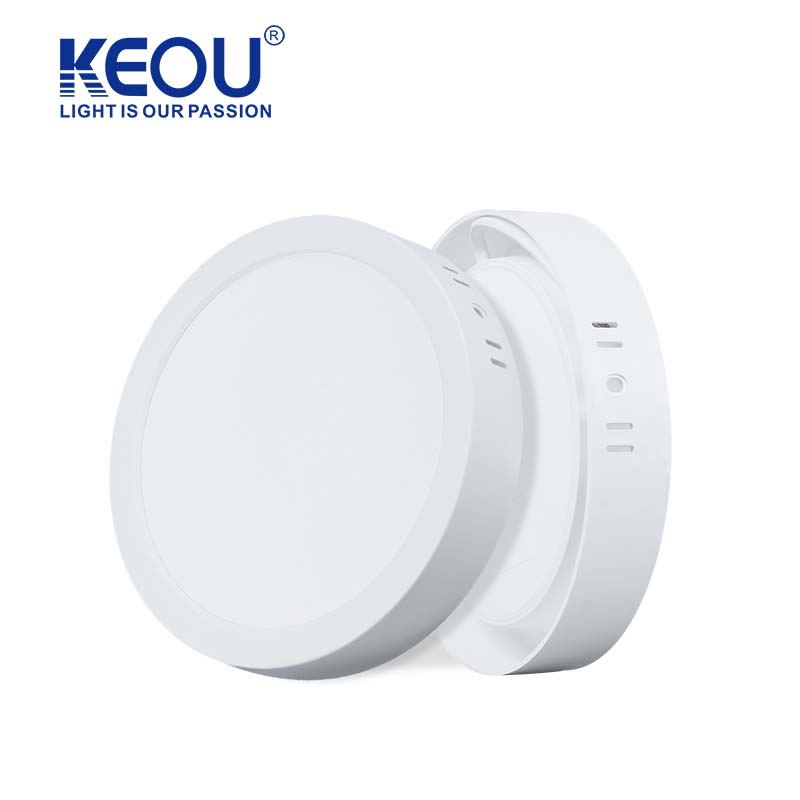
A finished LED panel light is mostly air. Take a 15W round panel at Φ140mm: the die-cast body is shallow, the diffuser needs clearance above it, and the driver box sits behind the back cover. Protected properly, the carton ends up far bulkier than the lamp itself. A knock-down kit removes that empty volume — housings stack and nest, boards ship flat in sleeves, diffusers are interleaved with protective film, drivers travel in trays and clips and terminals go into a bag. The same container carries noticeably more saleable units, and the saving compounds on a 40HQ.
Panels are actually a friendlier kit product than most fixtures, for one reason: the geometry is already flat and modular. A round panel is a housing, a board, a diffuser and a driver — four parts, few interfaces, no optics to align. Compare that with a linear batten or a track head and the disassembly is far less risky. That is precisely why panel light factories, especially those already running die-cast aluminium and push-in terminal designs, are the ones distributors approach first.
The trade vocabulary for this spectrum comes from the automotive trade. CBU (complete built unit) means the finished, plug-and-play product. SKD (semi-knock-down) means a partially assembled kit that the buyer completes with simple tools. CKD (complete knock-down) means largely unassembled components and full local production. SKD sits between the other two in technical demand, and moving along the spectrum is a trade-off, not a universal upgrade: each step down shifts labour, tooling and quality risk from the factory to the buyer.
Why Distributors Are Moving to Local Assembly
The commercial case builds in layers: freight first, then capital, then service capability, then configuration flexibility. Each layer only pays off if the one before it holds.
Freight, Volume and the Cost of Moving Air
Carriers charge on either actual weight or volumetric weight, whichever is greater, so a light but bulky carton pays for the space it occupies. LED panel lights suffer from this more than almost any other type: a 600×600 flat panel or a Φ140mm round panel weighs a few hundred grams but eats a disproportionate slice of container volume once foam corners and pulp trays are added. A nested kit raises units per container and lowers cost per unit landed. The saving depends on packing density, protection requirements and route — not on disassembly alone.
Cash Flow, SKU Breadth and the Inventory Trade-Off
Components let a distributor cover more configurations with less capital: one Φ110mm housing, one board family and one driver can serve the 7W and 10W variants, and a panel with a selectable colour temperature switch collapses three stock lines (3000K, 4000K, 6500K) into one. For a distributor stocking hospital corridors, hotel guest rooms and office ceilings at the same time, that is the difference between holding nine SKUs and holding three. The trade-off is honest — assembly labour, test equipment and assembly-induced quality risk move to the distributor’s floor.
Local Labour, Repair and After-Sales Control
A modular panel is repairable: a failed driver is swapped through the back cover and the panel returns to service without cutting the ceiling open, which is exactly the pain point on a finished sealed panel. Distributors who assemble also learn the product well enough to diagnose flicker, dimming drift and colour shift locally, which shortens after-sales response and reduces return freight. This is reasoning about the model, not a claim about any specific distributor’s operations.
CBU, SKD and CKD: Choosing the Right Level of Disassembly
The three supply models differ less in the product than in where the work happens.
| Model | What ships | Buyer’s workload | Best fit |
|---|---|---|---|
| CBU (complete built unit) | Finished, tested panel light | Unpack, install | Low labour capability, urgent projects, small volumes |
| SKD (semi-knock-down) | Housing, board, diffuser, driver, terminals and clips as a kit | Assemble, wire, test | Distributors with basic electrical skill and test gear |
| CKD (complete knock-down) | Largely unassembled components | Full assembly, calibration, testing | Buyers with real production capability |
The boundary between SKD and CKD is set by the buyer’s capability, not by a catalogue label. A distributor with a bench, a driver tester and one trained technician can handle a panel kit; a buyer who will mount chips, reflow boards and calibrate optics is in CKD territory. Volume matters too: small volumes rarely justify the tooling and training that deeper disassembly demands.
Tariff treatment can also differ by classification. The GCC has adopted a unified 12-digit customs structure, which allows products to be classified more precisely — Dubai Customs describes the 12-digit GCC structure and its classification objectives. Whether a panel kit and its finished equivalent fall under the same code is a question for a customs broker, not an assumption to build a price on.
The Compatibility Problem: Where Panel Kit Assembly Succeeds or Fails
Local assembly of LED panel lights fails at a handful of interfaces. Four of them decide whether a kit works in the field: the driver-to-board match, the thermal path through the die-cast body, the diffuser and light-mix, and the terminal and mounting hardware.
Driver and LED Board Matching
An LED board has a forward-voltage window and a rated drive current; a driver delivers a current at a voltage range it can sustain. Pair a driver rated for one board with another and it may under-drive (dim output, unstable regulation) or over-drive (excess heat, flicker, early failure). On a round panel the margin is tighter than on a big fixture, because the die-cast body has little spare thermal headroom — a panel that measures 1000lm at 10W on a test bench can sag to a dull, flickering light in a warm ceiling if the pair was never validated. A kit must ship as a matched, documented driver-board pair, not as two parts that happen to fit.
Thermal Path Through the Die-Cast Body
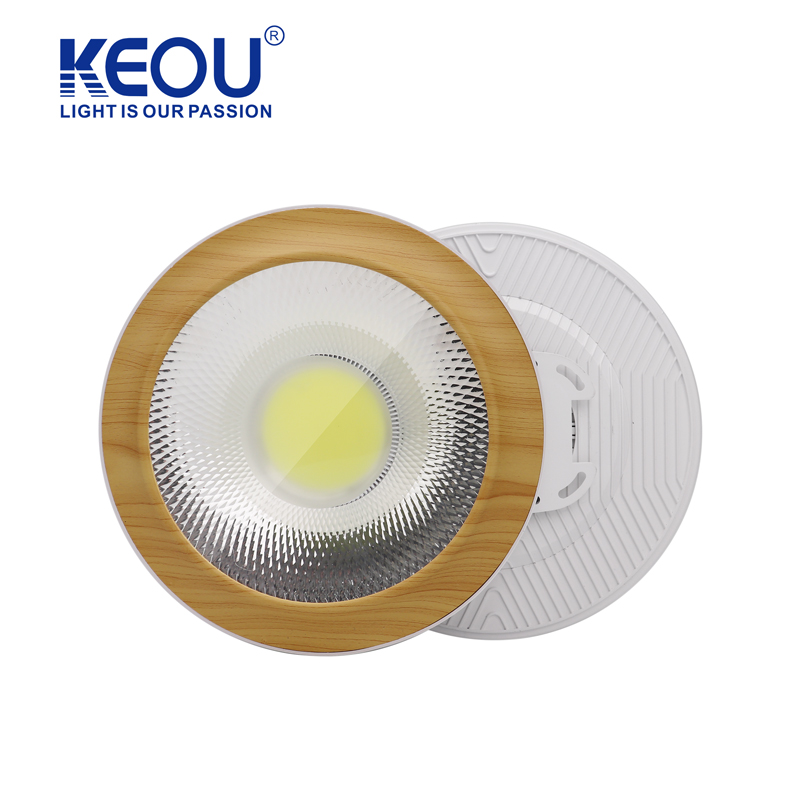
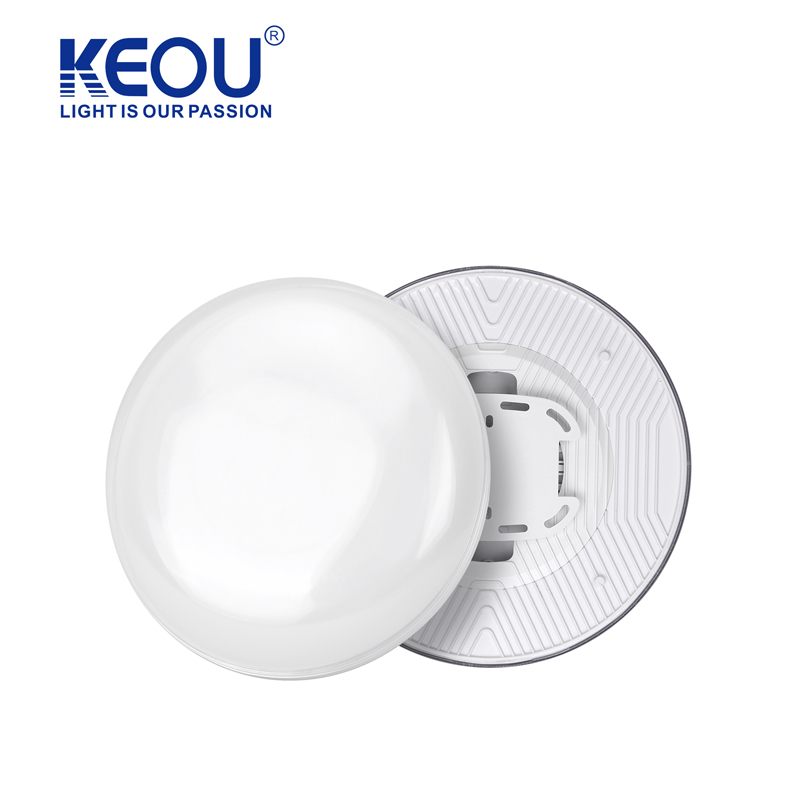
Heat leaves the LED through the board, the interface and the die-cast back cover. Panel lights use the body itself as the heat sink, so a dry joint, a trapped air gap, an uneven screw torque or a missing thermal pad raises junction temperature — and every degree above design shortens life and shifts colour. Die-cast aluminium bodies with a grooved back design, such as the KEOU panel and downlight series, are built to spread and dissipate that heat, but the interface still has to be assembled correctly. This is where post-assembly inspection earns its keep: a simple thermal check on the first batch reveals a systematic error before it reaches the ceiling.
Diffuser, Light-Mix and Sealing
The diffuser on a panel is not just a cover; it is the optical surface that decides glare and uniformity. Handle it carelessly and fingerprints, dust or a warped edge show up as bright rings. The gasket or foam ring must seat evenly along the whole circumference, and the body-to-diffuser gap must close without pinching. For high IP ratings the gasket has to stay uncompressed beyond its design range, so the factory must specify the closure order, not just the parts.
Terminals and Electrical Safety
Terminals must be tightened or seated with correct polarity. An embedded push-in terminal — the design used on KEOU’s panel series — removes the screwdriver and insulating tape and lets a single panel be wired in seconds, but the connection still needs a documented pull-test and polarity check. Surge protection matters just as much at assembly time: a panel specified with 2.5 kV surge protection only delivers that protection if the earth path is actually connected. The relevant references are IEC 60598-1 for luminaires and IEC 62031 for LED modules.
What a Chinese Panel Light Factory Must Prepare to Support SKD Buyers
Supporting SKD buyers is a factory capability, not a sales promise. For a panel light line it comes down to a short, auditable list — and each item is easier to build when the product family is a small, well-defined set of round panels and downlights rather than a sprawling catalogue.
A Modular, Documented BOM
Every kit needs a bill of materials mapping each part to its model, revision and supplier, so a buyer can reorder one component and trace a defect. For a panel this means the housing, the board with its chip and capacitor spec, the diffuser, the gasket, the driver and the spring clips are each individually identified. The BOM is also part of the technical file used for conformity documentation, so keeping it revision-controlled protects both the buyer and the factory.
A Compatibility Matrix and Matched Sets
The matrix pairs each driver with each board and states voltage, current and thermal limits — for a panel range that is typically a small grid: 7W, 10W, 12W and 15W boards against two or three drivers. Kits ship as validated sets; any substitution requires re-validation before it ships. Buyers routinely ask to swap in a cheaper driver, and that is exactly the request the matrix exists to answer with data instead of opinion.
Jigs, Fixtures and Test Equipment
Panel assembly has its own small set of aids: a seating jig that holds the housing while the board is fixed, a diffuser press that closes evenly, and a clip-fitting gauge so spring clips open to the right cut-out diameter. Test stations — driver function check, 1.5 kV dielectric withstand, surge and burn-in — should be specified by the factory with pass criteria. The factory should be able to hand over a fixture drawing and a test sheet for each kit, not just the fixtures themselves.
IQC, IPQC and OQC Discipline
Incoming inspection checks components, in-process checks catch assembly errors such as a missing thermal pad or a reversed terminal, and outgoing tests confirm function and safety. On panels, the incoming check on the diffuser and the board is where most quality escapes start, because both are visually easy to pass and functionally hard to catch later. The factory’s own ageing and reliability testing is what gives the buyer confidence in the kit.
Multilingual SOPs and Assembly Instructions
Step-by-step instructions, wiring diagrams and clip-fit dimensions must be in the buyer’s language. Arabic, Spanish and Portuguese are common requests from Middle East and Latin American distributors, and a photo or video SOP reduces assembly error more than a text sheet alone. For a four-part product this is short work — which is another reason panels suit SKD.
Packaging, Labelling and Traceability
Kit-level packaging must protect the diffuser and the housing face in transit; labels must identify model, batch and date; and traceability must let a defect be traced back to a batch of boards or drivers. Since a kit splits the finished product into parts that will be rebuilt far from the factory, the batch code on each part matters more than it does on a sealed luminaire.
Tiered MOQ and Kit Configuration
Set MOQ by kit type and by component, not as one blanket figure: a distributor can start with a small trial of complete kits, scale on housings and diffusers separately, and add boards and drivers only as assembly volume justifies it. Wide-voltage input, reinforced surge protection and local junction-box compatibility are typical configuration options, and each one changes the part list, so the MOQ should follow the configuration rather than the catalogue.
Splitting Warranty and Defect Responsibility
The moment assembly moves to the distributor’s shelves, the warranty question changes shape. A finished panel arrives as one tested object, so a failure is unambiguously the factory’s. A kit arrives as parts that a third party joins together, and the failure could originate in a driver, a board, a terminal, a gasket, a diffuser — or in the way those parts were put together.
A workable split assigns each failure mode to whoever controls it. The factory stands behind component defects and design faults within a stated period: a driver that fails inside its rated life, a board with a dead string, a terminal that cracks under specified torque, a diffuser that yellows early. The assembler stands behind assembly-induced faults: reversed polarity, a missing or contaminated thermal pad, an over-torqued fixing, a gasket pinched on seating, a spring clip seated off the cut-out so the panel sags at one edge.
Write that split down as a failure-mode matrix before the first kit ships. List the realistic failure modes, the inspection or test that would reveal each one, and which party bears the cost. Add a returns process with a defined evidence requirement — photographs, batch code, test reading — so a claim can be adjudicated without argument. This is commercial reasoning, not a legal opinion; have the final wording reviewed under the governing contract law.
Compliance and Tariff Questions to Confirm for the UAE
Two separate questions sit under this heading, and they are often confused: whether the product may be placed on the UAE market at all, and what duty applies when it crosses the border.
On the first, LED lamps, panel lights and luminaires, plus control gear, traded and used in the UAE fall within the lighting regulation administered under the Emirates Conformity Assessment Scheme (ECAS), which covers non-directional lamps, LED lamps, control gear for general lighting and luminaires for general lighting — the latter on electrical safety requirements, excluding energy efficiency and functionality. A conformity certificate is issued through a notified body, and the manufacturer or importer must hold a technical file for each model or range, draw up a declaration of conformity, and register the product. MoIAT now administers the scheme and publishes the service for issuing conformity certificates for regulated products. Certificates are time-limited and renewed, so a certificate is only meaningful together with its date and its stated model scope.
On the second, the GCC has moved to a 12-digit integrated customs tariff, expanded from the earlier 8-digit structure, which allows products to be classified more precisely — and classification is what determines the duty rate. The UAE’s general customs duty is 5% of CIF value for goods imported from outside the customs union, per the UAE government’s customs guidance; Dubai Customs sets out the integrated tariff structure and publishes a correlation table from 8-digit to 12-digit codes.
What this means for a panel kit is that the classification of a box of housings, boards, diffusers and drivers is a judgement, not a given, and the duty outcome can differ from that of a finished panel light. Confirm the correct code and treatment with a customs broker for the specific kit composition before pricing a shipment. Requirements and tariff structures change; verify the current position for the exact product and emirate rather than relying on any summary, including this one.
Common Misconceptions About Local Assembly
“SKD is always cheaper.” It is cheaper per cubic metre shipped, not necessarily per installed unit. Add assembly labour, test time, rework and the capital tied up in test gear, and a low-volume buyer with expensive labour can lose the advantage. Run the landed-cost comparison on your own numbers.
“Assembly needs no test equipment.” A screwdriver and a mains supply is not an assembly line. At minimum a distributor needs a driver function check, a dielectric withstand test and a burn-in or functional check before a panel leaves the shelf.
“Any driver fits any board.” Forward voltage and drive current must match, and the thermal design must be validated for the pair. On a panel this matters more, not less: an unmatched combination may light up on the bench and fade in the ceiling.
“Any housing takes any diffuser.” Diffusers are matched to housing depth and board layout. A diffuser swapped from another model can leave a visible gap, uneven brightness or a gasket that never seats, which is why kits should ship as matched housing-boards-diffuser sets.
“One certificate covers the whole range.” Conformity documentation is issued against a defined product scope. A certificate for one model or family does not automatically extend to a different housing, a different driver or a kit configuration that was never assessed.
Conclusion
The shift toward knock-down LED panel kits is a commercial response to three pressures that are not going away: freight cost per cubic metre on a product that is mostly air, capital tied up in finished stock across too many colour temperatures and wattages, and the need to cover more configurations than a distributor can afford to hold as complete panels. Disassembly addresses all three — but only when the factory treats a kit as an engineered panel rather than a box of loose parts.
That is the real answer to what a Chinese panel light factory must prepare. A documented, revision-controlled BOM for every housing, board, diffuser, gasket, driver and clip. A compatibility matrix that pairs each driver with each board and states the limits. Seating jigs, diffuser presses and a specified test regime including dielectric withstand and surge. IQC, IPQC and OQC discipline that survives the transition from shipping finished panels to shipping assemblies. Instructions in the buyer’s language. Packaging and traceability that let a defect be traced to a batch. Tiered MOQ that lets a distributor start small. And a written failure-mode matrix that says, before anything goes wrong, who bears which cost.
Factories that build those systems can support SKD buyers credibly. Factories that simply take a finished panel light apart and put the pieces in a carton transfer the risk to their customer and will hear about it in the first warranty cycle.
If you are evaluating a kit programme for LED panel lights, the practical next step is a conversation about your assembly capability, your target cut-out sizes and wattages, and your volumes. KEOU can discuss samples, bill-of-materials structure and driver-board pairing across its round panel and downlight ranges, subject to confirmation of the exact models and destination requirements.
Frequently Asked Questions
Is SKD always cheaper than buying finished LED panel lights?
No. Disassembly improves freight density, but the saving depends on packing density, order volume, local labour cost and whether you already own test equipment. A low-volume buyer with expensive labour can end up paying more per installed unit than on a finished panel.
What test equipment does a distributor need to assemble panel kits safely?
At minimum: a driver function or parameter check, a dielectric withstand (hipot) tester, and a burn-in or functional test station where assembled panels run before dispatch. On panels, a light-output and uniformity check after the diffuser is seated is worth adding, since a poor diffuser fit shows up as visible rings rather than an electrical fault. The factory should specify the test parameters and pass criteria for each kit.
Can a distributor mix drivers and boards from different suppliers?
Only after re-validating the combination. Forward voltage, drive current and thermal limits must all be checked against the actual board, and the pair should be run through a burn-in before it is offered as a product. Panel bodies have limited spare thermal headroom, so an unmatched pair that looks fine on a bench can flicker or fade in a warm ceiling.
Who is responsible when an assembled panel fails?
It depends on the cause. Component defects and design faults normally sit with the factory within a stated period; assembly-induced faults — reversed polarity, a missing thermal pad, a diffuser lip pinched in the gasket, a clip that doesn’t hold the cut-out — sit with the assembler. A written failure-mode matrix agreed before shipping is what makes that split workable.
Does a kit need its own ECAS certificate in the UAE?
Regulated lighting products need conformity documentation before being placed on the UAE market, and a certificate is issued against a defined product scope — so a panel kit whose driver or housing differs from the certified model may not be covered. Confirm the current requirement with MoIAT and your customs broker for the exact kit and emirate rather than assuming a certificate transfers.