A 2027 downlight catalogue is easy to read and hard to audit. Trimless trims, 2700 K warm dimming, Ra 95 badges and “smart-ready” logos are now printed on mid-market product sheets, not just premium ones. None of those phrases tells a distributor whether a fixture will still hold its output in year five, whether a hotel corridor will flicker at 10% dim, or whether a surge on a weak grid will take out a driver batch.
The parameters that actually decide that are less photogenic: the thermal path from LED junction to ambient, colour fidelity beyond the Ra average, the installation class a surge rating was tested to, and the interoperability of the control interface. Each is a property of the assembled luminaire, not of a component label. This article treats them as a selection method for distributors, contractors and project procurement working in 2027 tenders, and then applies the same logic to a tiered SKU portfolio. The argument throughout is that the durable 2027 trend is evidentiary: buyers will be judged on what they can document at the model level, not on what the datasheet headline claims.
What Is Actually Changing in the 2027 Downlight Market
Three directions show up consistently in trade reporting, and it is worth being precise about what kind of evidence each one is.
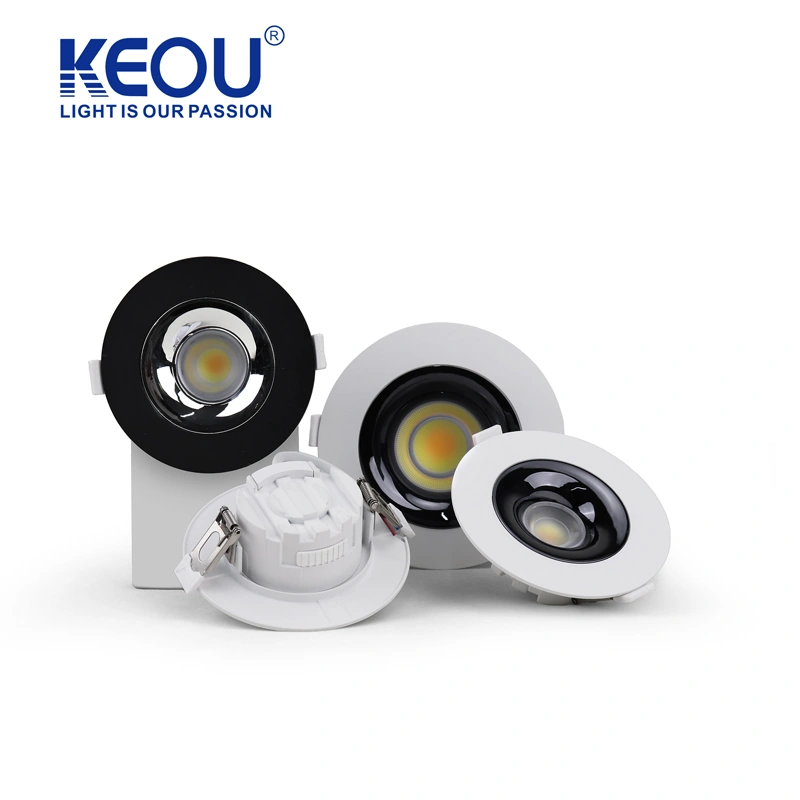
First, architectural form factors — trimless plaster-in and deep-recess anti-glare — are moving from premium specification into mid-market ranges. Second, warm colour temperature and high colour rendering are being written into hospitality, retail and residential retrofit specifications rather than offered as upgrades. Third, control-layer expectations are migrating downward: DALI-2 and D4i data, sensor integration and dimming interoperability now appear on mainstream commercial SKUs that five years ago would have carried a phase-cut driver only.
These are observed directions, not measured market shares. No single dataset in this material establishes a 2027 share for any of them, and directional trade commentary should be read as a signal of where specification language is heading, not as a forecast with a confidence interval. Treat the direction as probable and the magnitude as unknown.
The trend that will filter suppliers is not aesthetic. It is evidentiary. The EU Ecodesign regulation for light sources already converted “good enough” into numbers: for in-scope LED and OLED mains light sources, the functional requirements in Table 4 of Regulation (EU) 2019/2020 set CRI ≥ 80, chromaticity variation within a six-step MacAdam ellipse, Pst LM ≤ 1.0 and SVM ≤ 0.4 at full load, alongside displacement factor, lumen maintenance and survival factor thresholds. Those apply from 1 September 2021 and remain the floor, not a differentiator.
The differentiator is whether a supplier can document thermal, surge and dimming behaviour at the level of the individual model. A Ra 80 line on a box is now a compliance statement. An ISTMT report at the fixture’s real operating point, a surge test naming its class and coupling mode, and a DALI product ID in a public database are evidence. In 2027 procurement, the second list is what separates suppliers.
The Four Parameters That Decide Whether a 2027 SKU Survives
Four engineering pillars carry most of the risk: the thermal path, colour fidelity beyond the Ra average, the surge immunity class, and flicker and dimming interoperability. Each is a system property of the assembled luminaire — housing plus board plus driver plus control gear — so a component label cannot settle any of them. The sections below take them in that order.
IEC 61000-4-5 surge test levels by installation class, with the peak short-circuit current each level produces into the 2 Ω differential-mode source. A datasheet kV figure is a test level selected for an installation class, not a continuous withstand rating. Source: IEC 61000-4-5 via EMC Fast Pass application note.
Thermal Architecture: Housing Material Is Only Half the Story
Heat leaves an LED through the die, the solder joint, the MCPCB, the thermal interface, the housing and finally the ambient air inside a ceiling void. Any weak link in that chain raises junction temperature, and junction temperature is what governs lumen depreciation. The PNNL lumen-maintenance analysis shows the expected maintenance of a single LED package diverging substantially with junction temperature, which is itself set by drive current, ambient and the thermal performance of the luminaire the package sits in.
LM-80 is the test method behind most lifetime claims, and its limits matter. It specifies operation at three case temperatures — 55 °C, 85 °C and one selected by the manufacturer — with case temperature held within ±2 °C, a minimum of 6,000 hours and data collected every 1,000 hours. It does not specify pass/fail criteria, curve fitting, extrapolation or an L70 prediction method. TM-21 supplies the projection, but the projection only transfers to a luminaire if the in-situ LED temperature sits within the range that was tested — which is what an In Situ Temperature Measurement Test (ISTMT) establishes. PNNL notes that manufacturers may or may not take that step.
So the material name is half the story. Die-cast aluminium gives a continuous conductive path and structural rigidity, but fin area, surface treatment, the contact between MCPCB and housing, and where the driver sits determine real performance. A plastic body with a well-designed aluminium heat spreader can outperform a poorly coupled die-cast shell.
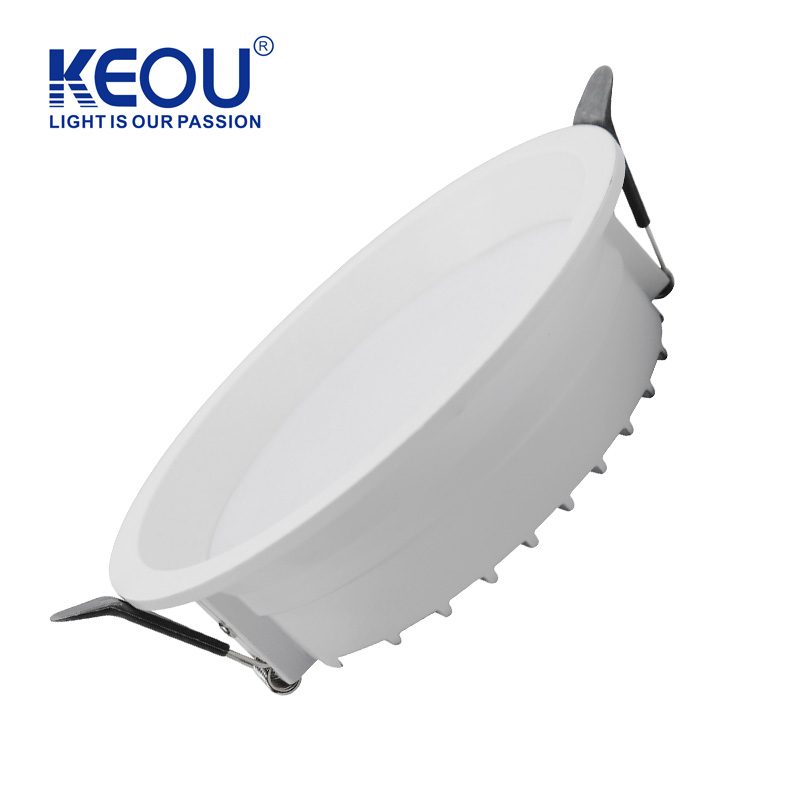
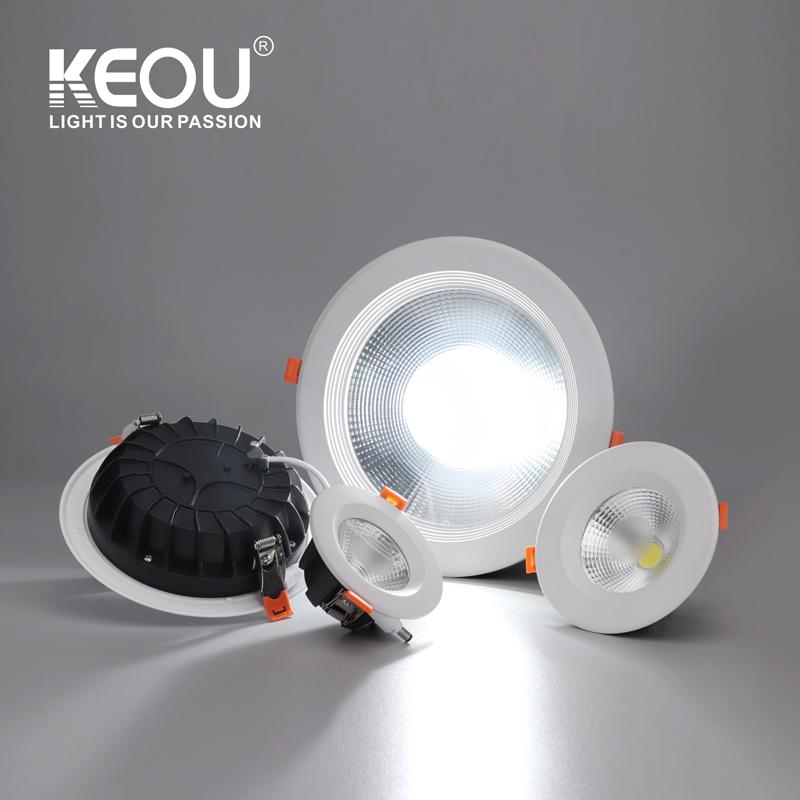
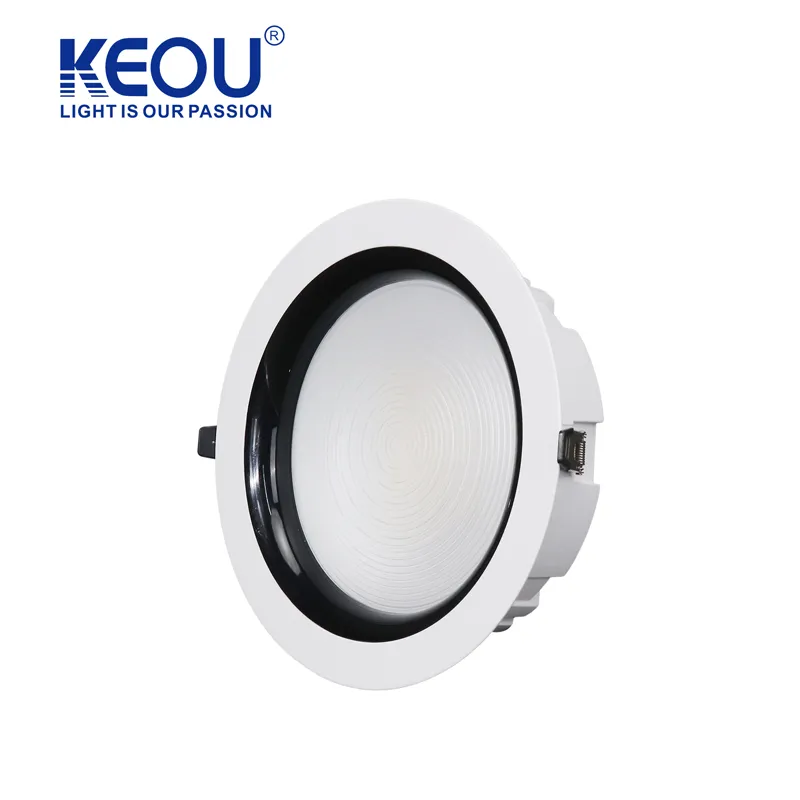
KEOU’s CrystalCore downlights use a die-cast aluminium base whose layered grooves are designed to double as heat-dissipation channels, positioned by the manufacturer as a larger dissipation area and slower temperature rise than conventional flat plastic bases. That is a design-intent and comparative-positioning claim, not a measured ΔT, and should be read as such.
What to request: an ISTMT or in-situ TMP measurement at the fixture’s rated ambient, the driver case temperature at that condition, and the LM-80 report’s tested case temperature set beside the fixture’s actual operating point. If the operating point sits above the tested range, the L70 figure does not transfer.
Color Fidelity: Why Ra 80 Is a Floor, Not a Specification
CRI (Ra) is an average fidelity score over eight pastel test samples. It says nothing about R9, the saturated-red sample that governs how meat, timber, skin and branded reds read in a retail or hospitality space. A fixture can clear Ra 80 comfortably and still render reds flatly.
TM-30 is the multi-measure alternative. Its Fidelity Index (Rf) describes average similarity to a reference and its Gamut Index (Rg) approximates average change in chroma; the DOE/LRC TM-30 tutorial records that the IES recommends lighting professionals transition to Rf, while the CIE stopped short of recommending Rf replace Ra for specifying and rating products. Both can sit in one specification without conflict.
The regulatory floor is separate. Regulation (EU) 2019/2020 requires CRI ≥ 80 for in-scope mains light sources, with an exemption where lighting standards allow CRI below 80 for outdoor, industrial or similar applications and a clear indication is shown on packaging and documentation. It also requires chromaticity variation within a six-step MacAdam ellipse.
A project specification should go further: Ra ≥ 90 with a declared R9 value, TM-30 Rf and Rg where the supplier offers them, and a 3-step or better MacAdam bin commitment per production batch rather than a single catalogue number. Warm CCT at high CRI is harder to achieve than 4000 K, so the warm-CCT trend raises the documentation bar rather than lowering it.
Surge Protection: What a kV Rating Actually Covers
A kV figure on a downlight datasheet is a test level, not a guarantee. IEC 61000-4-5 selects test levels by installation class, and the class table summarised in this application note runs from Class 1 at 500 V for a partially protected environment, through Class 2 at 1 kV where cabling is well separated and Class 3 at 2 kV where power and signal cables run in parallel, to Class 4 at 4 kV where interconnections include outdoor cables. The generator is a combination wave device: 1.2/50 µs open-circuit voltage, 8/20 µs short-circuit current, with a 2 Ω source impedance for differential-mode tests and 12 Ω for common mode.
Two consequences follow. A rating states that the fixture survived a defined waveform, at a defined coupling mode, under the test regime — it does not cover direct lightning, which is out of scope of the standard, nor repeated events beyond that regime. And the mode matters: L-N, L-PE and N-PE are different exposures. Field practice for outdoor installations is far harsher than a generic 2.5 kV figure implies; street-lighting guidance describes protection concepts built around 10 kV between L/N and earth and 6 kV between L and N for Protection Class I luminaires.
For unstable-grid export markets, the practical exposure is differential-mode switching transients and induced surges. KEOU’s CrystalCore series declares 2.5 kV surge protection plus a 1.5 kV dielectric withstand test, positioned for voltage-unstable regions. Read that as the product’s declared test level, and pair it with the question: 2.5 kV to which class, in which coupling mode, and is there a report?
Flicker and Dimming: The Interoperability Questions Buyers Forget
Flicker first. Regulation (EU) 2019/2020 caps Pst LM at ≤ 1.0 and SVM at ≤ 0.4 for in-scope LED and OLED mains light sources — but at full load. Complaints usually originate in the dimmed state, so ask for dimmed-level Pst and SVM figures, or at minimum a driver datasheet with the dimming curve and minimum dim level.
Dimming second. Phase-cut (leading or trailing edge, the territory of NEMA SSL 7A compatibility), 0/1-10V and DALI are different interfaces with different failure modes, and a fixture is only as interoperable as the driver behind it. For DALI, the certification distinction matters: DALI-2 certifies control gear and input devices through mandatory test sequences, while D4i extends DALI-2 with compulsory luminaire, energy and diagnostics data under IEC 62386 Parts 251–253 and integrated bus power under Part 250, as the DiiA D4i overview sets out. The DALI Product Database lets a buyer verify a claimed certification by product ID rather than trust a logo. Note also that 64 devices per line and 300 m of bus are design constraints of the installation, not product specifications.
Procurement ask: the certified product ID, the driver part number, and a mock-up dimming test on the control system that will actually be installed.
Reading a 2027 Datasheet: Marketing Language vs Engineering Evidence
The fastest way to separate a specification from a slogan is to read each claim as a question: what document would prove this, and does the supplier have it for this model? The table below maps the phrases that appear most often on 2027 downlight sheets to the evidence that should sit behind them, and what to do when it is missing.
| Datasheet phrase | Engineering evidence behind it | What to request |
|---|---|---|
| “Die-cast aluminium” | A described thermal path plus in-situ temperature data | ISTMT or TMP report at rated ambient; driver case temperature; LM-80 tested case temperature versus the fixture’s operating point |
| “High CRI” | Ra plus R9 plus a colour bin | Ra ≥ 90 with declared R9; TM-30 Rf/Rg if offered; 3-step MacAdam bin commitment per batch |
| “Surge protected 2.5 kV” | IEC 61000-4-5 class, coupling mode, test report | Report naming the class, the mode tested (L-N, L-PE, N-PE) and whether protection is built in or relies on external SPDs |
| “Flicker-free” | Pst LM and SVM at full and dimmed load | Dimmed-level Pst/SVM figures, or driver datasheet with dimming curve and minimum dim level |
| “DALI dimmable” | DALI-2 or D4i certification with a product ID | Product ID searchable in the DALI Product Database; driver part number |
| “50,000 hours” | LM-80 report plus TM-21 projection plus in-situ temperature within the tested range | LM-80 report, TM-21 projection, and evidence the in-situ LED temperature sits inside the tested set |
| “UGR < 19” | A standard-room value, not a universal property | The UGR table rather than a single figure; confirmation of the room dimensions and reflectances assumed |
EU Ecodesign flicker and stroboscopic-effect limits for in-scope LED and OLED mains light sources, measured at full load. Both apply from 1 September 2021 under Regulation (EU) 2019/2020, Annex II Table 4. The regulation sets no dimmed-level limit, which is why dimmed-state figures must be requested separately.
The last row deserves a note. A single UGR figure in a datasheet is not a product property that holds in every installation. As the ZVEI position paper on the UGR method explains, unless the manufacturer provides further information, a stated “UGR < 19” is the value the luminaire achieves in a standard room of 4H/8H with reflectances of floor 20%, walls 50% and ceiling 70%. In real applications, UGR values can be lower or higher. Ask for the table, not the badge.
When a supplier cannot produce the evidence in the right-hand column, the practical response is not to reject the product outright but to price the risk. An unverified 50,000-hour claim is a warranty exposure; an unverified surge rating is a field-failure exposure in exactly the markets where replacement labour costs more than the fixture.
Compliance and Tender Questions to Settle Before a 2027 Submission
Compliance questions are cheapest to settle before a tender is submitted and most expensive after a customs hold. Organise them by category and put them to the supplier in writing.
Safety and construction. Request IEC 60598-1 and IEC 60598-2-2 (recessed luminaires) test reports from an accredited laboratory. The SASO IECEE scheme lists both standards among those it recognises for lighting, which makes them a useful common baseline across destinations. Match the IP rating to the actual location under IEC 60529 — IP20 is normal for a dry ceiling void, higher where moisture is present — and add an IK rating under IEC 62262 where impact is a risk. Note that IK11, at 50 J, was added to the IK scale in 2021.
Ecodesign. Confirm the SKU is in scope as a mains light source, and that CRI, displacement factor, lumen maintenance, survival factor, colour consistency, Pst LM and SVM are met and declared on the packaging and documentation as the regulation requires. The European Commission product page for light sources is a reasonable starting point for the applicable regulations and labels.
Market access. Name the scheme per destination and require the certificate to match the exact model, not the family. For the UAE, that means the Emirates Conformity Assessment Scheme alongside the energy-efficiency labelling requirements; for Saudi Arabia, the SASO/IECEE route above. A family certificate covering a 15 W model does not automatically cover the 7 W variant if the driver differs.
Control. DALI-2 or D4i certification IDs, plus a written dimming compatibility statement naming the drivers and controllers that were actually tested together.
Warranty and after-sales. Establish what the warranty covers — driver, LED module, or both — the operating-hours assumption behind a fixed time period, and the failure-claim process. A warranty that replaces the unit but not the access equipment to swap it is a different commercial proposition from one that does.
Building a 2027 Downlight Portfolio: A Distributor’s SKU Logic
The portfolio question is not which single downlight to stock but how many tiers the local market will actually absorb. Three tiers cover most commercial demand, and the boundaries between them should be drawn by evidence, not by price alone.
Tier 1 — volume workhorse. Fixed CCT or 3-CCT switchable, Ra 80, a standard surge class, phase-cut or 0/1-10V dimming, IP20, lowest landed cost. This tier wins on price and availability, and its documentation burden is the regulatory minimum.
Tier 2 — project mid-tier. Ra 90 with a declared R9, a higher surge class, DALI-2 dimming, tighter MacAdam binning, and trimless or deep-recess options. This is where most hotel, retail and office fit-out specifications land.
Tier 3 — specification tier. D4i data capability, TM-30 documentation, in-situ thermal data available on request, and an extended warranty. Few projects need it; the ones that do will not accept a substitute.
The inventory logic behind 3-CCT switchable SKUs is straightforward: one SKU covers three colour-temperature demands, so stock depth falls without cutting the addressable specification. KEOU’s CrystalCore range uses a side-mounted DIP switch for CW/WW/NW selection rather than a rear-mounted one, which keeps the switch off the visible light-emitting face — a first-party design point, and the reason the range can be positioned as one SKU covering three CCT demands.
Two cautions. First, trimless is the most cycle-prone element in the portfolio; over-indexing on it before the local ceiling-trade skill base supports clean plaster-in installation produces callbacks that erase the margin. Second, thin housings are a landed-cost lever as much as a design choice. KEOU’s 10 W CrystalCore body is 35 mm high, and the manufacturer positions the reduced unit volume as allowing more units per carton and per container — a freight argument, stated as the product’s design fact rather than a guaranteed saving.
How the tiers are weighted depends on market and project mix. A distributor serving mainly residential retrofit will skew heavily to Tier 1; one serving hotel and retail fit-out will find Tier 2 carries the margin.
Is the Trimless, Warm-CCT, High-CRI Direction Durable?
Partly, and the parts differ in kind.
High CRI is the most durable element because it is anchored in regulation as well as preference. CRI ≥ 80 is a legal floor for in-scope mains light sources in the EU, and the hospitality and retail demand for Ra 90 with a real R9 value is a documented occupant expectation rather than a fashion. Warm CCT is similarly stable: 2700–3000 K has been the default architectural preference in hospitality and residential interiors for decades, and nothing in the current material suggests it is about to reverse.
Trimless is the cycle-prone element. It is tied to interior design fashion on one side and to installation labour skill on the other, and both move faster than LED technology does. Treat trimless as a form-factor bet, not a technology bet.
The hedge is to specify photometric and electrical performance independently of the form factor. If the tender fixes the thermal evidence, the colour metrics, the surge class and the control interface, then a change in ceiling fashion strands the trim, not the investment. A distributor who has documented the electrical and optical case can re-house the same platform in a different bezel when the interior trend moves.
Which returns to the article’s core position: in 2027 the suppliers who win will be the ones whose datasheets survive a procurement audit. Aesthetic direction will keep moving. The evidence behind a fixture either exists at the model level or it does not.
Conclusion
The 2027 downlight trend worth planning around is not a look. It is the shift from feature claims to verifiable parameters: thermal data measured at the operating point, color fidelity that goes beyond a single Ra number, a surge rating that names its class and coupling mode, and a control interface you can look up in a certification database.
Before you discuss price on your next supplier conversation, request four documents. First, the LM-80 report together with ISTMT or in-situ temperature data showing the LED operates within the tested case temperature. Second, a TM-30 report or, at minimum, a declared R9 value alongside Ra. Third, an IEC 61000-4-5 test report stating the class and the coupling modes covered. Fourth, the DALI-2 or D4i product ID, if the SKU claims a certified control interface.
A supplier who can produce these four quickly is telling you something about how the rest of the file is maintained. A supplier who cannot is asking you to carry that risk into a five-year project.
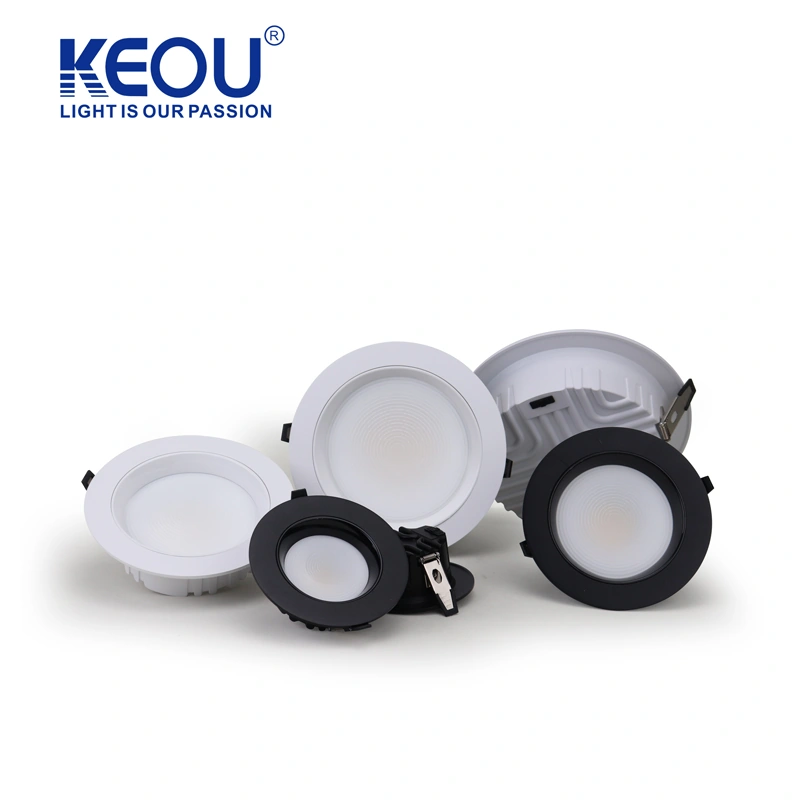
Where a project needs samples before commitment, KEOU Lighting supplies sample units, quotations and catalogs on request through its business contact. Its CrystalCore downlight series documents die-cast aluminum construction with grooved heat-dissipation channels, 2.5 kV surge protection with 1.5 kV dielectric withstand, and side-switch 3-CCT selection (3000K / 4000K / 6500K) in a 35 mm body — product context for evaluation, not a performance guarantee. Verify each parameter against the test documentation for the exact model you intend to order.
FAQ
Is a 2.5 kV surge rating enough for unstable-grid markets?
It depends on the installation class and the coupling mode, not on the number alone. A 2.5 kV declaration tells you the fixture survived a defined IEC 61000-4-5 waveform at a defined coupling mode. Ask which class it was tested to, whether L-N, L-PE and N-PE were covered, and whether a test report exists. Where Class 4 exposure applies — interconnections that include outdoor cabling — consider external SPDs as well.
Does Ra 80 meet EU requirements?
For in-scope mains light sources, yes: CRI ≥ 80 is the regulatory floor under Regulation (EU) 2019/2020, with an exemption for outdoor and industrial applications where lighting standards permit lower CRI and the packaging says so. Project specifications in retail, hospitality and residential work commonly call for Ra 90 plus a declared R9.
Can I trust a “50,000-hour” lifetime claim?
Only with three things: an LM-80 report, a TM-21 projection from that data, and evidence that the in-situ LED temperature sits within the tested range. LM-80 itself specifies no pass/fail criteria and no extrapolation method, so the report alone does not produce a lifetime figure.
What is the difference between DALI-2 and D4i?
D4i is an extension of DALI-2 certification with a compulsory feature set: every D4i driver provides luminaire, energy and diagnostics data (IEC 62386 Parts 251–253) and an integrated bus power supply (Part 250). DALI-2 certification covers control gear and input devices through mandatory test sequences; D4i adds the data layer on top.
Is a single UGR value a product property?
No. Unless the manufacturer states otherwise, a datasheet figure such as “UGR < 19” is the value the luminaire achieves in a standard room of 4H/8H with reflectances of 20% floor, 50% walls and 70% ceiling. In real installations the UGR can be lower or higher.
Does die-cast aluminum always beat plastic?
No. Die-cast aluminum offers a continuous conductive path and structural rigidity, but heat-sink geometry, surface treatment, the contact between MCPCB and housing, and driver placement determine real thermal performance. A plastic housing with a well-coupled aluminum heat spreader can outperform a poorly coupled die-cast body.