Walk into any lighting showroom this year and the spotlights barely look like spotlights. The visible lamp is gone. What’s left is a thin dark line across the ceiling, or a small square aperture you have to hunt for, or a magnet that lets the client move a light three feet to the left after the sofa has arrived.
That shift is worth taking seriously, because it isn’t only cosmetic. Over the past decade the LED spotlight has been redesigned twice at once — once in how it looks and gets installed, and once in what it can actually do after installation. The first redesign changed the ceiling. The second changed the conversation between the fixture, the room and the person controlling it.
This guide is about both, and about where they’re headed next. It treats in its practical sense: directional LED spotlights for accent, display and task lighting — recessed adjustable heads, surface-mounted spots, and track heads sold as spotlights rather than as bare track fittings. Floodlights and track-only heads sold without a spotlight optic sit outside this scope, because their design logic runs differently.
The argument here is simpler than a procurement checklist. Design trends make the fixture disappear into architecture and make the lighting itself adjustable. Feature trends put more of that adjustment into controls — dimming, colour temperature, sensors, data. The interesting part is what happens where the two meet: a fixture small enough to vanish, doing something the previous generation physically couldn’t.
Two Lines of Development Running at Once
It helps to separate the physical from the behavioural, because they show up in the same product photos and get confused constantly.
The physical line is about the object. Housings shrink, trims disappear, the LED sits further behind a baffle, and the mounting system becomes a rail instead of a hole in the ceiling. The Guangzhou International Lighting Exhibition’s 2027 framing leans mostly on the other line — an “AI lighting ecosystem” of algorithms, sensors, smart drivers and building platforms — while B2B sourcing commentary points to museums and galleries pulling modular track systems, adjustable heads and tightly controlled beams. Read both as direction rather than measurement: they say what exhibitors plan to show and what buyers are asking about, not how many units move.
The behavioural line is about the light. The same fixture now dims to 1% without a visible flicker, walks from 2700K to 6500K, warms as it dims, notices an empty room, and knows how many hours it has run. A decade ago the design brief was simply to get a clean beam out of an LED. That was the whole job.
The two lines reinforce each other in a specific way. A fixture that disappears into the ceiling has nothing else to sell itself on, so it has to be optically excellent. That’s why the design story and the feature story keep landing on the same four specs: beam control, glare, colour and dimming quality.
How Spotlight Design Has Evolved, Generation by Generation
From exposed lamp to hidden source
The earliest LED spots made a virtue of visibility. You could see the chip, the reflector, the metal heatsink — the fixture announced itself. It was also a glare problem: a bare LED die at several thousand candelas per square metre, parked thirty centimetres from someone’s eyes, is unpleasant regardless of colour quality.
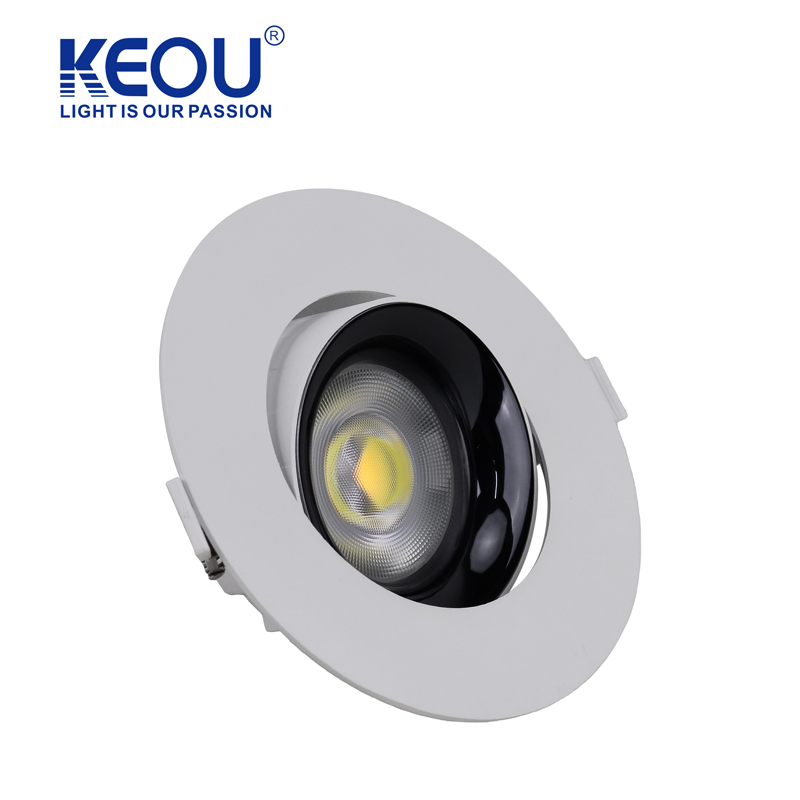
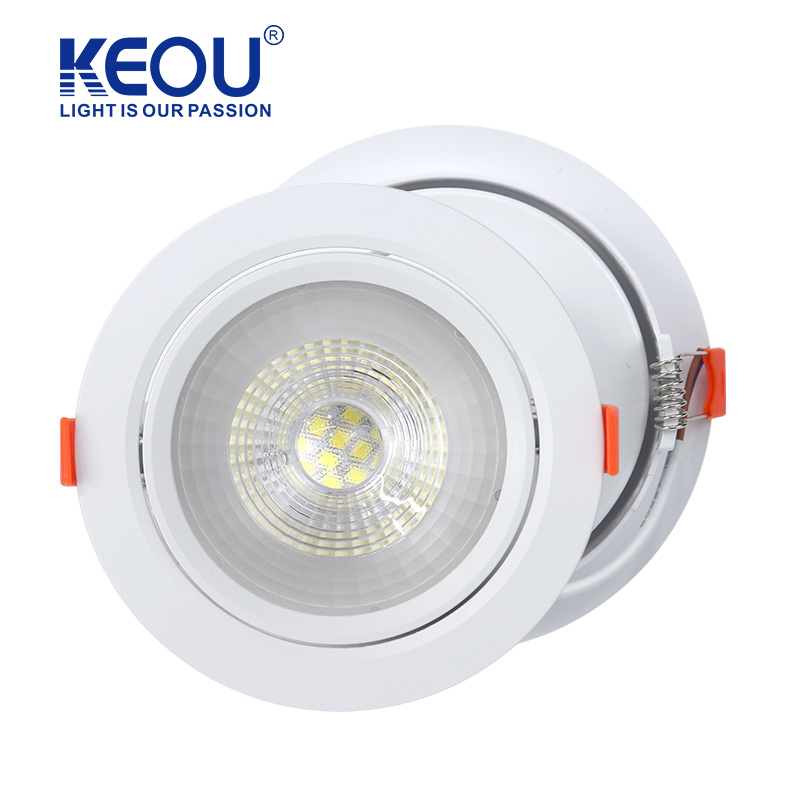
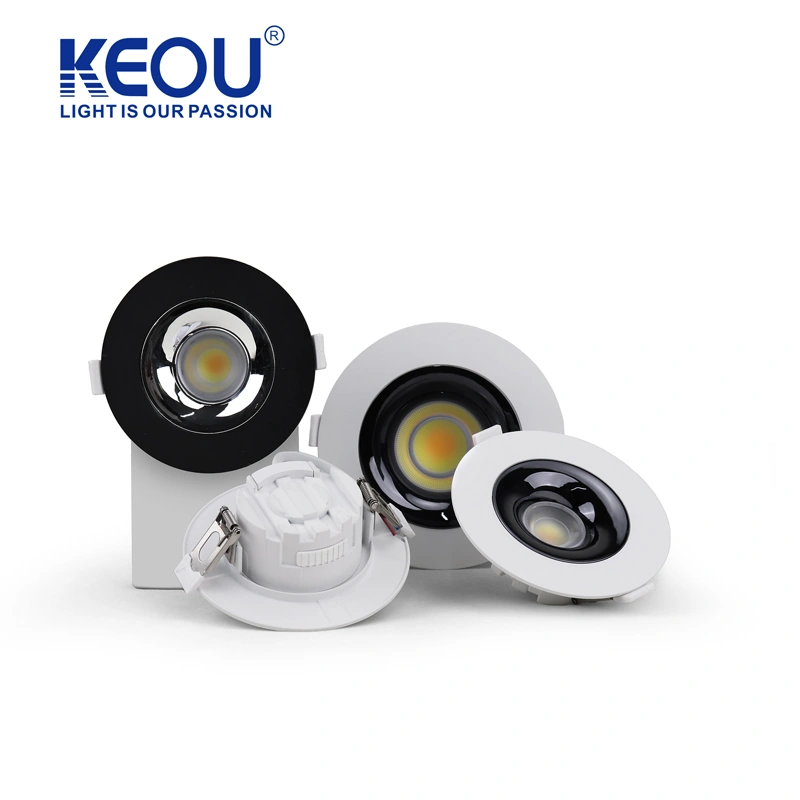
The correction was optical rather than electrical. Push the source back into a deep recess, surround it with a matte black baffle, and the direct view of the emitter disappears while the beam stays. Honeycomb and cross-blade louvers do the same job more aggressively, breaking the source into many small apertures below the eye’s discomfort threshold. KEOU builds this into its anti-glare range as a honeycomb element behind a toughened glass mask, and the effect is what you’d expect: at eye level the fitting reads as a dark disc, while the floor below stays bright.
That single change — hiding the source instead of dimming it — did more for comfort than a decade of diffuser films.
From hole in the ceiling to system on the ceiling
Recessed spots have one structural weakness: the ceiling has to be built around them. Move a display, redesign the floor plan, and the lighting no longer fits.
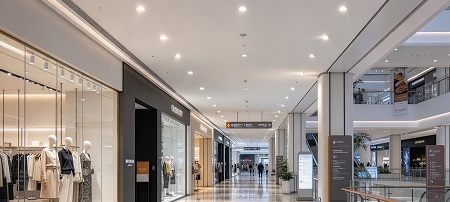
Trimless and plaster-in versions push the design further toward invisibility — only the aperture remains, flush with the plasterboard, and the ceiling reads as a continuous plane. Small-aperture fittings, often with cut-outs under about 55 mm, take the same idea into corridors and niches where a standard downlight would feel clumsy.
Track-based systems went the other way and made the ceiling a platform instead of a fixed layout. The 48 V magnetic rail is the current form of that idea: low-voltage modules clip onto the rail and slide, so a gallery can re-aim for a new exhibition without an electrician. Hybrid rails now carry spots, linear modules, wall-washers and pendants on one infrastructure, which is why the same fitting family can handle ambient, task and accent duty from a single line.
The trade-off is honest. Magnetic systems usually lock you into one manufacturer’s modules, drivers and accessories, because the mechanical and electrical interface isn’t standardised across brands. A ceiling you can rearrange is a ceiling you can’t mix and match.

From one beam to an adjustable one
A fixed 36° beam used to be the safe default. Designers now ask for interchangeable lenses, roughly 15°–24° for artwork and merchandise, 36°–60° for general illumination, and cleaner beam edges with less spill. Adjustable heads — eyeball, gimbal, and the aimable recessed spots that make up most of the category — are now the norm rather than an upgrade, because a fixture you can aim is a fixture that survives a layout change.
Why the housing got smaller
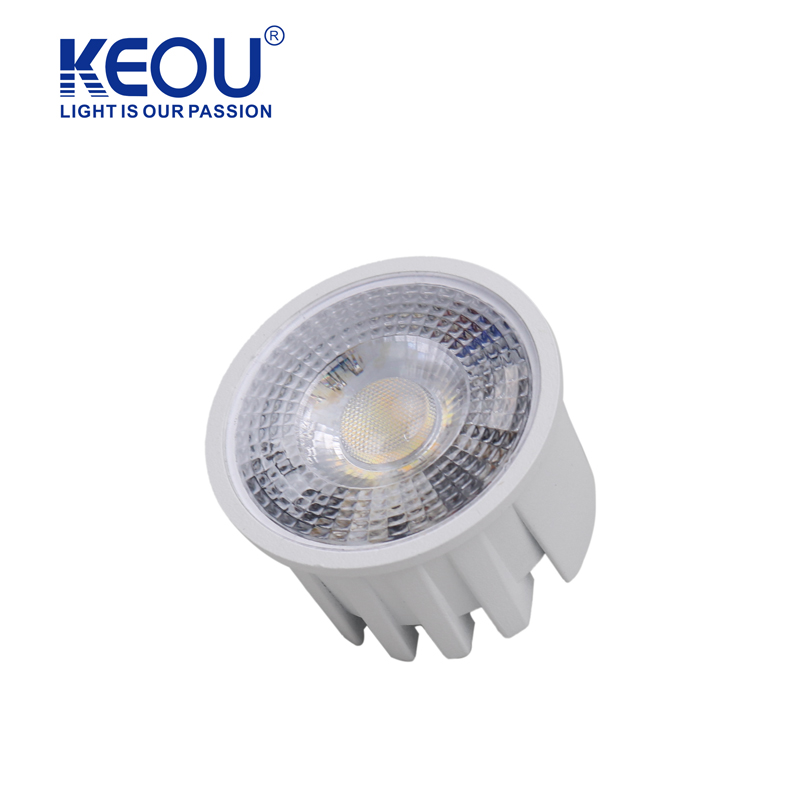
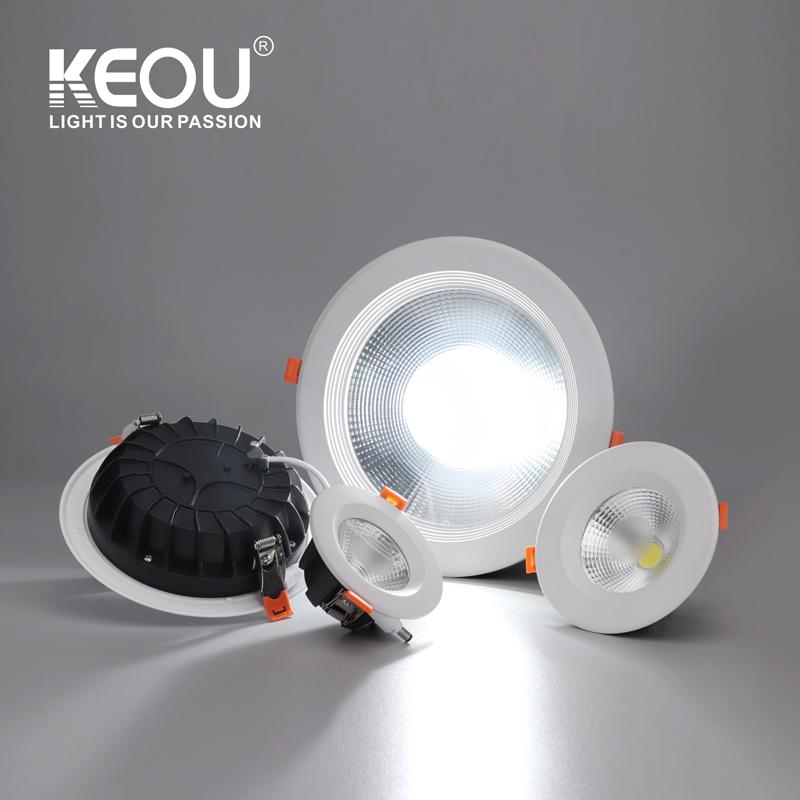
Smaller apertures didn’t come from aesthetics alone. COB packages concentrate the light source into one small emitting area, which lets a reflector produce a tight beam from a much shallower body. Die-cast aluminium housings and aviation-grade castings then handle the heat in that compressed volume. KEOU’s stated approach — COB-based in-house designs, precision die-cast aluminium, toughened glass front — is a fairly typical expression of where this generation has landed. The fixture shrinks; the thermal and optical work moves into the parts you can’t see.
How Spotlight Features Have Evolved
Design changed what the fitting looks like. Features changed what it can promise after the ceiling is closed.
Dimming got smoother, not just possible
The first dimmable LED spots dimmed, but badly: a dead zone at the bottom, a visible step, a buzz, and a hard floor around 20–30% output. The fix came in two layers — high-frequency, constant-current drivers that avoid visible modulation, and driver-dimmer compatibility that’s actually been tested rather than assumed. Dimming to 1% with a clean curve is now a normal expectation in hospitality and residential work, not a special order.
Phase-cut dimming hasn’t gone away, and it shouldn’t. Where existing mains wiring has to be reused, a trailing-edge (ELV) dimmer remains the pragmatic choice, provided the specific driver is on the dimmer maker’s compatibility list. That last condition is where most retrofit projects still fail.
Colour temperature became a control, then a schedule
Field-switchable CCT was the first step: pick 3000K, 4000K or 6500K at installation and never touch it again. Next came tunable white, where CCT and brightness are set independently — cooler through the working day, warmer in the evening. DALI-2 Device Type 8, standardised in IEC 62386-209, handles colour control through a single address per fixture, which matters once a project has dozens of spots.
Then there’s dim-to-warm, which does something subtler: as brightness falls, the light shifts warmer, imitating the behaviour of a halogen lamp. Restaurants and residential interiors have adopted it faster than tunable white, because it doesn’t need commissioning or a scene controller — it just behaves like a light people already liked.
Sensors and networks moved into the driver
Occupancy sensing and daylight harvesting used to be separate ceiling devices wired back to a panel. They now sit in or alongside the driver, which changes how a spotlight behaves: it can hold an area at a set illuminance, drop to a standby level when empty, and ramp up before anyone notices a change.
Wireless control — Bluetooth Mesh, Zigbee, and increasingly Matter — is moving the same capability into retrofit projects that can’t run a control bus. The catch is ecosystem lock-in again, and reliability questions in large installations, which is why wired DALI still wins in buildings where per-fixture control and diagnostics matter.
The comparison that actually matters
| Approach | What it lets you do | Where it fits | What to watch |
|---|---|---|---|
| TRIAC / trailing-edge | Dim on existing wall dimmers, cheapest to install | Small retrofits, residential | Dimmer-driver compatibility; low-end stability |
| 0–10V | Zone dimming across a group of fixtures | Offices, retail floors, warehouses | Separate control wiring; one-way only |
| DALI-2 (DT6 / DT8) | Address each fixture, scenes, tunable white | Galleries, hospitality, higher-end commercial | Commissioning effort and cost |
| DALI-2 + D4i | Per-fixture energy, hours, temperature, diagnostics | Buildings with energy reporting or maintenance contracts | Value only if the building system reads the data |
| Wireless mesh | Control without new wiring | Retrofits, residential, small commercial | Vendor lock-in, network robustness |
| Tunable white / dim-to-warm | Change CCT by scene or by dim level | Retail, hospitality, residential, museums | Colour consistency across fixtures |
None of these is a 2027 novelty in itself. What’s new is the price point and the physical integration — the control electronics now fit inside a spotlight that’s smaller than the one it replaced, which is why the feature list that used to belong to a downlight project now shows up on a spec sheet for a 50 mm aperture.

Dimming Quality Is Now the Real Test of a Driver
The most consequential feature change of the past five years isn’t a new control protocol — it’s that dimming stopped being a checkbox and became a quality question. Any driver can dim. Few dim well.
The visible symptom is flicker, and it gets worse at low output, which is exactly where hospitality, museums and residential interiors spend most of their evening hours. The technical fix is a high-frequency constant-current driver with stable modulation depth; the cheap alternative is PWM at a low switching frequency, which looks fine on a datasheet and reads as a shimmer on a phone camera.
There are two useful yardsticks for judging how bad it gets. Under EU ecodesign rules, flicker measured as Pst LM must stay at or below 1.0 at full load, and the stroboscopic effect measured as SVM at or below 0.4 at full load — with exemptions for certain high-flux HID sources and for sources in applications where lighting standards allow CRI below 80. The Commission Regulation (EU) 2019/2020 defines both: Pst LM = 1 is where the average observer has a 50% chance of detecting flicker, and SVM = 1 is the visibility threshold.
The IEEE 1789-2015 recommended practice comes at it from a health angle instead. Its screening method: check that flicker frequency is at least 100 Hz, measure percent flicker, then multiply frequency by 0.08 and round up. If the measured percent flicker sits below that ceiling, the product is acceptable for all but unusually sensitive people. At 120 Hz the ceiling is 10%; at 1250 Hz and above, 100% flicker passes. Special populations get a stricter 0.0333 multiplier.
These aren’t the same test, and a fixture can pass one while looking shaky under the other. What they share is what a buyer should be asking for: flicker figures at several dim levels, not just at full output. A driver that holds Pst LM and SVM in spec at 10% dim is a different class of component from one that only manages it at 100%.
The quick field check remains the waving hand or a phone camera on a dimmed sample in a dark room, which catches the gross offenders. A handheld flicker meter rated to at least 2,000 Hz catches the rest — though ambient light from windows or nearby fixtures will skew readings, so keep the test in controlled conditions.
Colour Went from a Number to a Set of Numbers
For years “CRI 80” closed the conversation. It doesn’t any more, and the reason is that one index can’t describe what a spotlight does to a red handbag, a piece of oak, or a face.
The pragmatic baseline for accent and display work has moved to Ra ≥ 90 with R9 ≥ 50 — R9 being the deep-red sample that CRI’s average quietly hides. Above that sits TM-30, which splits colour fidelity (Rf) from gamut (Rg) and averages across 99 evaluation samples rather than 8 or 15. LightNOW’s review of colour rendering metrics makes the case that TM-30 gives a fuller picture for architectural specification. The IES TM-30 documentation is careful to add that fidelity, vividness and preference are different design intents calling for different metric combinations — the method isn’t a verdict, it’s a vocabulary.
Consistency is the half of the story that gets skipped. A spot wall-washing a gallery needs every unit to look identical, and the MacAdam ellipse (SDCM) is how far a production unit can drift from its declared chromaticity point. As Professional Electrician’s explainer puts it, tighter bins buy near-identical LEDs at higher cost — that’s the trade. EU ecodesign already caps LED light sources at six MacAdam steps, so six-step is a floor rather than a feature worth advertising.
Where this lands in practice: premium retail, museum and hospitality spotlights increasingly ship at three-step binning with TM-30 data attached, because the merchandise is the point. General commercial work is fine at six-step with Ra ≥ 80, and paying for TM-30 data a project will never open is money spent on a PDF.
Switchable CCT Quietly Changed the SKU Map
The least glamorous feature trend turns out to be one of the most useful: a fixture that offers 3000K, 4000K and 6500K from one housing lets a distributor carry one order code where three used to sit.
KEOU’s CrystalCore family illustrates the pattern: a side-mounted DIP switch selects CW, WW or NW (3000K, 4000K, 6500K) on a single fixture, positioned so the switch does not intrude on the light-emitting face. The stated intent is inventory relief — one model covering three colour temperatures. The same family lists AC110–265V input, die-cast aluminium construction, Ra 80, and 2.5 kV surge protection with 1.5 kV dielectric withstand, with a 3-year warranty. Those are the manufacturer’s stated specifications for that product line; they are not a claim about the whole spotlight category.
The inventory logic is worth spelling out. If a distributor historically carried three CCT variants at 100 units each to hold a 95% service level, a switchable fixture can hold the same service level with a single pool sized closer to the combined demand plus safety stock — because demand variability across CCTs partially offsets when pooled. The saving is not just shelf space; it is the working capital tied up in slow-moving warm-white stock while neutral-white sells out.
Two cautions keep this honest. First, switchable CCT creates a compliance question: EU rules define “reference control settings” as the factory-default state a user encounters at first installation, and require compliance information to be reported at those settings, with a range of obtainable values optionally indicated. A buyer sourcing switchable fixtures for the EU must confirm which CCT is the declared reference setting and that packaging reflects it. Second, switchable-white sources that only shift CCT within the regulated white range are explicitly not treated as colour-tuneable light sources under EU 2019/2020 — a useful clarification, but one that puts the labelling burden on getting the reference setting right.
The practical questions are narrower than they look. How many positions, at which exact CCT values, which one is the factory default, and does the flux and CRI declaration hold at all three positions or only at the default? A switchable fixture on which only one setting meets the catalogue numbers is doing less work than the marketing implies.
Glare Control Is a Design Decision, Not a Datasheet Line
If there’s one place where the design evolution and the marketing language part company, it’s glare. A line reading “UGR < 19” looks like a property of the fixture. It isn’t.
The ZVEI position paper on the UGR method is blunt about this: unless the manufacturer provides further information, a published UGR value is what the luminaire achieves in a standard room with dimensions 4H/8H and reflectances of 20% floor, 50% walls and 70% ceiling. In real applications, UGR values can be lower or higher. The paper notes that in industrial halls with dark ceilings below 30% reflectance, the tabular method is not applicable at all, and that a luminaire with a low glare rating in the office standard room can present a larger UGR in a hall with different geometry.
For spotlights, the practical consequence is that glare control is a design-and-optic question, not a single number. Deep recessing, honeycomb or cross-blade anti-glare accessories, and controlled beam distribution do the work; the UGR figure is a room-dependent outcome. EN 12464-1 sets the application limits — for offices, a maximum UGR of 19 is commonly cited — but the limit belongs to the installation, not the box.
What matters instead is the geometry that produces comfort: beam angle, peak intensity, luminance above 65° from nadir, and whether the anti-glare accessory is a standard part or an add-on. Those are the numbers that let you predict how a room will feel before it’s built.
Data-Capable Drivers: Useful, Sometimes Overkill
The ecosystem narrative is the loudest part of the trend talk, and the least relevant to a fitting you’re choosing for a corridor. The part that does matter is narrower: whether the driver can report on itself.
The DALI Alliance draws a clear line. DALI-2 certification treats the data specifications — Part 251 (luminaire data), Part 252 (energy reporting) and Part 253 (diagnostics and maintenance) — as optional. D4i certification makes all three mandatory, along with an integrated bus power supply under Part 250. In practice, a D4i driver can report luminaire identity, CCT and CRI, energy use, operating hours, temperature and failure counters to a lighting network — the raw material for asset management and predictive maintenance.
That’s a real capability, but it only pays off where the building actually reads the data. In a general commercial fit-out, D4i adds driver cost nobody recovers. Where an energy-reporting obligation or a maintenance contract sits in the brief, it’s the difference between a submittal that passes and one that comes back.
Under DALI-2, the three data parts — Part 251 for luminaire data, Part 252 for energy reporting, Part 253 for diagnostics and maintenance — are each optional, so “DALI-2 certified” alone says very little. Ask which parts, not whether. D4i is the version worth insisting on when data is genuinely part of the scope.
The Unglamorous Constraint: Voltage and Certification
None of the above travels without a certificate and a compatible supply. That’s not a trend in any interesting sense, but it sets the boundary on where a design or feature can be sold at all.
In Great Britain, the picture has simplified: legislation in force from 1 October 2024 continued recognition of CE marking, and businesses can choose UKCA or CE marking to place goods on the GB market, provided the product complies with GB ecodesign requirements. The UK government guidance confirms this flexibility. For the EU, CE marking under the applicable directives and the 2019/2020 and 2019/2015 ecodesign and energy-labelling rules remains the gate.
North America runs a different stack. UL 1598 covers luminaires for non-hazardous locations on branch circuits of 600 V nominal or less, and UL 8750 supplements it for LED equipment. On the EMC side, FCC Part 15 Subpart B governs unintentional radiators, with conducted and radiated emission limits and equipment-authorisation procedures. Canada layers ICES-005 for lighting equipment on top.
Voltage architecture then multiplies the problem, because a fixture built for 220–240 V can’t simply be shipped into a 120 V market. This is where a wide-input driver earns its premium. The 100–277 V range lets one housing serve European and North American projects, collapsing two SKU families into one — at a cost, and with its own certification consequences for whichever market it lands in. The alternative, holding regional 220–240 V and 120 V variants, is simpler to certify and harder to stock.
Worth noting too that the same logic applies to checkable numbers generally. A trend becomes a purchasing decision at the moment it has a figure a supplier can declare and a sample can confirm. Until then it stays a design conversation, which is where most of the interesting ideas above still live.
Where Design and Features Converge
Pull the threads together and a pattern shows up. The design evolution bought invisibility and flexibility. The feature evolution bought control and honesty about what the light is doing. Neither is much use on its own — a trimless aperture with a driver that flickers at 15% is a bad fitting in a good hole.
| Development | What changed | What it’s worth in a room |
|---|---|---|
| Deep-set optics and baffles | The emitter is hidden; the beam isn’t | Comfortable at eye level without losing punch |
| Trimless and small-aperture forms | The fixture stops reading as a fixture | Clean ceilings in galleries, hospitality, homes |
| Magnetic and hybrid track | Layout becomes reconfigurable | Retail and exhibitions that change seasonally |
| Interchangeable optics | Beam angle becomes a design variable | One family covers artwork and general light |
| Low-flicker drivers | Dimming stays clean to 1% | Evening scenes, camera-friendly spaces |
| Tunable white and dim-to-warm | CCT becomes a setting, not a purchase | Day-to-night shifts; restaurant warmth |
| Embedded sensing | The light responds to the room | Energy savings without a separate control layer |
| D4i reporting | The fixture becomes a data point | Maintenance and energy reporting in large buildings |
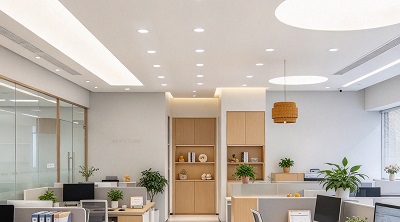
The most capable 2027 spotlights sit at the intersection: a 50 mm aperture, honeycomb-glare optics, tunable white on a single DT8 address, and a driver that holds its numbers at 10% dim. KEOU’s development direction points the same way — COB-based in-house designs, anti-glare structures behind toughened glass, die-cast aluminium bodies, and switchable CCT on one housing, with customisation offered across the range rather than as a one-off.
What to Watch Next
The clearest way to summarise 2027 is that the spotlight is becoming architecture at one end and electronics at the other. The aperture keeps shrinking, the rail keeps replacing the hole, and the driver keeps absorbing more of the intelligence that used to live in a control panel.
For specifiers and brands alike, three things follow. Choose the physical system — optical architecture, mounting, beam flexibility — before the control system, because the ceiling is the part you can’t change later. Then judge the feature set by what the room will actually use: flicker performance at low dim, colour consistency across the run, CCT flexibility where the space changes purpose. And keep an eye on the crossover points, where sensing and data reporting start to appear on fixtures small enough to disappear.
Ask any spotlight what it does at 10% brightness and how it behaves after three years of dust, and you’ll learn more than a page of trend language will tell you.
FAQ
What’s the biggest change in spotlight design? The light source is no longer visible. Deep recessing, baffles and honeycomb louvers hide the emitter, and trimless or magnetic-track mounting removes the fixture from the ceiling’s visual language.
Why did spotlights get so small? COB packages concentrate the emitter into a small area, so a shallow reflector can still produce a narrow beam. Better thermal design in die-cast aluminium bodies made the smaller housing workable.
What does tunable white actually change for a room? It turns CCT into a setting rather than a purchasing decision — cooler in the morning, warmer at night, or a fixed scene per zone. Dim-to-warm does a simpler version of the same thing with no commissioning.
Is “UGR < 19” a property of the spotlight? No. It’s a standard-room result with defined dimensions and reflectances. Ask for the luminance above 65° from nadir instead; installed UGR depends on the actual space.
Does switchable CCT really help inventory? Yes, if the flux and CRI figures hold at every position and the factory default is clearly labelled. Otherwise the flexibility is cosmetic.
Do I need D4i on a spotlight? Only where the building reads energy, hours or diagnostic data. For general commercial work, DALI-2 dimming without the data parts is usually enough.
Can one fixture serve both EU and North American projects? With a 100–277 V wide-input driver and separate certification for each market. Voltage range alone doesn’t make a fixture sellable across regimes.