2027 is the year commercial panel specification stops being a wattage conversation. Two dated rules set the calendar: the DesignLights Consortium will delist products not qualified under SSL V6.0 on December 15, 2026, and Wisconsin’s Focus on Energy program requires V6.0 listings for DLC-qualified rebates from January 1, 2027. By the time a 2027 project is tendered, the wattage figure on the box will be the least informative line on the spec sheet.
What replaces it is a set of questions a distributor, contractor or procurement team can actually check: how many delivered lumens the panel produces at the specified CCT, whether it is genuinely controls-ready, how it manages glare and flicker, and whether its driver and LED board can be replaced without scrapping the housing. This article works through those questions across function, form factor and wattage, and closes with a tier structure and procurement checklist for planning a 2027 range.
Why 2027 Is a Specification Reset, Not a Style Cycle
The DLC released the combined SSL V6.0 and LUNA V2.0 technical requirements on November 3, 2025, with a table update in April 2026. The transition schedule is fixed: the DLC stopped accepting new V5.1 applications on April 20, 2026, October 9, 2026 was the last date to submit updates moving V5.1 products to V6.0, and products not qualified under V6.0 are delisted effective December 15, 2026.
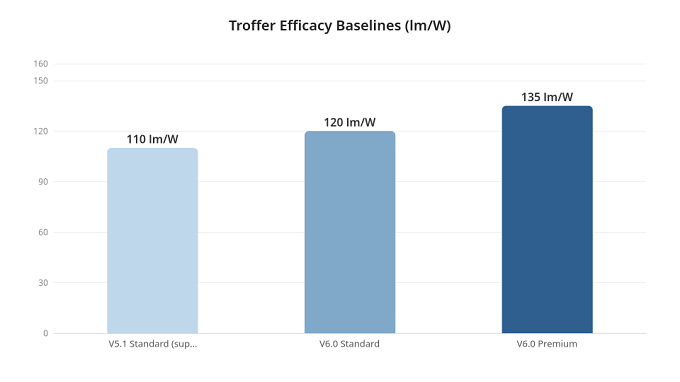
DLC Standard efficacy baselines for Troffer Luminaires (Ambient Lighting, 2×2 / 1×4 / 2×4), before applicable allowances. Efficacy is measured luminaire lumens divided by input watts. Allowances (e.g. warm CCT, high colour rendition, corrected UGR < 16.0) reduce the required value. V5.1 Standard is superseded; V6.0 Standard applies to listings from the V6.0 transition. Source: DLC SSL V6.0 & LUNA V2.0 Technical Requirements Tables (released 3 Nov 2025, updated 15 Apr 2026); V5.1 figure via Bees Lighting trade summary — confirm against the DLC TRT before publishing.
For troffers, the Standard efficacy baseline rises from 110 lm/W under V5.1 to 120 lm/W under V6.0, with a Premium baseline of 135 lm/W. That is a threshold change, not a marketing refresh: a panel that sat comfortably above the old line can fall below the new one without any change to its design.
Focus on Energy adds a program-level deadline. From January 1, 2027, lighting products needing DLC qualification must be listed under V6.0 to be eligible for its rebates. Products listed under V5.0 or V5.1 may still qualify in narrow cases: installations completed in 2026 with applications submitted by January 31, 2027, or units purchased in 2026 and installed in 2027 with applications within 60 days of installation and no later than June 30, 2027, with proof of purchase.
Keep the scope precise. A DLC listing does not guarantee a rebate. The DLC states that listing is required for eligibility for roughly 75% of North American programs, but each utility sets its own eligibility rules and grace periods. Separately, the EU ecodesign regulation 2019/2020 sets flicker limits of Pst LM ≤ 1.0 and SVM ≤ 0.4 at full load for mains light sources, giving buyers outside North America a parallel quality floor to specify against.
Function: What a 2027 Panel Is Expected to Do
Compliance is the floor, not the job description. A 2027 panel is expected to meet four functional duties, and each one maps onto the basic, project and premium tiers set out later in this article.
Efficacy Is Now a Threshold, Not a Selling Point
At 120 lm/W Standard and 135 lm/W Premium for troffers, efficacy no longer separates one supplier from another; it decides whether a product is listed at all. The threshold applies to the listed configuration, not to a product family claim, so a datasheet headline for one model says nothing about a sibling variant.
Warm-CCT panels are not automatically non-compliant. The DLC efficacy allowances scale with colour temperature: 8% at CCT ≤ 2700 K, 10% at ≤ 2200 K, 20% at ≤ 2000 K and 25% at ≤ 1800 K, with a cumulative cap of 15% for most products and 25% for 2000 K and 1800 K products. A 2700 K panel therefore needs roughly 110 lm/W to clear a 120 lm/W baseline.
Controls Readiness and the Receptacle Question
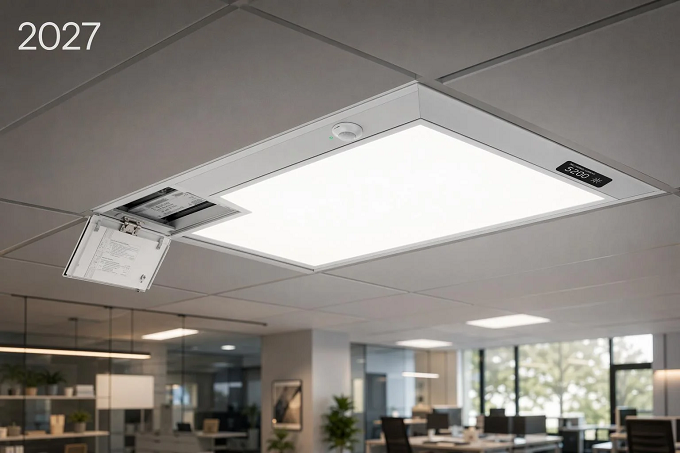
A panel without a receptacle is not controls-ready — the DLC states this explicitly. The recognised receptacle types are 7-pin and 5-pin twistlock, Zhaga Book 18 and Book 20, Z10, USB-C and pogo pin. A 3-pin twistlock is treated as not eligible on its own unless the specification sheet clearly identifies 5 or 7 pins, though a product combining a 3-pin twistlock with another integral sensor or controller can now qualify.
Accepted protocols include 0-10V, DALI, DALI-2, D4i, DMX512, KNX, Modbus and phase cut. Premium requires continuous dimming to 10% or lower. Verify the exact control option on the listing rather than the family name — the receptacle fitted to the shipped unit is what determines whether a sensor can be added later without field wiring.
Glare, Flicker and Light Quality as Procurement Criteria
Quality of light now sits alongside efficacy as a procurement criterion. DLC Premium troffers require corrected UGR < 16.0, generated per CIE 190-2010 at a reference condition of room dimensions X = 4H and Y = 8H, spacing-to-height ratio 1, and reflectances of 70/50/20. Colour rendition must be reported as either TM-30 with Rf ≥ 70 and Rg ≥ 89, or CRI ≥ 80 with R9 ≥ 0.
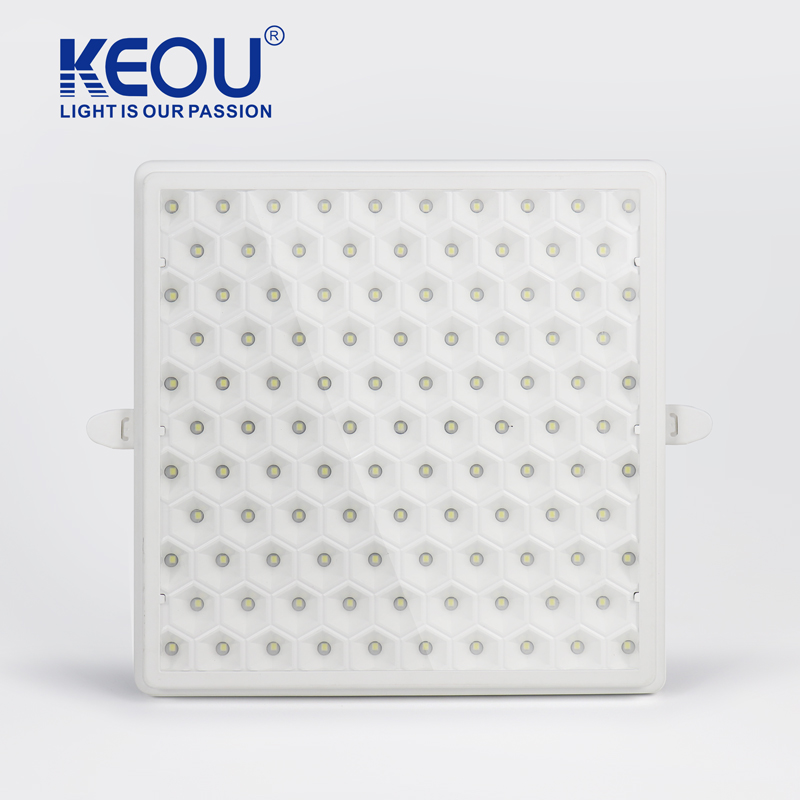
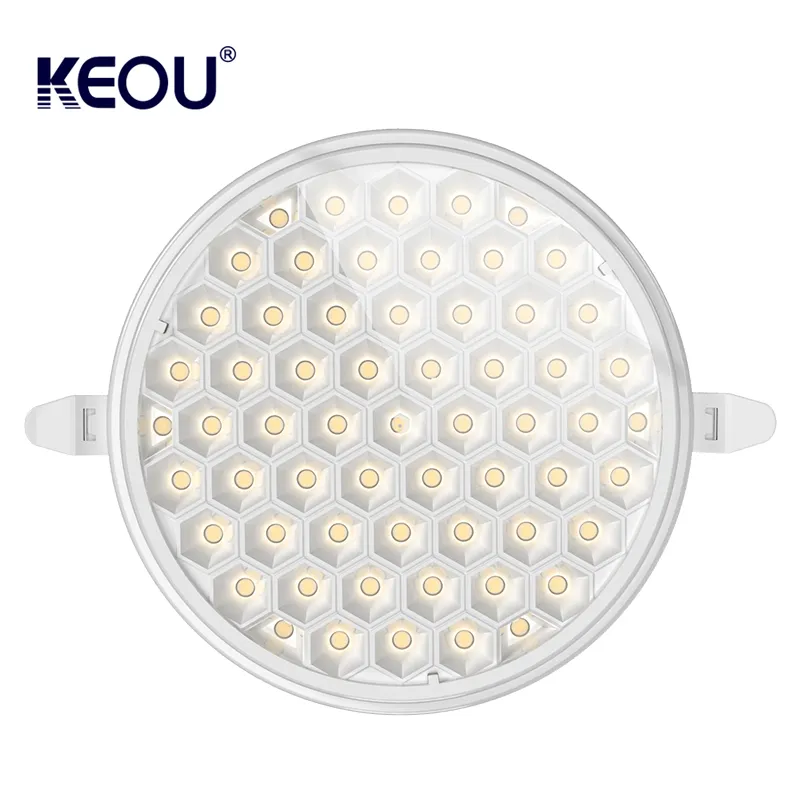
Flicker is the criterion most often reduced to the unverifiable phrase “flicker-free”. Ask instead for Pst LM and SVM results measured to IEC TR 61547-1 and IEC TR 63158, at full output and at the lowest dimmed level the control scheme will use. Honeycomb anti-glare louvres are one design response to the UGR requirement; the number that matters is the tested UGR value for the specific optic.
Serviceability: Replaceable Drivers and Modular Boards
A panel’s economic life is set by its driver and LED board, not its housing. When either fails, a sealed luminaire becomes waste; a replaceable driver and modular LED board turn the same failure into a maintenance task, shortening downtime and letting a distributor stock spares instead of whole fittings.
DLC Premium gives buyers a documented basis for comparing driver durability, because it requires driver lifetime data from a worst-case driver temperature measurement (driver ISTMT) for each unique driver. Standard listings do not carry that requirement, so ask for the data directly when comparing tiers.
Form Factor: Sizes, Mounting and Ceiling Fit
Form factor in 2027 is driven by ceiling system compatibility and retrofit economics, not by novel shapes. The questions that decide a specification are which grid the panel drops into, whether the existing housing stays, and whether the resulting configuration is listed in its own right.
The Enduring 2×2, 1×4 and 2×4 Grid
The DLC recognises three troffer designations — 2×2, 1×4 and 2×4 — and all three share the same distribution requirements: spacing criteria of 1.0 to 2.0 in both axes, and zonal lumen distribution of at least 75% within 0–60°.

As practical guidance rather than a code rule: 2×2 suits smaller offices and grid infill where a full 2×4 would over-light the room; 1×4 suits corridors and linear runs that follow circulation; 2×4 remains the default for open-plan offices and classrooms. The final choice belongs to the lighting design, which sets illuminance targets and layout.
Recessed, Surface, Suspended and Retrofit Kits
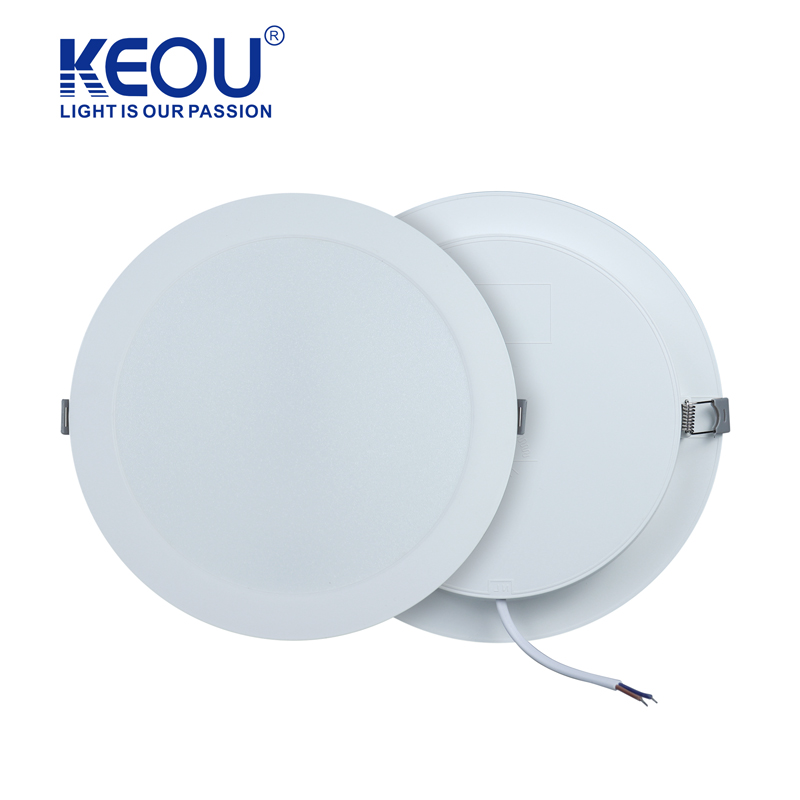
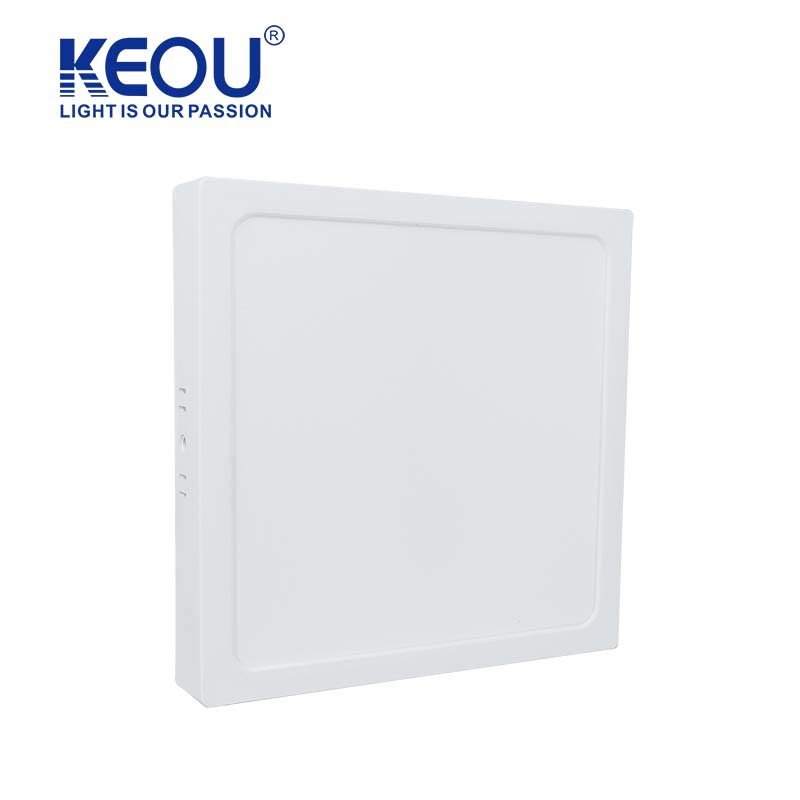
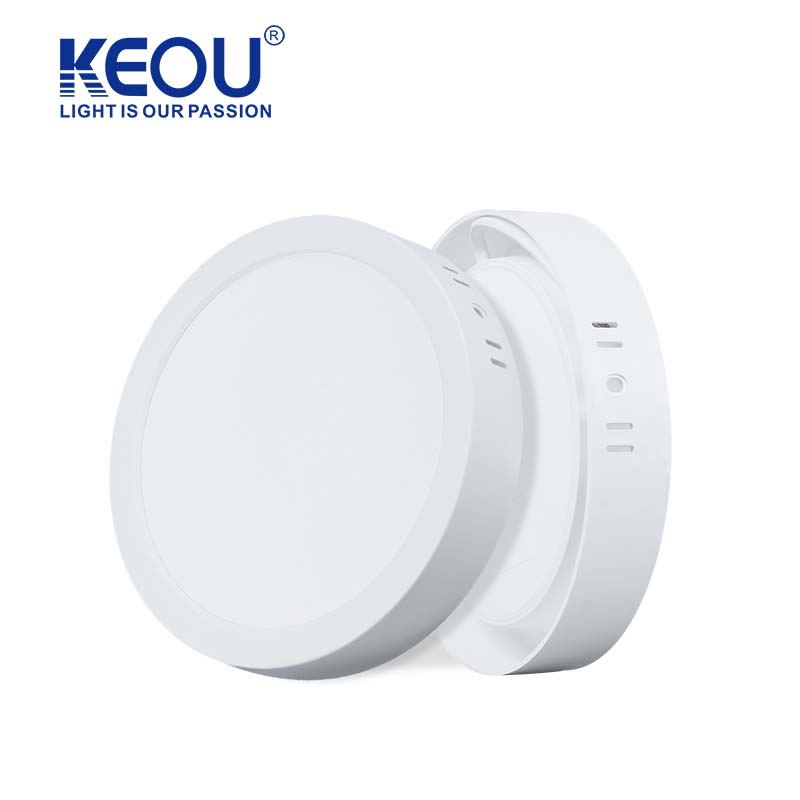
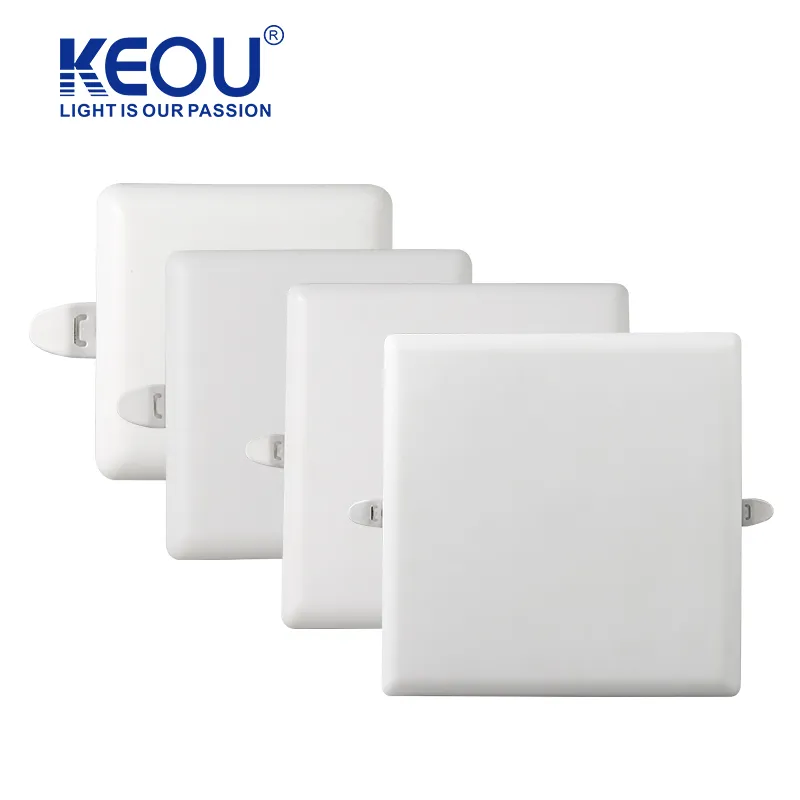
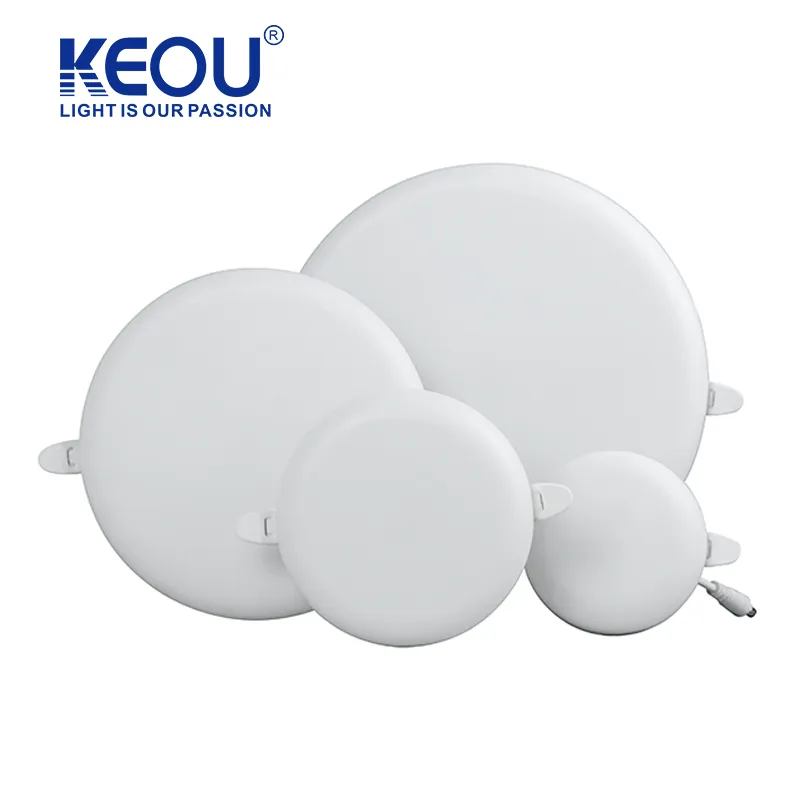
Match the mounting format to the ceiling: lay-in recessed panels for an exposed T-bar grid, surface-mount for hard ceilings without a grid, suspended for high ceilings and open plenums where light must reach the working plane, and retrofit kits where the existing troffer housing stays in place.
The retrofit distinction carries commercial weight. The DLC lists linear and integrated retrofit kits for 2×2, 1×4 and 2×4 troffers as separate designations, so a kit is not interchangeable with a luminaire for rebate purposes, and kits carry their own distribution requirements — the same spacing criteria and 75% zonal lumen figure.
Where Form Factor Is Heading
Three directional expectations are worth planning around, framed as expectations rather than confirmed 2027 releases. First, thinner profiles as thermal design improves and heat spreads across a larger back plate. Second, more consistent frame dimensions so a failed panel can be swapped without cutting or patching ceiling grid. Third, modular construction that separates the light engine from the housing.
The third is the one with regulatory momentum. EU circular-economy pressure is pushing manufacturers toward panels with replaceable LED engines and drivers, which extends product life and changes the replacement-purchase pattern: buyers re-order modules rather than complete fittings.
Wattage: Why the Number on the Box Matters Less
Wattage is an output of efficacy and delivered lumens, not an input. Once a buyer accepts that, the comparison between a legacy fitting and a current one becomes arithmetic rather than a judgement about how much power a room “needs”.
Illustrative arithmetic only, not measured product data: input wattage required to deliver 3,000 lumens at different luminaire efficacies (wattage = delivered lumens ÷ efficacy). Assumes equal delivered lumens, the same CCT, the same driver setting and the same LM-79 test conditions across all cases; it does not account for the DLC tolerances of ±10% on light output and −3% on efficacy.
Comparing Panels on Delivered Lumens, Not Watts
Delivered lumens = wattage × luminaire efficacy. A 36 W panel at 100 lm/W delivers about 3,600 lm. A 24 W panel at 130 lm/W delivers about 3,120 lm — short of the legacy unit. A 30 W panel at 130 lm/W delivers about 3,900 lm, which matches and slightly exceeds it.
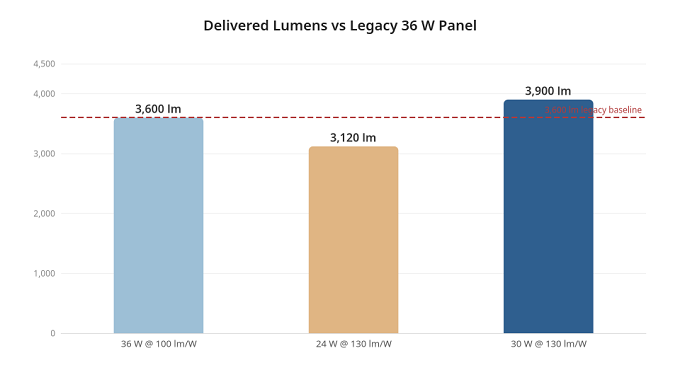
The comparison only holds when both figures are measured at the same CCT, the same driver setting and the same test standard, LM-79. The DLC tolerances allow ±10% on light output and −3% on efficacy, so a 3,900 lm claim could test as low as roughly 3,510 lm — below the legacy panel. Specify with margin rather than at the line.
Wattage-Selectable and Consolidated SKUs
Wattage-selectable panels let one SKU cover several project wattages, cutting the number of part numbers a distributor stocks and reducing obsolete-stock risk when a project specifies a different output late in the fit-out.
The risks are documentation and commissioning. The field-set wattage must be recorded on the listing, the selected setting must still meet the efficacy threshold, and the distributor needs clear labelling so a panel left at the wrong setting does not fail commissioning. Treat the selector as a specification item, not a convenience.
What Wattage Range to Stock for 2027
Stock by delivered-lumen band rather than wattage alone. Lower-output panels suit offices and meeting rooms, where the design illuminance is modest and glare control matters more than raw output. Mid-range panels cover open-plan offices and education. Higher-output panels serve healthcare and retail back-of-house, where mounting heights and task demands rise.
The right number for any given room depends on the design illuminance and the layout, which the project’s lighting design should set. A stocking plan built on lumen bands survives a change of efficacy; one built on wattage does not.
Building a Function-Tier Product Matrix
The three tiers below turn the function, form factor and wattage discussion into a range structure a distributor can use to plan a 2027 catalogue. They are a planning tool, not a description of any specific product line.
| Tier | Efficacy target | Controls | Glare / quality | Serviceability | Typical use |
|---|---|---|---|---|---|
| Basic | Meets the 120 lm/W Standard baseline | Dimmable, receptacle optional | Standard diffuser, CRI ≥ 80 | Sealed or limited-access driver | Volume replacement, price-sensitive projects |
| Project | Standard baseline with margin | Controls-ready receptacle, 0-10V or DALI-2 | Low-glare optic, UGR managed | Replaceable driver | Specified commercial fit-outs |
| Premium | 135 lm/W Premium baseline | Continuous dimming to 10% or lower, D4i/DALI-2 | Corrected UGR < 16.0, TM-30 reporting | Replaceable driver and modular LED board | Rebate-driven and high-spec projects |
Read the matrix as cumulative. A Premium panel must still meet every Standard requirement, so the Premium column adds criteria rather than replacing them. The tier a distributor stocks should follow the projects it actually serves: a range weighted toward price-sensitive volume does not need a deep Premium line, and a range serving rebate-driven fit-outs cannot be built on Basic alone. The Premium column reflects DLC Premium criteria; confirm the exact requirements against the current technical requirements document before committing a catalogue.
What to Confirm Before Committing to a Panel SKU
The checklist below converts the preceding sections into questions a supplier can answer in writing. Ask for the exact model number and control option as it appears on the DLC Qualified Products List, not the product family name, and confirm the qualification version and current listing status. Request efficacy at the CCT you will actually specify, including any allowance claimed, and the LM-79 report behind it.
Then press on serviceability: is the driver replaceable, is the LED board modular, and which spare parts will be stocked and for how long. Ask for flicker and glare data at full output and at the dimmed level the project will run. Finally, get warranty terms in writing — the DLC requires a minimum five-year warranty covering the complete luminaire, and component-only warranties do not meet that bar — plus the compliance documents for each destination market.
Regional Compliance Checks per Market
Compliance does not travel with the product. Each destination market has its own safety, performance and documentation requirements, and a certificate issued for one does not satisfy another.
For the US and Canada, UL 1598 fifth edition was published on March 26, 2021, with an effective date of September 20, 2021; it covers luminaires for non-hazardous locations on branch circuits of 600 V nominal or less, and the fourth edition was withdrawn. In the EU, light sources fall under ecodesign and energy-label rules, including the Regulation 2019/2015 label and the 2019/2020 flicker limits. China issued GB 30255-2026 on June 15, 2026, effective September 1, 2026, with a specified label format and CNAS test documentation. For UAE projects, confirm the ECAS certificate of conformity itself rather than a declaration.
What This Means for 2027 Planning
Three dates set the planning rhythm. The DLC delists products not qualified under SSL V6.0 on December 15, 2026. Focus on Energy requires V6.0 listings for DLC-qualified rebates from January 1, 2027, with narrow grace windows for 2026 purchases. China’s GB 30255-2026 took effect on September 1, 2026. Everything else in this article follows from those deadlines: the specification conversation has moved from wattage to delivered lumens, controls readiness, glare control and serviceability, and the panel’s wattage is now a derived number rather than an input.
For distributors, the practical step is a range audit against the tier matrix. Sort every panel SKU by efficacy band, receptacle type, glare data and driver replaceability, then flag anything still listed only under V5.1. A SKU that misses the 120 lm/W Standard baseline will not be listed after December 15, 2026, and a SKU without a recognized receptacle cannot be sold as controls-ready regardless of its driver. Stocking decisions made before those checks are guesses.
For contractors and procurement teams, specify on delivered lumens at the design CCT, on the control protocol and receptacle the building will use, and on documented flicker and glare values. Ask for the driver’s replaceability and spare-part path in the tender documents, because that is what determines the cost of the second and third maintenance visits. Where a project depends on a rebate, confirm the program’s rules for the exact model and control option before the order is placed — a listing is a starting point, not an approval.
The direction of travel is consistent across markets: fewer, better-documented SKUs; efficacy as a gate rather than a headline; and a luminaire judged on what it delivers over its service life. Panels that meet that description in 2027 will be the ones specified, stocked and rebated.
FAQ
Short answers to the comparison and procurement questions that come up most often when a 2027 panel range is being assembled.
Can a 24–30 W panel really replace a 36 W panel?
Yes, when the higher-efficacy panel’s delivered lumens match or exceed the legacy unit’s at the same CCT and test conditions. A 36 W panel at 100 lm/W delivers about 3,600 lm; a 30 W panel at 130 lm/W delivers about 3,900 lm, and a 24 W unit about 3,120 lm. Apply the DLC tolerance of ±10% on light output before treating the figures as equivalent.
Does a DLC listing guarantee a utility rebate?
No. Listing on the DLC QPL is necessary for many programs but not sufficient. Utilities set their own eligibility rules, and the transition from V5.1 to V6.0 affects QPL status without creating a universal rebate cutoff. Verify the exact model, control option, qualification version and the program’s own deadlines and grace periods.
Is a 3-pin twistlock receptacle controls-ready?
Not on its own. The DLC assumes any twistlock receptacle is 3-pin and therefore not eligible for listing unless the specification sheet clearly states 5 or 7 pins. The recognized options are 7-pin and 5-pin twistlock, Zhaga Book 18 and Book 20, Z10, USB-C and pogo pin. A panel with no receptacle is not controls-ready at all.
What changes for distributors when panels become wattage-selectable?
Fewer part numbers to stock and less obsolete-stock risk when a project specifies a different output. In exchange, the field-set wattage must be documented on the listing, the selected setting must still clear the efficacy threshold, and labeling must be clear enough that a mis-set panel does not fail commissioning.
Which panel size should I stock for a typical office fit-out?
2×4 for open-plan areas and classrooms, 2×2 for smaller rooms and grid infill, 1×4 for corridors and linear runs. All three troffer PUDs share the same distribution requirements, so the choice is driven by the ceiling grid and the lighting design’s illuminance and layout targets rather than by the panel itself.